Ruins of El Fuerte ceremonial site, Samaipata
The largest carved ceremonial rock in the Americas, where jungle meets Andes and cultures converge
Understand sacred places, explore living traditions, and learn how to engage respectfully with Pilgrim Map.
Access has not been verified. Check current local guidance before planning a visit.
Municipio Samaipata, Santa Cruz, Bolivia
Read the sources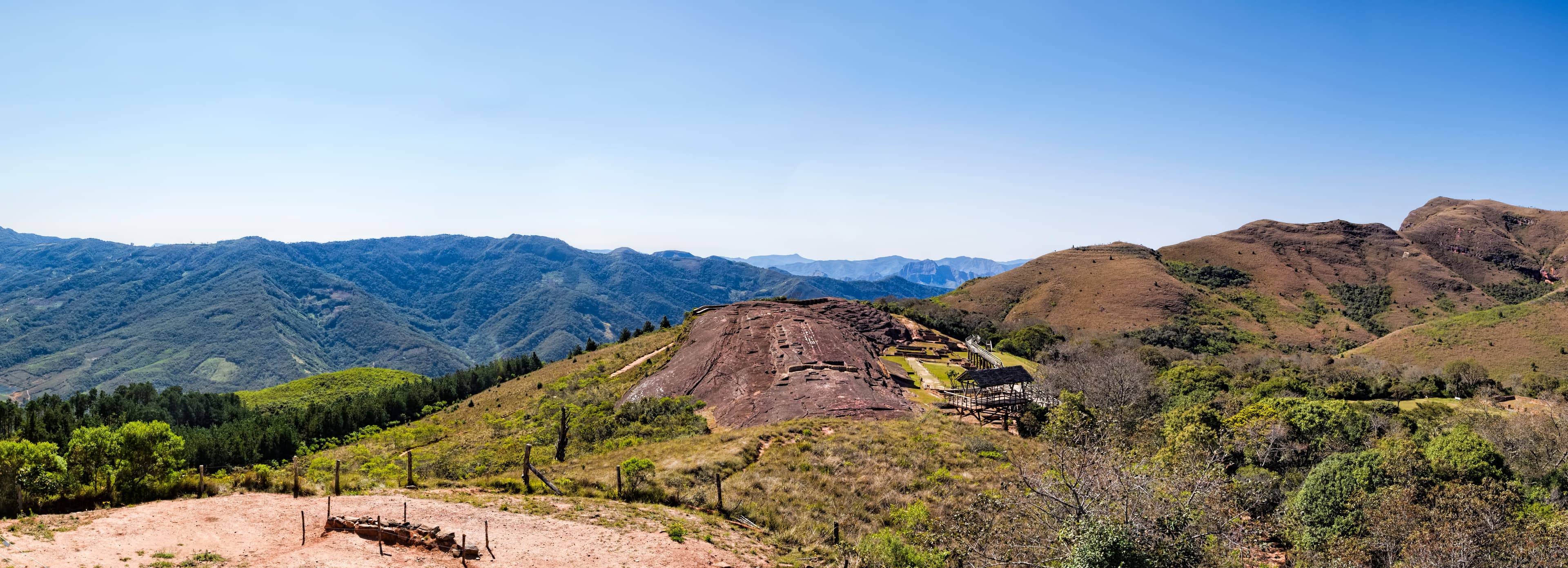
Image of Ruins of El Fuerte ceremonial site, Samaipata. Image source · CC-BY-SA-2.0
Visit essentials
A quick read before you go
- Duration
- A thorough visit to the archaeological site takes approximately two hours.
- Access
- The site lies approximately 15 minutes by car from the town of Samaipata.
Overview
A reddish sandstone ridge roughly 220 meters long and 60 meters wide rises above montane forest, sculpted into sinuous channels, circular niches, and animal outlines emerging from stone: earth reshaped devotionally rather than architecture placed upon it.
Around 300 CE, the Chane, the southernmost Arawak branch, began carving jaguar, serpent, and now-unidentifiable birds from their cosmology. Arriving in the late 15th century, the Inca preserved these and added southern-face temples, an Acllahuasi for chosen women, and a summit circle of deep niches scholars call the choir of the priests, where leaders held ceremonies whose nature is lost.
Later Spaniards misread it as a fort and named it El Fuerte, recognizing power but not purpose. Successive cultures layered sacred grammars on the ridge, making it a devotional palimpsest slowly returning to the mountain.
Why this place is sacred
At nearly 1,950 meters elevation, the site occupies a threshold. Below, the land drops toward the Amazon basin. Above and to the west, the Andes rise into a different world entirely. The Chane people, whose origins lie in Amazonian Arawak culture, chose this ridge as their ceremonial center—a place where the lowland and highland worlds could meet.
The rock itself may have invited the carving. Sandstone is soft enough to work without metal tools, yet holds its form against the scale of centuries. The Chane seem to have understood it as living material, worthy of sustained attention rather than mere utility. The channels they carved—long parallel grooves running the length of the rock, sometimes called the spine of the serpent—may have directed water in ways that served ritual purposes, though the exact practice remains uncertain.
When the Inca incorporated Samaipata into Tawantinsuyu, they recognized what the Chane had known: this was a place where the sacred could be made tangible. The name they gave the area, Samaipata—the heights of rest in Quechua—carries a quality of arrival, of reaching a place where effort can be set down and something else can begin.
Their additions to the rock, particularly the circle of priestly niches at the summit, suggest ceremonies conducted in a space that was simultaneously carved by human hands and shaped by geological forces far older than any culture.
UNESCO's inscription in 1998 recognized the site as bearing no parallel in the Americas. That phrase is worth sitting with. In a hemisphere rich with monumental sacred architecture—from Teotihuacan to Tiwanaku—this carved ridge stands alone in its approach: not building upon the earth, but entering into conversation with it.
Archaeological consensus holds that the site was primarily a religious and ceremonial center, not the military installation its Spanish name implies. The Chane people of the Mojocoyas culture established it as a ritual and residential complex beginning around 300 CE, carving the sandstone with imagery scholars describe as having a magical and religious character.
When the Inca expanded the site in the late 15th century, they added temples, administrative buildings, and the summit priestly circle, combining religious function with the governance of their eastern frontier. In Inca understanding, as throughout the Andes, these functions were inseparable—administration was ceremony, and ceremony was how the world held together.
The site's history is one of accretion followed by silence. The Chane carved for centuries. The Inca arrived around 1470 and added their own layer. Then came the Chiriguano raids—Guarani warriors who attacked repeatedly from the 1520s onward—and the Spanish, who established a brief presence before abandoning the site in 1618. After that, the mountain reclaimed what it could.
For centuries, the carvings weathered. The sandstone, soft enough to carve, is also soft enough to erode. By the time the French naturalist Alcide d'Orbigny visited in 1832, significant detail had already been lost. Today, visitors observe from cordoned pathways because every footstep on the carved surface accelerates an irreversible process. The site is slowly dissolving back into the mountain from which it was drawn.
Since the late 20th century, a different kind of visitor has arrived—spiritual seekers drawn by the site's atmospheric quality and layered history. The town of Samaipata has become a hub for contemplative travelers. These visitors bring no continuity with the Chane or Inca traditions, yet their consistent reports of the site's affect suggest that whatever drew those earlier cultures to this ridge has not entirely dissipated.
Experience and orientation
The first impression is scale. The carved rock stretches further than you expect, and the forms scored into it—channels, basins, niches, the fading outlines of animals—unfold gradually as you walk the perimeter pathways. There is no single vantage point from which the site becomes legible. It requires movement, and that movement becomes a kind of reading.
The serpent imagery is what most visitors remember. The long parallel channels running the length of the rock carry an unmistakable suggestion of directed flow, whether of water, of energy, or of something the Chane understood and we do not. The feline carvings—jaguars, probably, though erosion has softened their features into ambiguity—watch from positions that feel deliberate, placed where they might guard something.
At the summit, the priestly circle opens to the sky. Here, religious leaders once gathered in carved niches arranged in a ring. The number of seats is disputed—some sources count twelve, others eighteen. What is not disputed is the quality of the space: a place of intentional convergence, where human beings sat in a configuration that echoed something circular and complete.
The surrounding landscape deepens the effect. Mountains rise in every direction, covered in montane forest that shifts color with the seasons. The air at this elevation carries a clarity that visitors frequently remark upon. Whether the site produces an effect beyond its visual and spatial drama is a question each visitor answers differently, but the consistency of reports—a sense of stillness, of accumulated purpose, of the stone holding more than it shows—is difficult to dismiss.
Walk slowly. The pathways that circle the carved rock were designed for observation, not transit, and the site rewards the pace of someone studying a text rather than crossing a room. The carvings reveal themselves gradually—what looks like natural erosion from one angle resolves into intentional form from another.
Give particular attention to transitions: the places where Chane carving gives way to Inca addition, where water channels emerge from and disappear into the rock, where the stone shifts from worked surface to raw outcrop. These boundaries between the made and the given are where the site's character becomes most legible.
If the summit circle is visible from your vantage point, spend time with it. Imagine the space occupied—filled with figures seated in the niches, conducting ceremonies whose form we can only guess at. The not-knowing is part of the experience here. El Fuerte does not yield its meaning easily, and that resistance is itself a teaching.
Context and lineage
According to the 17th-century chronicler Diego Felipe de Alcaya, the Inca ruler Tupac Yupanqui sent his relative Guacane to bring the Samaipata region into the empire. Guacane approached the local Chane leader Grigota not with an army but with gifts—elaborate enough to persuade Grigota and his 50,000 subjects to accept Inca sovereignty. Whether this account reflects historical reality or imperial self-flattery is an open question.
What is clear from the archaeological record is that the Inca did not destroy what they found. They built upon it, adding their own sacred architecture to a rock already dense with Chane meaning.
The site's earlier origins are less well documented. The Chane—an Arawak-speaking people who migrated from Amazonia into the Andean foothills—left no written records. Their history at Samaipata is told entirely through what they carved into stone: animals, channels, geometric forms that suggest a cosmology centered on the relationship between water, predatory power, and the sacred properties of the rock itself.
The site's lineage is one of interrupted transmission. The Chane carved for roughly five centuries. The Inca added their layer for perhaps fifty years before the Chiriguano raids disrupted the region. The Spanish occupied briefly, then withdrew. No continuous community has maintained a relationship with the site since the early 17th century.
What survives is the stone itself and the scholarly tradition that has grown around it since the mid-20th century. The University of Bonn has conducted research at the site since 1992. The Centre of Samaipata's Archaeological Investigations, established in 1974, manages ongoing study and conservation. These are the site's living custodians—scientists and conservators who have taken on the work of preservation that no religious community now performs.
The Chane Carvers
historical
The anonymous artisans who began shaping the sandstone around 300 CE, carving jaguars, serpents, and water channels that remain the site's oldest and most fundamental sacred layer. Their specific beliefs are largely lost, but their work endures as the largest example of rupestrian architecture in the Americas.
Tupac Yupanqui
historical
The Inca emperor (ruled 1471-1493) who ordered the incorporation of the Samaipata region into Tawantinsuyu. Under his direction, the site was expanded with temples, an Acllahuasi, and the priestly circle at the summit.
Grigota
historical
The Chane leader who, according to chronicler Alcaya, accepted Inca sovereignty over his 50,000 subjects after receiving elaborate gifts from Guacane. His decision marked the moment when two cultural traditions merged at this site rather than one erasing the other.
Diego Felipe de Alcaya
historical
A 17th-century Spanish chronicler whose accounts provide much of what we know about the Inca arrival at Samaipata. His records, while filtered through colonial perspective, preserve details of the site's history that would otherwise be lost.
Alcide d'Orbigny
historical
French naturalist who visited in 1832 and produced early documentation of the carvings. His theory that the parallel channels were used for gold washing has been set aside by modern archaeology, but his observations remain valuable as records of what was visible before further erosion.
Traditions and practice
The Chane carved sacred animals into the rock—jaguars, serpents, birds—as part of ceremonies whose specific form is no longer recoverable. The imagery suggests a cosmology in which predatory animals served as intermediaries between worlds, and water played a central ritual role, directed through channels carved with evident care.
The Inca added ceremonies of their own. The choir of the priests at the summit—a ring of carved niches—housed religious leaders conducting rituals that likely involved sun and moon worship, offerings, and possibly blood sacrifice. The Acllahuasi sheltered chosen women who participated in ceremonies, wove sacred textiles, and were, on occasion, offered in sacrifice. Water channels carved into the rock may have served libation purposes, connecting Inca practice with the Chane tradition of ritual water flow that preceded it.
These practices ended centuries ago. What remains is architecture—and the questions it poses.
The town of Samaipata has drawn contemplative travelers since the late 20th century, and some visitors approach El Fuerte with intentionality beyond archaeological interest. No formal spiritual practice is associated with the site, and no surviving indigenous tradition maintains ceremonial connection to it. What visitors bring is their own attention, directed toward a place that rewards it.
Begin at the museum before ascending to the site. The context it provides transforms what might otherwise appear as weathered grooves in stone into the traces of specific human intention. Understanding what you are looking at deepens the quality of your encounter.
Once at the site, resist the impulse to see everything quickly. Choose a section of the carved rock—the serpent channels, the feline carvings, the summit circle—and stay with it. Let your eyes adjust to the scale. Sandstone erodes in ways that blur the boundary between intention and accident, and learning to read the difference is itself a form of attention that slows the mind.
At the summit area, if the priestly circle is visible from the viewing pathway, stand still and let the configuration register. A ring of seats carved into stone, open to the sky, facing inward. Whatever was spoken or performed in that circle is gone, but the form persists—and the form itself communicates something about gathering, about enclosure, about the relationship between a small circle of humans and the vastness surrounding them.
Notice the landscape beyond the rock. The mountains, the forest, the quality of light at this elevation. The Chane chose this ridge from among thousands of possible locations. Stand where they stood and ask yourself what they may have recognized here that you are only beginning to see.
Chane/Mojocoyas (Arawak) ceremonial tradition
HistoricalThe Chane people, the southernmost branch of the Arawak-speaking peoples, were the original carvers of the great rock, beginning around 300 CE. Over centuries they transformed a natural sandstone ridge into the largest work of rupestrian architecture in the Americas—a ceremonial center incised with jaguars, serpents, birds, and geometric forms reflecting a cosmology that placed predatory animals and water at the center of sacred experience. The Mojocoyas period (200-800 CE) represents the foundational layer of meaning at the site, the one upon which all subsequent traditions built.
Ceremonial rock carving itself appears to have been a sacred act, sustained over generations. Rituals likely centered on the serpent and jaguar as cosmological figures. The water channels carved into the rock suggest ritual use of water flow, perhaps as libation or as symbolic representation of life force moving through the landscape. The residential structures surrounding the rock indicate that the community lived in proximity to the ceremonial center, suggesting that sacred practice was woven into daily life rather than separated from it.
Inca religious and administrative tradition
HistoricalBeginning in the late 15th century under Tupac Yupanqui, the Inca incorporated Samaipata as a major eastern frontier outpost combining military, administrative, and religious functions. They added temples, an Acllahuasi for chosen women, and the summit circle of priestly niches. The site served as a point of contact between the highland Andean empire and the Amazonian world—and in Inca cosmology, such boundary places held particular spiritual power. That they built upon the Chane carvings rather than replacing them suggests recognition that the rock's sacred character preceded and exceeded any single tradition's claim.
Inca ceremonies at Samaipata likely included sun and moon worship at the temple complex, rituals conducted by priests seated in the carved niches of the summit circle, and ceremonial activities involving the Aclla—chosen women who participated in rituals, wove sacred textiles, and were on occasion offered in sacrifice. Blood sacrifice was part of the broader Inca religious practice. Water channels carved into the rock may have served libation purposes, connecting Inca practice with the older Chane tradition of sacred water flow.
Archaeological research and conservation
ActiveSince the establishment of the Centre of Samaipata's Archaeological Investigations (CIAAS) in 1974 and the University of Bonn's sustained research program beginning in 1992, a scholarly and conservation tradition has developed around the site. This tradition serves as El Fuerte's living custodianship—preserving, documenting, and interpreting a monument whose original communities are no longer present to do so. UNESCO inscription in 1998 and World Monuments Fund involvement have added international dimensions to this stewardship.
Ongoing archaeological research, digital photogrammetry documenting the carvings as they erode, conservation measures including the cordoning of the inner carved areas to prevent foot traffic, and public interpretation through the on-site museum. These activities constitute the current form of devoted attention at the site—different in kind from the Chane and Inca ceremonies but continuous in the fundamental act of recognizing the rock as worthy of sustained care.
Contemporary spiritual tourism
ActiveSince the late 20th century, El Fuerte has attracted visitors drawn by the site's atmospheric qualities, its sense of layered mystery, and the contemplative character of the town of Samaipata itself. These visitors bring no continuity with the Chane or Inca traditions, and their experiences are self-reported rather than framed by any established practice. Nevertheless, the consistency of accounts—a sense of stillness, of accumulated purpose, of the site communicating something beyond its archaeological content—suggests that whatever quality drew the original cultures to this ridge has not entirely dissipated.
Contemplative visits, personal meditation, photography as a form of attention, and pilgrimage in the broad sense of intentional travel to a place held sacred. No organized ceremonies or rituals are conducted at the site.
Perspectives and open questions
El Fuerte invites interpretation but resists conclusion. The cultures that created it left no written records of their intentions. The Spanish who named it misidentified its purpose. Modern scholarship has established much, but significant questions remain open. Honest engagement with this site requires comfort with not-knowing—and a willingness to let the stone speak in whatever register you can hear.
Scholarly perspective
Archaeological consensus holds that El Fuerte was primarily a religious and ceremonial center, correcting the Spanish assumption of military purpose embedded in the name. The site was first carved by the Chane people of the Mojocoyas culture, an Arawak-origin group, beginning around 300 CE. The Inca expanded it in the late 15th century under Tupac Yupanqui, adding temples, administrative buildings, and the summit priestly circle.
UNESCO's inscription under criteria (ii) and (iii) highlights two dimensions: the site as a meeting point between Amazonian and Andean cultures, and the carved rock as bearing no parallel in the Americas. The University of Bonn has conducted sustained research since 1992, and digital photogrammetry projects now document the carvings as they slowly erode—a race against geological time.
Scholars continue to debate specific questions. The exact function of the parallel channels remains contested. The number of niches in the priestly circle varies between sources. The specific beliefs of the Mojocoyas culture are sparsely documented. What is not debated is the site's significance: the largest work of rupestrian architecture in the world, bearing the accumulated sacred intention of multiple civilizations.
Living and traditional perspectives
The Chane understanding of this site is accessible only through what they carved. The imagery—jaguars, serpents, birds, water channels—points toward a cosmology in which predatory animals held spiritual power and water served as a conduit between realms. In many Amazonian and Andean traditions, the jaguar represents shamanic transformation and the serpent embodies the flow of life force through the landscape. Whether these broad patterns apply specifically to the Chane at Samaipata is a matter of inference rather than certainty.
The Inca understood the site within their own cosmological framework. Samaipata—the heights of rest—served as a ceremonial center where priests conducted rituals connecting the imperial state with cosmic forces. The Acllahuasi and summit circle suggest the full apparatus of Inca state religion was present here, adapted to a landscape and a set of existing carvings that predated Inca arrival by a millennium.
Alternative interpretations
Some alternative interpretations attribute the carvings to non-human or extraterrestrial origins, proposals that mainstream archaeology firmly rejects. The site's scale and precision can seem startling, but they are well within the capabilities of people working soft sandstone over centuries with stone tools and sustained intention.
More measured alternative perspectives frame El Fuerte as an energy site or power place, drawing on the vocabulary of contemporary spiritual tourism. Some visitors describe experiencing the site's energetic qualities in ways that parallel accounts from other carved or monumental sacred sites worldwide. These reports, while not connected to any surviving indigenous tradition, reflect genuine responses to a place whose atmospheric qualities persist beyond the ceremonies that originally animated them.
Open questions
Genuine mysteries remain at Samaipata, and they are worth preserving rather than papering over with speculation. The precise cosmological beliefs of the Chane and Mojocoyas culture are sparsely documented—we have their carvings but not their words. The exact ceremonies conducted at the choir of the priests are a matter of informed conjecture. The relationship between the parallel channel carvings and specific ritual practices has not been definitively established.
The full extent of what was once carved into this rock is unknown. Erosion had already claimed significant detail before the Spanish arrived in the late 16th century, and the process has continued ever since. What visitors see today is a diminished version of what the Chane and Inca knew. Whether the site held astronomical alignments—plausible given its ceremonial function but unconfirmed by specific data—remains an open question.
The rock holds more than it reveals, and some of what it held is already gone.
Plan your visit
Access and arrival
The site lies approximately 15 minutes by car from the town of Samaipata. Taxis are available from town. The walk from Samaipata takes roughly two hours on foot. Santa Cruz de la Sierra, the nearest major city, is approximately 120 km to the northeast. Tour operators in both Santa Cruz and Samaipata offer organized visits. The entry fee is 50 Bolivianos, which includes access to the on-site museum.
No mobile phone signal information was available at time of writing; check with local operators for current connectivity. For emergency access, the town of Samaipata is the nearest settlement with services.
The town of Samaipata, a 15-minute drive from the site, offers a range of lodging from budget hostels to comfortable guesthouses. The town has developed as a destination for travelers seeking a slower pace, with several establishments catering to those interested in contemplative or nature-oriented visits. Santa Cruz de la Sierra provides full urban accommodation options for those making a day trip.
Respectful visit
No formal dress code applies. Comfortable walking shoes with good grip are essential, as the terrain around the site is uneven. Sun protection is critical—a hat, sunscreen, and water are necessities rather than comforts, as the hilltop site offers no shade and the tropical-altitude sun is intense.
Photography is permitted throughout the site and the dramatic landscape offers striking compositions. The carved rock surfaces photograph best in early morning or late afternoon light, when lower sun angles reveal the depth of the carvings that midday light flattens.
The inner carved rock area is cordoned off and visitors must remain on designated pathways. Walking on carved surfaces is prohibited. Dogs are not permitted on site. The entry fee of 50 Bolivianos includes museum access.
The carved rock is extremely fragile sandstone. Walking on the carved surfaces—once permitted—has been prohibited to prevent further erosion. The inner area is cordoned off, and visitors observe from designated pathways. This is not a bureaucratic inconvenience but a genuine conservation necessity: every footstep on this rock accelerates the loss of carvings that have survived seventeen centuries.
Do not attempt to touch or climb on any carved surfaces. Do not leave offerings or objects on the rock. The site's preservation depends on each visitor accepting that proximity is not the same as connection, and that observing from a distance can be its own form of respect.
Current practical details
Address
R5CJ+J63, Bolivia
Hours
Hours, fees, and access can change — verify on the official source before you travel. Practical details last checked Jun 2026.
Location
Map loads as you approach this section.
Pilgrim reflections
A portrait of encounter, not a score
Pilgrims describe what they felt, how present they could become, and whether the place would shape a journey. There are no stars and no ranking of traditions.
No reviewed reflections yet
The first pilgrims can help describe the character of being here.
Share a reflection
Available after an account-backed “Been there.” Every reflection is reviewed before publication.
Nearby sacred places
Explore other sacred places in the region. Proximity does not establish access or travel time; check each place’s guidance.
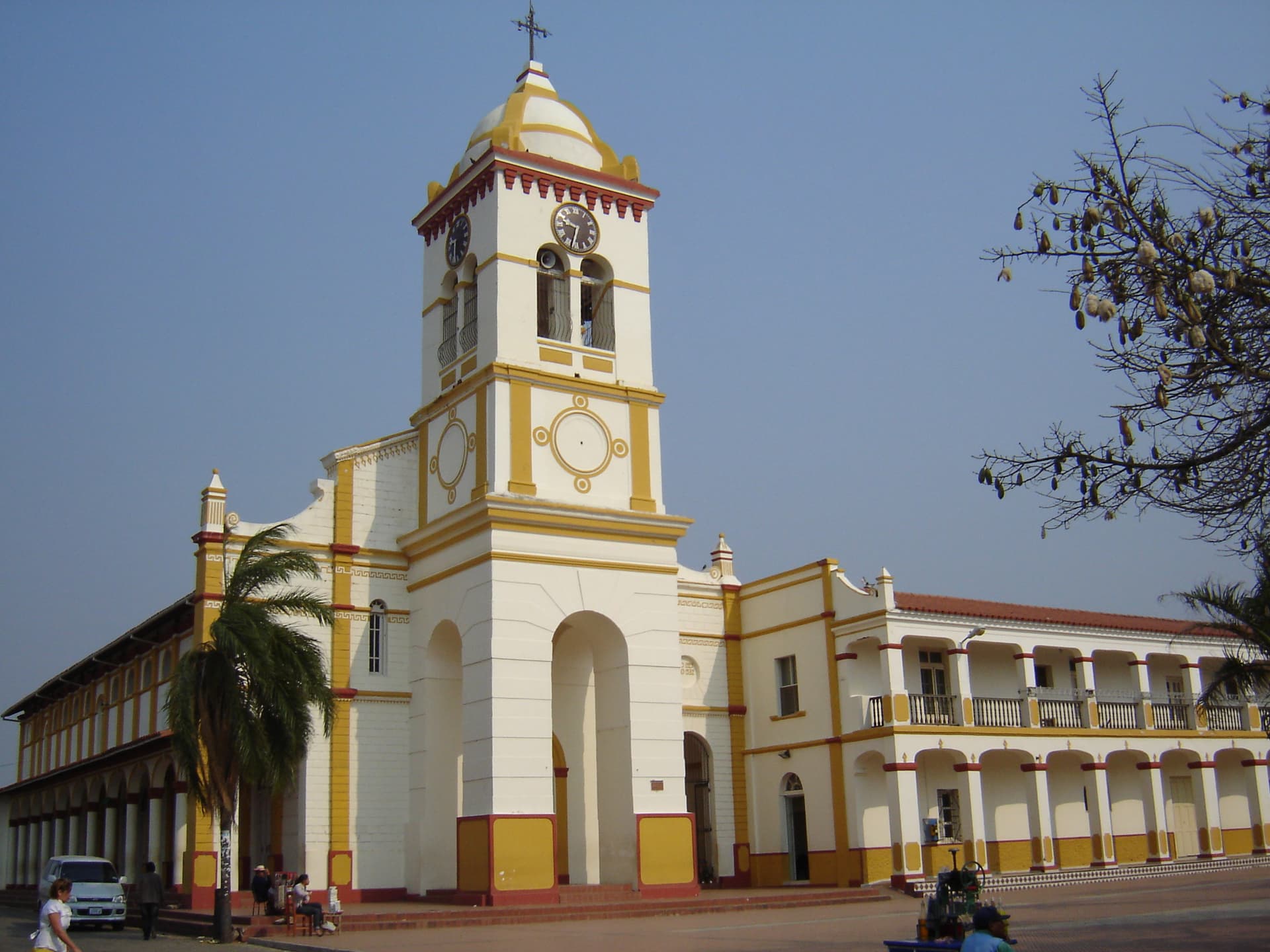
Cotoca, Santuario de la Virgen de Cotoca
Cotoca, Santa Cruz, Bolivia
99.1 km away
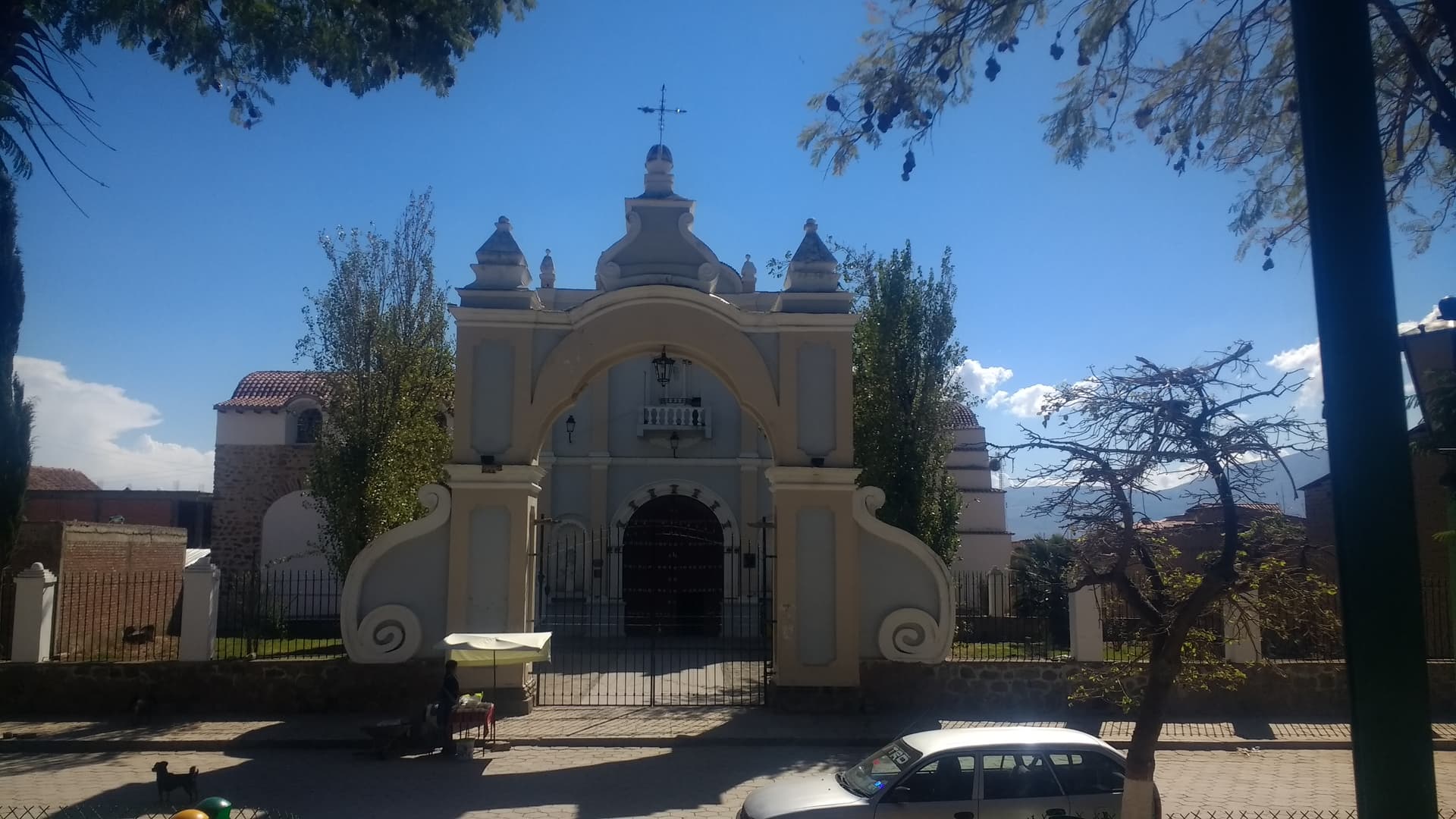
Arani, Church of San Bartolomé, Nuestra Señora La Bella
Municipio Arani, Cochabamba, Bolivia
216.9 km away

Quillacollo, Iglesia de San Ildefonso, Virgen of Urkupina
Quillacollo, Cochabamba, Bolivia
274.6 km away
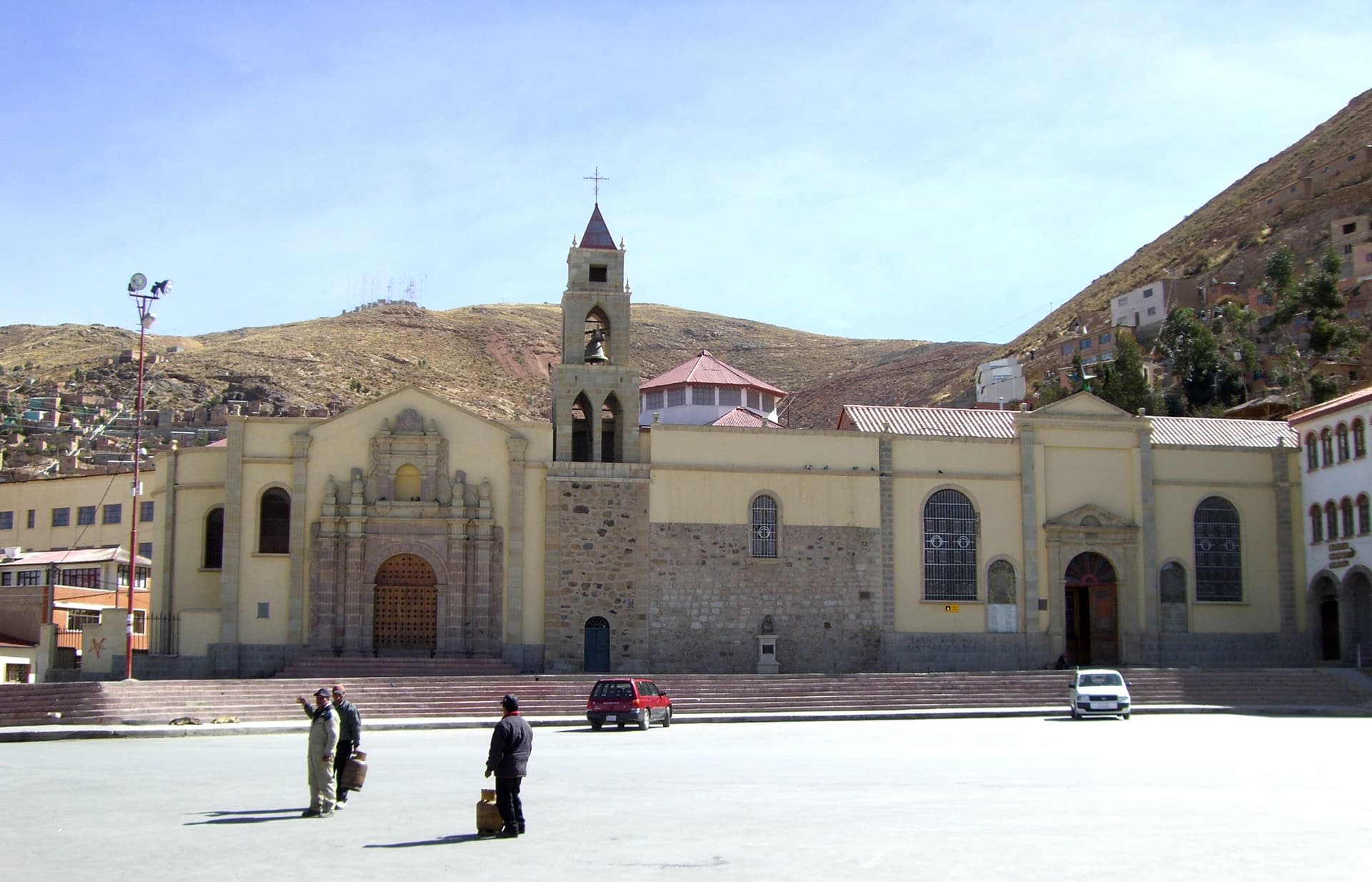
Oruro, Santuario de Virgen de Socavón
Oruro, Oruro, Bolivia
349.5 km away
References
Sources consulted for this page. Source categories describe the publication, not a guarantee that every claim is verified. Traditional accounts and outside interpretations may differ.
- 01Fuerte de Samaipata - UNESCO World Heritage Centre — UNESCO World Heritage CentreofficialOfficial UNESCO listing with criteria, description, integrity and authenticity assessments
- 02El Fuerte de Samaipata - World Monuments Fund — World Monuments FundofficialConservation organization documentation of threats and preservation efforts
- 03ICOMOS Evaluation of Fuerte de Samaipata (WHC Nomination Document 883) — ICOMOS / UNESCOofficialOfficial nomination evaluation document with detailed archaeological and historical analysis
- 04Samaipata project – aim of the research, methodology, and methods of documentation — Jacek KościukacademicAcademic paper on archaeological research methodology at the site
- 05El Fuerte de Samaipata - WikipediaacademicWell-cited Wikipedia article with references to academic sources and chroniclers
- 06El Fuerte de Samaipata: Bolivia's Cultural Crossroads — LAC GeoacademicDetailed cultural and historical overview of the site's multi-cultural significance
- 07Samaipata - World Pilgrimage Guide — Martin GrayspiritualPilgrimage researcher's documentation; includes spiritual perspectives alongside factual data
- 08El Fuerte de Samaipata - History and Facts — History HitguidePopular history site with accessible overview of key facts
- 09Fort Samaipata, the largest rupestrian architectural work in the world — La Brújula VerdeacademicDetailed article on the site's archaeological significance as the largest carved rock in the world
- 10Fuerte De Samaipata - A Site of Ceremonial Carvings and Sacrifice — Ancient OriginsspiritualCovers ceremonial interpretations with focus on carvings and sacrificial practices
- 11Who carved El Fuerte de Samaipata, the largest carved stone in the world? — BoliviaBella.comguideBolivian travel site with local perspective on the site's history and significance
Share a photo
Help visitors recognize Ruins of El Fuerte ceremonial site, Samaipata. Every submission is reviewed before publication.