Oruro, Santuario de Virgen de Socavón
Where masked devils dance their devotion to the Virgin above the mines of the Altiplano
Understand sacred places, explore living traditions, and learn how to engage respectfully with Pilgrim Map.
Access has not been verified. Check current local guidance before planning a visit.
Oruro, Oruro, Bolivia
Read the sources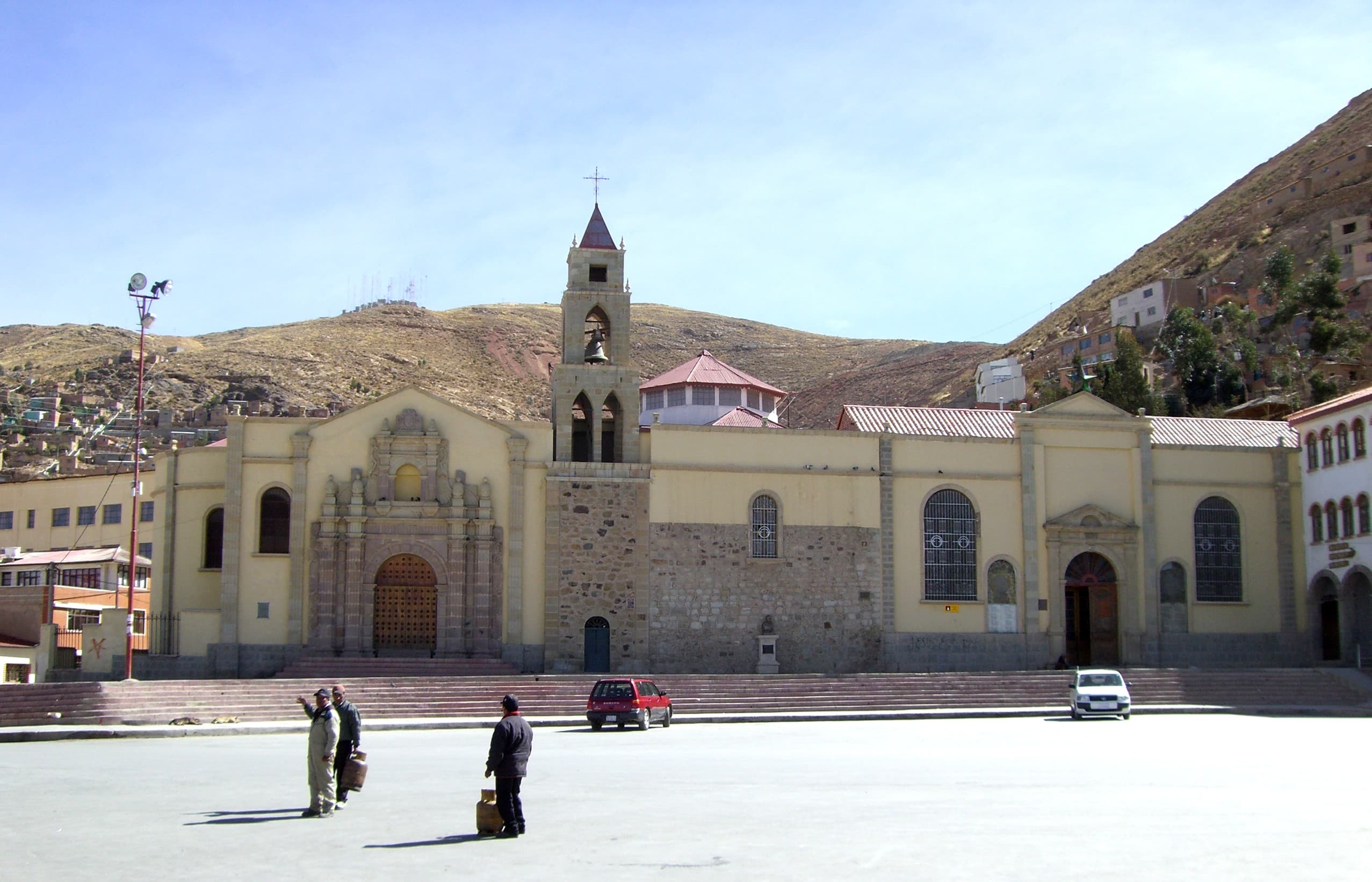
Image of Oruro, Santuario de Virgen de Socavón. Image source · CC-BY-SA-3.0
Visit essentials
A quick read before you go
- Duration
- 1-2 hours for the sanctuary and guided museum tour; full day or multiple days for Carnival…
- Access
- Calle Baptista esquina Adolfo Mier, Cerro Pie de Gallo, Oruro, Bolivia.
Overview
Built over mine shafts, the Santuario de la Virgen del Socavón joins surface to El Tío's underworld, where miners still offer coca leaves and alcohol to horned effigies embodying forces older than Christianity.
The Uru called the city Jururu and made it an Andean pilgrimage center. Their myth says the Ñusta, a divine female protector, saved them from four plagues sent by the malevolent deity Huari—a southern serpent, western lizard, eastern ants, and northern colossal toad—by petrifying creatures still identified in Oruro's landscape.
Augustinian friars arriving from Spain in 1559 brought Virgen de la Candelaria devotion. Between the sixteenth and seventeenth centuries an unknown artist painted the Virgin in a Cerro Pie de Gallo hermitage. Ñusta became Virgin and Tío Supay Devil, while Andean understanding continued through Carnival masks, steps, and offerings.
Around 1780, Chiru Chiru—a Robin Hood-like beggar stealing for the poor—was mortally wounded, reached his Cerro Pie de Gallo cave, and died invoking the Virgin. Her image reportedly appeared above his body, prompting a sanctuary.
Today's colorful nineteenth-century Basílica Menor has an Altiplano-night starry ceiling. Below, a mining museum enters original tunnels; from Santa Bárbara hill, a monumental Virgin overlooks miners, dancers, pilgrims, and the petrified beings.
Why this place is sacred
Few sacred sites make their liminality so literal. The Santuario de la Virgen del Socavón is built over mine shafts. Below the altar where the Virgin receives prayers, the tunnels descend into the domain of El Tío — the lord of minerals, the underground, the forces that can either kill a miner or make him wealthy. The sanctuary does not resolve this tension. It houses it.
The surface world belongs to the Virgin. The underground belongs to El Tío. But the miners who enter the earth each day must honor both. They light candles to the Virgin before descending, then make offerings to El Tío once below. The sanctuary sits at exactly the point where these two devotions meet — the threshold between light and darkness, the Christian and the Andean, the vertical aspiration of prayer and the horizontal negotiation with the earth's interior.
The pre-Columbian layer adds further depth. Long before the Spanish arrived, the Uru people recognized this place as sacred. The Ñusta's battle against Huari's four plagues established the landscape itself as a record of divine intervention — petrified serpents and toads visible in the geology around the city. When the Augustinians identified the Ñusta with the Virgin Mary, they were not replacing one sacred narrative with another. They were layering one upon the other, and both remain legible.
During Carnival, this layering becomes visible. The Diablada dancers wear devil masks — but they dance in devotion to the Virgin. The mystery plays enact the triumph of good over evil — but the 'evil' they depict is a version of Tío Supay, a figure who is not evil in Andean cosmology but simply powerful. The result is a place where two complete spiritual systems coexist in creative, unresolved tension.
The thinness is not despite this ambiguity — it is because of it.
Pre-Columbian ceremonial center of the Uru people, sacred to the Ñusta who protected them from the four plagues of Huari. Later consecrated as a Catholic sanctuary following the Chiru Chiru legend and the discovery of the miraculous fresco.
From Uru ceremonial center to colonial hermitage (1550-1600 fresco), to formal sanctuary (1781), to the colorful basilica standing today. The 1904 formalization of the Diablada dance and the 2001 UNESCO recognition marked the site's emergence as an internationally recognized expression of religious syncretism. Throughout, the fundamental character of the site — a threshold between worlds — has remained constant.
Experience and orientation
Outside of Carnival season, the Santuario de la Virgen del Socavón offers a quieter encounter. The approach takes you up the western slope of Cerro Pie de Gallo, through streets that narrow as they climb. The church itself is modest from the outside — colorful, compact, a neighborhood basilica rather than a monumental cathedral. Inside, the ceiling painted with stars against a blue sky creates an unexpected spaciousness, as though the Altiplano night had been invited indoors.
The venerated fresco of the Virgin — painted between 1550 and 1600 by an unknown hand — is the devotional heart of the space. Miners and their families come here to pray before shifts, to light candles, to ask for protection in the darkness below. The atmosphere is one of intimate, working-class piety — not the reverent hush of a European cathedral but the lived faith of people whose relationship with the sacred is daily and practical.
Then you descend. The museum tour leads into the mining tunnels beneath the church, and here the atmosphere changes entirely. The tunnels are narrow, dimly lit, and inhabited by representations of El Tío — horned figures with open mouths, surrounded by offerings of coca leaves, cigarettes, and alcohol. The effect is visceral. You understand, physically, why miners needed both the Virgin above and El Tío below.
The two devotions are not contradictory — they are complementary halves of a cosmology shaped by the daily reality of entering the earth.
During Carnival, the experience transforms. Over forty-eight dance groups, representing eighteen traditional dances, process along Avenida Cívica to the sanctuary. The Diablada — dancers in elaborate devil masks and costumes adorned with serpents, lizards, and toads — is the centerpiece. The noise, color, and devotional intensity are overwhelming. Two medieval-style mystery plays are performed: one depicting the Spanish conquest, the other the battle between good and evil.
The celebration extends over six days, and the boundary between festival and prayer dissolves entirely.
Begin inside the sanctuary, spending time with the fresco and observing the devotional life of the space. Take the guided museum tour to descend into the mining tunnels — this is essential for understanding the site's dual cosmology. If visiting during Carnival, secure a position along the procession route early. The cable car to the monumental Virgin statue on Santa Bárbara hill provides a panoramic view that contextualizes everything below.
Context and lineage
The site's sacredness has two origin streams. In Uru mythology, the Ñusta saved the people from four plagues sent by Huari — petrifying a serpent, lizard, ants, and toad that remain visible in the landscape. In Catholic tradition, around 1780, a thief known as Chiru Chiru was mortally wounded and died in his cave on Cerro Pie de Gallo invoking the Virgin.
When his body was discovered, the image of the Virgen del Socavón had appeared on the wall above him. A sanctuary was built to enshrine this miracle, incorporating the earlier hermitage with its fresco painted between 1550 and 1600.
The sanctuary belongs simultaneously to two lineages. In Catholic tradition, it is part of the network of Marian shrines in the Americas — a Basílica Menor dedicated to the Virgen de la Candelaria, patroness of miners. In Andean tradition, it continues the sacred geography of the Uru people, whose ceremonial center at Jururu predates European contact. The Carnaval de Oruro, with its Diablada dance formalized in 1904, represents the living convergence of these lineages.
UNESCO's 2001 recognition affirmed the irreplaceable cultural value of this convergence.
The Ñusta
Divine female protector in Uru mythology who defeated the four plagues of Huari; later identified with the Virgen de la Candelaria
Chiru Chiru
Legendary Robin Hood figure whose death in a cave on Cerro Pie de Gallo was followed by the miraculous appearance of the Virgin's image
Augustinian Friars
Spanish missionaries who brought Marian devotion to the Oruro region and established the Candlemas feast
Traditions and practice
The Carnaval de Oruro pilgrimage — held on Carnival Saturday, typically in February — is the defining ritual. Over forty-eight folk dance groups perform eighteen traditional dances in a procession to the sanctuary, culminating in mystery plays that enact the battle between good and evil and the Spanish conquest. The Diablada, formalized in 1904, is the most iconic of these dances: performers in elaborate devil costumes dance in simultaneous devotion to the Virgin and acknowledgment of El Tío.
The celebration extends over six days. Separately, the Feast of the Virgen de la Candelaria (February 2) marks the liturgical heart of the devotion. Miners' prayers to the Virgin before entering the mines constitute the oldest continuous practice at the site.
Regular Holy Mass at the sanctuary, candle-lighting, and veneration of the historic fresco continue year-round. The mining and folklore museum offers guided tours through the tunnels, providing access to El Tío representations and archaeological exhibits spanning from Wankarani-period artifacts to Carnival costumes. The Teleférico Turístico cable car to the monumental Virgin statue on Santa Bárbara hill serves both pilgrims and cultural visitors.
If visiting during Carnival, allow the procession to carry you — let the music, masks, and movement overwhelm analysis. Outside Carnival, attend Mass to witness the living devotion of miners and their families. Descend into the museum tunnels with attention to the shift in atmosphere — the transition from Virgin to Tío, from light to darkness. At the apparition of El Tío in the dim tunnel, notice what you feel before you think.
Roman Catholicism - Marian Devotion
ActiveOne of Bolivia's most important Marian shrines, dedicated to the Virgen del Socavón (Virgen de la Candelaria), patroness of Oruro and its miners. Elevated to Basílica Menor.
Regular Mass, veneration of the 1550-1600 fresco, Carnival pilgrimage with 48+ dance groups, Feast of the Virgen de la Candelaria (February 2), miners' devotions, candle-lighting, mystery plays
Andean Indigenous (Uru/Pre-Columbian)
ActiveThe site was sacred to the Uru people as a ceremonial center at Jururu before European contact. The Ñusta's defeat of Huari's four plagues established the landscape itself as a record of divine feminine protection.
Diablada dance honoring both the Virgin and El Tío, offerings to El Tío in mine tunnels (coca leaves, alcohol, cigarettes), Carnival celebrations preserving Uru ceremonial traditions in syncretized form, costumes depicting the four plagues
Perspectives and open questions
The Santuario de la Virgen del Socavón sits at the intersection of Catholic Marian devotion, Andean indigenous cosmology, and miners' folk religion — one of the most remarkable examples of religious syncretism in the Americas.
Scholarly perspective
Scholars recognize the sanctuary and the Carnaval de Oruro as a paradigmatic case of religious syncretism. Peer-reviewed research, including studies published through Simon Fraser University, documents how the indigenous Ñusta was identified with the Virgen de la Candelaria, while the Andean deity Tío Supay was reinterpreted as the Christian Devil. Historians note that the Augustinian friars deliberately leveraged existing sacred associations at Cerro Pie de Gallo to advance evangelization.
UNESCO's 2001 recognition validates the scholarly consensus that this tradition represents irreplaceable cultural patrimony. The precise dating of the hermitage fresco (1550-1600) and the historical basis of the Chiru Chiru legend remain areas of ongoing inquiry.
Living and traditional perspectives
From the Andean indigenous perspective, the site's sacredness is rooted in the Uru people's pre-Columbian relationship with the land. The Ñusta was their figure before she was the Virgin. El Tío is not the Devil of Christian theology but the lord of minerals and the earth's interior — powerful, demanding, but not evil. The Carnival dances are acts of spiritual obligation and reciprocity.
The identification of the Virgin with Pachamama reflects an Andean understanding that the Catholic figure is one manifestation of the same divine feminine principle. The indigenous perspective holds that the Uru spiritual traditions were not replaced by Christianity but continue to animate the Carnival from within.
Alternative interpretations
Some alternative interpretations focus on the telluric significance of Oruro as a mining center, suggesting that the concentration of mineral wealth underground created a natural energy vortex recognized by pre-Columbian peoples. The coincidence of the sanctuary being built over mine shafts — at the threshold between surface and underworld — is seen by some as reflecting universal patterns of sacred architecture at transitional points between realms.
Open questions
The identity of the artist who painted the hermitage fresco between 1550 and 1600 is lost. Whether the Chiru Chiru legend reflects a historical event or is a devotional narrative remains unresolved. The precise mechanism by which the Ñusta transitioned to the Catholic Virgin is debated. Whether the petrified geological forms around Oruro inspired the myth of the four plagues, or whether the myth shaped how people perceived the landscape, remains an open question.
The relationship between Wankarani-period artifacts found in the museum and the pre-Columbian sacred use of Cerro Pie de Gallo has not been fully explored archaeologically.
Plan your visit
Access and arrival
Calle Baptista esquina Adolfo Mier, Cerro Pie de Gallo, Oruro, Bolivia. Approximately 3-3.5 hours by bus or car from La Paz (230 km). Regular bus services from La Paz terminal. Juan Mendoza International Airport serves Oruro with limited flights. The Teleférico Turístico cable car connects the city center to the monumental Virgin statue on Santa Bárbara hill.
Oruro has a range of hotels and hostels. Book well in advance for Carnival — accommodation fills months ahead. Altitude acclimatization is essential: arrive 2-3 days early if coming from lower elevations.
Respectful visit
Modest clothing covering shoulders and knees. Warm layers are practical at 3,709 metres where temperatures are consistently cold.
Photography is generally permitted in the sanctuary and museum. During Carnival processions, photography and filming of the dancers is welcomed. Be discreet during Mass and in prayer areas.
Candles are the traditional offering to the Virgin, following the Chiru Chiru legend. In the mining tradition, offerings to El Tío include coca leaves, alcohol, and cigarettes — this is primarily a miner's practice and visitors should observe rather than participate unless invited.
Museum access is by guided tour only | Maintain respectful silence during Mass and in prayer areas | El Tío representations should be treated with cultural respect | During Carnival, crowd management may restrict access to certain areas
The sanctuary is at 3,709 metres altitude. Arrive in Oruro two to three days before Carnival to acclimatize. Stay hydrated and avoid alcohol initially. During Carnival, the crowds are immense — plan viewing positions early and expect limited access to the sanctuary itself.
Current practical details
Address
2VMJ+2C8, Oruro, Bolivia
Phone
Hours, fees, and access can change — verify on the official source before you travel. Practical details last checked Jun 2026.
Location
Map loads as you approach this section.
Pilgrim reflections
A portrait of encounter, not a score
Pilgrims describe what they felt, how present they could become, and whether the place would shape a journey. There are no stars and no ranking of traditions.
No reviewed reflections yet
The first pilgrims can help describe the character of being here.
Share a reflection
Available after an account-backed “Been there.” Every reflection is reviewed before publication.
Nearby sacred places
Explore other sacred places in the region. Proximity does not establish access or travel time; check each place’s guidance.


References
Sources consulted for this page. Source categories describe the publication, not a guarantee that every claim is verified. Traditional accounts and outside interpretations may differ.
- 01Carnival of Oruro - UNESCO Intangible Cultural Heritage — UNESCOofficialOfficial UNESCO listing of the Carnival of Oruro as Masterpiece of Oral and Intangible Heritage of Humanity
- 02Virgin Mary/Pachamama Syncretism: The Divine Feminine in Early-Colonial Copacabana — Western Tributaries (Simon Fraser University)academicPeer-reviewed academic article on Virgin Mary/Pachamama syncretism in Bolivia
- 03Carnival of Oruro - Diablada — UNESCOofficialUNESCO page specifically on the Diablada dance tradition
- 04Virgen del Socavón - Wikipedia, la enciclopedia libre — Wikipedia contributorsacademicComprehensive Spanish-language article on the Virgen del Socavón devotion, history, and traditions
- 05Carnaval de Oruro - Wikipedia — Wikipedia contributorsacademicDetailed English-language article on the Carnival, its history, dances, and UNESCO status
- 06Bolivia's Virgen del Socavón or the Virgen de la Candelaria — Elaine JordanspiritualDetailed account of the sanctuary's history, the Augustinian missionaries, and the Chiru Chiru legend
- 07Santuario de la Virgen del Socavón - Lonely Planet — Lonely PlanetguideTravel guide information on visiting the sanctuary, museum, and practical details
- 08The legend of the four plagues is a symbol of the Diablada — Bolivian ThoughtsacademicBilingual article detailing the pre-Columbian legend of the four plagues sent by Huari
- 09Bolivia's Dance of the Devils Is a Party and a Battle Between Good and Evil — Atlas ObscuraguideCultural reporting on the Diablada dance and its significance
- 10Scattering seeds: Catholicism and the Pachamama — Bolivian ExpressacademicAnalysis of Catholic-Andean religious syncretism in Bolivia
- 11Chiru-Chiru and the pilgrimage to Oruro — PilgrimapsspiritualAccount of the Chiru Chiru legend and its connection to the sanctuary
- 12Virgen del Socavón - Antipode Bolivia — Antipode BoliviaguideTravel information and historical summary of the sanctuary
- 13Santuario de la Virgen del Socavón, Oruro, Oruro, Bolivia — GCatholicofficialCatholic directory listing for the sanctuary
- 14Sanctuary of the Virgin of Socavon - Oruro, Bolivia — Tiwy.comguideVisitor account with practical information and museum details
- 15Sanctuary of Socavon, Oruro — Bolivia Travel SiteguideTourism information about the sanctuary and its museum
Share a photo
Help visitors recognize Oruro, Santuario de Virgen de Socavón. Every submission is reviewed before publication.