Royal Monastery of Yuste
Where an emperor gave up the world and asked to hear Mass from his deathbed
Understand sacred places, explore living traditions, and learn how to engage respectfully with Pilgrim Map.
Access has not been verified. Check current local guidance before planning a visit.
Cuacos de Yuste, Cáceres, Spain
Read the sources
Visit essentials
A quick read before you go
- Duration
- One to two hours for the palace apartments, church, cloisters, and gardens.
- Access
- Located in Cuacos de Yuste, Cáceres province, in the Vera valley and Sierra de Gredos foothills,…
Overview
In his final years, an emperor who ruled Spain, the Holy Roman Empire, the Netherlands, and territories across two oceans chose three modest rooms attached to a monastery church in Extremadura's mountains. That choice carried Yuste's memory beyond its religious community.
The Hieronymites founded the monastery in 1402, more than a century and a half before Charles V. For over a hundred and fifty years, its daily rhythm of prayer, silence, and manual work used Sierra de Gredos isolation to sustain concentrated attention.
In 1556, the ailing, exhausted emperor—having abdicated to his son Philip II and brother Ferdinand—commissioned private apartments against the south wall. He arrived in early 1557 and died the next year. His retirement was not unique, but one architectural decision was: a window between bedroom and church let him see the altar and follow Mass from bed during his final illness.
Yuste survived him, then suffered near-total destruction in the 1809 Peninsular War and a slow, politically freighted restoration completed in 1949. Today a resident religious community still celebrates daily Mass while state heritage management receives visitors drawn by an emperor's final surrender.
Why this place is sacred
For the Hieronymites, this valley represented an ideal: a setting remote enough, and mountain-enclosed enough, to support a contemplative life built on prayer and withdrawal from worldly affairs. That kind of sacredness is the ordinary, durable kind — the sort a monastic order builds slowly over a century and a half of unremarkable days, and it would have defined Yuste's character with or without any later intervention.
What layered onto that ordinary sanctity was a single, deliberate architectural choice. Charles V did not merely retire near a monastery; he had his private quarters built with a window opening directly onto the church, positioned so that during his final illness he could witness Mass from his bed without needing to be moved.
That window is where the site's two registers of significance meet physically — imperial power, at the exact moment of its dissolution, made to face the altar it could no longer walk to.
Whether that architectural gesture reflects genuine devotion, political theater aimed at how history would remember his abdication, or some inseparable mixture of both is not something the surviving record settles conclusively. What is documented is the intention behind the window's placement and the fact that Charles V used it during his last illness. The rest — what he felt looking through it, what it meant to him privately — belongs to the historical record's silences rather than its certainties.
The monastery's original purpose is comparatively unambiguous: a Hieronymite house built in 1402 for contemplative retreat, contemplative labor, and the order's characteristic blend of Carthusian, Trappist, and Benedictine influence. It is the palace apartments, added a century and a half later, that complicate the picture — built explicitly to let a reigning emperor end his life inside a monastery's rhythm without abandoning the comforts an entourage of fifty to sixty people required.
The two functions, monastic and dynastic, were designed from the outset to sit against each other rather than apart.
Charles V's death in 1558 did not end the site's dynastic significance, but it did return daily life to the Hieronymites for two and a half more centuries. That continuity broke in 1809, when French troops during the Peninsular War destroyed much of the monastery, including significant losses to its fabric and furnishings. The building stood substantially ruined for well over a century.
Restoration began under the Franco government, completing in 1949 — a project some scholars note carried its own political symbolism, restoring a monument tied to Spanish imperial history at a moment when that history served the regime's self-image. In 2007, the site received the European Heritage Label from the European Commission, formally recognizing its significance to a shared European history rather than a solely Spanish or dynastic one.
Today Patrimonio Nacional, the Spanish state heritage authority, manages the palace and museum portions, while a resident religious community maintains the working monastery and church.
Experience and orientation
Most visitors arrive already knowing the outline of the story — an emperor who gave up an empire and came here to die — and the apartments do not contradict that outline so much as make it physically small. The rooms are modest by any royal standard: low-ceilinged, plainly finished, more befitting a senior cleric than a man who had ruled from Castile to the Low Countries.
That contrast between the man's former reach and the size of the space he chose for his ending is the emotional center of most accounts of visiting Yuste.
The window to the church altar draws particular attention, and for good reason: it is the one place in the building where the visitor is asked to imagine a specific, physically verifiable moment — Charles V, too ill to walk downstairs, watching Mass through that opening. Visitors describe pausing there longer than at almost any other point in the tour.
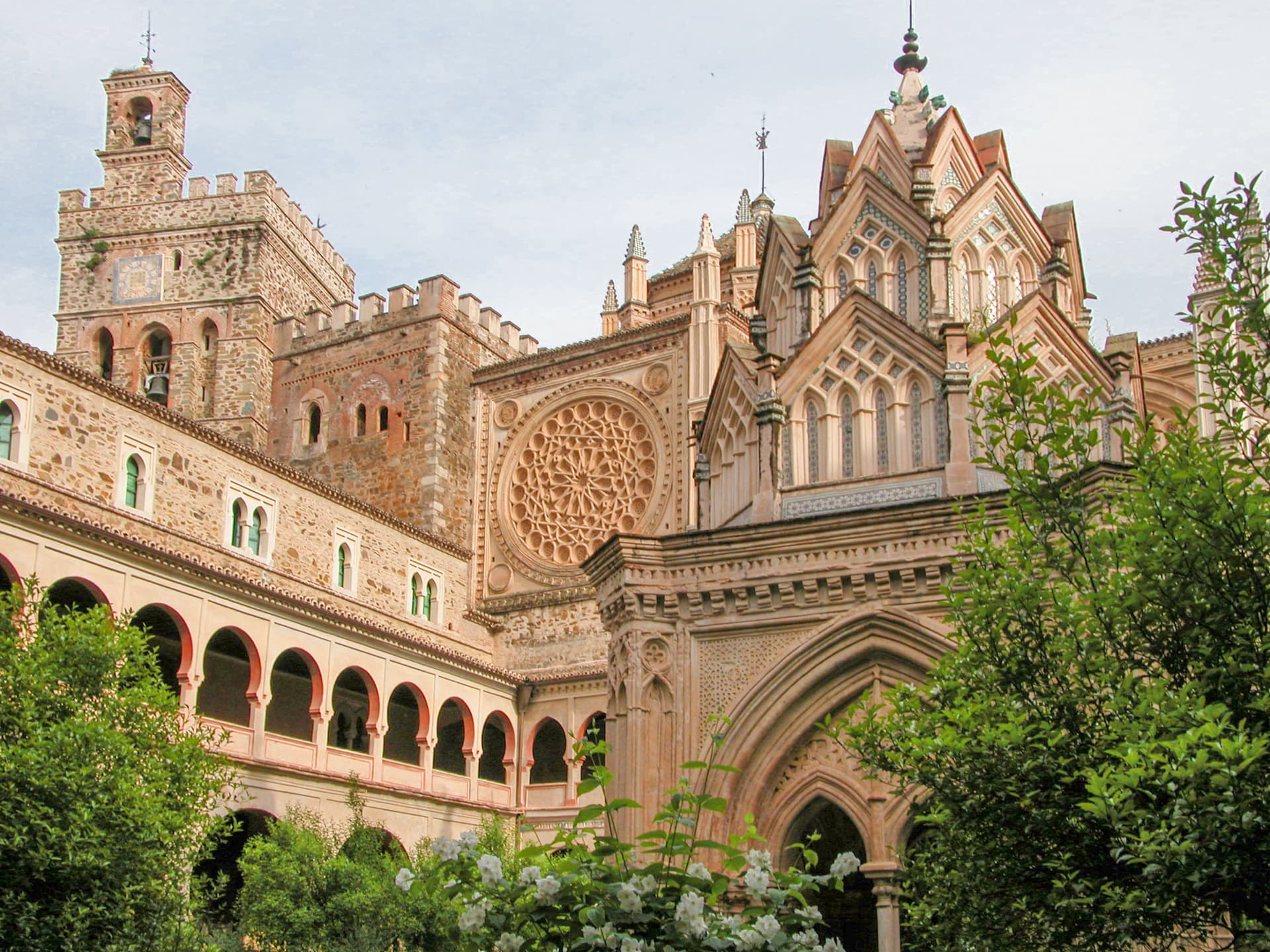
Outside the apartments, the monastery's cloisters and gardens offer a different register entirely — quieter, more given over to the ordinary rhythm of monastic life that predates and outlasts the imperial episode. The Vera valley's mountain setting, with the Sierra de Gredos rising behind, reinforces the same isolation the Hieronymites originally sought in 1402, largely undisturbed by the drama that later attached itself to the place.
Move through the palace apartments before the church, if the visit order allows it — arriving at the window from Charles V's side first lets the architectural logic register before you stand on the altar side and look back. Give the small rooms more time than their size suggests they need; their scale is part of what the site is telling you.
In the church and cloisters, slow down deliberately. This remains a place of active worship, not solely a museum sequence, and the two functions ask for slightly different kinds of attention within the same walk.
Context and lineage
The Hieronymites — the Order of Saint Jerome — established Yuste in 1402, drawn to its isolation in the Vera valley beneath the Sierra de Gredos. Their rule combined elements of Carthusian, Trappist, and Benedictine practice around a core of prayer, silence, and manual labor, and for more than a century and a half the monastery's history was simply the history of that community's daily observance.
That changed in 1556, when Charles V — Holy Roman Emperor and King of Spain, having abdicated his thrones to his son Philip II and his brother Ferdinand — commissioned a two-story palace house built against the monastery's south wall to accommodate his retirement and the entourage of fifty to sixty people who would attend him.
Most sources cite 3 February 1557 as his arrival date, though one account states he reached the monastery on 5 February 1557 after departing the port of Laredo in autumn 1556; this discrepancy is not resolved in the surviving record. He died at Yuste in 1558, having spent his final illness in rooms built specifically so he could hear Mass from his bed via a window onto the church altar.
The monastery's fortunes after Charles V's death followed a harder arc. French troops largely destroyed the building during the Peninsular War in 1809, and it stood substantially ruined for over a century before a state-led restoration, completed in 1949 under the Franco government, returned it to something like its former form. The European Heritage Label, awarded in 2007, marked its formal recognition as a site of shared European, not only Spanish, significance.
Hieronymite monks maintained Yuste continuously from 1402 until the order's broader suppression in Spain in the nineteenth century, and the community's presence resumed in some form after the twentieth-century restoration. Precisely which religious order maintains the monastery today is not settled across available sources: one account states the monastery is now home to monks of the Polish Order of St Paul the First Hermit — the Pauline Fathers — while another states that Hieronymites once again run the monastery.
Both claims appear in reputable secondary sources, and this content does not assert either as certain. What is clear is a division of responsibility: Patrimonio Nacional oversees the palace and museum portion as a state heritage site, while a resident religious community — Hieronymite or Pauline, per the unresolved sources — maintains the working monastery and church, including daily Mass. Visitors and researchers seeking precision on current occupancy should verify directly with Patrimonio Nacional or the monastery.
Charles V
historical
Holy Roman Emperor and King of Spain, who abdicated his thrones and spent his final year and a half in retirement at Yuste, dying there in 1558. His purpose-built apartments, including the window onto the church altar, remain the site's central historical feature.
Hieronymite Order
founding institution
Founded the monastery in 1402 as a contemplative retreat and maintained it for over four centuries; the order's current presence at Yuste is contested in available sources (see context.lineage).
Franco-era restoration authorities
restorers
Oversaw the monastery's reconstruction, completed in 1949, after its near-total destruction in 1809; some scholars note the restoration carried political symbolism tied to the Franco government's use of Spanish imperial history.
Patrimonio Nacional
steward
The national heritage authority that manages public access to the palace apartments, museum, and gardens today, distinct from the religious community maintaining the working church.
Traditions and practice
The Hieronymite rule centered daily life on Mass, choral office, and periods of silent manual labor, in a pattern drawing on Carthusian, Trappist, and Benedictine precedent. The monastery's recovered fifteenth-century choir furniture, dispersed after the 1809 destruction and later reassembled, reflects the order's liturgical life across four centuries. During his final illness, Charles V maintained his own private religious observance from the adjoining chamber, following Mass through the window onto the altar rather than attending in person.
Daily Mass is celebrated by the monastery's current resident religious community and remains open to visitors outside the restricted service times of Tuesday through Friday, 13:00 to 13:30, and Saturday and Sunday, 13:00 to 14:00. Outside these windows, the church and palace apartments function as a self-guided or guided museum visit under Patrimonio Nacional's management.
Separately, a modern commemorative tradition has grown around the site's secular history: the Council of Europe-certified Ruta de Carlos V retraces the emperor's final journey from Jarandilla de la Vera to Yuste, and nearby towns including Tornavacas, Jarandilla de la Vera, and Aldeanueva de la Vera hold period reenactments and markets recreating his final passage. This route is explicitly a historical and cultural itinerary rather than a religious pilgrimage.
If your visit coincides with the daily Mass window, consider attending rather than timing your visit around it — the church remains a working space of worship, and being present for the liturgy, even briefly, gives a different register to the building than a purely museum-paced walk-through.
At the window between Charles V's chamber and the altar, resist moving on quickly. Consider both directions of that sightline: what it meant to look toward the altar from a sickbed, and what it might mean to stand at the altar and look back toward where he watched from.
Roman Catholicism — Hieronymite Order (Order of Saint Jerome)
ActiveFounded in 1402, the monastery was built by the Hieronymites as a contemplative retreat combining elements of Carthusian, Trappist, and Benedictine monastic life centered on prayer, silence, and manual work. Its rural, isolated setting in the Sierra de Gredos foothills embodied the order's ideal of withdrawal from worldly affairs. Sources disagree on whether the Hieronymites or the Pauline Fathers currently maintain the working monastery; this entry follows the Hieronymite founding tradition while noting that current occupancy is unresolved (see context.lineage and perspectives.unknown).
Daily Mass and choral office; historically silent contemplative labor; the monastery's fifteenth-century choir furniture, recovered after being dispersed in 1809, reflects the order's liturgical life across four centuries.
Spanish royal historical veneration (Charles V commemorative tradition)
ActiveBeyond its monastic identity, Yuste holds unique standing as the retirement residence and death place of Charles V, Holy Roman Emperor and King of Spain, who abdicated his thrones and spent his final years, 1557 to 1558, here in a purpose-built palace adjoining the monastery church, from which he could hear Mass from his bed. This dual religious-and-dynastic significance makes Yuste a site of national historical memory as much as religious practice, commemorated today through the Ruta de Carlos V historical route and period reenactments in nearby towns.
Modern commemorative practices include the Council of Europe-certified Ruta de Carlos V walking route, from Jarandilla de la Vera to Yuste, and town festivities in Tornavacas, Jarandilla de la Vera, and Aldeanueva de la Vera reenacting the emperor's final journey with period costume and markets.
Perspectives and open questions
Yuste asks to be read on two tracks at once: as a still-functioning monastic house with its own quiet continuity, and as the fixed point in European history where an emperor chose to end his reign and his life. Historians hold these together more easily than casual visitor accounts sometimes do, and a few genuine uncertainties — about current occupancy, about the emperor's private motivations — remain open rather than settled.
Scholarly perspective
Historians agree that Yuste is significant on two counts that reinforce rather than compete with each other: as a well-preserved example of Hieronymite monastic architecture, and as the definitive site of Charles V's abdication-era retirement and death, a pivotal moment marking the division of the Habsburg inheritance between its Spanish and Austrian branches.
The 1809 destruction and 1949 state-led restoration are well documented, and some scholars note the political symbolism the Franco government attached to restoring a monument tied to Spanish imperial history at that particular moment. On the more granular question of current religious occupancy, scholarly and journalistic sources genuinely disagree — some stating Pauline Fathers now maintain the community, others stating Hieronymites have returned — and no single source available in this research resolves the discrepancy conclusively.
Living and traditional perspectives
For the Hieronymite order historically, and for whichever community maintains the church today, Yuste's sanctity rests on the same foundation it always has: a life ordered around prayer, silence, and withdrawal, largely unaltered by the site's dynastic fame. From this perspective, the emperor's apartments are a historical addendum to a monastic identity considerably older than his arrival.
Open questions
Two questions remain genuinely open. First, which religious order currently resides at and maintains Yuste — Hieronymite or Pauline Fathers — is inconsistently reported across available sources and is not resolved here; anyone requiring precision should verify directly with Patrimonio Nacional or the monastery.
Second, what Charles V actually experienced or intended in having that window built onto the altar — devotion, political stagecraft, or some inseparable blend — is not something the documentary record settles, and speculation beyond the architectural fact itself should be held lightly.
Plan your visit
Access and arrival
Located in Cuacos de Yuste, Cáceres province, in the Vera valley and Sierra de Gredos foothills, reachable by the N-110 and local roads through the La Vera comarca. Tickets can be purchased on-site or in advance through the official Patrimonio Nacional website. No specific mobile signal information was available at time of writing for this well-populated valley setting; check with Patrimonio Nacional for current details if traveling to a remote lodging nearby.
Respectful visit
Photography without flash is permitted for personal use except where expressly prohibited. Tripods, selfie sticks, and similar equipment are not allowed.
Visits should avoid the religious service times of Tuesday through Friday, 13:00 to 13:30, and Saturday and Sunday, 13:00 to 14:00, out of respect for ongoing worship. Visitor conduct should respect the privacy of other visitors, monastery staff, and the resident religious community. Guided tours must be purchased at the ticket office for an additional cost.
The church remains an active place of worship as well as a heritage site; do not treat it as a photo backdrop during or near service times, and follow Patrimonio Nacional staff guidance regarding which areas are open to general visitors versus reserved for the religious community.
Location
Map loads as you approach this section.
Pilgrim reflections
A portrait of encounter, not a score
Pilgrims describe what they felt, how present they could become, and whether the place would shape a journey. There are no stars and no ranking of traditions.
No reviewed reflections yet
The first pilgrims can help describe the character of being here.
Share a reflection
Available after an account-backed “Been there.” Every reflection is reviewed before publication.
Nearby sacred places
Explore other sacred places in the region. Proximity does not establish access or travel time; check each place’s guidance.


References
Sources consulted for this page. Source categories describe the publication, not a guarantee that every claim is verified. Traditional accounts and outside interpretations may differ.
- 01Monastery of Yuste — Wikipedia — Wikipedia contributorsencyclopediaCore reference for founding date (1402), Hieronymite order, Charles V's retirement and death, 1809 Peninsular War destruction, 1949 restoration, and European Heritage Label (2007).
- 02Monastery of San Jerónimo de Yuste — Patrimonio Nacional (Spanish national heritage authority)officialOfficial Spanish state heritage body managing the site; used for visitor rules, accessibility, and site management context.
- 03Monastery of San Jerónimo de Yuste, Cuacos de Yuste (Spain) — European Commission — Culture and Creativity (European Heritage Label)officialOfficial EU cultural heritage body confirming European Heritage Label status and site significance.
- 04Yuste Monastery Tickets, Cáceres — Patrimonio NacionalofficialOfficial ticketing page; used for opening hours, free-admission windows, and guided-tour pricing.
- 05Ruta de Carlos V — Wikipedia (Spanish) — Wikipedia contributorsencyclopediaDocuments the commemorative historical route retracing Charles V's final journey to Yuste; confirms Council of Europe cultural-itinerary certification (2016) and route details. Used to establish that Yuste is not on a religious pilgrimage route but is the endpoint of a secular/historical commemorative route.
- 06Yuste Monastery, the last resting place of Charles V — Barceló ExperiencesguideReputable travel-guide overview; used for general visitor context, cross-checked against official sources.
- 07Monastery of Yuste — Grokipedia — GrokipediaSource contextSecondary aggregator entry; used only to corroborate facts already established in higher-reliability sources, not as a standalone authority.
- 08Ruta de Carlos V: journey of a reluctant royal — Adventures in ExtremadurablogEnglish-language travel/history blog on the Charles V route; used for narrative color on the emperor's final journey, cross-checked against Spanish Wikipedia.
Share a photo
Help visitors recognize Royal Monastery of Yuste. Every submission is reviewed before publication.