Rajakangas Giant’s Church
The northernmost Giant's Church, aligned to the spring equinox sun
Understand sacred places, explore living traditions, and learn how to engage respectfully with Pilgrim Map.
Access has not been verified. Check current local guidance before planning a visit.
Haukipudas (Oulu), North Ostrobothnia, Finland
Read the sources
Visit essentials
A quick read before you go
- Duration
- Not documented in available sources.
- Access
- Rajakangas is located in Haukipudas, a district of the city of Oulu since the 2013 municipal…
Overview
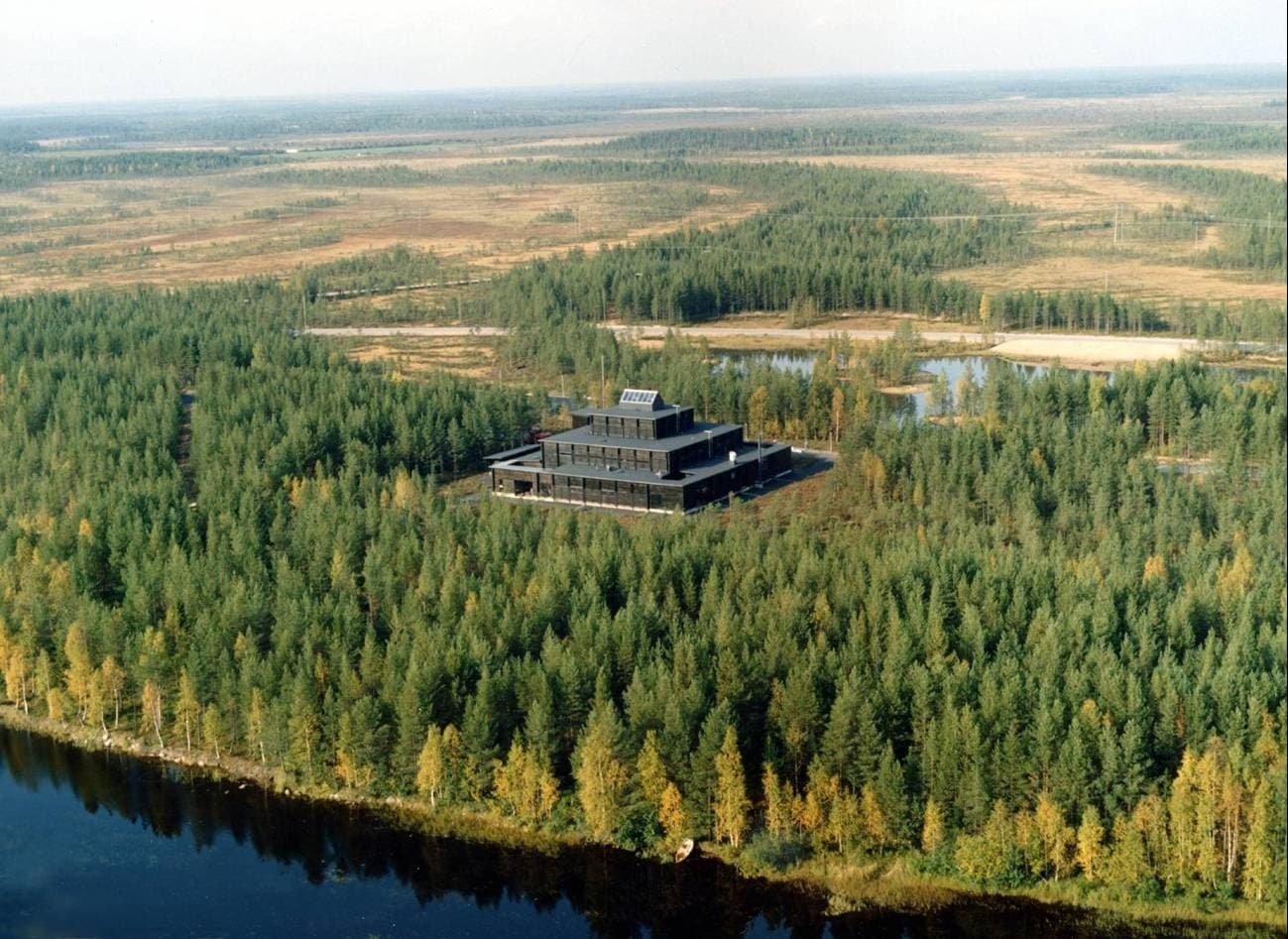
Rajakangas Giant's Church stands on a ridge in Haukipudas, part of Oulu since 2013, in Finland's North Ostrobothnia province. Double stone walls form a roughly 32-by-26-meter rectangle, barely half a meter above the forest floor, with northeast and west gateways. It is the northernmost documented example among around forty jätinkirkot, or “Giant's Churches,” distributed along 400 kilometers of Ostrobothnia's coast.
Comb Ceramic hunter-gatherers of the Pöljä tradition built it in the third or fourth millennium BCE, before regional agriculture. Communities without farming, storage surplus, or apparent hierarchy nevertheless organized the labor to move and stack this stone. No excavation has tested what lies beneath the walls.
Researchers Marianna Ridderstad and Jari Okkonen documented the spring-equinox sun setting directly behind the western gateway in their survey of Giant's Church orientations. Whether intentional or coincidental remains unresolved, as does nearly everything about the site's original purpose.
Why this place is sacred
What draws attention to Rajakangas isn't a legend or a lineage of worship — none is recorded — but the plain fact of the structure itself. Comb Ceramic communities living without agriculture, metal tools, or (as far as evidence shows) social stratification nonetheless committed sustained collective effort to build a stone enclosure large enough to cover roughly 830 square meters, with two carefully placed gateways and double wall construction.
That kind of investment usually signals gathering, ceremony, or shared meaning of some kind — but at Rajakangas, as at the other Giant's Churches, no artifact record survives to say what that meaning was, because the site has never been excavated. The one hard data point beyond the walls themselves is astronomical: the sun sets behind the western gateway at the spring equinox.
That single, measurable fact is what keeps the site from being purely inert stone in the eyes of researchers — it suggests, without proving, that whoever built the western gate at that angle was tracking something in the sky as well as on the ground.
Unknown and actively debated. Proposed functions include a ceremonial or ritual gathering site, a seasonal camp or storage structure tied to hunting seals on the spring ice of the Gulf of Bothnia, a dwelling site, or a defensive enclosure — none confirmed, none excluded.
Post-glacial land uplift has carried the site roughly to its present elevation of about 55 meters above sea level; when it was built, the surrounding land lay far closer to, or beneath, the waterline of the ancient Gulf of Bothnia.
Comb Ceramic use appears to have ended by around 1500 BCE, after which the site had no recorded further habitation or ceremonial use — it passed directly from prehistoric use into archaeological dormancy, without any documented intermediate reuse by later cultures.
Experience and orientation
There is no visitor center here, no ticket booth, no paved path — Rajakangas sits in ordinary managed forest on a moraine ridge, and finding it means navigating by coordinates or a hiking map rather than signage. The approach itself is unremarkable: forest track, moss, glacial till underfoot, the kind of terrain that covers most of inland North Ostrobothnia.
What changes is the moment the ground opens into a slight, deliberate rectangle and the walls resolve out of the undergrowth — knee-high at most, built of stones under half a meter across, running in a double course that is easy to miss from a distance and unmistakable once you're beside it.
Standing inside the perimeter gives a rough sense of the enclosed space: roughly the footprint of a small stadium pitch, empty of any visible internal structure, open to the sky and the surrounding pines. The two gateways — one northeast, one west — are the only formal openings in an otherwise continuous perimeter, and it's worth standing in the western one near the spring equinox, since this is the one measured alignment the site is known for.
Beyond that, there is little to instruct the eye: no reconstructed huts, no interpretive panels, no reconstructed hearths. The experience is closer to encountering a fact in the landscape than a curated heritage attraction — the walls simply exist, roughly four thousand years old, and the visitor is left to supply whatever meaning the builders once had.
Enter, if possible, near either gateway rather than stepping over the wall itself, out of respect for the stonework. The northeastern gateway is the more casual approach; the western gateway is the one aligned to the equinox sunset and worth reaching deliberately if timing allows.
Context and lineage
No founding narrative or oral tradition survives; the site's origin is understood purely through archaeological inference. It was raised by Sub-Neolithic communities of the Pöljä variant of the Comb Ceramic culture, working without agriculture or metal tools, sometime in the broad window of roughly 3500 to 2000 BCE (some site-specific estimates narrow this to 2500–2000 BCE). Its function was never recorded because writing did not yet exist in the region; every explanation offered since is a modern hypothesis.
Rajakangas sits within the wider Giant's Church tradition unique to coastal Ostrobothnia, alongside roughly forty other known enclosures including Kastelli (the largest, near Raahe) and Linnakangas and Linnamaa. All are attributed to the same Sub-Neolithic Comb Ceramic milieu, though each site's precise dating and function is assessed independently, and Rajakangas — as the northernmost — marks the current known edge of the phenomenon's geographic range.
Paula Purhonen
Archaeologist who visited and documented the site in 1977 and 1979, part of the early modern survey record for Rajakangas.
Markku Mäkivuoti
Conducted the 1993 Haukipudas archaeological inventory in which Rajakangas was formally surveyed and recorded.
Marianna Ridderstad
University of Helsinki researcher who, with Jari Okkonen, identified the spring equinox solar alignment at Rajakangas's western gateway as part of a wider study of 23 Giant's Church orientations.
Jari Okkonen
University of Oulu archaeologist and co-author of the orientation study; a leading scholar of Ostrobothnian Stone Age monuments generally.
The Comb Ceramic (Pöljä tradition) builders
The unnamed Sub-Neolithic hunter-gatherer communities who quarried, moved, and stacked the stone walls themselves — the site's true authors, known only through their material remains.
Traditions and practice
No traditional rituals are documented or attested. The single practice inferable from the physical evidence is that the western gateway was positioned, or came to align, with the equinox sunset — whether this reflects a deliberate ceremonial marker or a coincidence of construction is not established.
None documented — there is no ongoing devotional, ceremonial, or festival use of the site by any modern community.
Walk the perimeter slowly before entering, taking in the full rectangle from outside the walls, then enter through one of the two gateways rather than crossing the stonework directly. Spend time at the western gateway noting its orientation, particularly if visiting near the spring equinox (around March 20–21), when the sun is documented to set directly behind it.
Sit with the questions the site raises rather than seeking an answer: why builders without agriculture or apparent hierarchy invested this much collective labor, and what a four-thousand-year-old structure with no roof, no hearth, and no burial evidence was actually for.
Finnish Stone Age / Comb Ceramic Culture (Pöljä ceramic tradition)
HistoricalRajakangas is the northernmost known example of Finland's Giant's Churches, a category of Sub-Neolithic monumental stone enclosure unique to the Ostrobothnian coast, built by Comb Ceramic hunter-gatherer communities roughly 3500/2500–2000 BCE.
Archaeoastronomy / heritage-research stewardship
ActiveAn active scholarly tradition — represented by researchers such as Marianna Ridderstad and Jari Okkonen — continues to study Giant's Church orientations and the wider Ostrobothnian Sub-Neolithic monument landscape, of which Rajakangas is a documented case.
Perspectives and open questions
Rajakangas is read almost entirely through an archaeological lens, since no folk tradition, indigenous account, or continuous community memory survives to offer a competing interpretation — what perspectives exist are variations within scholarship itself, plus the open question scholarship hasn't closed.
Scholarly perspective
Archaeologists agree Rajakangas is a deliberately constructed stone enclosure, one of roughly forty Giant's Churches built along coastal Ostrobothnia by Sub-Neolithic Comb Ceramic (Pöljä-tradition) hunter-gatherers between approximately 3500/2500 and 2000 BCE, abandoned by around 1500 BCE. It is documented as the northernmost known example of the type.
Beyond construction and dating, however, there is no scholarly consensus on function: proposed uses span ceremonial gathering sites, seasonal seal-hunting camps tied to spring ice conditions, dwellings, and defensive enclosures, and because Rajakangas has never been excavated, none of these hypotheses can currently be tested against artifact evidence from the site itself.
Alternative interpretations
Enthusiast megalith-cataloguing sources tend to group Rajakangas loosely alongside stone circles, forts, and enclosures from other traditions worldwide under broad classificatory schemes; no source found makes a specific esoteric, alternative-history, or origin claim about Rajakangas itself beyond this general comparative framing.
Open questions
The central unknown is functional: why a society without agriculture, metal tools, or apparent hierarchy organized the labor to build a stone enclosure of this scale, and whether the documented equinox alignment at the western gate reflects intentional design or coincidence. Because no excavation has ever been carried out, even foundational questions — how long the site was in use, whether it saw habitation or purely periodic gathering, what if anything was deposited within its walls — remain open.
Plan your visit
Access and arrival
Rajakangas is located in Haukipudas, a district of the city of Oulu since the 2013 municipal merger, roughly 18 km northeast of the old Haukipudas church and about 5 km east of Lake Onkamonjärvi, on a ridge at the northeastern edge of the Rajakangas moraine hill.
No source consulted documents a marked trail, parking area, or signage at the site itself, and mobile phone signal reliability at the precise location is not confirmed by any source found — visitors should not assume coverage and should carry offline maps or GPS coordinates as a precaution, particularly given the rural, forested character of the surrounding terrain.
No information on keyholders, guided access, or booking requirements was found; none appears to be needed, as the site sits on open forest land rather than behind a gate, but anyone planning a visit should check with the Finnish Heritage Agency (Museovirasto) for current access notes, since this could not be independently verified during this research pass.
Respectful visit
No restrictions are documented; photography for personal or educational use appears generally permitted, as at most open-access Finnish ancient monuments.
None are traditional or documented at this site; there is no devotional practice to which an offering would attach.
Do not move, stack, remove, or add stones to the enclosure walls or the nearby cairn (röykkiö) — this is a legally protected ancient monument under Finnish antiquities law (Muinaismuistolaki). | No digging, probing, or metal-detecting; the site has never been excavated and any unauthorized disturbance is prohibited by law.
Do not attempt to dig, probe, or move stones in search of artifacts — the site is an unexcavated, legally protected ancient monument, and any disturbance is both illegal under Finnish antiquities law and destroys the very evidence that might one day answer the questions above.
Location
Map loads as you approach this section.
Pilgrim reflections
A portrait of encounter, not a score
Pilgrims describe what they felt, how present they could become, and whether the place would shape a journey. There are no stars and no ranking of traditions.
No reviewed reflections yet
The first pilgrims can help describe the character of being here.
Share a reflection
Available after an account-backed “Been there.” Every reflection is reviewed before publication.
Nearby sacred places
Explore other sacred places in the region. Proximity does not establish access or travel time; check each place’s guidance.
Kierikki Stone Age Centre
Yli-Ii (Oulu), North Ostrobothnia, Finland
18.0 km away

Yli-Ii Kierikki Settlement Area
Yli-Ii (Oulu), North Ostrobothnia, Finland
18.3 km away

Kastelli Giant’s Church
Raahe, North Ostrobothnia, Finland
81.5 km away

Värikallio Rock Paintings
Suomussalmi (Hossa), Kainuu, Finland
171.7 km away
References
Sources consulted for this page. Source categories describe the publication, not a guarantee that every claim is verified. Traditional accounts and outside interpretations may differ.
- 01Giant's Church – Wikipedia — Wikipedia contributorsencyclopediaGeneral context on Giant's Churches as a phenomenon: c. 40 known sites over a 400km coastal strip of Ostrobothnia, built by Sub-Neolithic hunter-gatherers c. 3500-2000 BCE (abandoned by c. 1500 BCE), function undetermined ('no hard evidence'), seal-hunting camp hypothesis noted as speculative. Notes Kastelli (60x35m) as the largest example, for comparative scale.
- 02Orientations of the Giant's Churches in Ostrobothnia, Finland — Marianna Ridderstad (University of Helsinki) and Jari Okkonen (University of Oulu)academicAcademic astronomical-archaeology study surveying 23 Giant's Church structures for orientation; identifies Rajakangas in Haukipudas as the northernmost site studied and finds the sun sets at the spring equinox behind the western gateway. PDF itself could not be OCR'd during this research pass, so findings are relayed via corroborating secondary summaries (Megalithic Portal, search-engine synopsis) rather than direct quotation from the paper.
- 03Rajakankaan jätinkirkko. Muinaisjäännökseen kuuluu myös röykkiö ja kivikautinen asuinpaikka. | Museovirasto | Finna.fi — Museovirasto (Finnish Heritage Agency)officialOfficial Finnish Heritage Agency ancient-monument register record confirming the enclosure is part of a protected monument complex that also includes a cairn (röykkiö) and a Stone Age dwelling site. Direct fetch returned HTTP 403 during this research session, so exact wording is not verbatim-quoted here; the title itself (confirming cairn + dwelling site) is nonetheless usable as it appeared in search-result metadata.
- 04Kastelli Giant's Church – Wikipedia — Wikipedia contributorsencyclopediaUsed only for comparative scale context (Kastelli as the largest known Giant's Church) to situate Rajakangas within the wider phenomenon; not itself a source on Rajakangas.
- 05Rajakankaan kirkko – Wikipedia — Wikipedia contributors (Finnish)encyclopediaMost detailed single source on Rajakangas specifically: coordinates, wall dimensions (32x26m, wall width 1.5-3m, height 50-60cm), two gateways, LIDAR-detected inner/outer wall systems, survey history (Purhonen 1977/1979, Mäkivuoti 1993 inventory), no excavations conducted, nationally significant heritage listing ('Maiseman muisti 2001'), nearby settlement site Rajakangas 2, associated standing stones.
- 06Rajakangas Giant's Church [Rajakangas Jätinkirkko] Stone Fort or Dun — The Megalithic Portal and Megalith MapguideCorroborates dimensions (32x26m double walls), gives rounded coordinates (65.2N, 25.8E), cites Ridderstad & Okkonen equinox alignment finding, notes debated function including seal-hunting/storage hypothesis.
- 07Rajakangas Giant's Church — Wikidata (Q28721290) — Wikidata contributorsencyclopediaStructured-data entry corroborating identity and classification of the site as a Giant's Church instance.
Share a photo
Help visitors recognize Rajakangas Giant’s Church. Every submission is reviewed before publication.