Kierikki Stone Age Centre
A riverside village that proved Stone Age Finland never left home
Understand sacred places, explore living traditions, and learn how to engage respectfully with Pilgrim Map.
Access has not been verified. Check current local guidance before planning a visit.
Yli-Ii (Oulu), North Ostrobothnia, Finland
Read the sources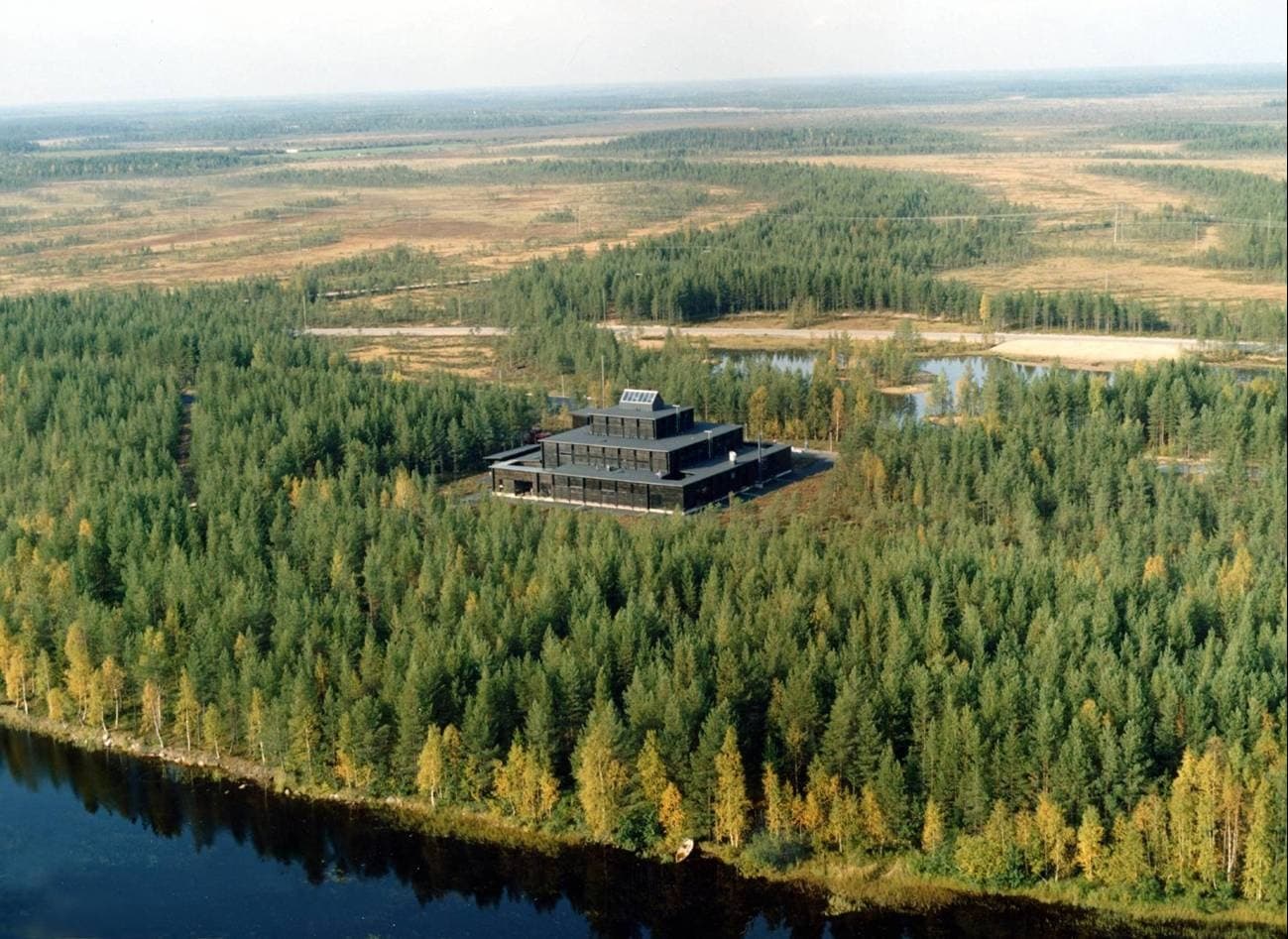
Image of Kierikki Stone Age Centre. Image source
Visit essentials
A quick read before you go
- Duration
- Half a day (3-4 hours) to see the exhibitions, the reconstructed village, and take part in at…
- Access
- Pahkalantie 447, Yli-Ii (City of Oulu), roughly 55 km northeast of central Oulu on the Iijoki…
Overview
Kierikki asks visitors to hold together a vivid reconstruction and the plain ground beside it where the evidence was found. On the Iijoki River, fifty-five kilometres northeast of Oulu, the Centre anchors a settlement area excavated since 1960. Dwelling depressions overturned the assumption that Stone Age Finns moved seasonally in small bands, revealing large, permanent fishing-and-seal-hunting villages tied to exchange networks that brought Baltic amber and Russian flint into this northern river landscape.
Completed in 2001 from a project begun in 1995 by University of Oulu historian Kyösti Julku, archaeologist Pentti Koivunen, and then-municipal manager Anneli Mehtälä, the Centre is among the Nordic countries' largest modern log structures. It received a European Heritage Award for both architecture and interpretation. Roughly five hundred metres away, a reconstructed pit-house village lets visitors knap stone, loose an arrow, or paddle a dugout canoe.
Near the museum, largely undisturbed ground holds actual Stone Age houses and a red-ochre burial. The colouring appears across the wider Comb Ceramic cultural world and is understood by archaeologists as marking the dead for transformation or protection. Reconstruction teaches skills; the nearby ground preserves the harder question of how this community met death.
Why this place is sacred
The scholarly importance of Kierikki rests substantially on what it revealed about how Stone Age people in this part of Finland actually lived: not as itinerant foragers passing through, but as a community that built and returned to substantial pit-house dwellings on this stretch of the Iijoki across multiple centuries, sustaining itself through fishing and seal hunting rich enough to support a settled existence.
The amber found here — the largest collection in Finland — travelled more than a thousand kilometres from the Baltic; flint arrived from Russia. A community this well-connected clearly had the surplus, security, and social organisation to sustain long-distance exchange for goods that were not, strictly, necessary for survival.
The red-ochre burial documented near the site adds a further dimension. Comb Ceramic-culture mortuary practice across the wider region involved covering the dead and their grave goods — typically amber ornaments, flint tools, whetstones, occasionally pottery or bone implements — liberally with red ochre, a practice widely read by archaeologists as symbolically marking transformation, protection, or some other significance now inferred rather than known outright.
Finding this practice attested here, in the ground beside a museum otherwise organised around domestic and craft life, is a reminder that the same community engaged in exchange, fishing, and toolmaking also observed some form of ritual attention to death.
A permanent Neolithic riverside settlement supporting fishing, sealing, craft production, long-distance exchange, and, evidenced by a nearby red-ochre burial, ritual mortuary practice.
Settlement occupation, c. 4000-3100 BC → gradual abandonment as the ancient shoreline receded inland through post-glacial land uplift → rediscovery and excavation beginning 1960 → project concept initiated by Kyösti Julku and Pentti Koivunen, early 1990s → Kieriki Project launched 1995 under Anneli Mehtälä → Centre building completed 2001, recognised with a European Heritage Award → ongoing excavation and public-participation programs into the present.
Experience and orientation
The visit typically begins inside the Centre's log building, among exhibits that include Finland's largest collection of Stone Age amber jewellery and tools recovered from the surrounding settlement area. From there, a walk of about five hundred metres leads to the reconstructed Stone Age Village: pit-house dwellings built according to the archaeological evidence recovered nearby, arranged to be entered and used rather than viewed from behind glass.
What distinguishes Kierikki from a conventional museum is this permission to do rather than only observe — visitors can try flintknapping, take a turn with a bow, or paddle a dugout canoe on the river the original settlement depended on. In early August each year, the Ancient Fair Festival extends this hands-on approach into a larger seasonal event.
The quieter part of the experience, easy to miss amid the activity, is the awareness that the reconstructed village stands within a real, largely unexcavated settlement landscape — genuine dwelling depressions and a red-ochre burial lie in the ground nearby, distinct from anything rebuilt for visitors. Walking from the vivid, hands-on village back toward the plain forest and riverside ground where the actual evidence was found is itself a useful shift in register, from imaginative reconstruction to sober archaeological fact.
Start at the Centre building (Pahkalantie 447, Yli-Ii) for orientation and exhibits, then walk the roughly 500 metres to the reconstructed Stone Age Village. Budget time for at least one hands-on activity. If visiting in early August, check whether the Ancient Fair Festival is running, as it substantially changes the day's program.
Context and lineage
No myth or founding narrative survives from the Neolithic community itself; what is known comes entirely from more than sixty years of archaeological work.
The modern Centre's own origin story is comparatively well documented: University of Oulu historian Kyösti Julku and archaeologist Pentti Koivunen conceived the idea of a dedicated Stone Age heritage venue in the early 1990s, and Anneli Mehtälä, then Yli-Ii's municipal manager, launched the Kieriki Project in 1995 to realise it, culminating in the 2001 opening of the Centre building.
Neolithic Comb Ceramic-culture settlement, c. 4000-3100 BC → gradual abandonment as the shoreline receded inland → rediscovery and excavation from 1960 → heritage-project concept, early 1990s → Kieriki Project launched 1995 → Centre building completed 2001, winning a European Heritage Award/Europa Nostra Award → ongoing excavation, public participation, and interpretive programming into the present.
Kyösti Julku
University of Oulu historian whose idea, with archaeologist Pentti Koivunen, initiated the concept behind the Kierikki heritage project
Pentti Koivunen
Archaeologist who co-originated the project concept and contributed archaeological expertise to its development
Anneli Mehtälä
Former municipal manager of Yli-Ii who launched and drove the Kieriki Project from 1995 through the Centre's completion
Excavation teams active since 1960
Conducted the systematic archaeological work that revealed the settlement's scale, permanence, and material culture, including a 2007 discovery of Stone Age birch-bark chewing gum reported by the BBC and a public-participation amber find by an 11-year-old excavator in 2012
Traditions and practice
The original community practised permanent pit-house dwelling supported by fishing and seal hunting, produced a distinct regional pottery style (Kierikki Ware, 3500-3100 BC) within the broader Comb Ceramic culture, maintained long-distance exchange for amber and flint, and observed a red-ochre burial custom for at least some of its dead, marking bodies and grave goods with the mineral pigment in a manner archaeologists read as symbolically significant.
The Centre operates as a staffed museum and reconstructed village offering guided tours, craft and survival-skill workshops (toolmaking, archery, canoe paddling), the annual Ancient Fair Festival in early August, and periodic public participation in ongoing excavation seasons.
Visit the exhibition hall before the reconstructed village, so the amber, tools, and pottery on display frame what you then encounter hands-on outside. Try at least one skill-based activity rather than only observing — the physical effort of flintknapping or paddling gives a more direct sense of the settlement's material culture than any label can.
Before leaving, take a moment to locate, even approximately, where the genuine (unreconstructed) dwelling depressions and red-ochre burial lie in the surrounding ground, and register that this is where the evidence for everything you have just experienced actually came from.
Finnish Prehistoric / Comb Ceramic Neolithic Culture
HistoricalKierikki was a substantial, year-round Neolithic village on the Iijoki river, occupied roughly 4000-3100 BC, that overturned earlier assumptions of Stone Age Finnish nomadism and revealed extensive trade networks bringing Baltic amber and Russian flint into the settlement.
Permanent pit-house dwelling, fishing and sealing subsistence, pottery production (Kierikki Ware, 3500-3100 BC), long-distance amber and flint exchange, red-ochre burial of the dead with modest grave goods.
Modern Heritage Interpretation and Archaeology
ActiveSince the 1995 Kieriki Project and the Centre's 2001 opening, Kierikki has become one of Finland's foremost venues for experimental archaeology and public engagement with the Stone Age, recognised with a European Heritage Award/Europa Nostra Award for its architecture and heritage program.
Reconstructed pit-house village, hands-on craft workshops, the annual Ancient Fair Festival, and continuing excavation with public participation opportunities.
Perspectives and open questions
Kierikki is understood through complementary rather than competing lenses: archaeological revision of settlement models, modern heritage-interpretation practice, and the specific question of what a red-ochre burial can and cannot tell us about belief.
Scholarly perspective
Archaeologists regard Kierikki as pivotal to revising the model of Finnish Stone Age settlement from seasonal mobility to permanent, year-round village life, supported by fishing, sealing, and long-distance exchange networks reaching the Baltic and Russia. Kierikki Ware (3500-3100 BC) is recognised as a distinct regional variant within the broader Comb Ceramic cultural sphere.
Living and traditional perspectives
No living community traces direct unbroken descent from or ritual claim to the Neolithic settlement; interpretation here rests on archaeological and museological authority rather than continuing indigenous tradition.
Alternative interpretations
The Centre's own framing — hands-on reconstruction paired with a nearby, largely undisturbed archaeological zone — can be read as an unusually honest model for heritage interpretation generally: it lets visitors do the imaginative, embodied work of reconstruction while keeping the actual evidentiary ground visibly separate and undramatized.
Open questions
The specific beliefs behind the red-ochre burial custom — what the ochre was understood to do for the dead, and whether this particular burial reflects wider community practice or an individual case — remain inferred rather than known; likewise the full social meaning of amber as a prestige or exchange good beyond its evident value and the distance it travelled.
Plan your visit
Access and arrival
Pahkalantie 447, Yli-Ii (City of Oulu), roughly 55 km northeast of central Oulu on the Iijoki river, about 10 km southeast of Yli-Ii centre toward Pudasjärvi. Reachable by car; phone +358 50 410 7309 or email kierikki@ouka.fi for arrival and accessibility details. Mobile phone signal is not separately confirmed in sources consulted for this rural riverside location — travellers relying on connectivity should confirm locally before their visit.
The Centre offers on-site accommodation options (confirm current availability via kierikki.fi); further lodging is available in Yli-Ii village and central Oulu.
Respectful visit
No specific dress code; practical outdoor clothing suited to riverside grounds and hands-on activities (archery, canoe paddling) is recommended.
Permitted in the Centre and reconstructed village; check current signage for any restrictions on specific exhibits.
Not applicable.
The genuine archaeological settlement area beyond the reconstructed village is a protected fixed ancient monument — do not dig, remove material, or leave marked paths without authorisation.
Confirm current opening hours before travelling, as the Centre operates a defined seasonal schedule with reduced days later in summer and group-reservation-only access outside the main season. The surrounding archaeological settlement area is a protected fixed ancient monument — do not dig or remove material from any exposed ground beyond the maintained museum grounds.
Location
Map loads as you approach this section.
Pilgrim reflections
A portrait of encounter, not a score
Pilgrims describe what they felt, how present they could become, and whether the place would shape a journey. There are no stars and no ranking of traditions.
No reviewed reflections yet
The first pilgrims can help describe the character of being here.
Share a reflection
Available after an account-backed “Been there.” Every reflection is reviewed before publication.
Nearby sacred places
Explore other sacred places in the region. Proximity does not establish access or travel time; check each place’s guidance.

Yli-Ii Kierikki Settlement Area
Yli-Ii (Oulu), North Ostrobothnia, Finland
0.4 km away

Rajakangas Giant’s Church
Haukipudas (Oulu), North Ostrobothnia, Finland
18.0 km away

Kastelli Giant’s Church
Raahe, North Ostrobothnia, Finland
99.5 km away

Värikallio Rock Paintings
Suomussalmi (Hossa), Kainuu, Finland
158.7 km away
References
Sources consulted for this page. Source categories describe the publication, not a guarantee that every claim is verified. Traditional accounts and outside interpretations may differ.
- 01Spark of the Stone Age — Kierikki Stone Age Centre — Kierikkikeskus / City of OuluofficialOfficial site homepage
- 02Kierikki Stone Age Centre — Kierikkikeskus / City of OuluofficialOfficial description of the Centre building, exhibitions, and address
- 03Opening times — Kierikkikeskus / City of OuluofficialSummer 2026 opening hours, Midsummer closure, school-group/winter reservation policy
- 04Kierikkikeskus / Kierikki Stone Age Centre — EXARC (international experimental archaeology/open-air museum network)academicPeer-network museum documentation; distinguishes the Centre building from the reconstructed Stone Age Village (500m away) and notes remains of Stone Age houses and a red ochre burial near the museum
- 05Kierikki Stone Age Centre in Yli-Ii — European Heritage Awards / Europa Nostra AwardsofficialAward citation with project history: initiated by Prof. Kyösti Julku and archaeologist Pentti Koivunen, municipal manager Anneli Mehtälä launched the Kieriki Project in 1995, building completed 2001
- 06Kierikki - Wikipedia — Wikipedia contributorsencyclopediaCoordinates (65°21'39"N 25°56'13"E), settlement chronology 4th millennium BC, year-round village finding, excavation since 1960, Kierikki ceramics 3500-3100 BC, amber and flint trade evidence
- 07Kierikki Stone Age Centre - Where Stone Age comes to life — Discovering FinlandguideVisitor-oriented overview of location, activities, and Ancient Fair Festival
- 08Comb Ceramic culture - Wikipedia — Wikipedia contributorsencyclopediaRed ochre burial ritual, grave goods (amber, flint, whetstones, bone implements) associated with the broader Comb Ceramic cultural sphere to which Kierikki belongs
Share a photo
Help visitors recognize Kierikki Stone Age Centre. Every submission is reviewed before publication.