Quinkan Split Rock Art Site
Rock galleries of the Quinkan spirit beings in Cape York's sandstone country
Understand sacred places, explore living traditions, and learn how to engage respectfully with Pilgrim Map.
Access has not been verified. Check current local guidance before planning a visit.
Laura, Queensland, Queensland, Australia
Read the sources
Visit essentials
A quick read before you go
- Duration
- The self-guided loop walk takes roughly one to two hours depending on pace; trail length is…
- Access
- By vehicle via the Peninsula Development Road, approximately 12-15 km south of Laura,…
Overview
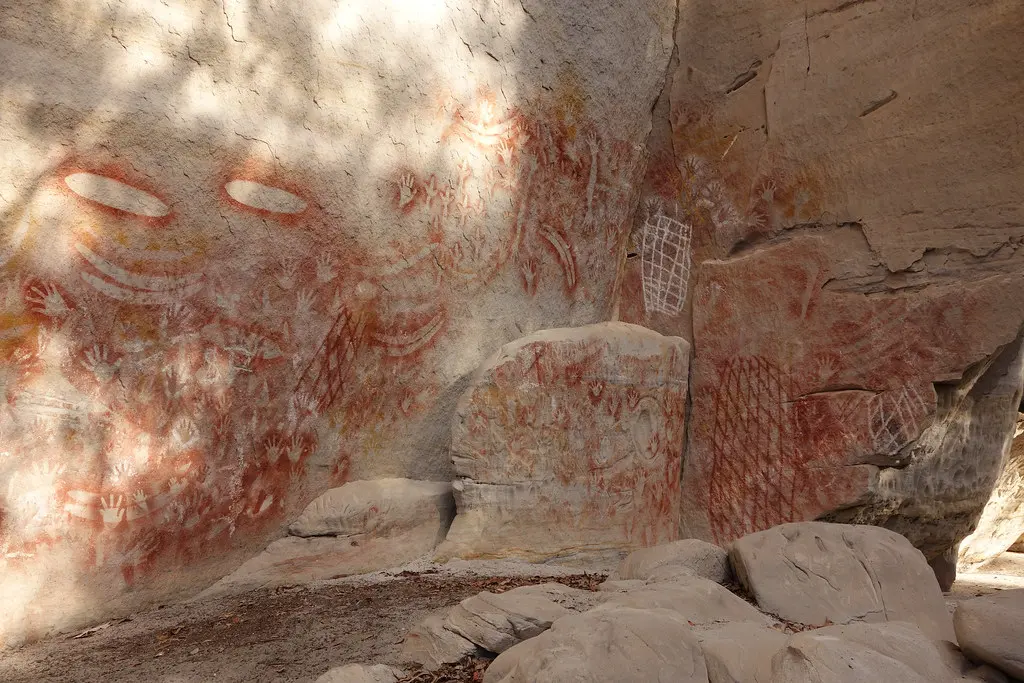
Split Rock is a sandstone outcrop in Cape York Peninsula's Quinkan Country, reached by a short trail from the Peninsula Development Road south of Laura, Queensland. Its shelters hold painted and engraved figures, including Quinkan spirit beings understood in Aboriginal Dreaming tradition as ancestral figures connected with law, teaching, and children's safekeeping. Sources describe the art as being of great antiquity without assigning a settled age.
The site is open for a small self-guided fee, but the wider Quinkan Reserves and their galleries remain closed to the public, held by Aboriginal Trustees and accessible only through guides arranged with the Ang-Gnarra Aboriginal Corporation. The corporation also runs Laura's Quinkan and Regional Cultural Centre and the biennial Laura Quinkan Indigenous Dance Festival. Heritage-listed rock art therefore remains within living custodianship carried by Kuku-Thaypan, Kuku-Yalanji, Gugu-Yimithirr, and other Laura-region peoples.
Why this place is sacred
The Aboriginal Dreaming framework that gives Split Rock its significance does not map onto the Celtic or Christian idea of a thin place, where a veil between worlds grows porous in a particular location.
Here the rock art is not a doorway to somewhere else; it is itself the record — ancestral spirit beings pressed into the sandstone, law and teaching made visible on a surface that has held them for an unresolved span of time that heritage documentation describes only as great antiquity, declining to attach a precise figure where the evidence does not support one.
What makes Split Rock significant to seekers from outside this tradition, then, is not a felt threshold but a different kind of proximity: standing before a surface where instruction to children, moral order, and the presence of spirit beings were never separated into different categories of knowledge.
The site asks a visitor to set aside the thin-place vocabulary altogether and meet the place on its own terms — as part of a living legal and cultural order encoded directly into the landscape, still read by the people whose country this is.
The shelters at Split Rock were painted and engraved by generations of Aboriginal artists from the traditional owner groups of the Laura region, encoding Dreaming narratives and behavioral law — including instruction bound up with the protection of children — directly into the rock face.
From the late 1960s, the site drew wider public and scholarly attention through the documentation work of Percy Trezise, and it was formally inscribed on the Australian National Heritage List on 10 November 2018 as part of Quinkan Country. Throughout this outward attention, the site has remained under active traditional-owner custodianship, with knowledge of the art and its stories transmitted between generations rather than frozen at the point of academic discovery.
Experience and orientation
The approach to Split Rock begins from a car park off the Peninsula Development Road, a short drive south of Laura through flat, dry-season country that gives little warning of the outcrop ahead. The trail climbs gently through open woodland before the sandstone begins to rise on either side, and the first galleries appear in shallow overhangs where the rock has weathered into shelter.
Painted figures sit close enough to study without strain — Quinkan spirit beings rendered in ochre alongside other images built up over long use of the same rock faces.
The walk continues past further shelters toward higher ground, where the trail opens onto views across the surrounding escarpment and scrub, the kind of exposed vantage that makes the scale of Cape York's sandstone country legible all at once. Visitors moving at an ordinary pace complete the loop in one to two hours, with time to linger at each shelter rather than pass through quickly.
Nothing about the walk requires special equipment or permission — it is a self-guided route, kept open in a landscape whose adjacent galleries are not.
Move slowly through the shelters and let your eyes settle before trying to read a whole panel at once; the figures reward the same patience given to a Renaissance fresco. Carry water and expect heat and glare in the open sections between galleries.
Context and lineage
Quinkan spirit beings belong to the Dreaming of the Aboriginal peoples of the Laura region — ancestral figures understood to have shaped aspects of the landscape and to carry lessons about behavior, particularly the safekeeping of children. Sources document two distinct categories: Timara, described as tall, thin, benevolent trickster figures who protect children, and Imjim, associated with the real danger of straying from safety at night and said to take children who wander from it.
Together they form a coherent moral and legal framework rather than a single undifferentiated category of 'spirit,' each figure carrying its own name, form, and teaching function within Aboriginal cosmology.
Custodianship runs through the traditional owner language groups of the Laura region — including Kuku-Thaypan, Kuku-Yalanji, and Gugu-Yimithirr peoples associated with Quinkan Country — continuing today through the Ang-Gnarra Aboriginal Corporation, which holds trusteeship over Ang Gnarra lands and operates the Quinkan and Regional Cultural Centre in Laura.
Timara
Protective trickster spirit beings of the Dreaming
Tall, thin figures documented as benevolent tricksters who watch over and protect children, one of two distinct categories of Quinkan spirit being depicted in the region's rock art.
Imjim
Cautionary spirit beings of the Dreaming
Figures associated with the danger of wandering from safety at night, understood as encoding a lesson about real hazards to children rather than functioning as horror-genre monsters — a distinction traditional-owner-affiliated and heritage sources are explicit about.
George Musgrave
Traditional owner and elder
A traditional owner who, alongside Tommy George, dedicated his life to protecting the Quinkan galleries and passing their stories to younger generations.
Tommy George
Traditional owner and elder
A traditional owner recognized, with George Musgrave, for sustained work teaching and protecting the cultural knowledge held in Quinkan Country's rock art.
Percy Trezise
Documentarian and advocate
A pilot and artist whose documentation of the Laura galleries from the late 1960s, partly in collaboration with Aboriginal artist Dick Roughsey, brought the region to broader public and academic attention.
Traditions and practice
Specific ceremonial practices historically tied to Split Rock itself are not documented in available sources, consistent with the likelihood that such knowledge remains appropriately held within the community rather than published. What is documented is the broader, sustained pattern of elders teaching younger traditional owners the stories and responsibilities attached to the art — a form of transmission that George Musgrave and Tommy George carried forward for much of their lives.
The Ang-Gnarra Aboriginal Corporation hosts the biennial Laura Quinkan Indigenous Dance Festival, described in Queensland Government statements as a celebration of the world's oldest living culture, with government backing supporting recent editions since 2021. This is a public, current expression of connection to Quinkan Country, though it is held in Laura township rather than at Split Rock specifically.
A visitor without ceremonial standing engages appropriately by walking the self-guided loop attentively, pausing at each shelter rather than moving through quickly, and — where a deeper visit is wanted — booking guided interpretation through the Quinkan and Regional Cultural Centre, which can speak to context a self-guided walk cannot supply.
Aboriginal traditional owner custodianship (Laura region language groups, including Kuku-Thaypan, Kuku-Yalanji, Gugu-Yimithirr, and other groups associated with Quinkan Country)
ActiveSplit Rock and the wider Quinkan Country hold Dreaming significance as sites where ancestral spirit beings are depicted and where traditional law, teaching, and behavioral guidance — particularly concerning children — is encoded directly in the rock art. Elders including George Musgrave and Tommy George dedicated their lives to protecting the art and passing its knowledge to younger generations.
Cultural transmission between generations of traditional owners; joint management and interpretation through the Ang-Gnarra Aboriginal Corporation-run Quinkan and Regional Cultural Centre; the biennial Laura Quinkan Indigenous Dance Festival as a living expression of connection to Country.
Archaeological and heritage-management scholarship
ActiveThe Laura rock art galleries, including Split Rock, are recognized as a globally significant body of Aboriginal rock art, inscribed on the Australian National Heritage List in 2018 under the name Quinkan Country.
Ongoing conservation partnership between traditional owners and heritage authorities; documentation stretching back to Percy Trezise's work from the late 1960s.
Perspectives and open questions
Split Rock's Quinkan figures have been described in sharply different registers, and the gap between them matters. Tourism and pop-mythology sources — the kind of 'world bestiary' or 'legend encyclopedia' sites that catalogue folklore for entertainment — have rendered Imjim in particular as an 'evil spirit' or 'cave demon,' language borrowed from horror-genre convention rather than drawn from the tradition itself.
Heritage authorities and traditional-owner-affiliated sources describe something considerably more coherent: Timara and Imjim as complementary figures within a moral and legal framework, one protective, one cautionary, both teaching tools bound up with the safekeeping of children rather than freestanding monsters. This entry follows the latter framing and treats the horror-genre version as a documented distortion worth naming rather than repeating.
Scholarly perspective
Archaeological and heritage-management scholarship, including peer-reviewed work on forty years of cultural heritage management in the Quinkan region, treats the Laura galleries as a globally significant body of Aboriginal rock art requiring sustained conservation partnership between traditional owners and heritage authorities.
Percy Trezise's documentation from the late 1960s, published as Quinkan Country and Rock Art of South-East Cape York, brought the region to wider scholarly attention, in places working alongside Aboriginal collaborators such as artist Dick Roughsey — though a direct primary source from researcher Andrée Rosenfeld, often referenced in overviews of the region's academic study, was not retrieved in this research pass.
Living and traditional perspectives
Sources affiliated with traditional owners — the Ang-Gnarra Aboriginal Corporation-run Quinkan and Regional Cultural Centre, and the record of elders George Musgrave and Tommy George's teaching — frame Quinkan spirit figures as part of the Dreaming: ancestral beings integral to law and to instruction about behavior and safety, particularly concerning children. This framing is actively maintained, not archived, carried forward through generational teaching and through public institutions including the Cultural Centre and the Laura Quinkan Dance Festival.
Alternative interpretations
General-audience mythology and pop-culture sources have at times reframed Imjim and other Quinkan figures using horror-genre vocabulary — 'evil spirits,' 'demons,' figures said to eat children — treating the tradition more like cryptid cataloguing than respectful engagement with a living cosmology.
This is a documented mischaracterization, not a legitimate alternative reading: heritage-body and traditional-owner-affiliated sources are consistent in presenting Timara and Imjim as complementary teaching figures within a coherent framework, and this distortion is named here precisely so it is not repeated.
Open questions
The precise age of Split Rock's earliest paintings is not firmly established; some tourism sources cite figures as high as 25,000 years without a clearly identified dating study behind them, while official heritage documentation is more conservative, describing the art only as being of great antiquity.
Exact language-group attribution specific to Split Rock, as distinct from Quinkan Country broadly, and the question of whether any restricted or gender-specific imagery exists at Split Rock itself (as opposed to the closed wider Reserves) remain unconfirmed in the sources reviewed and would need direct consultation with Ang-Gnarra Aboriginal Corporation before further claims are made.
Plan your visit
Access and arrival
By vehicle via the Peninsula Development Road, approximately 12-15 km south of Laura, Queensland, in Cape York Peninsula, Far North Queensland — roughly a 3.5-hour drive from Cairns. No permit is required for the self-guided visit at Split Rock, though a small entry fee applies. Mobile phone signal in this part of Cape York Peninsula should not be assumed reliable; travelers should plan for limited connectivity and treat Laura township as the nearest point of reliable services.
Access to further Quinkan Country galleries requires arranging a guided tour through Ang-Gnarra Aboriginal Corporation in advance.
No specific accommodation information was available at time of writing; check with the Quinkan and Regional Cultural Centre in Laura or Cooktown and Cape York regional tourism resources for current options, as Laura functions as the practical base for visiting Split Rock.
Respectful visit
No specific dress code is documented for Split Rock; practical wear suited to a warm-climate walk over uneven sandstone terrain, with sun protection, is appropriate.
No blanket photography restriction is documented at Split Rock itself, though visitors should follow any on-site signage and, on guided tours elsewhere in Quinkan Country, defer entirely to guide instructions — restrictions can apply to specific galleries even where none is posted at Split Rock.
No visitor offering practices are documented for this site.
Visitors are explicitly asked not to touch the rock art. Access at Split Rock is self-guided, but the broader Quinkan Reserves are closed to the public and held by Aboriginal Trustees; anyone wishing to see galleries beyond Split Rock should arrange guided access through Ang-Gnarra Aboriginal Corporation or the Quinkan and Regional Cultural Centre rather than seek independent entry.
The wider Quinkan Reserves beyond Split Rock are closed to public access and held by Aboriginal Trustees; visitors should not attempt to seek out additional galleries independently, and any interest in seeing more of Quinkan Country should be directed to Ang-Gnarra Aboriginal Corporation's guided tours rather than informal exploration.
Location
Map loads as you approach this section.
Pilgrim reflections
A portrait of encounter, not a score
Pilgrims describe what they felt, how present they could become, and whether the place would shape a journey. There are no stars and no ranking of traditions.
No reviewed reflections yet
The first pilgrims can help describe the character of being here.
Share a reflection
Available after an account-backed “Been there.” Every reflection is reviewed before publication.
Nearby sacred places
Explore other sacred places in the region. Proximity does not establish access or travel time; check each place’s guidance.



References
Sources consulted for this page. Source categories describe the publication, not a guarantee that every claim is verified. Traditional accounts and outside interpretations may differ.
- 01Quinkan Country — National Heritage Places — Department of Climate Change, Energy, the Environment and Water (Australian Government)officialOfficial Australian Government heritage listing for Quinkan Country, inscribed on the National Heritage List 10 November 2018. Could not fully render content (fetch timeout) but confirmed via search snippet as authoritative status source.
- 02Ang-Gnarra Aboriginal Corporation — Laura Facilities — Ang-Gnarra Aboriginal CorporationofficialAng-Gnarra Aboriginal Corporation is the trustee body for Ang Gnarra traditional lands in Quinkan Country and operates the Quinkan and Regional Cultural Centre in Laura. Direct page fetch returned 404 at time of research; existence and role confirmed via search result summaries and corroborating sources (Cooktown and Cape York tourism authority, ACNC charity register).
- 03Ang-Gnarra Aboriginal Corporation of Laura — Charity Profile — Australian Charities and Not-for-profits Commission (ACNC)officialAustralian government charity register confirming Ang-Gnarra Aboriginal Corporation's registered status and role in Laura.
- 04Qld Government backs Laura Quinkan Dance Festival — Queensland Government Ministerial Media StatementsofficialConfirms the biennial Laura Quinkan Indigenous Dance Festival, hosted in partnership with/by Ang-Gnarra Aboriginal Corporation since 2021, as an active living-culture event connected to Quinkan Country.
- 05ENDANGERED ROCK ART: Forty years of cultural heritage management in the Quinkan region, Cape York Peninsula — ResearchGate (peer-reviewed publication)academicAcademic publication on the history of cultural heritage management in the Quinkan region; title and abstract confirm decades of conservation work distinct from tourism narratives. Full text not fetched in this research pass; flagged for deeper follow-up if content is expanded.
- 06Quinkan rock art — Wikipedia contributorsacademicGeneral overview of Quinkan Country, Split Rock access, traditional owner figures George Musgrave and Tommy George, Percy Trezise bibliography, and 2018 Australian National Heritage listing. Treated as academic-adjacent encyclopedic tertiary source per mapping convention; cross-checked against official heritage source.
- 07Quinkan Cultural Centre, Laura — Explore Cooktown and Cape York (regional tourism authority)Source contextRegional tourism-authority description confirming the Quinkan and Regional Cultural Centre is operated by Ang-Gnarra Aboriginal Corporation and serves as the gateway/booking point for guided tours to the rock art galleries.
- 08Does Anyone Remember the Quinkins? — Meanjin (literary quarterly)Source contextLiterary essay describing Percy Trezise's collaboration with Aboriginal artist Dick Roughsey on children's books featuring Imjim (child-stealing spirits) and Timara (trickster spirits who protect children). Useful for tracing the popularization of Quinkan figures in settler-Australian culture but does not represent a traditional-owner primary source; does not address tourism sensationalization directly.
- 09Split Rock Trail, Queensland, Australia — AllTrailsSource contextCrowd-sourced trail information confirming Split Rock's location ~12-15 km south of Laura on the Peninsula Development Road, self-guided access, and a short (approx. 2.8 mile) loop walk. Used only for practical access details, not cultural interpretation.
- 10Split Rock QLD (1.1 km) — Australian HikerSource contextCorroborates self-guided access, request not to touch the art, and general visitor etiquette expectations. Cross-referenced against AllTrails for consistency on distance/access.
Share a photo
Help visitors recognize Quinkan Split Rock Art Site. Every submission is reviewed before publication.