Mossman Gorge
Rainforest gorge and living Kuku Yalanji Country in the Daintree
Understand sacred places, explore living traditions, and learn how to engage respectfully with Pilgrim Map.
Access has not been verified. Check current local guidance before planning a visit.
Mossman, Queensland, Queensland, Australia
Read the sources
Visit essentials
A quick read before you go
- Duration
- The public boardwalk and suspension-bridge loop is roughly 2.4 km and takes 60-90 minutes at a…
- Access
- Mossman Gorge is in the Shire of Douglas, about 78.8 km northwest of Cairns and a short drive…
Overview
Roughly 80 kilometres northwest of Cairns, Mossman Gorge lies where the Mossman River leaves the Daintree rainforest and crosses granite boulders smoothed by monsoon floods. To the Eastern Kuku Yalanji, whose Country this is and has been for tens of thousands of years, the place is Jinkalmu: not separate from ordinary land, but part of a working Country whose rivers, mountains, and rainforest canopy are animated by ancestral creation beings.
Manjal Dimbi (Mount Demi), a great rock face visible from the valley, is one such presence—a protector who, in Kuku Yalanji telling, still holds back a malign force confined to a neighbouring ridge. This relationship between story and land is not reconstructed history; Kuku Yalanji people narrate it in the present on the ground described.
Since 1986, the Traditional Owner-run Mossman Gorge Cultural Centre has offered guided Ngadiku Dreamtime Walks into the rainforest. This makes the Gorge one of relatively few sacred sites in this collection where a visitor's primary way in is being hosted, walked, and taught by the people whose ancestors the place remembers. The Gorge also carries the 1870s gold rush, frontier violence, and a twentieth-century mission and reserve period alongside—not opposed to—its visible living culture.
Why this place is sacred
For the Eastern Kuku Yalanji, Mossman Gorge is not a discrete holy site carved out from an otherwise ordinary landscape — the whole of Country carries this quality, and the Gorge is one especially vivid expression of it. The granite gorge, the rainforest canopy, and the river are read as inseparable from the presence and action of ancestral beings from the Dreaming, so that the physical terrain functions simultaneously as home, law, and living memory.
The mountain visible from the Gorge, Manjal Dimbi, is not a symbol of a story; in Kuku Yalanji understanding it is a protective ancestral figure who took that form and, in doing so, continues an act of protection into the present tense.
What gives the place its particular charge for a visitor is the layering of very long time depth — occupation going back tens of thousands of years, among the rainforest-adapted Aboriginal groups, a relatively unusual ecological adaptation — against the immediacy of the people who still live this relationship and choose, on their own terms, to share parts of it with outsiders.
A thin place is often described as one where the distance between what is seen and what is meant collapses; here that collapse happens specifically because the storyteller and the story's subject are the same community, standing in the place the story is set.
Jinkalmu functioned, and functions, as an integral part of Eastern Kuku Yalanji Country — a place of daily life, food and medicine gathering, story, and law rather than a site built or set aside for a single ceremonial purpose distinct from ordinary living.
Colonial contact from the 1870s Palmer River gold rush onward brought Native Police violence, documented forced removals, and, from 1916, an Aboriginal reserve followed by decades of Pentecostal mission control that suppressed open cultural practice.
From this disruption, Kuku Yalanji elder Uncle Roy Gibson began leading Dreamtime Walks in 1986, a initiative that has grown into the Traditional Owner-run Cultural Centre operating today, alongside the 2007 native title determination and 2021 handback of surrounding Daintree lands to the Jabalbina Yalanji Aboriginal Corporation.
Experience and orientation
The visit begins, for almost everyone, at the Mossman Gorge Cultural Centre, where private vehicles stop and a shuttle bus carries people the rest of the way into the Gorge itself — a system built to keep vehicle traffic out of World Heritage rainforest. From there, two experiences run in parallel.
Independent visitors follow a 2.4-kilometre boardwalk and suspension-bridge loop past cascades and swimming holes where the Mossman River runs cool and startlingly clear over pale granite, the rainforest canopy closing overhead and cutting the light to a green dimness that visitors consistently describe as immediately calming after the heat of the car park. The other path into the Gorge is the Ngadiku Dreamtime Walk, and it is here that the site's real distinctiveness in this region shows itself.
A Kuku Yalanji guide — a Traditional Owner of this exact Country, not an interpreter of someone else's culture — leads a small group along private rainforest tracks past traditional bark shelters, pointing out bush medicine plants and bush tucker along the way, timing the walk to stop where a story belongs rather than where a map suggests.
At some point in most walks, a guide gestures toward the ridgeline and tells some version of the Manjal Dimbi story: how the ancestral figure Kubirri took the form of that mountain to hold back the malign spirit Wurrumbu, who remains confined to a nearby outcrop called The Bluff. Guides choose, deliberately, what is shared and what is not — a boundary that is itself part of the practice, not an absence of one.
The Centre has taken more than 345,000 people on this walk over roughly a decade, and the pattern visitors report is consistent: a shift from sightseeing a rainforest to being taught, in person, by the people whose ancestors the rainforest's stories are about. That distinction — hosted cultural transmission rather than self-guided encounter — is closer to attending a living tradition's own telling of itself than to visiting a ruin or a shrine.
Start at the Cultural Centre, which is free to enter; decide there whether to take the shuttle to the boardwalk loop independently or book the guided Ngadiku Dreamtime Walk, which departs from the same point and is the recommended way to encounter the site's Kuku Yalanji dimension directly rather than as backdrop.
Context and lineage
The Manjal Dimbi Dreaming narrative recounts how the ancestral figure Kubirri came to the aid of the Kuku Yalanji people when they were being persecuted by an evil spirit, Wurrumbu. Kubirri became the great humanoid rock formation now known as Manjal Dimbi (Mount Demi), and in that form continues to hold back Wurrumbu's malign influence, which remains confined to a nearby ridge, The Bluff (Wurrmbu).
Colonial-era history, documented separately by Queensland Government sources, records the 1870s Palmer River gold rush, Native Police violence against Kuku Yalanji people, at least 113 documented forced removals, the 1916 gazettal of an Aboriginal reserve at Mossman Gorge, and a Pentecostal mission that controlled the community from the 1930s into the mid-twentieth century — a history that runs alongside, rather than contradicting, the community's own pride in what has been rebuilt since.
Kuku Yalanji cultural authority over Mossman Gorge and the surrounding Daintree is exercised today through the Jabalbina Yalanji Aboriginal Corporation, the Registered Native Title Body Corporate recognised by the Federal Court's native title determination of 9 December 2007 over 30,300 hectares, and holder since September 2021 of freehold title to 160,213 hectares including Daintree, Ngalba Bulal, Black Mountain, and Hope Islands National Parks.
Uncle Roy Gibson
Kuku Yalanji elder and founder
Began leading Dreamtime Walks at Mossman Gorge in 1986, the initiative that grew into today's Traditional Owner-run Cultural Centre and its Ngadiku Dreamtime Walk program.
Kubirri
Ancestral protector figure
In the Manjal Dimbi narrative, took the form of the mountain to shield the Kuku Yalanji people from the malign spirit Wurrumbu, an act of protection understood as ongoing.
Traditions and practice
Ceremonial detail from before and during the disruption of the reserve and mission era is not published, in keeping with cultural protocols that reserve some knowledge for community members.
What is documented is a pattern of daily and seasonal practice woven into rainforest life: gathering and preparing bush foods and medicines, maintaining camps at named sites within the Gorge such as Jinkalmu, Brie-Brie, and the Junction on the Mossman River, and the oral transmission of Dreaming narratives from elders to younger generations as the primary way traditional law and history are kept.
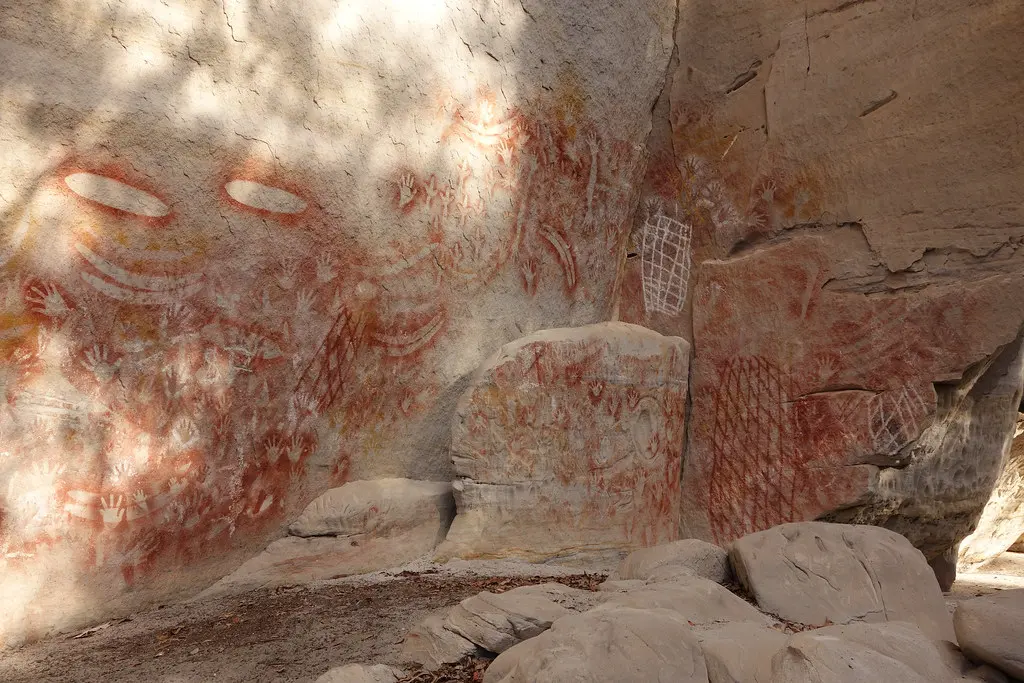
The living centre of Kuku Yalanji practice today is the Ngadiku Dreamtime Walk itself, run continuously by the Cultural Centre since Uncle Roy Gibson began it in 1986. On the walk, a Kuku Yalanji guide takes visitors along private rainforest tracks past traditional bark shelters, demonstrating bush medicine and bush tucker knowledge and sharing selected stories — the Manjal Dimbi narrative among them — as living instruction rather than museum display. Rock painting demonstrations run alongside the walks.
This sits within the wider, ongoing practice of joint managing Daintree National Park (CYPAL) under an Indigenous Management Agreement between the Jabalbina Yalanji Aboriginal Corporation and Queensland Parks and Wildlife Service, through which Traditional Owners exercise continuing custodial authority over the land the stories describe, not simply narrative rights over it.
The Centre itself has been recognised with the Qantas Award for Aboriginal & Torres Strait Islander Tourism (Gold, 2014, 2016, 2018), and functions as a working model of Indigenous-led employment and cultural transmission for Kuku Yalanji youth, not a heritage re-enactment.
Book the Ngadiku Dreamtime Walk in advance rather than treating it as an optional add-on to the boardwalk loop — it is the closest a visitor can come to encountering the site's living tradition directly. During the walk, let the guide set the pace and the content: ask questions, but follow their lead on what is shared rather than pressing for more than is offered.
Eastern Kuku Yalanji (Bama) traditional culture and Dreaming
ActiveThe Eastern Kuku Yalanji are the recognised Traditional Owners of Mossman Gorge and the wider Daintree region, holding native title since 2007 and freehold title to 160,213 hectares of surrounding country since September 2021. Mossman Gorge and landscape features such as Manjal Dimbi (Mount Demi) carry Dreaming significance tied to creation ancestors, continuing to be held and taught by the community today.
Guided Ngadiku Dreamtime Walks led by Kuku Yalanji guides; sharing of bush medicine and bush tucker knowledge; rock painting demonstrations; joint management of Daintree National Park; intergenerational oral transmission of Dreaming stories from elders to younger community members.
Perspectives and open questions
Mossman Gorge is read consistently, across scholarly, official, and Indigenous-media sources, as both a site of very long Aboriginal occupation and a place whose modern life has been shaped by frontier violence and mission control — accounts that sit alongside rather than against the Cultural Centre's own story of living cultural continuity.
Scholarly perspective
Archaeological and historical scholarship documents Aboriginal occupation of the Wet Tropics, including the Mossman area, extending back tens of thousands of years, with the Kuku Yalanji among the relatively few Aboriginal groups specifically adapted to rainforest ecology. Queensland Government sources treat the colonial-era record — the 1870s Palmer River gold rush, Native Police violence, and twentieth-century removals under state protection legislation — as established historical fact.
Living and traditional perspectives
The Eastern Kuku Yalanji understand Mossman Gorge and its surrounding landscape, including Manjal Dimbi, as animated by ancestral presence from the Dreaming, with the landscape itself functioning as record and teacher of law and history. Through the Jabalbina Yalanji Aboriginal Corporation and the Mossman Gorge Cultural Centre, the community actively asserts continuing custodianship, native title, and authority over how their culture and Country are represented to outsiders.
Open questions
The fuller content of pre-contact ceremonial practice and the complete range of Dreaming narratives beyond what is selectively shared on public tours is not published, in keeping with cultural protocols that reserve some knowledge for community members rather than public disclosure.
Plan your visit
Access and arrival
Mossman Gorge is in the Shire of Douglas, about 78.8 km northwest of Cairns and a short drive from Mossman or Port Douglas via the Captain Cook Highway. Visitors park at the Mossman Gorge Cultural Centre, which is free to enter, and take a shuttle bus (fee applies) into the Gorge, as private vehicles are not permitted beyond the Centre; walking or cycling in independently is also possible at no charge.
The Ngadiku Dreamtime Walk is bookable through the Cultural Centre, run by Kuku Yalanji guides as the Centre's flagship guided experience; check the Centre's site for current tour times and prices before visiting.
Respectful visit
No specific dress code is published. Closed shoes and clothing suited to warm, humid, occasionally wet rainforest conditions are appropriate given the terrain.
No blanket photography restriction applies to the public boardwalk tracks. On the Ngadiku Dreamtime Walk, follow the guide's instructions on when photography is and is not appropriate — guides may ask that specific cultural content not be photographed, at their discretion.
No offering practices are documented or expected of visitors.
Private vehicles are not permitted past the Cultural Centre car park; entry to the Gorge is by shuttle bus, or on foot or bicycle for those who forgo it. Visitors are asked to remain on boardwalks and marked tracks, not disturb wildlife including cassowaries, and remove all rubbish.
Swimming in the Mossman River is strongly discouraged — this is a safety warning, as fatalities have occurred, rather than a cultural restriction, and no source identifies any part of the publicly accessible track network as culturally off-limits.
Detailed pre-contact ceremonial content and the fuller content of Dreaming narratives are deliberately not published; visitors should not expect or request access to knowledge guides choose not to share, and should understand story-boundaries as part of respectful practice rather than an incomplete account.
Location
Map loads as you approach this section.
Pilgrim reflections
A portrait of encounter, not a score
Pilgrims describe what they felt, how present they could become, and whether the place would shape a journey. There are no stars and no ranking of traditions.
No reviewed reflections yet
The first pilgrims can help describe the character of being here.
Share a reflection
Available after an account-backed “Been there.” Every reflection is reviewed before publication.
Nearby sacred places
Explore other sacred places in the region. Proximity does not establish access or travel time; check each place’s guidance.



References
Sources consulted for this page. Source categories describe the publication, not a guarantee that every claim is verified. Traditional accounts and outside interpretations may differ.
- 01Kuku Yalanji People — Mossman Gorge Cultural CentreofficialKuku Yalanji-run cultural centre's own account of their people, territory, and connection to the Gorge; primary community-facing source.
- 02Our Story — Mossman Gorge Cultural CentreofficialHistory of the Cultural Centre's founding by Uncle Roy Gibson in 1986 and its growth into an award-winning Indigenous tourism enterprise.
- 03About | Daintree National Park (CYPAL) — Queensland Department of the Environment, Tourism, Science and InnovationofficialOfficial joint-management authority confirming Jabalbina Yalanji Aboriginal Corporation + QPWS co-management under Indigenous Management Agreement; CYPAL (Cape York Peninsula Aboriginal Land) status.
- 04Mossman Gorge (Community Histories) — Queensland Government, First NationsofficialOfficial state government historical record documenting frontier violence, forced removals (113 documented cases), 1916 reserve gazettal, and mission period (1916-1960s+). Most detailed dispossession-era source found.
- 05ATTN: Eastern Kuku Yalanji Traditional Owners — North Queensland Land CouncilofficialConfirms Federal Court native title determination (9 December 2007) over 30,300 hectares and Jabalbina Yalanji Aboriginal Corporation as the Registered Native Title Body Corporate.
- 06Daintree Rainforest handed back to its Traditional Owners, the Eastern Kuku Yalanji people — Yarn (Aboriginal and Torres Strait Islander media)Source contextIndigenous-affairs media source confirming September 2021 transfer of 160,213 hectares (including Daintree, Ngalba Bulal, Black Mountain, Hope Islands National Parks) to Jabalbina Yalanji Aboriginal Corporation.
- 07Ancient legacy continues as tourism mixes with culture — National Indigenous TimesSource contextNational Indigenous Times coverage of the Cultural Centre's contemporary tourism/culture model; Indigenous-owned media source.
- 08Mossman Gorge, Queensland — Wikipedia contributorsacademicCorroborates locality data, local name 'Jinkalmu', 1916 reserve, mission history, and Daintree National Park context.
- 09Kuku Yalanji — Wikipedia contributorsacademicBackground on Kuku Yalanji language group, territory, and history including Palmer River gold rush resistance.
- 10Frequently Asked Questions — Mossman Gorge Cultural CentreofficialPractical visitor information: shuttle-only access beyond car park, wildlife safety, swimming danger warnings.
- 11Kuku Yalanji Country — Daintree Coast (regional tourism/cultural information site referencing Traditional Owner place names)Source contextSource for named sacred landscape features (Wundu/Thornton Peak, Manjal Dimbi/Mount Demi, Wurrmbu/The Bluff, Kulki/Cape Tribulation) and the Manjal Dimbi Dreaming narrative involving Kubirri and Wurrumbu.
Share a photo
Help visitors recognize Mossman Gorge. Every submission is reviewed before publication.