Mt. Dicti
Where Zeus entered the world, hidden in a mountain older than the gods themselves
Understand sacred places, explore living traditions, and learn how to engage respectfully with Pilgrim Map.
Access has not been verified. Check current local guidance before planning a visit.
Psichro, Crete, Greece
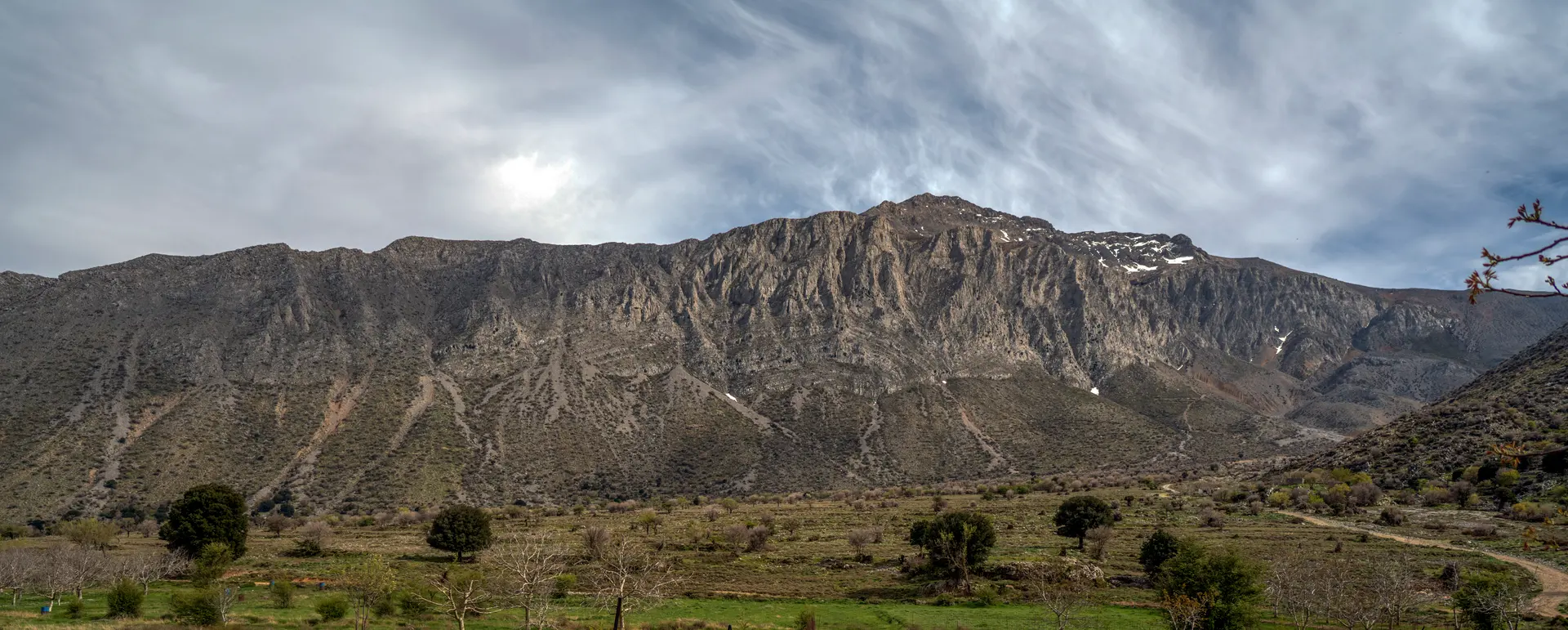
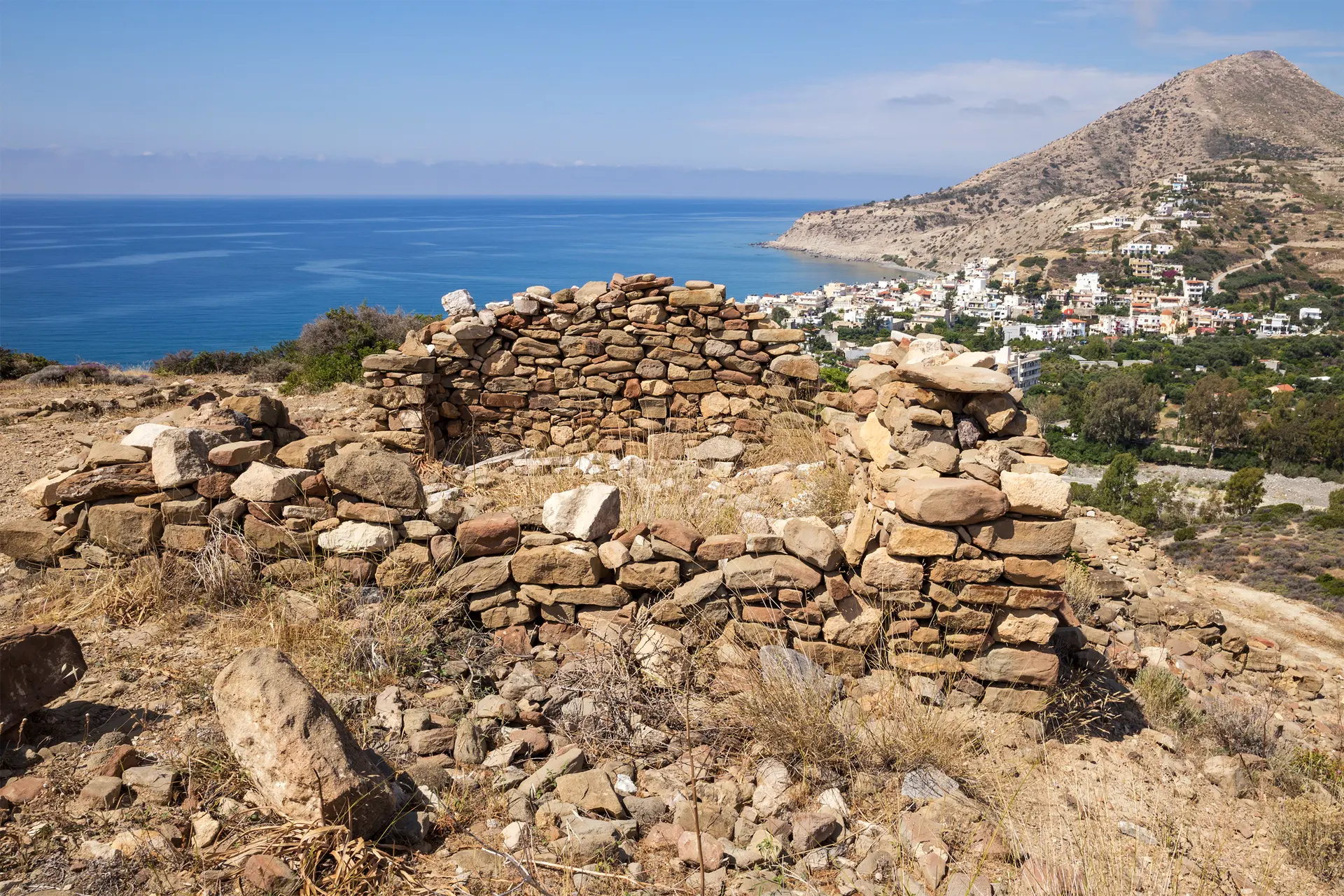
Image of Mt. Dicti. Image source · CC-BY-SA-3.0
Visit essentials
A quick read before you go
- Duration
- Lassithi Plateau to Spathi summit and return: 8 to 9 hours starting from Agios Georgios village.
- Access
- The Lassithi Plateau is reached by road from Heraklion (70 kilometers east, approximately 90…
Overview
Mount Dikti's limestone peaks above eastern Crete have accumulated human meaning for roughly eight thousand years, since Neolithic settlers recognized that its vast enclosed plateau could sustain life. Minoans built peak sanctuaries and left cave offerings. Later Greeks placed Zeus's birth from concealment by his child-devouring father Cronus within the contested claims of Dikti and Mount Ida. Above two thousand meters, only wind, rock, sky, and silence remain—a landscape from which immense origins can feel intelligible.
Before Zeus and beside his mythology, Dikti belonged to Britomartis, goddess of hunting and wild places, called Diktynna by Cretans and shown on coins atop a mountain grasping animals. Scholars disagree whether the goddess named the mountain or the reverse, revealing how inseparable they became.
The Natura 2000 range protects bearded vultures, endemic wildflowers, and the healing herb dictamo named for these slopes. Lassithi Plateau remains cultivated after millennia, though most of its ten thousand white-sailed irrigation windmills are silent. Hikers now follow the E4 European Long Distance Path, while a small Orthodox chapel on Afendis Christos continues consecration of the heights.
Places within this site
Why this place is sacred
Dikti's sacred accumulation spans at least eight thousand years of Neolithic farmers, Minoan priests, Greek pilgrims, Roman votaries, Byzantine Christians, and modern hikers making offerings, paying attention, or climbing.
The 840-meter Lassithi Plateau forms a fertile natural amphitheater enclosed by rugged peaks, cultivated continuously for millennia and seeming intentionally designed though its intent is geological. Above it, the smaller, higher Limnakaro Plateau shifts from settlement toward seasonal grazing; beyond, only rock, sky, and wind remain. From the myth-set summit zone above two thousand meters, Crete lies below and sea appears in every direction.
Its silence and exposure make divine origin intelligible without claiming the mountain proves a god was born there.
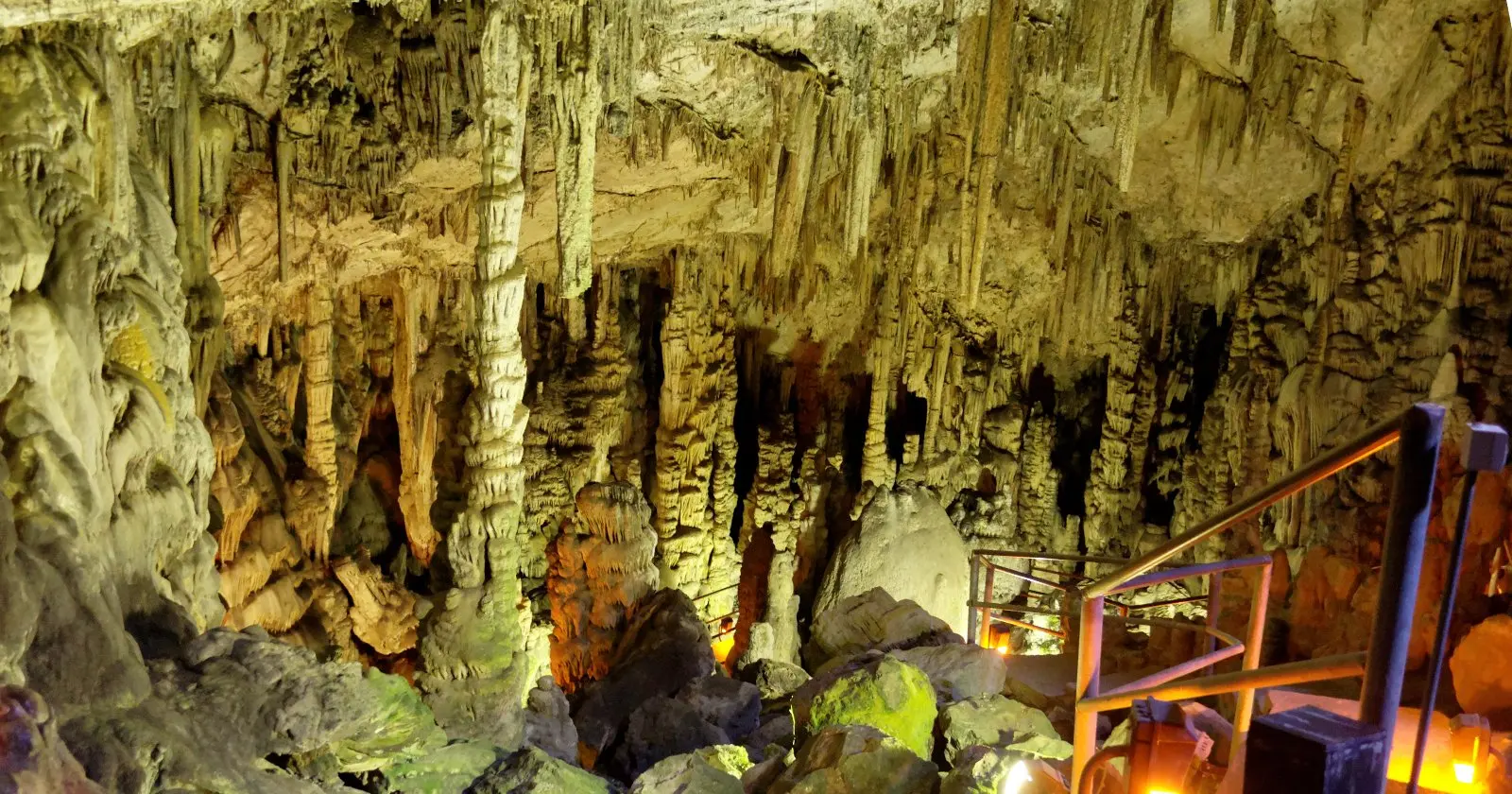
On Dikti's northern slopes, the Diktaion Andron cave received offerings from the late Neolithic through the Roman period—roughly four thousand years of sacred attention in one location, an uncommon continuity whose presence saturates the mountain.
The Dikti range served as a sacred landscape for Minoan religion, hosting peak sanctuaries on its prominent summits and cave cults within its many caverns. The Diktaion Andron functioned as one of the most important religious sites in all of Crete, receiving continuous offerings from at least the late Neolithic through the Roman period. The mountain was also the dwelling place of Britomartis/Diktynna, a pre-Olympian goddess of mountains, hunting, and wild nature.
In the Greek period, the mountain's primary sacred function was as the setting for the Zeus birth narrative, making it the origin point of the supreme deity and thus a site of cosmic significance.
The mountain's sacred status has transformed repeatedly across millennia without ever fully breaking. Minoan peak sanctuary worship gave way to Greek cave cult practices centered on Zeus. The Zeus cult flourished through the Roman period before fading with Christianization. Orthodox Christianity reclaimed the heights by building the summit chapel of Afendis Christos on the second-highest peak, continuing the ancient pattern of consecrating the boundary between earth and sky.
The Venetian era brought upheaval to the plateau below, with authorities banning habitation in 1293 and calling the Lassithi Plateau the 'thorn in the heart' of Venice before permitting resettlement in the 15th century. In 1890, Emmanouil Papadakis devised the wind-pump irrigation system that would produce over ten thousand windmills, transforming the plateau's landscape. The Natura 2000 designation in the modern era introduced ecological conservation as a new form of sacred regard.
Today, the mountain's primary visitors are hikers whose ascent, whether framed as spiritual practice or physical challenge, retraces the ancient pattern of pilgrimage upward.
Experience and orientation
The encounter with Dikti begins not on the mountain but within it, on the Lassithi Plateau. Arriving by road from Heraklion or Agios Nikolaos, you climb through olive groves and hairpin turns until the road crests a pass and the plateau opens below: a vast, improbably flat expanse at 840 meters, ringed by peaks, cultivated in orchards and fields. The remnants of thousands of white-sailed windmills dot the landscape, most now still. A few restored ones turn slowly.
The effect is of entering an enclosed world, a hidden valley that the mountains have kept separate from the rest of Crete for millennia.
From the plateau village of Agios Georgios, a rough dirt road leads south toward Limnakaro. This smaller, higher plateau at around 1,200 meters marks the transition from the inhabited to the wild. Limnakaro is seasonally grazed but not permanently settled. The Strovili mountain shelter of the Mountaineering Club of Lassithi stands here at 1,533 meters, offering basic accommodation for those who wish to begin the summit push at dawn.
The trail from Limnakaro follows the E4 European Long Distance Path, marked with yellow-and-black blazes. The route climbs steadily through diminishing vegetation. Below the treeline, scattered shrubs and seasonal wildflowers line the path. Above it, the world simplifies. Rocky terrain, loose scree, and the steady work of ascending occupy the mind completely. The summit ridge, where Spathi reaches 2,148 meters, opens into an unrestricted panorama. Eastern Crete lies below in its entirety. The Sea of Crete stretches north.
The Libyan Sea gleams to the south. On clear days, the outline of the Psiloritis massif is visible to the west, where the competing cave of Zeus on Mount Ida holds its own claim to the birth of the king of the gods.
The alternative summit of Afendis Christos, at 2,141 meters, carries the small Orthodox chapel that continues the mountain's long habit of hosting the sacred at its heights. The chapel also serves as an emergency shelter. Standing beside it, you are at the intersection of the mountain's oldest and newest sacred traditions: the pre-Olympian worship of high places and the Christian practice of consecrating peaks.
In spring, the mountain's middle elevations erupt with wildflowers. In winter, snow covers the peaks above 1,800 meters, and the mountain assumes the austere character that most closely matches its mythology. In any season, the solitude above the treeline is the mountain's deepest offering. The popular Diktaion Andron cave draws thousands of visitors. The summit draws very few.
Begin at the Lassithi Plateau, accessible by car from Heraklion (70 kilometers, roughly 90 minutes) or Agios Nikolaos (44 kilometers). The plateau villages of Agios Georgios and Tzermiado offer food, accommodation, and orientation. For the summit, drive or walk to Limnakaro Plateau and the Strovili shelter (advance contact with the Mountaineering Club of Lassithi recommended). Follow the E4 path markings from above Limnakaro to the summit ridge.
Allow a full day for the round trip from Lassithi, or overnight at Strovili for a dawn summit. Carry all water, food, and emergency supplies beyond Limnakaro. There are no facilities on the upper mountain. Sturdy hiking boots, sun protection, and warm layers are essential even in summer. The mountain's weather changes without warning.
Context and lineage
The foundational narrative places the birth of Zeus within a cave on Dikti's slopes. Rhea, pregnant with the youngest of the Olympian gods, fled from Cronus, who had swallowed each of his previous children at birth. She reached Crete and gave birth in the Diktaion Andron, then wrapped a stone in swaddling clothes and gave it to Cronus to swallow in the infant's place.
The newborn Zeus was nursed by the divine goat Amalthea, whose horn became the cornucopia, and guarded by the Kouretes, warrior-priests who clashed their shields and spears in a ritual dance to drown out the baby's cries and prevent Cronus from discovering his surviving son. Zeus grew in the mountain's keeping until he was strong enough to overthrow his father and establish the rule of the Olympians.
This narrative was not the only one. Mount Ida in central Crete made a competing claim. The ancient sources themselves disagreed: Apollodorus and Hesiod's Theogony favored Dikti, while other traditions placed the birth at the Idaion Andron. This rivalry between mountains reflected the political competition between different regions of Crete rather than a genuine mythological contradiction. Both traditions are ancient and authoritative.
Running alongside the Zeus narrative is the older story of Britomartis, the Minoan goddess of mountains and wild places, who was so closely associated with Dikti that the mountain and the goddess share a name whose etymology scholars still debate. According to Callimachus, she fled King Minos and leaped from the mountain into the sea, becoming entangled in fishing nets. The Cretans thereafter called her Diktynna, Lady of the Nets.
An alternative reading suggests that Diktynna was always the goddess of Dikti, and her epithet derives from the mountain rather than from nets. She appeared on Cretan coins as a winged figure standing atop a peak, grasping animals, the Mistress of Animals in her own domain.
The sacred lineage of Mount Dikti begins in the Neolithic period, when the Lassithi Plateau and its surrounding caves first drew permanent human settlement. By the Middle Minoan period, around 2000 BCE, formal peak sanctuaries had been established on prominent summits throughout the Dikti range, with Karfi likely serving as one of the earliest. Cave worship at the Diktaion Andron was already ancient by this time, with the earliest evidence predating the Minoan palaces by two millennia.
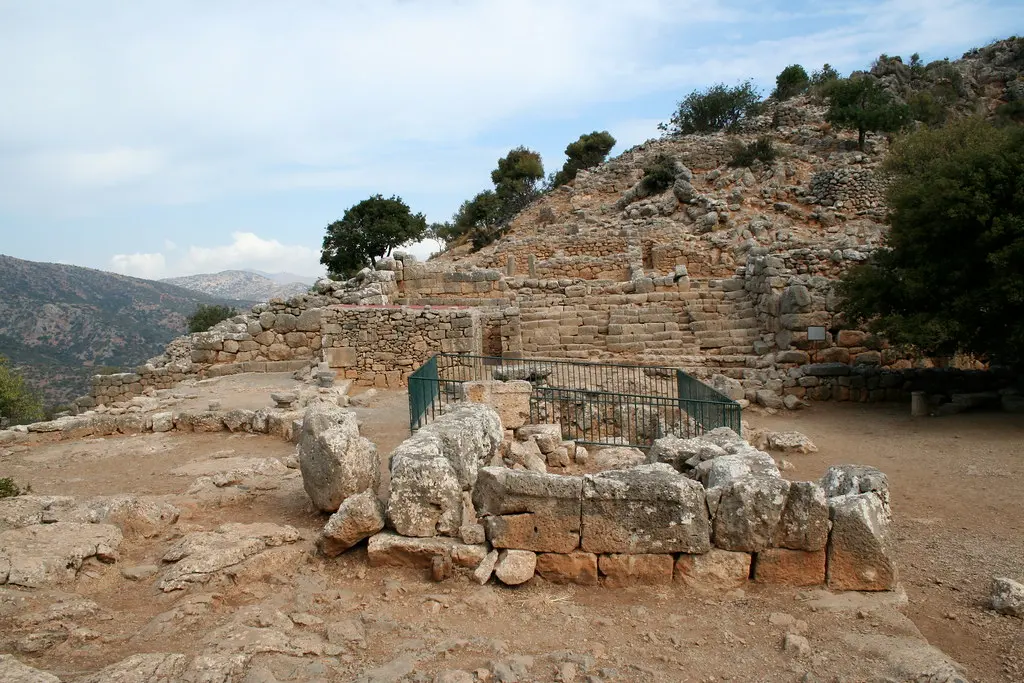
After the fall of Knossos and the collapse of palatial Minoan civilization around 1200 BCE, refugees fled to the heights of Dikti. The settlement at Karfi, perched at 1,100 meters above the northern entrance to the Lassithi Plateau, became one of the last places where Minoan religious practices continued. The goddess-with-upraised-hands figurines found there represent the terminal expression of a tradition that had spanned a thousand years.
In the Greek and Roman periods, the Zeus birth cult dominated the mountain's sacred identity, with the Diktaion Andron receiving offerings continuously through the Roman era. Christianization brought the construction of the Afendis Christos chapel on the second-highest summit, consecrating the peak in a new theological register while maintaining the ancient pattern of sacred presence at the heights.
Zeus
King of the Olympian gods, whose birth narrative on Mount Dikti established the mountain as the origin point of divine sovereignty. The story of his concealment in the Diktaion Andron cave, his nursing by Amalthea, and his protection by the Kouretes is the foundational myth of the site.
Britomartis / Diktynna
Pre-Olympian Minoan goddess of mountains, hunting, and wild nature, whose name is intertwined with the mountain itself. Depicted on Cretan coins standing atop a mountain grasping animals, she represents the oldest layer of divine association with Dikti, predating the Zeus narrative.
J. D. S. Pendlebury
British archaeologist who excavated Karfi in 1937 and 1939, revealing the last Minoan refuge settlement high in the Dikti range, where remnants of Minoan civilization survived for four hundred years after the collapse of Knossos. Pendlebury was killed fighting in the Battle of Crete in 1941.
Callimachus
Hellenistic poet and scholar whose third hymn to Artemis provides the principal literary account of Britomartis/Diktynna and the etymology linking the goddess to Mount Dikti, shaping how subsequent generations understood the mountain's divine associations.
Joseph Hazzidakis
Cretan archaeologist who conducted early explorations of the Diktaion Andron cave in the 1880s and 1890s, initiating the modern archaeological investigation of the cave that would confirm thousands of years of votive offerings and sacred use.
Traditions and practice
The Minoans practiced a layered sacred engagement with the Dikti range that scholars are still working to fully understand. Peak sanctuaries on prominent summits received clay votive figurines in human and animal forms, deposited as acts of devotion or petition. The Diktaion Andron cave was the principal cult site, receiving an extraordinary range of offerings: bronze figurines, double axes (the labrys, the defining symbol of Minoan religion), gold jewelry, olive oil, honey, wine, wheat, and animal sacrifices.
Stone altars within the cave served as platforms for libations. These offerings spanned at least four thousand years, from the late Neolithic through the Roman period.
The Kouretes ceremony, associated with the Zeus birth narrative, involved ritual warrior dances in which participants clashed shields and weapons. Whether these dances were performed on the mountain itself or in the settlements below is not known. The ceremony encoded the mythic role of the Kouretes as protectors of the infant god and may have served as an initiation rite.
At Karfi, the Late Minoan refugees maintained religious practices in a small temple structure where goddess-with-upraised-hands figurines were deposited. These figurines represent the last expression of a distinctly Minoan religious tradition, carried out in the mountain fastness long after the palatial civilization that created it had disappeared.
The primary contemporary practice on the mountain is hiking, experienced by many as a contemplative engagement with a mythologically charged landscape. The E4 European Long Distance Path provides a marked route through the range, and the summit ascent of Spathi functions as a physical pilgrimage for those who undertake it.
Orthodox services may still occasionally be held at the Afendis Christos summit chapel during major feast days, though their regularity is uncertain. The chapel represents the living, if intermittent, continuation of worship on the mountain.
Locals still collect wild dictamo from the mountain's slopes, continuing a practice with roots in antiquity. The herb, named for the mountain itself, was considered sacred to Artemis and was believed to heal wounds and expel arrowheads from the flesh of wild goats.
Approach the mountain as a layered text to be read through the feet. Begin on the Lassithi Plateau, where eight thousand years of human cultivation have produced a landscape that is both deeply inhabited and enclosed by wilderness. Walk the plateau's edges and notice how the mountains surround it completely, creating a space that feels held.
On the ascent, pay attention to the transitions. The passage from Lassithi to Limnakaro marks the boundary between the permanently settled and the seasonally visited. The passage from Limnakaro to the treeline marks the boundary between the vegetated and the bare. The summit ridge marks the boundary between the earthly and the exposed, the place where myth was set because the place itself suggested myth.
At the summit, sit for at least ten minutes in silence. Face each cardinal direction in turn. To the west, the Psiloritis massif holds the competing cave of Zeus. To the north and south, the sea surrounds Crete. Below you, the Lassithi Plateau is invisible, hidden by the same mountain walls that hid Zeus from Cronus. Consider what it means that the Greeks chose to locate the birth of the supreme deity in a place of concealment rather than display.
Minoan Mountain and Cave Worship
HistoricalThe Dikti range was one of the most sacred landscapes in Minoan Crete, hosting peak sanctuaries on prominent summits and cave cults in the range's many caverns. The Diktaion Andron was one of the most important sacred caves in all of Crete, receiving offerings over a span of roughly four thousand years. Karfi served as both a peak sanctuary and, later, the final refuge of Minoan civilization after the collapse of the palatial system.
Deposition of clay votive figurines in human and animal forms at peak sanctuaries. Cave offerings of bronze figurines, double axes, gold jewelry, olive oil, honey, wine, wheat, and animal sacrifices. Construction of stone altars within caves for libations. Communal pilgrimage from surrounding settlements to mountain sanctuary sites. Late Minoan worship involving goddess-with-upraised-hands figurines at the Karfi temple.
Cult of Zeus — Birth and Rearing on Dikti
HistoricalThe Zeus birth narrative placed the most consequential divine origin story in Greek mythology within a cave on Mount Dikti. This mythology drove centuries of pilgrimage and offerings at the Diktaion Andron and established the mountain as the origin point of the supreme deity, lending it a cosmic significance that persists in cultural memory.
Pilgrimage to the Diktaion Andron cave with votive offerings. Deposition of bronze double axes, figurines, and precious objects. Offerings of olive oil, honey, wine, wheat, and animal sacrifice. The Kouretes ceremony of ritual warrior dances associated with the protection of the infant Zeus.
Cult of Britomartis / Diktynna
HistoricalBritomartis was a Minoan-origin goddess of mountains, hunting, and wild nature whose association with Dikti was so intimate that mountain and goddess share a name. As Diktynna, she appeared on Cretan coins in the Potnia Theron motif, standing atop a mountain grasping animals. Her cult represents a pre-Olympian layer of Cretan mountain worship that was later partially absorbed into the mythology of Artemis.
Veneration of the goddess on mountain peaks and in her temples. Association with hunting rituals and animal mastery. Coin iconography depicting the goddess atop the mountain with animals.
Greek Orthodox Christianity — Afendis Christos Chapel
ActiveThe summit chapel of Afendis Christos on the second-highest peak of the Dikti range (2,141 meters) continues the ancient pattern of consecrating mountain heights. The chapel follows the widespread Cretan and Greek Orthodox practice of building churches on prominent peaks, often on or near sites with pre-Christian sacred associations.
Orthodox feast day processions ascending to the summit chapel have been documented historically, though current regularity is uncertain. The chapel receives candle offerings and prayers from visiting hikers and occasional pilgrims. It also serves as an emergency shelter.
Perspectives and open questions
Mount Dikti can be understood as a geological formation, an archaeological landscape, a mythological setting, or a living ecology. Each lens reveals dimensions the others cannot access alone.
Scholarly perspective
Scholars recognize the Dikti range as one of the most significant sacred landscapes in the ancient Aegean. The archaeological record confirms continuous sacred use from the Neolithic through the Roman period, with the Diktaion Andron as the primary anchor site. The debate over whether Zeus was born at Dikti or Ida reflects the political competition between different Cretan regions in antiquity rather than a genuine mythological divergence; both traditions are ancient and have scholarly support.
The Minoan peak sanctuary phenomenon, well-documented across Crete with over thirty sites identified, included locations within the Dikti range, though the highest peaks themselves have not been formally surveyed for sanctuary remains. Karfi is the most extensively excavated Dikti site, and its significance extends beyond religion: the settlement represents one of the most important sites for understanding the transition from Minoan to Greek civilization.
Its location high in the Dikti range was chosen not merely for defensive advantage but because of the mountain's pre-existing sacred associations.
The Britomartis/Diktynna connection demonstrates that the mountain carried goddess-worship associations predating the Olympian pantheon, reflecting the Minoan Potnia Theron archetype. This layer of pre-Greek sacredness, partially absorbed into the later mythology of Artemis, adds depth to the mountain's religious stratigraphy. The etymology of Dikti itself remains unresolved: scholars continue to debate whether the name derives from the goddess, from a pre-Greek substrate word, or from the Greek word for net.
Living and traditional perspectives
For Cretans, the Dikti range is not a distant mythological setting but an immediate presence. The Lassithi Plateau communities have lived within the mountain's encirclement for thousands of years, their agricultural rhythms shaped by its weather and their cultural identity shaped by its stories. The Orthodox chapel on Afendis Christos represents the natural continuation of sanctifying the heights, a practice that local communities understand as both Christian devotion and a deeper relationship with the mountain itself.
The herb dictamo holds particular significance in Cretan folk tradition. Named for the mountain and associated with divine healing since antiquity, it continues to be gathered from the mountain's slopes and used in teas and remedies. This practice connects contemporary Cretans to the Aristotelian accounts of wild goats healing themselves with the herb and to the broader tradition of understanding the mountain as a source of both spiritual and physical restoration.
Alternative interpretations
Contemporary spiritual pilgrimage groups visit the Dikti range as part of goddess tours of Crete, interpreting the Britomartis/Diktynna tradition and the Minoan cave cults as evidence of a pre-patriarchal Cretan goddess religion centered on mountain and cave worship. The Lassithi Plateau, enclosed by mountains and sustaining life for eight thousand years, is sometimes interpreted as a natural womb or cauldron, a landscape manifestation of the Great Mother archetype.
These readings draw on the work of Marija Gimbutas and the broader goddess spirituality movement, and while they extend beyond what the archaeological evidence strictly supports, they respond to real features of the landscape and its deep history.
Open questions
Whether the highest peaks of Dikti hosted formal peak sanctuaries remains archaeologically unconfirmed. No systematic survey of the Spathi or Lazaros summits has been published, and the mountain's sacred significance above the cave and settlement sites exists primarily in inference rather than direct evidence. The exact nature of the rituals the Kouretes performed, whether on the mountain or elsewhere, is unknown beyond the mythological accounts.
How the Karfi community maintained Minoan religious practices for four hundred years in isolation, and what the goddess-with-upraised-hands figurines found there represent in terms of living religion, remains only partially understood. The mountain, like most genuinely sacred places, has not yielded all of its meanings to investigation.
Plan your visit
Access and arrival
The Lassithi Plateau is reached by road from Heraklion (70 kilometers east, approximately 90 minutes) or from Agios Nikolaos (44 kilometers). Approach roads wind up from the north via Krasi village (where a plane tree estimated at 2,400 years old stands in the village square) or from the east via Neapoli. No public transport serves the plateau reliably; a rental car is strongly recommended.
The trailhead for Spathi summit is at Agios Georgios village, from which a rough dirt road leads to Limnakaro Plateau. A four-wheel-drive or high-clearance vehicle is recommended. The E4 European Long Distance Path is marked from Limnakaro upward with yellow-and-black paint blazes. The Strovili mountain shelter at Limnakaro accommodates 12 people in bunk beds; contact the Mountaineering Club of Lassithi in advance. No facilities exist above Limnakaro. Nearest airports: Heraklion Nikos Kazantzakis International (main), Sitia (smaller, seasonal).
Coordinates of Spathi summit: approximately 35.12 degrees North, 25.48 degrees East.
The Lassithi Plateau villages of Agios Georgios, Tzermiado, and Psychro offer guesthouses, small hotels, and tavernas. Accommodation is modest but adequate, with the advantage of placing visitors within the mountain's enclosed plateau landscape. The Strovili mountain shelter at Limnakaro (1,533 meters, 12 beds, basic facilities) serves hikers making the summit attempt. Advance booking through the Mountaineering Club of Lassithi is recommended.
For fuller tourist services, Agios Nikolaos (44 kilometers) or Heraklion (70 kilometers) provide a wide range of hotels and restaurants.
Respectful visit
Mountain hiking gear is essential for any ascent beyond the Lassithi Plateau. Sturdy hiking boots with ankle support, layered clothing for a temperature range of 30 degrees Celsius at the plateau to near freezing at the summit, sun protection, and wind and rain layers. Winter ascents above 1,800 meters require full mountaineering gear including crampons and ice axes. For the Lassithi Plateau itself, standard casual attire is appropriate.
No restrictions on the mountain or plateau. Use discretion near nesting raptor sites. At the Afendis Christos chapel, photograph respectfully, especially if any service is underway. The light on the summit ridge, particularly at dawn and in the hour before sunset, produces conditions worth waiting for.
No formal offering traditions are currently practiced on the mountain summits. Do not leave objects on the trails or at summit points. At the Afendis Christos chapel, a candle may be lit in the traditional Orthodox manner. At the Diktaion Andron cave, which is a ticketed archaeological site managed separately, visitors should follow posted guidelines.
The Natura 2000 designation protects the mountain's flora and fauna. Do not collect plants or disturb wildlife. Do not collect or disturb archaeological remains at Karfi or any other site. Do not camp outside of designated areas. Open fires are prohibited.
The summit of Spathi requires genuine mountain hiking experience. The route above Limnakaro traverses rocky, unstable terrain with no facilities, water sources, or shelter. Weather changes rapidly at altitude, and the mountain can produce strong winds, sudden cloud cover, and dramatic temperature drops even in summer. Do not attempt the summit in deteriorating weather. In winter, snow above 1,800 meters requires mountaineering equipment including crampons.
The rough dirt road from Agios Georgios to Limnakaro is passable only with a high-clearance vehicle and may be impassable after rain. There is no mobile phone signal on the upper mountain. Inform someone of your planned route and expected return time.
Current practical details
Address
Lasithi Plateau, Greece
Hours, fees, and access can change — verify on the official source before you travel. Practical details last checked Jun 2026.
Location
Map loads as you approach this section.
Pilgrim reflections
A portrait of encounter, not a score
Pilgrims describe what they felt, how present they could become, and whether the place would shape a journey. There are no stars and no ranking of traditions.
No reviewed reflections yet
The first pilgrims can help describe the character of being here.
Share a reflection
Available after an account-backed “Been there.” Every reflection is reviewed before publication.
Nearby sacred places
Explore other sacred places in the region. Proximity does not establish access or travel time; check each place’s guidance.
Share a photo
Help visitors recognize Mt. Dicti. Every submission is reviewed before publication.