Diktaion Andron Cave
Part ofMt. Dicti
Where the supreme god of the Greeks was born from darkness, stone, and the hidden waters of the earth
Understand sacred places, explore living traditions, and learn how to engage respectfully with Pilgrim Map.
Access has not been verified. Check current local guidance before planning a visit.
Psichro, Crete, Greece
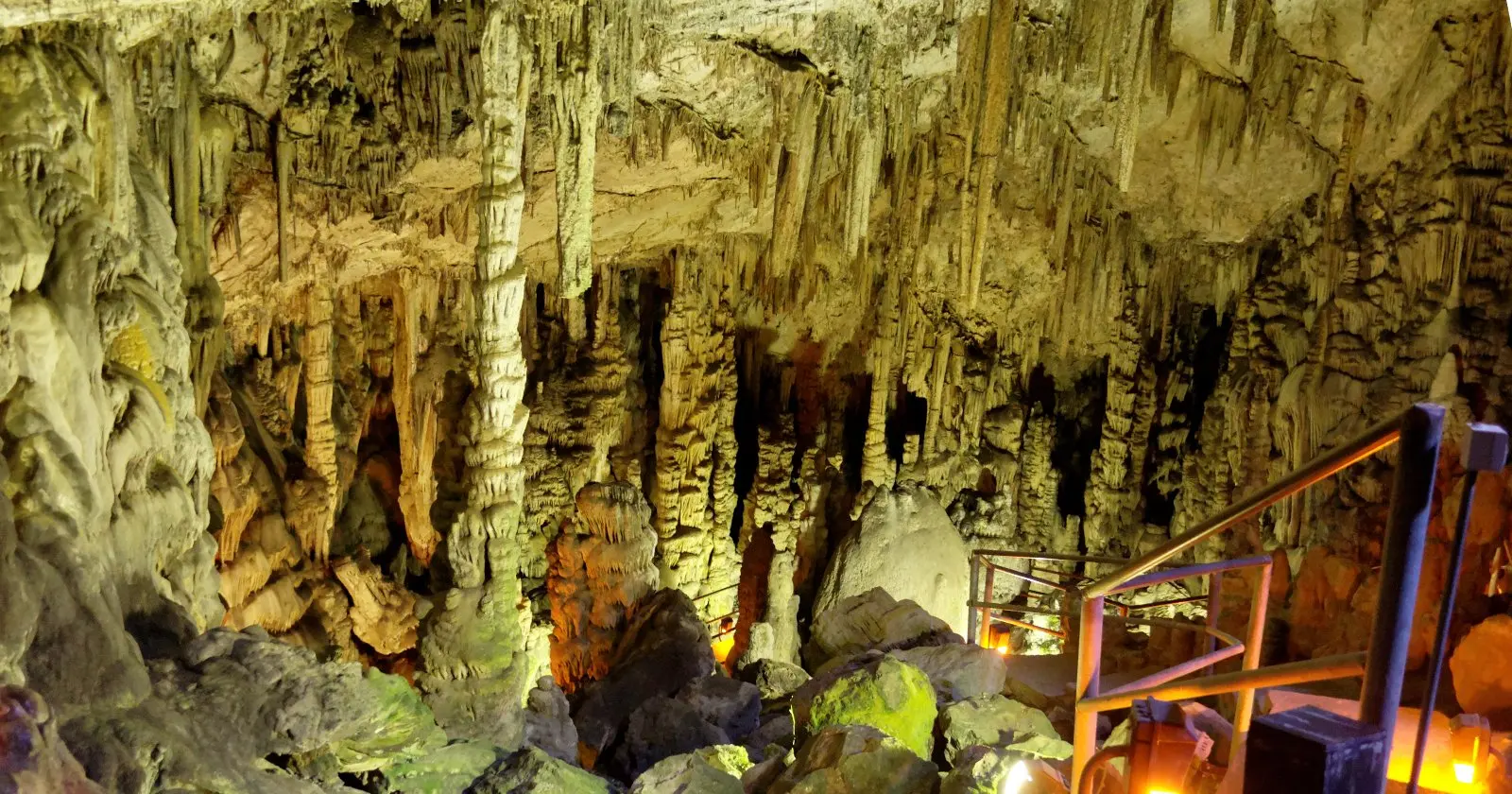
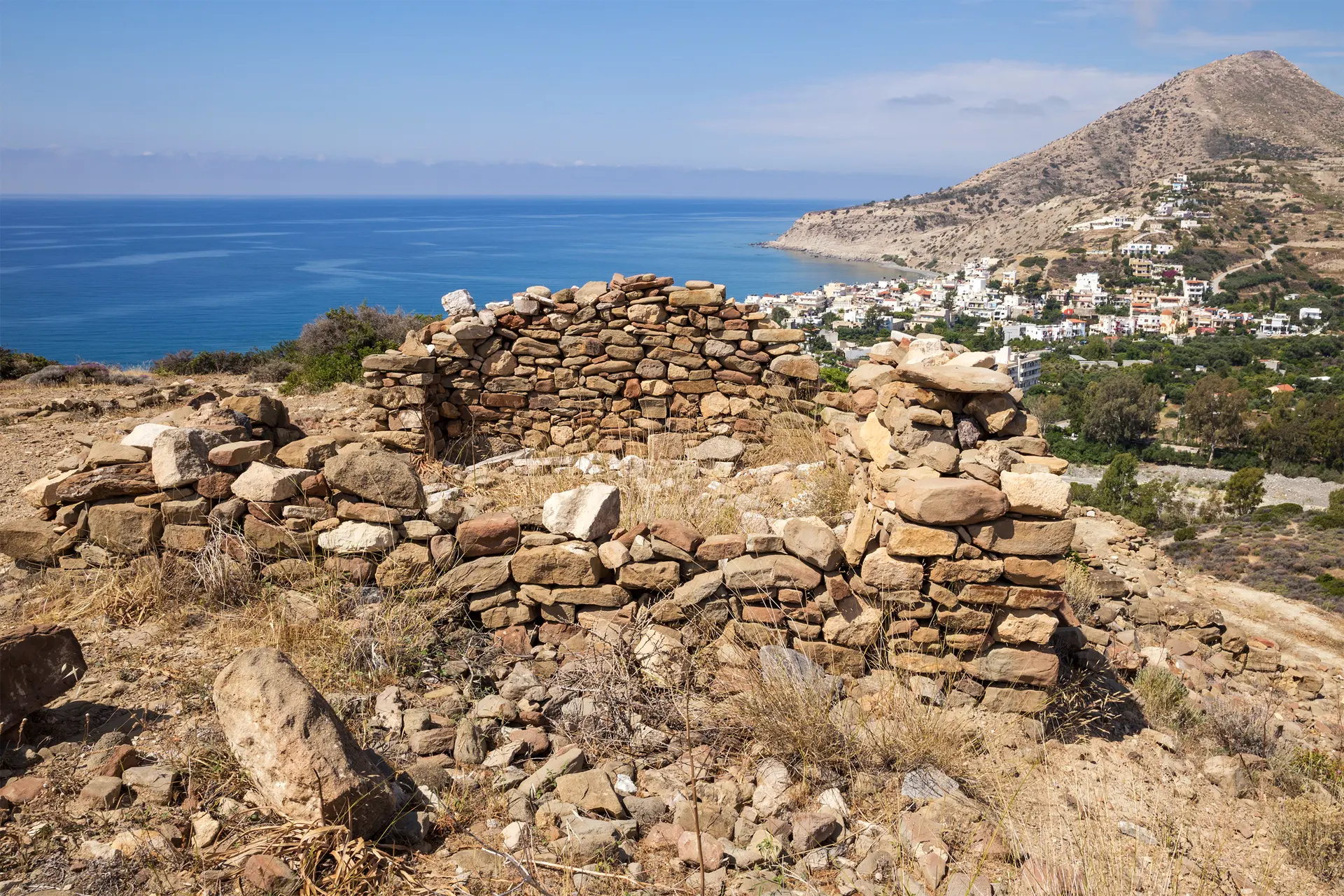
Image of Diktaion Andron Cave. Image source · CC-BY-3.0
Visit essentials
A quick read before you go
- Duration
- Allow one and a half to two hours total.
- Access
- The cave is located above the village of Psychro, on the southern edge of the Lassithi Plateau,…
Overview
Six thousand years of human presence inhabit the cave above Psychro. Its chambers descend into deepening darkness past stalactites like drapery and frozen waterfalls to a cold, still subterranean lake eighty-four meters below the entrance.
Minoans treated the place as sacred from at least the Early Minoan period, around 3000 BC; by the Middle Minoan era, Diktaion Andron was Crete's most frequented shrine. Worshippers pressed miniature bronze double-axes—the labrys, sacred symbol of their civilization—figurines, ceramic libation cups, and engraved gems into poolside mud and stalactite crevices, and burned animal offerings on an upper-chamber stuccoed altar. Excavators found over thirty libation tables, evidence of organized ritual across centuries.
Greek mythology later located here, or in a cave like it, Rhea's secret birth of Zeus after Kronos swallowed her previous children. The Curetes clashed shields and spears to mask the infant's cries; Amalthea nursed him and sacred bees brought honey. Zeus emerged to overthrow the old order and establish the Olympians.
Now managed by the Hellenic Ministry of Culture, the archaeological site has lit, concreted walkways that partly domesticate its darkness. Yet the descent, falling temperature, changing light, and dark underground lake remain—the same qualities that drew Minoan worshippers to leave precious objects at its edge.
Why this place is sacred
The quality that distinguishes certain places from the merely old or merely beautiful operates through accumulation. At the Diktaion Andron, what accumulates is depth in every sense of the word.
The first depth is geological. The cave formed over millions of years as water dissolved the karst limestone of Mount Dicte, hollowing out chambers and passages, depositing calcium carbonate in formations that grew at rates measured in centimeters per millennium. The stalactites and stalagmites are not decoration. They are the visible record of geological time, the slow mineral testimony of water moving through stone in darkness.
The second depth is temporal. Human beings have been entering this cave since the late Neolithic, around 4000 BC. Sacred use began by 3000 BC at the latest. The Diktaion Andron was among the most important sanctuaries of a civilization, the Minoans, whose religion we can observe in its material remains but whose beliefs we cannot fully reconstruct. The Linear A tablets found at the cave remain undeciphered. We know what was offered. We do not know what was asked.
The third depth is mythological. The story of Zeus's birth is among the foundational narratives of Western civilization, and this cave is its setting. But the Cretan Zeus was not the Zeus of Olympus. He was something older and stranger: a god who died and was reborn annually, a deity of earth power and vegetation cycles, closer to the chthonic forces of the Minoan cave cult than to the sky father of Classical Greece.
The cave holds the memory of this transition, this moment when older earth-powers were absorbed into newer sky-narratives.
The fourth depth is physical. You descend. The cave goes down eighty-four meters from entrance to lowest chamber. The temperature drops to fifteen degrees. The air changes. Sound changes. At the subterranean lake, you have entered a space that exists in permanent night, where the only light for millennia was whatever the worshippers carried with them. This is not metaphor.
This is architecture created by the earth itself, and it produces in the body the experience that mythology describes: the descent into the origin of things.
The Diktaion Andron served as a Minoan sacred cave sanctuary, one of the most important in Crete, from the Early Minoan period onward. Cave sanctuaries, along with peak sanctuaries and palatial shrines, formed the three pillars of Minoan religious practice. The cave's natural features, particularly its descent into darkness and its subterranean water, made it a place of chthonic power where worshippers encountered the hidden forces of the earth through votive deposition, libation, and animal sacrifice.
The cave's sacred function evolved through several phases. During the Minoan period, it served as a cult center where votive offerings of extraordinary richness were deposited over centuries, reaching peak intensity around 1700 BC. As Minoan civilization gave way to the Mycenaean and then the Archaic Greek world, the cave's sacredness was reinterpreted through the emerging mythology of Zeus.
The Diktaean Zeus, worshipped through the Geometric and Archaic periods, retained the chthonic character of the older Minoan tradition rather than adopting the sky-father attributes of the Olympian Zeus familiar from Homer. Sporadic worship continued into Roman times, through the first century AD, before the cult finally ceased. For centuries the cave served only as occasional shelter for shepherds and hunters.
Its archaeological significance was recognized in 1883, leading to excavations by Hatzidakis and Halbherr in 1886, Arthur Evans in 1896, and the systematic work of David Hogarth in 1899-1900. Today, the cave functions as a managed archaeological attraction receiving over 200,000 visitors annually.
Experience and orientation
The approach matters. The Lassithi Plateau is itself a remarkable place: a high-altitude agricultural basin at approximately 850 meters, ringed by mountains, reached by roads that wind up through gorges and over passes. As you drive up from the coast, the landscape transforms from Mediterranean scrub to something greener, cooler, more enclosed. The plateau, when it opens before you, feels hidden. This is not incidental.
Sacred sites in Crete tend to occupy liminal positions, and the Lassithi Plateau, a fertile bowl concealed within mountains, has the quality of a world apart.
The village of Psychro sits at the southern edge of the plateau. From the parking area, the path to the cave climbs steadily for fifteen to twenty minutes through scrubland and sparse trees. The ascent is real exertion, especially in warm weather. Donkeys are available for those who prefer them. But the walk serves a purpose beyond transportation. It lifts you out of the casual tourist frame and into something more deliberate.
By the time you reach the cave entrance at 1,025 meters, you have earned the descent.
The cave opens into the mountainside with a wide mouth that narrows as you enter. The temperature drops immediately, from the sun-warmed Cretan air to the cave's constant fifteen to twenty degrees. The illuminated walkway leads downward through the upper chambers, past stalactite formations of considerable beauty. The largest, called the Mantle of Zeus, hangs in folds that resemble draped fabric.
It is the kind of natural form that invites narrative, that asks to be read as something made rather than grown.
The stuccoed altar where Minoan worshippers burned animal offerings was located in the upper cave. The excavation sites are marked but not reconstructed. What you see is the cave as geological formation, with the knowledge of what took place here supplied by memory and imagination.
The path continues downward. The chambers darken despite the electric lights. The air grows cooler, more humid. At the lowest level, the subterranean lake appears. It is not large, but it is profoundly still. The water level fluctuates with the seasons, lowest in late September. The Minoans deposited their most precious votive offerings in the mud at this pool's edge, pressing bronze figurines and double-axes into the boundary between water and earth. This was not convenience.
This was theology expressed in gesture: the most sacred act performed at the most sacred point, where the boundary between worlds was thinnest.
Stand here quietly if the crowd allows it. The underground lake in permanent darkness, surrounded by formations shaped over millions of years, is a place where contemplation does not need to be cultivated. It arises naturally from the conditions.
Arrive early in the morning, ideally at the 8:00 AM opening, to experience the cave with fewer visitors. The uphill walk is more comfortable in the cool of the morning. Bring a light jacket even in summer, as the cave interior is significantly cooler than the plateau. Wear sturdy footwear with good grip, as the cave paths can be slippery from moisture. Allow ninety minutes to two hours for the full experience, including the walk, the cave, and the return.
Combine with time in Psychro village or an exploration of the Lassithi Plateau.
Context and lineage
The mythological origin is among the most consequential in Western tradition. Kronos, lord of the Titans, had received a prophecy that his own son would overthrow him. To prevent this, he swallowed each child that his wife Rhea bore: Hestia, Demeter, Hera, Hades, Poseidon, one by one consumed. When Rhea was pregnant with her sixth child, she fled to Crete and entered the cave on Mount Dicte.
There she gave birth to Zeus and, in a desperate act of maternal cunning, wrapped a stone in swaddling clothes and gave it to Kronos to swallow in the infant's place.
The cave became the hidden nursery of the future king of the gods. The divine goat Amalthea fed the infant with her milk. The nymph Melissa brought him honey, and sacred bees attended him. But the child's cries threatened to betray his hiding place. So the Curetes, a company of armored warriors, gathered at the cave entrance and performed a thunderous war dance, clashing their shields and spears in a rhythm that drowned out every sound.
When Zeus grew to maturity, he emerged from the cave, confronted his father, and compelled Kronos to disgorge the five swallowed children. With his freed siblings and the Cyclopes as allies, Zeus overthrew the Titans in the war called the Titanomachy and established the rule of the Olympian gods.
The archaeological reality is quieter but no less remarkable. The Minoans began sacred use of the cave by at least 3000 BC, and the density of votive deposits found by excavators, particularly Hogarth's systematic work in 1899-1900, testifies to centuries of intense devotion that predates the Zeus mythology by over a millennium.
The Diktaion Andron belongs to the tradition of sacred cave worship that was fundamental to Minoan religion, alongside peak sanctuaries and palatial shrines. Caves in Crete were understood as places of chthonic power, liminal spaces where the forces of the earth could be encountered and petitioned. The Diktaion Andron, the Idaean Cave on Mount Ida, and the Kamares Cave were among the most significant of these sanctuaries.
As Minoan religion evolved into the mythological framework of the Greek world, the cave's sacredness was preserved and reinterpreted through the narrative of Zeus's birth. The cave's influence extends into the broadest currents of Western civilization: the myth of the divine child born in a hidden place, nurtured in secret, emerging to overthrow tyranny. The site is protected under Greek cultural heritage law and managed by the Hellenic Ministry of Culture and Sports.
David George Hogarth
British archaeologist who conducted the first systematic excavation of the Diktaion Andron in 1899-1900, working under the British School at Athens. He uncovered the stuccoed altar in the upper cave, the extraordinary votive deposits in the stalactite crevices and at the subterranean pool, and established the archaeological framework through which the cave's sacred history is understood. His work revealed the full scale of the cave's importance as a Minoan cult center.
John Boardman
Art historian and archaeologist who published the definitive study of the cave's artifacts in 'The Cretan Collection in Oxford: The Dictaean Cave and Iron Age Crete' (Clarendon Press, 1961). His meticulous cataloguing and analysis of the votive objects, many held at the Ashmolean Museum, remains the essential scholarly reference for the site's material culture.
Joseph Hatzidakis
Greek archaeologist who, together with the Italian Federico Halbherr, conducted the first excavations at the cave in 1886, three years after its significance as a major cult site was recognized by chance. Their early work established the cave's importance and attracted subsequent excavators including Arthur Evans.
Sir Arthur Evans
British archaeologist who investigated the Diktaion Andron in 1896, before his famous excavation of the Palace of Knossos. His work at the cave contributed to his developing understanding of Minoan civilization and the religious practices that preceded the Greek mythological tradition.
Federico Halbherr
Italian archaeologist who collaborated with Hatzidakis on the 1886 excavations. His broader work in Crete, including excavations at Gortyna and Phaistos, helped establish the island as one of the most important archaeological landscapes in the Mediterranean.
Traditions and practice
The Minoan cult practices at the Diktaion Andron were sustained across approximately two thousand years and left an archaeological record of extraordinary density. Worshippers descended into the cave carrying votive offerings: miniature bronze double-axes, the labrys that was the most potent sacred symbol of Minoan Crete; bronze figurines of men and women; knife-blades and needles; engraved gems; and ceramic vessels. In the upper cave, a built and stuccoed altar served as the site of animal sacrifice.
Excavators found thick strata of ash containing the burnt remains of bulls, sheep, goats, deer, and boar. Over thirty libation tables were recovered, along with Linear A inscribed tablets whose contents remain undeciphered.
The most sacred deposits were made at the subterranean pool in the lowest chamber. Here, worshippers pressed their offerings into the mud at the water's edge, placing bronze figurines and double-axes at the boundary between earth and water. The concentration of finds at this point suggests that the underground lake was understood as the place of greatest sacred power within the cave, the point where the boundary between the human world and whatever lay beneath was thinnest.
In the Greek period, the cave was venerated as the birthplace of Zeus Diktaios, the Diktaean Zeus, a deity who retained the chthonic and vegetation-cycle associations of the older Minoan tradition. Pilgrims continued to bring votive offerings. The cult of the Curetes, the armored dancers who protected the infant Zeus, was associated with the site.
The Hymn of the Kouretes, discovered at Palaikastro and possibly connected to the Diktaean cult, is an invocation calling upon the greatest kouros to come to Dikte for the year, bringing prosperity to flocks, fields, and cities.
No religious worship takes place at the cave. The site functions as a managed archaeological attraction, receiving over 200,000 visitors annually. The Hellenic Ministry of Culture maintains illuminated walkways through the cave, allowing visitors to follow a 250-meter path from the upper chambers to the subterranean lake. Educational and cultural tours frequently combine the cave with visits to Knossos and other Minoan sites.
The Diktaion Andron does not require instruction in contemplation. The cave provides the conditions. What it asks of visitors is simply to be present to the descent.
Pause at the cave entrance before entering. Let your eyes adjust. Notice the temperature change as you cross the threshold from the sun-drenched Cretan air into the cave's cool interior. This transition, from light to shadow, from warmth to cold, from the open sky to enclosed stone, is the fundamental experience of the site and has been for six thousand years.
As you descend, attend to the stalactite formations not as geological curiosities but as records of time operating at scales far beyond human history. Each formation represents thousands of years of mineral deposition in darkness. The Mantle of Zeus, the largest formation, invites the eye to read meaning into natural form, the same impulse that led ancient worshippers to understand these caves as places of divine presence.
At the subterranean lake, if the space and crowd allow, stand still. This is where the Minoans placed their most precious offerings. The darkness, the water, the silence converge here into something that precedes language and interpretation. You do not need to believe anything in particular to feel the weight of a place where human beings have been bringing their most valued objects for four thousand years.
Minoan Cave Cult
HistoricalThe Diktaion Andron was among the most important and most intensively used sacred caves in Minoan Crete, with archaeological evidence of cult activity spanning from the Early Minoan period (c. 3000 BC) to the end of the Bronze Age. By the Middle Minoan IIIA period (c. 1700 BC), it had become the most frequented shrine on the island based on the density and richness of votive deposits. Cave sanctuaries were one of the three fundamental categories of Minoan sacred space, alongside peak sanctuaries and palatial shrines, and the Diktaion Andron represented the tradition at its most concentrated.
Ancient Greek Religion (Zeus Diktaios)
HistoricalIn Greek mythology, the cave was celebrated as the birthplace or nurturing place of Zeus, the supreme deity. The Diktaean Zeus was a distinct Cretan form of the god: not merely the sky father of mainland Greek religion but something older and more connected to earth power, vegetation cycles, and annual death and rebirth. Worship at the cave continued from the Geometric period through the Archaic era (c. 900-500 BC) and persisted sporadically into Roman times (1st century AD).
Perspectives and open questions
The Diktaion Andron has been understood as a geological formation, an archaeological site, a mythological setting, and a place where the earth opens to reveal something about the origins of the sacred. Each perspective illuminates a different aspect of a cave that has drawn human attention for six thousand years.
Scholarly perspective
Archaeological scholarship recognizes the Diktaion Andron as one of the most important Minoan sacred caves in Crete, with a votive deposit of extraordinary richness spanning from the Early Minoan through Archaic periods. John Boardman's 1961 publication remains the definitive catalogue of the artifacts, many of which are held at the Ashmolean Museum in Oxford and the Heraklion Archaeological Museum.
The scholarly consensus holds that cave sanctuaries were fundamental to Minoan religion, serving as places where the chthonic powers of the earth could be accessed through ritual deposition and sacrifice. The identification of the Psychro cave with the mythological Diktaean Cave is widely but not universally accepted, with some scholars proposing a cave above Palaikastro as an alternative candidate.
The Cretan Zeus worshipped at the cave was demonstrably distinct from the Olympian Zeus of mainland Greece, retaining associations with annual death and rebirth, vegetation cycles, and earth power that connect him to older, pre-Greek religious traditions.
Living and traditional perspectives
For Cretans, the Diktaion Andron is a source of deep cultural pride: evidence that Crete was the setting for the most foundational myth of Greek civilization, the birthplace of the king of the gods. The mythology of Zeus's Cretan birth is woven into local identity, and the Lassithi Plateau itself carries a particular resonance as the setting for this story.
Modern Greek cultural narratives position the cave as part of the evidence that Crete served as the cradle of European civilization, linking the Minoan sacred tradition through Greek religion to the broader arc of Western cultural development.
Alternative interpretations
Some spiritual seekers understand the cave as an archetypal earth womb, a place where the boundary between the material and spiritual worlds becomes permeable. The descent into darkness, the encounter with underground water, and the return to light mirror initiatory death-and-rebirth symbolism found across many traditions. The cave's association with the birth of the divine from the earth resonates with goddess spirituality and earth-centered spiritual traditions.
Some interpreters read the Minoan cave cult as evidence of a pre-patriarchal religion centered on earth and fertility goddesses, understanding the later Zeus mythology as a patriarchal overlay on older feminine sacred traditions, a narrative of appropriation embedded in the mythology of birth itself.
Open questions
The exact nature of Minoan cave cult rituals remains an open question. The physical evidence is rich: votive deposits, ash strata, altar remains, Linear A tablets. But Linear A remains undeciphered, and without readable texts, the meaning that the Minoans attached to their offerings, the words they spoke in the darkness, and the beliefs that structured their descent remain inaccessible. Whether the Psychro cave is actually the ancient Diktaean Cave or whether that designation belongs to another site is unresolved.
The relationship between the Diktaean and Idaean cave cults, whether they were competing traditions, sequential developments, or complementary aspects of a single religious system, remains debated. The significance of the stalactite formations in ancient ritual imagination, including the great formation now called the Mantle of Zeus, is interpreted but not established.
And the deepest question persists: what was it about this particular cave, this particular descent to this particular water, that made it the place where four thousand years of worshippers chose to bring their most valued possessions?
Plan your visit
Access and arrival
The cave is located above the village of Psychro, on the southern edge of the Lassithi Plateau, at 1,025 meters altitude on the northern slopes of Mount Dicte. It lies approximately 48 km from Agios Nikolaos and 60 km from Heraklion. Parking near the cave costs approximately four euros. KTEL buses from Heraklion and Agios Nikolaos serve the Lassithi Plateau, though schedules are limited.
Donkeys are available at Psychro village to carry visitors to the cave entrance for approximately fifteen euros. Admission is approximately six euros for adults, free for students and children, with fifty percent discount during winter months. The cave spans approximately 2,200 square meters with a vertical descent of 84 meters from entrance to lowest chamber. The interior is electrically illuminated with maintained walkways. Moderate physical fitness is required for the steep internal stairs.
The village of Psychro offers basic tavernas and some accommodation. The Lassithi Plateau has a small number of guesthouses and agritourism lodgings. More extensive options are available in Agios Nikolaos (48 km) or Heraklion (60 km). Staying on the Lassithi Plateau itself, where available, allows an early-morning visit to the cave and an experience of the plateau's distinctive atmosphere.
Respectful visit
No formal dress code. Sturdy footwear with good grip is strongly recommended, as the cave interior is slippery from moisture and the paths include steep stairs. A light jacket or sweater is advisable even in the height of summer, as the cave maintains a constant temperature of approximately fifteen to twenty degrees Celsius, significantly cooler than the outside air on the Lassithi Plateau.
Photography is permitted inside the cave. The electric illumination eliminates the need for flash. Tripods may be impractical on the narrow walkways. The subterranean lake and the larger stalactite formations are the most commonly photographed features.
Not applicable. The Diktaion Andron is an archaeological site with no active worship. No objects should be left in the cave. No geological or archaeological material should be removed.
Stay on designated walkways at all times. Do not touch stalactites, stalagmites, or any cave formations. Do not remove any material from the cave. The path involves steep stairs and can be challenging for visitors with limited mobility. The donkey service assists only with the approach path, not the cave interior.
The cave interior involves steep stairs and can be slippery from moisture. Visitors with mobility limitations should assess their ability before descending. The donkeys available at Psychro village can assist with the approach path but not the interior stairs. Stay on designated walkways at all times. The cave's geological formations are irreplaceable and must not be touched.
Current practical details
Address
Psichro 720 52, Greece
Hours
Hours, fees, and access can change — verify on the official source before you travel. Practical details last checked Jun 2026.
Location
Map loads as you approach this section.
Pilgrim reflections
A portrait of encounter, not a score
Pilgrims describe what they felt, how present they could become, and whether the place would shape a journey. There are no stars and no ranking of traditions.
No reviewed reflections yet
The first pilgrims can help describe the character of being here.
Share a reflection
Available after an account-backed “Been there.” Every reflection is reviewed before publication.
Nearby sacred places
Explore other sacred places in the region. Proximity does not establish access or travel time; check each place’s guidance.
Share a photo
Help visitors recognize Diktaion Andron Cave. Every submission is reviewed before publication.