Pulemelei Mound
The largest ancient structure in Polynesia, overgrown on private land in Savai'i
Understand sacred places, explore living traditions, and learn how to engage respectfully with Pilgrim Map.
Access has not been verified. Check current local guidance before planning a visit.
Palauli, Savai'i, Palauli, Samoa
Read the sources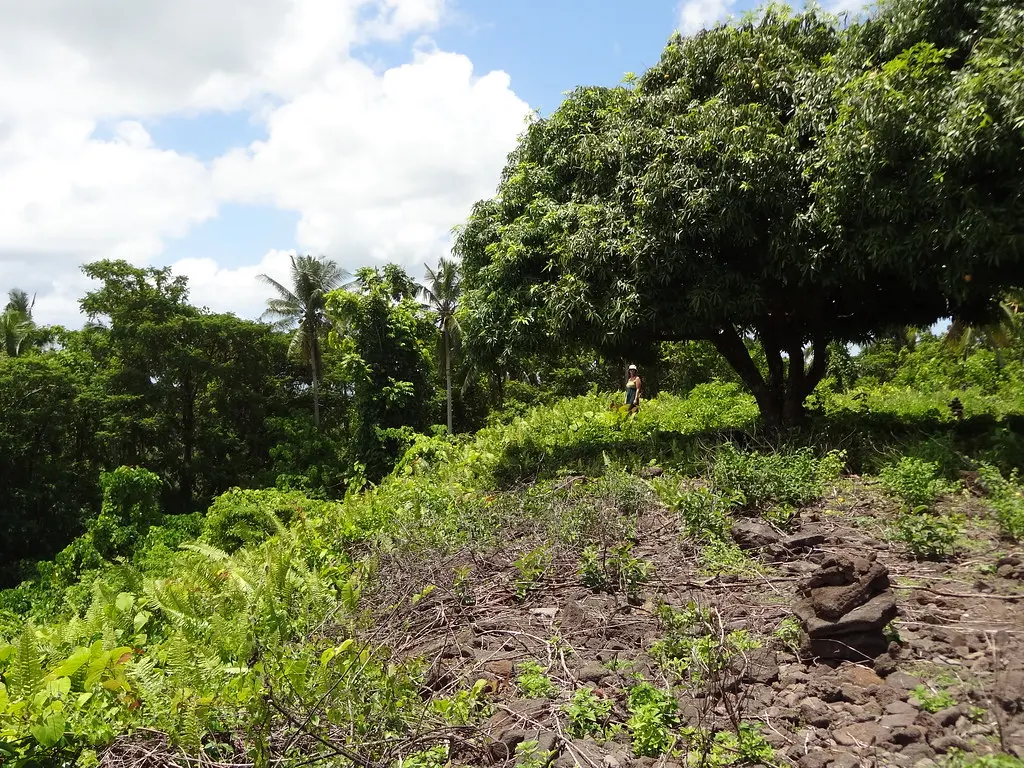
Image of Pulemelei Mound. Image source
Visit essentials
A quick read before you go
- Duration
- No specific duration guidance is documented; the mound itself likely warrants only a short visit…
- Access
- Located within the Letolo Plantation, Palauli district, at the eastern end of Savai'i island,…
Overview
Within the Letolo Plantation at the eastern end of Savai'i, Samoa's largest island, Pulemelei is a stepped stone pyramid rising up to twelve meters from a roughly 65-by-60-meter base. Construction began around 1100–1400 CE; sunken walkways were added in the sixteenth century, and use appears to have ended around 1700–1800 CE.
The mound anchors a partially mapped settlement landscape of more than 3,000 recorded house platforms, walls, walkways, earth ovens, and stone piles. Excavations by University of Auckland and University of Oregon-affiliated archaeologists in 2002–2004 found high-temperature earth ovens, interpreted as likely connected to ceremonial preparation of ti-plant roots.
Its meaning remains less settled. Local tradition, as recorded in tourism and general sources, offers three unreconciled purposes: a chief's house foundation, a meeting place for district chiefs, or a burial ground. Available research does not establish which, if any, carries fuller local authority.
Why this place is sacred
What can be said with some confidence is architectural and social: Pulemelei represents an extraordinary concentration of labor within a pre-contact Samoan settlement landscape, and archaeologists read its scale as evidence of a stratified society in which chiefs or a priestly-ruler class expressed political and spiritual authority through monumental construction. The mound did not stand alone — it anchored a settlement of thousands of recorded features built up over many generations. Beyond that, the record thins considerably.
This research pass found no published statement from a Samoan traditional authority, such as a matai council or the national cultural heritage body, addressing what Pulemelei means to the communities connected to it today or in living memory; available sources are dominated instead by international archaeological literature and general tourism writing.
The three differing local accounts of the mound's original purpose — a chief's house foundation, a meeting place for district chiefs, a burial ground — appear in tourism sources without being reconciled, and it is not established whether these represent genuinely different surviving oral traditions or simply insufficient documentation. This content names that gap directly rather than resolving it with invented certainty.
Archaeologists interpret Pulemelei as a ceremonial and political center within a stratified pre-contact Samoan society, though local tradition offers three unreconciled possibilities for its specific original function: a chief's house foundation, a district meeting place, or a burial ground.
Construction proceeded across multiple phases between roughly 1100 and 1400 CE, with a final modification adding sunken walkways in the sixteenth century. Use of the site appears to have ended by around 1700 to 1800 CE, after which it was left to overgrowth. Excavations conducted between 2002 and 2004 under the supervision of the site's private landowners, working with University of Auckland and University of Oregon-affiliated researchers, produced the fullest modern archaeological account of the mound.
Experience and orientation
Getting to Pulemelei is itself part of the encounter. Available sources describe the walking route from the road as unmarked, something closer to trial and error than a signed trail, and note that the mound can be difficult to visually appreciate without recent vegetation clearing — this is not a manicured heritage site with interpretive signage at every turn, but a stepped stone structure quietly holding its ground against the rainforest reclaiming it.
Approaching through dense undergrowth, the mound's scale registers gradually rather than all at once; unlike a coastal monument visible from a distance, Pulemelei reveals its stepped form only once you are close enough to see past the vegetation obscuring its lower courses. This is worth sitting with rather than treating as an inconvenience.
The overgrowth is not neglect exactly — it reflects centuries since the site's last documented use, and moving through it gives a physical sense of how much time separates the mound's builders from the present. Listen for the sounds of the surrounding rainforest rather than expecting the hush of a curated monument; this is a working plantation landscape as much as an archaeological one, and the two registers overlap rather than sitting cleanly apart.
Pulemelei lies within the Letolo Plantation, Palauli district, at the eastern end of Savai'i island. No marked trail or visitor center has been documented; reaching the mound requires a walk from the road along a route that available sources describe as unmarked and sometimes difficult to locate.
Context and lineage
Local tradition, as reported in tourism and general sources, offers differing and unreconciled accounts of the mound's purpose: some describe it as the foundation for a chief named Lilomaiava's house, others as a meeting place for important district chiefs, and others as an ancient burial ground. Available research does not establish which account, if any, reflects a fuller or more authoritative local understanding, and this content presents all three as documented but unreconciled traditions rather than resolving them.
Pulemelei sits within a much larger, only partially mapped pre-contact Samoan settlement complex of over 3,000 recorded archaeological features, suggesting sustained habitation and organized labor across many generations rather than a single isolated building project.
Lilomaiava
Chief named in one local tradition
Named in one of several unreconciled local accounts as the chief whose house the mound may have been built to support; this attribution is not corroborated or ranked against the mound's other proposed purposes in available sources.
Traditions and practice
Evidence of high-temperature earth ovens at the site is interpreted by archaeologists as likely connected to ceremonial preparation of ti-plant roots, though the specific ritual choreography that once accompanied this activity is not documented in available sources.
No organized contemporary ceremonial practice is documented at Pulemelei.
Approach the mound with time to spare rather than a fixed schedule, given the unmarked route; treat the walk itself as part of the encounter rather than an obstacle to it. Once at the site, move slowly around its base and, where recent clearing allows, its stepped faces, since the overgrowth means the mound's full form is not always visible from any single vantage point.
Resist the urge to fill the site's genuine gaps in documented meaning with confident narrative of your own; sitting with the unresolved local traditions honestly is more faithful to what is actually known than settling on one version.
Pre-contact Samoan chiefly ceremonial and political tradition
HistoricalArchaeologists interpret Pulemelei as a central place within a stratified pre-contact Samoan society, potentially used by local leaders to express political and spiritual authority; the site sits within a much larger settlement complex documented through over 3,000 recorded features built up over many generations.
Evidence of high-temperature earth-oven use is interpreted by archaeologists as likely connected to ceremonial preparation of ti-plant roots; specific ritual choreography is not documented in available sources.
International heritage-preservation and archaeological research
ActiveOngoing international attention, including from the World Monuments Fund and university-affiliated archaeological teams, continues to document and advocate for the conservation of Pulemelei and its surrounding settlement landscape.
Excavation, mapping, and conservation advocacy conducted by international research institutions in coordination with the private landowners.
Perspectives and open questions
Pulemelei is understood almost entirely through international archaeological research and general heritage-tourism writing; dedicated Samoan traditional-authority commentary on the site is genuinely thin in available sources, and this content discloses that absence rather than filling it with invented perspective.
Scholarly perspective
Archaeologists, notably through 2002-2004 excavations conducted under the supervision of the site's private landowners with University of Auckland and University of Oregon-affiliated researchers, interpret Pulemelei as an important ceremonial and political center reflecting the stratification of pre-contact Samoan society, situated within a much larger and still only partially understood ancient settlement complex.
Living and traditional perspectives
Available sources document differing, unreconciled local traditions about the mound's specific purpose — a chief's house foundation, a district meeting place, or a burial ground — without establishing which, if any, carries fuller local authority. A dedicated Samoan traditional-authority perspective specifically addressing the site, such as a statement from a matai council or Samoa's national cultural heritage body, was not located in this research pass.
This is a notable and honestly disclosed gap rather than an indication that no such perspective exists; it reflects the limits of the sources reviewed, not the absence of Samoan understanding of the site.
Alternative interpretations
Some alternative-history-oriented publications frame the mound's scale and pyramid-like form as invoking broader speculative narratives about ancient Pacific civilizations. This content treats such framing as a documented alternative-interpretation category, distinct from and not equivalent in reliability to the mainstream archaeological consensus described above.
Open questions
The site's precise original purpose remains genuinely debated even among the differing local traditions reported in available sources, and the extent of surviving direct Samoan oral tradition about the mound, as distinct from archaeological interpretation alone, is not clearly established in this research.
Plan your visit
Access and arrival
Located within the Letolo Plantation, Palauli district, at the eastern end of Savai'i island, Samoa. The plantation is privately owned by O.F. Nelson Properties, a holding dating to the nineteenth century, and no confirmed formal visitor access arrangement — fee, permission process, or designated entry point — was established in the research behind this content. One travel source describes the walking route from the road as unmarked and requiring some searching to locate.
Visitors should anticipate needing to arrange access with the landowner directly and should not expect a visitor center, formal signage, or on-site staff; this is a genuine gap in documentation, not an oversight in this description.
No specific accommodation information was located for this site in available sources; general Savai'i lodging in nearby districts would be the likely practical option, though this has not been confirmed against the site specifically.
Respectful visit
No specific dress code is documented in available sources; practical clothing suited to walking an unmarked route through dense vegetation is advisable.
No specific photography restriction is documented in available sources.
No offering practice is documented in available sources.
No formally documented visitor restrictions were located. Given the site's location on privately owned land within the Letolo Plantation, owned by O.F. Nelson Properties, visitors should assume that permission or some arrangement with the landowner may be expected, though this was not confirmed in detail in available sources.
No formal visitor infrastructure, guide service, or safety signage has been confirmed for this site; visitors should exercise the same caution appropriate to any unmarked, overgrown rural walking route on private land.
Location
Map loads as you approach this section.
Pilgrim reflections
A portrait of encounter, not a score
Pilgrims describe what they felt, how present they could become, and whether the place would shape a journey. There are no stars and no ranking of traditions.
No reviewed reflections yet
The first pilgrims can help describe the character of being here.
Share a reflection
Available after an account-backed “Been there.” Every reflection is reviewed before publication.
Nearby sacred places
Explore other sacred places in the region. Proximity does not establish access or travel time; check each place’s guidance.



References
Sources consulted for this page. Source categories describe the publication, not a guarantee that every claim is verified. Traditional accounts and outside interpretations may differ.
- 01Pulemelei Mound — World Monuments FundofficialInternational heritage-preservation organization's official site listing; used for conservation-status context
- 02Archaeological Investigations at the Pulemelei Mound, Savai'i, Samoa — University of Hawaiʻi at Mānoa (eVols repository)academicPrimary academic excavation report; highest-reliability source for construction dating and archaeological interpretation
- 03Pulemelei Mound — Wikipedia contributorsacademicCore structural, dating, and settlement-context information, drawing on published archaeological excavation reports
- 04Centre for Samoan Studies answers: What is the Pulemelei Mound? — Samoa Observer / Centre for Samoan StudiesSource contextSamoan national newspaper carrying commentary from the National University of Samoa's Centre for Samoan Studies; the most directly Samoa-based source located in this research
- 05History could be changed by Pulemelei and Letolo — Samoa ObserverSource contextSamoan national newspaper coverage discussing the site's significance to understanding Samoan history
- 06Pulemelei Mound in Palauli - Samoa — Atlas ObscuraSource contextTravel/heritage-curiosity guide; used for practical access description
- 07The Perplexing Purpose of the Gigantic Pulemelei 'Pyramid' Mound of Samoa — Ancient OriginsSource contextAlternative-history-oriented publication; used only for supplementary narrative color and cross-checked against academic sources for factual claims, given the outlet's general tendency toward speculative framing
Share a photo
Help visitors recognize Pulemelei Mound. Every submission is reviewed before publication.