Haʻamonga ʻa Maui
Three stones at the edge of Tongatapu, older than memory can confirm
Understand sacred places, explore living traditions, and learn how to engage respectfully with Pilgrim Map.
Access has not been verified. Check current local guidance before planning a visit.
Niutoua / Heketā, Tongatapu, Tongatapu, Tonga
Read the sources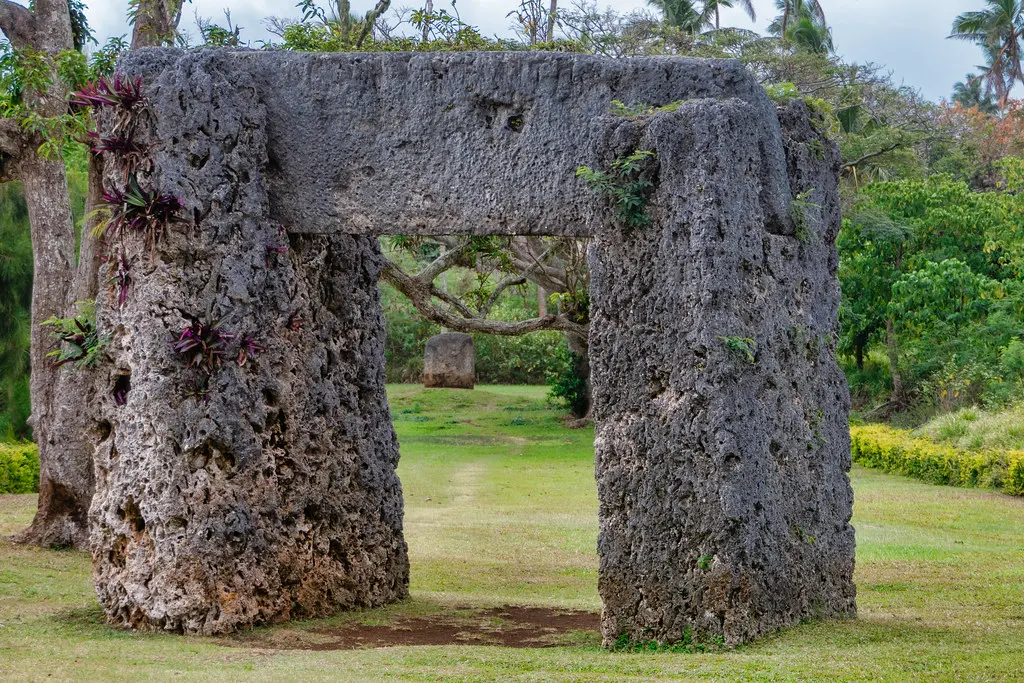
Image of Haʻamonga ʻa Maui. Image source
Visit essentials
A quick read before you go
- Duration
- Roughly twenty to forty-five minutes for most visitors, given the site's compact scale — the…
- Access
- Located at the eastern tip of Tongatapu near the village of Niutōua, in the locality of Heketā,…
Overview
Near Niutōua, three coral-limestone slabs have stood on open grassland for roughly eight hundred years: two uprights and a lintel, now a doorway to a vanished compound. Tradition says Tuʻitātui, eleventh Tuʻi Tonga at the height of his central-Pacific empire, ordered it built as the entrance to his Heketā royal seat, the uprights representing his sons and lintel their bond.
An older myth credits demigod Māui with bringing the stones by canoe from ʻUvea because no ordinary person could move them. Both stories remain side by side. In 1967, King Tāufaʻāhau Tupou IV proposed that a lintel notch tracks the solstice sunrise, a claim Tongan astronomers still debate. Uncontested are tens of tons of stone raised without metal and still standing.
Why this place is sacred
What makes Haʻamonga ʻa Maui feel liminal is not atmosphere in the usual sense — no incense, no chant, no enclosed dark. It is a threshold standing alone in an open field, a doorway with nothing left on either side to walk between. The structure asks a question it does not answer: was this built by a king, or carried by a god, or aimed at the sun?
Tongan tradition holds all three possibilities in the same breath, and the disagreement is not treated as a problem to be resolved but as part of what the stones mean. Standing before something whose exact purpose has slipped out of reach, even as its physical fact remains stubbornly present, is its own kind of thinness: the past pressing close enough to touch, while its intention stays just out of grasp. The scale amplifies this.
Slabs weighing tens of tons, quarried and set without metal tools, make a plain, undeniable claim on the imagination regardless of which origin story a visitor favors.
Most likely constructed as a ceremonial gateway to Tuʻitātui's royal compound at Heketā — the second capital of the Tuʻi Tonga Empire, relocated there from Toloa by his father Momo in the tenth century. If this reading holds, the trilithon marked a threshold between the outside world and the seat of Tongan paramount power at its widest reach.
The royal compound the trilithon once fronted disappeared long ago, leaving the gateway standing without what it once opened onto. Its meaning shifted accordingly — from a functioning entrance within a living court to a freestanding monument read variously as dynastic memorial, mythic relic, and, since 1967, a candidate astronomical instrument. It was placed under formal protection as a national park in 1972 and now sits on Tonga's UNESCO Tentative List, its role having moved from architecture to heritage.
Experience and orientation
Visitors arrive expecting, perhaps, something more theatrical than what's there. The site is unassuming: a mowed field on the eastern tip of Tongatapu, a scattering of interpretive panels, the trilithon itself standing free in open air with nothing else built up around it. That plainness is part of the encounter. Without ropes, crowds, or elaborate staging, the stones are left to make their own case — and they do, mostly through scale.
Standing close enough to see the coral limestone's texture, to register how far above head height the lintel sits, gives a bodily sense of what tens of tons of raised stone actually means, in a way photographs flatten out. Nearby, the ʻesi Maka Faʻakinanga — the leaning stone once used by Tuʻitātui himself — offers a second, smaller point of contact with the same vanished court.
Most visits run short, twenty minutes to three-quarters of an hour, but the site rewards slowing down inside that window: walking the perimeter, sitting a while in the quiet, letting the eye trace the lintel's notch and consider, without needing to settle, what it might once have pointed toward.
The trilithon stands in an open grass park near Niutōua on Tongatapu's eastern end, a short walk from roadside parking. Panels near the stones outline the site's history; the Maka Faʻakinanga stone sits a short distance away within the same park.
Context and lineage
Tongan tradition credits Tuʻitātui, the eleventh Tuʻi Tonga, with ordering the trilithon's construction around 1200 AD as the gateway to his royal compound at Heketā, working with his high chief Loʻau. Heketā itself had been established as the Tuʻi Tonga capital a couple of centuries earlier, when the tenth Tuʻi Tonga, Momo — Tuʻitātui's father — relocated the seat of power there from Toloa.
In this dynastic telling, the trilithon's two upright stones represent Tuʻitātui's two sons, and the lintel resting across them represents the bond between them. Running alongside this historical account is an older oral-mythological one: that the demigod Māui carried the massive stones himself, in some versions bringing them by canoe from ʻUvea (Wallis Island), because their weight put them beyond what ordinary people could move.
Neither story is treated in Tongan tradition as canceling the other; the monument's popular name, Maui's Burden, comes directly from the second.
Heketā, the compound the trilithon is thought to have fronted, was the second capital of the Tuʻi Tonga Empire, established by the tenth Tuʻi Tonga Momo after relocating from Toloa; his son Tuʻitātui, eleventh in the line, is credited with the trilithon itself. The Tuʻi Tonga title continued afterward through further capitals, eventually including Lapaha, where the dynasty's royal tombs stand.
Tuʻitātui
Eleventh Tuʻi Tonga, traditionally credited as the trilithon's builder
Ruled the Tuʻi Tonga Empire at its widest reach across the central Pacific. Tradition holds he commissioned the gateway at Heketā and used the nearby Maka Faʻakinanga stone as a leaning-seat to guard his back against assassination attempts during his reign.
Loʻau
High chief associated with the trilithon's construction
Named in tradition alongside Tuʻitātui as a figure involved in directing the monument's building, though sources give little further detail on his specific role.
Māui
Demigod credited in oral tradition with carrying the stones
The trickster-hero figure common across Polynesian traditions, said in Tongan oral history to have carried the massive stones himself — in some tellings by canoe from ʻUvea — because they were too heavy for ordinary hands. The monument's name, meaning Maui's Burden, comes from this account.
Tāufaʻāhau Tupou IV
King of Tonga, amateur astronomer
Proposed in 1967 that a V-shaped notch cut into the lintel marks solstice and equinox sunrise positions, connecting the ancient monument to a claimed function as a solar calendar. His reading, along with that of Tongan historian Tevita Fale, remains disputed by at least one astronomer.
C.F. Velt
Astronomer, ʻAtenisi Institute
Directly disputes the solstice-notch theory, arguing the notch is too short to function as a precise sightline and more likely served as a simple directional marker along the lintel's axis, with no firm evidence the alignment mattered to the monument's original builders.
Traditions and practice
In its original context, the trilithon is thought to have served the ceremonial and courtly life of the Tuʻi Tonga at Heketā, standing as the threshold into the royal compound. The nearby Maka Faʻakinanga stone carried its own practical-ceremonial role, reportedly used by Tuʻitātui as a protective leaning-seat during his reign, allowing him to rest with his back guarded against attack.
No organized ceremony is documented at the site today. What continues is a layer of national and scholarly interest: the site's status as a cultural symbol of Tongan identity and Tuʻi Tonga heritage, and a recurring popular and semi-official curiosity about the disputed solstice alignment first proposed in 1967, which draws occasional visitors to observe sunrise near the June solstice.
Move slowly around the trilithon rather than straight at it — the site rewards circling, viewing the lintel from multiple angles as its notch catches different light through the day. Spend time at the Maka Faʻakinanga stone as well, imagining its use as a seat rather than only a monument. Resist the urge to resolve the site's central ambiguity; let the coexistence of king, god, and possible solar instrument sit unresolved, since that unresolved quality is close to the point.
Tuʻi Tonga dynastic tradition
HistoricalAttributes the trilithon to Tuʻitātui, eleventh Tuʻi Tonga, built around 1200 AD as a gateway to his royal compound at Heketā, with the two uprights representing his sons and the lintel their bond.
Historically tied to Tuʻi Tonga courtly life at Heketā, including use of the nearby Maka Faʻakinanga stone as a defensive leaning-seat.
Tongan oral mythology (Māui legend)
ActiveCredits the demigod Māui with single-handedly carrying the stones, in some versions by canoe from ʻUvea, giving the monument its name, Maui's Burden.
Ongoing storytelling and oral transmission of the legend, retold to visitors and featured in local guiding and tourism narration.
Modern Tongan astronomical/royal heritage interest
ActiveSince 1967, King Tāufaʻāhau Tupou IV's proposal that a lintel notch marks solstice and equinox sunrise has added a layer of scientific and national interest, though the claim is disputed by astronomer C.F. Velt.
Occasional public and touristic observation of sunrise alignment near the solstices; the claim is widely repeated in tourism and popular-science material.
Perspectives and open questions
Haʻamonga ʻa Maui is read through at least three lenses that Tongan tradition and outside scholarship hold simultaneously rather than resolve.
Scholarly perspective
Archaeologists and historians generally attribute the trilithon to the early thirteenth century, most likely commissioned by Tuʻitātui as a monumental gateway to his royal compound at Heketā, during the Tuʻi Tonga Empire's widest reach across the Pacific. Sources are explicit that this remains an inferred, unconfirmed theory rather than settled archaeological fact — no independent absolute dating has been reported, and the 1967 astronomical-calendar claim is actively disputed within Tongan astronomical circles, notably by C.F. Velt of the ʻAtenisi Institute.
Living and traditional perspectives
Tongan oral tradition holds the monument through two intertwined readings: as a dynastic memorial to royal fatherhood and the bond between Tuʻitātui's two sons, and as evidence of the demigod Māui's superhuman strength, tying the structure into the wider Polynesian mythology of Māui also found in Samoan, Hawaiian, and Māori tradition. The site remains a source of cultural pride and national identity, carried forward in its place on Tonga's own UNESCO Tentative List submission.
Alternative interpretations
Popular 'ancient mystery' outlets emphasize the sheer engineering difficulty of moving thirty-to-forty-ton slabs without metal tools, often placing the Māui legend alongside speculative theories about lost building knowledge. These framings circulate widely in travel and alternative-history media but are not corroborated by the archaeological sources consulted here.
Open questions
The precise construction date, the identity of the responsible Tuʻi Tonga, the original quarry source and transport method for the stones, and above all the monument's intended function — ceremonial gateway, calendrical instrument, or purely symbolic tribute to a father's bond with his sons — remain genuinely open questions on which even specialist sources disagree.
Plan your visit
Access and arrival
Located at the eastern tip of Tongatapu near the village of Niutōua, in the locality of Heketā, an easy day trip from Nukuʻalofa by taxi, private car, or organized tour. Entry is free, with basic facilities including parking and toilets on site.
No specific on-site or immediately adjacent accommodations were identified in research; visitors typically base themselves in or near Nukuʻalofa and visit as a day trip. Check current Tonga Tourism Authority listings for lodging options on Tongatapu.
Respectful visit
No strict dress code is enforced at the monument, but modest clothing is generally appreciated as a matter of broader Tongan custom, which tends toward conservative dress.
Photography of the stones is permitted and common. If local people are present, ask permission before photographing them.
Avoid climbing on or otherwise disturbing the ancient stonework, and follow any posted signage or guidance from site staff.
Treat the stonework as a historic and, for many Tongans, ancestrally significant structure rather than a curiosity to clamber over. There is no formal ritual to observe or inadvertently disrupt, which makes ordinary care and quiet the appropriate register for a visit.
Location
Map loads as you approach this section.
Pilgrim reflections
A portrait of encounter, not a score
Pilgrims describe what they felt, how present they could become, and whether the place would shape a journey. There are no stars and no ranking of traditions.
No reviewed reflections yet
The first pilgrims can help describe the character of being here.
Share a reflection
Available after an account-backed “Been there.” Every reflection is reviewed before publication.
Nearby sacred places
Explore other sacred places in the region. Proximity does not establish access or travel time; check each place’s guidance.



References
Sources consulted for this page. Source categories describe the publication, not a guarantee that every claim is verified. Traditional accounts and outside interpretations may differ.
- 01The Ancient Capitals of the Kingdom of Tonga — UNESCO World Heritage Centre (Tentative List) — UNESCO World Heritage Centre / Government of TongaofficialSite inscribed on Tonga's UNESCO Tentative List (2007) as part of a serial nomination covering Haʻamonga ʻa Maui Historical Park (including the trilithon and the Maka Faʻakinanga stone) and the royal tombs (langi) at Muʻa, under criteria (iii) and (iv). Direct fetch was blocked (403); information drawn from search-result summaries citing this page.
- 02Things To See & Do | Ha'amonga a Maui — Tonga Tourism (Tonga Tourism Authority) — Tonga Tourism AuthorityofficialOfficial Tongan government tourism body page for the site. Direct fetch returned HTTP 403; content drawn from search-result summaries citing this page for visitor access and site framing.
- 03Haʻamonga ʻa Maui — Wikipedia — Wikipedia contributorsacademicCore overview: dimensions, attribution to Tuʻitātui (11th Tuʻi Tonga) and chief Loʻau, astronomical alignment controversy (King Taufaʻahau Tupou IV / Tevita Fale vs. astronomer C.F. Velt), Maka Faʻakinanga throne stone, Māui legend (stones carried by canoe from ʻUvea), 1972 national park protection status.
- 04Ha'amonga 'a Maui in Tonga — World History Commons — World History CommonsacademicConfirms Heketā as the second capital of ancient Tonga, relocated from Toloa by the 10th Tuʻi Tonga Momo in the 10th century, with Tuʻitātui (11th Tuʻi Tonga, Momo's son) reaching the height of the Tuʻi Tonga Empire's expansion and tribute-taking from chiefdoms.
- 05Tuʻi Tonga Empire — Wikipedia — Wikipedia contributorsacademicContext on the Tuʻi Tonga dynasty's maritime empire and its 12th-13th century peak, the period during which Haʻamonga ʻa Maui was built.
- 06Ha'amonga 'a Maui (Trilithon) and 'esi Maka Fa'akinanga — Wondermondo — WondermondoSource contextDetail on the nearby ʻesi Maka Faʻakinanga (chief's leaning/throne stone) associated with the trilithon complex and Tuʻitātui's defensive use of it.
- 07Ha'amonga 'a Maui Guide (Tonga, 2026) — Take Your BackpackSource contextIndependent travel guide with practical access details (transport from Nukuʻalofa, free entry, dry-season visitation patterns July-September, shoulder-season quiet months).
- 08Ha'amonga 'a Maui — prehistoric trilithon in Nuku'alofa, Tonga — OpenDestinations — OpenDestinationsSource contextPractical visitor details: free entry, basic facilities (parking, toilets), open grass-field setting.
- 09Ha'amonga 'a Maui - Tongatapu, Tonga ancient Tongan ruins — Megalithic Builders — Megalithic BuildersSource contextEnthusiast megalith-cataloguing site; used only for cross-checking dimension figures, not as a primary claim source.
- 10The Megalithic Gate of Ha-amonga a Maui — Ancient Origins — Ancient OriginsSource contextAlternative-history-oriented outlet; covers construction-method speculation and legendary/esoteric framing. Direct fetch blocked (403); referenced via search snippet only, used cautiously and flagged as alternative/low reliability per site editorial pattern.
- 11Haamonga 'a Maui up date — Kalapu Feʻofaʻaki — Kalapu Feʻofaʻaki (Tongan community blog)Source contextTongan community-authored blog; potentially closer to a community/diaspora perspective on the site's ongoing significance, but unverified authorship credentials, treated as a low-reliability supplementary source rather than a formal indigenous-authority source.
- 12Discovering the Tongan Stonehenge: Ha'amonga 'a Maui — Tongan Tribes — Tongan TribesSource contextTongan culture-focused website; used for supplementary cultural-pride and community-identity framing, cross-checked against higher-reliability sources rather than relied on alone.
Share a photo
Help visitors recognize Haʻamonga ʻa Maui. Every submission is reviewed before publication.