Tuoro
The point on Rarotonga where spirits departed for the ancestral homeland
Understand sacred places, explore living traditions, and learn how to engage respectfully with Pilgrim Map.
Access has not been verified. Check current local guidance before planning a visit.
Avarua / Nikao, Rarotonga, Rarotonga, Cook Islands
Read the sources
Visit essentials
A quick read before you go
- Duration
- Typically 20 to 60 minutes as part of a self-guided round-island day, longer if swimming or…
- Access
- Located on the Main Road (Ara Tapu) at the western end of Avarua, at Nikao beach across from the…
Overview
At Nikao beach across from Rarotonga Golf Club, Tuoro's dark basalt shelf, roughly 1.9 million years old, descends into clear water. Locally called Black Rock, it is an ordinary swimming, snorkeling, and sunset gathering place.
Rarotongan Māori tradition gives this coast an older, solemn identity: the reinga vaerua, or leaping place of spirits, where souls of the dead were believed to leave Rarotonga forever, traveling west to ancestral Avaiki. This belongs to a documented Polynesian pattern. Aotearoa Māori tell a related Cape Reinga story, and nearby Mangaia records Renga-Vaerua, suggesting fixed departure points for the dead were shared cosmology rather than a purely local invention.
Christianity, arriving through London Missionary Society contact in the 1820s, reshaped many Rarotongan understandings of death and afterlife. Tuoro retains no ritual practice today, but its story endures through telling, teaching, and an official interpretive panel for those who stop to read it.
Why this place is sacred
According to Rarotongan Māori tradition, a person's spirit, once free of the body, made its way to this exact point on the coast, climbed a pua tree growing there, and leapt from its branches to begin the crossing to Avaiki.
Fuller versions of the story, apparently drawn from nineteenth-century missionary-era ethnographic recording, describe the journey as staged rather than immediate: some spirits fell into a net at Tuoro itself, guarded in some tellings by a being named Muru; others pressed on to nearby Nikao, where they paused at a weeping laurel tree to lament what they were leaving, before a final departure from another tree — a pua, or, according to Ngāti Tangi'ia tradition, a toa, an ironwood.
What made this ground significant was never its appearance. It was its function as a named, fixed threshold — the one place on the island where the dead were understood to cross from the world of the living into whatever lay beyond it, in the same way Aotearoa Māori understand Cape Reinga in the far north of their own islands.
A separate strand of Rarotongan afterlife belief, recorded independently, describes a goddess named Miru presiding over a realm of trial and a paradise called Iva, reached by a different logic entirely — coconut kernels hidden on the body to deceive Miru at the crossing.
How, or whether, these two traditions were once understood as a single cosmology, or represent distinct threads recorded by different observers at different times, is not settled in the sources available, and this uncertainty is worth holding rather than resolving in either direction.
Tuoro functioned in pre-Christian Rarotongan cosmology as the reinga vaerua, the departure point from which the spirits of the deceased left the physical world to begin their journey to Avaiki, the ancestral homeland to the west. It carried no separate function as a site of veneration; its significance was narrative and cosmological rather than ritual.
Following London Missionary Society contact beginning in the early 1820s, Christian understandings of heaven and hell substantially reshaped Cook Islands Māori afterlife belief, and the traditional cosmology of Miru, Iva, and the Tuoro departure journey receded from lived religious practice.
The belief did not disappear, however; it persisted as oral tradition and has since been formalized as heritage knowledge, marked with an official interpretive storyboard at the site itself, maintained by the national tourism authority as a piece of living Cook Islands cultural identity rather than a discarded superstition.
Experience and orientation
Arrive at Nikao beach and the first impression is entirely physical: dark basalt rock, worn smooth in places by roughly 1.9 million years of exposure and, before that, by Neolithic-era hands shaping it into adze heads, knives, sling stones, and anchors.
The water is clear, sheltered somewhat from the open ocean by the headland's shape, and locals gather here regularly, especially as the light lowers toward evening — the site's westward orientation makes it one of the island's most reliable sunset points. None of this, on its own, signals what the place has meant. That comes from the storyboard installed at the site, which sets out the tradition of Tuoro as the point where the dead once crossed toward Avaiki.
Reading it standing at the same rock the story describes has a particular effect: the ordinary act of watching the sun sink into the water to the west becomes, for a moment, legible as the exact direction the old cosmology assigned to the departing dead. Visitors are not asked to treat the water differently, or to observe any special conduct beyond ordinary respect. The site holds both identities at once without asking anyone to choose between them.
Tuoro sits on Rarotonga's Main Road (Ara Tapu) at the western edge of Avarua, at Nikao beach directly across from the Rarotonga Golf Club — an easily reached coastal stop on the island's round-road route, facing open water to the west.
Context and lineage
The core tradition, as told by the Cook Islands Tourism Corporation and local guides, holds that after death a person's spirit traveled to Tuoro on Rarotonga's northwest coast, climbed a pua tree growing there, and leapt from its branches to begin the westward crossing to Avaiki.
More elaborate versions, apparently drawing on nineteenth-century missionary-ethnographer recording that could not be directly located in this research, describe a staged journey — a net at Tuoro itself, a pause at a weeping laurel tree at Nikao, a final departure from a further tree.
The relationship between this departure-point tradition and a separately documented strand of Rarotongan afterlife belief, involving the goddess Miru and a paradise called Iva, is not established in available sources; both appear to be genuine pieces of Rarotongan cosmology, recorded by different observers, without a clear account of how — or whether — they were traditionally reconciled into one system.
Muru
Guardian figure associated with the net at Tuoro
In some tellings of the tradition, a being said to guard a net at Tuoro into which some departing spirits fell rather than completing their journey to Avaiki; details of this figure are not fully elaborated in the sources located.
Miru
Goddess of the underworld
Presides over an underworld domain in a separately recorded strand of pre-Christian Rarotongan afterlife belief, distinct from the Tuoro departure narrative; associated with a paradise realm called Iva and a tradition of spirits attempting to deceive her using hidden coconut kernels.
Traditions and practice
According to the tradition, the spirit of a deceased person traveled to Tuoro, climbed a pua tree, and leapt from it to begin the journey to Avaiki. This was understood as something that happened to the dead, not a rite performed by the living — there is no record of the living conducting ceremonies, offerings, or observances toward the site itself in connection with this belief.
The Cook Islands Tourism Corporation and Cook Islands News have documented the installation of an official interpretive storyboard at the site, explaining its history and cosmological significance to both residents and visitors. This is an act of heritage preservation and public education, and it signals that the tradition is actively maintained as cultural knowledge rather than left to fade.
Read the interpretive panel on site before swimming or photographing, and take a few minutes afterward to look west across the water the tradition describes as the direction of the crossing. This is a place to receive a story, not to perform a rite of your own invention.
Rarotongan Māori (Cook Islands Polynesian) traditional cosmology
ActiveTuoro is identified as the reinga vaerua, the leaping place of the spirits, the point from which the souls of the deceased were believed to depart Rarotonga on their journey west to Avaiki, the ancestral homeland — a tradition closely paralleling Aotearoa Māori belief in Cape Reinga and reflecting a shared pan-Polynesian pattern of westward-facing departure points for the dead.
According to the tradition, a departing spirit traveled to Tuoro, climbed a pua tree, and leapt from it to begin the crossing to Avaiki; fuller tellings describe an intermediate risk of falling into a net at Tuoro, or pausing at a weeping laurel tree at Nikao before a final departure from a further tree. No ongoing ritual practice toward the site is documented today; the tradition survives through oral history and heritage interpretation.
Perspectives and open questions
Tuoro is read through at least three distinct lenses — scholarly comparative religion, the Cook Islands Māori community's own heritage framing, and a looser popular mythology discourse — and these do not fully agree on how the tradition relates to other strands of Rarotongan afterlife belief.
Scholarly perspective
Academic sources, notably a Brigham Young University Religious Studies Center comparative review, document that pre-Christian Cook Islands Māori afterlife cosmology was substantially reshaped following London Missionary Society contact from the early 1820s, with traditional concepts of the underworld presided over by Miru and a paradise called Iva giving way over time to Christian heaven-and-hell framing.
Scholars and heritage bodies separately situate the Tuoro departure-point narrative within a well-documented pan-Polynesian pattern of fixed 'leaping places of the spirit,' comparable to Cape Reinga in Aotearoa and Renga-Vaerua on Mangaia — evidence of a shared voyaging-culture cosmology across the wider Polynesian triangle rather than a belief unique to Rarotonga.
Living and traditional perspectives
According to Cook Islands Māori tradition, as represented by the national tourism board, local press, and community cultural-framework documents, Tuoro is the place where the spirits of the dead left Rarotonga to return to Avaiki, the ancestral homeland — a genuine and meaningful piece of ancestral heritage rather than folklore to be outgrown.
It is presented today primarily as heritage knowledge to be preserved and shared through the on-site storyboard, explicitly framed by Cook Islands sources themselves, not only by outside observers, as spiritually significant.
Alternative interpretations
Popular mythology-reference sites frame Avaiki in broader esoteric and comparative-mythology terms, describing it as a cosmic underworld structured like a coconut shell and connecting it to the creation goddess Varima-te-takere. This framing is speculative and synthesized rather than sourced to Cook Islands community authorities, and should be read as popular interpretation rather than established tradition.
Open questions
It remains unresolved how the Tuoro departure narrative traditionally related to the separately documented Miru and Iva afterlife cosmology — whether these were one integrated belief system, sequential historical layers, or distinct district or tribal traditions within Rarotonga and the wider Cook Islands.
The original ethnographic source or sources behind the more elaborate, multi-stage version of the story — the net at Tuoro, the weeping laurel at Nikao, the final tree departure — were not directly located in this research, and likely trace to nineteenth-century missionary-ethnographer recording that would need direct consultation to confirm precise wording and attribution.
Plan your visit
Access and arrival
Located on the Main Road (Ara Tapu) at the western end of Avarua, at Nikao beach across from the Rarotonga Golf Club. Freely accessible by car, scooter, bicycle, or the round-island bus service, with no entry fee and no restricted access reported.
No specific on-site or immediately adjacent accommodation is documented in available sources; the site sits within Avarua's western edge, close to the island's main town and its range of visitor lodging.
Respectful visit
No specific dress code applies beyond standard modest beach and swimwear etiquette appropriate to a public Rarotonga beach; no ceremonial dress requirements are documented.
No restrictions apply. The site is an openly promoted public attraction with an official interpretive panel intended to be read and photographed by visitors.
No tradition of leaving offerings at the site has been documented, either historically or today.
No formal tapu prohibitions or community objections govern visiting or discussing Tuoro; the tourism authority itself promotes the site and its story. What matters is framing: this is a genuine sacred narrative about death for the Cook Islands Māori community, not a haunted-house curiosity, and it deserves the same respect one would extend to a culturally significant cemetery or memorial elsewhere, even while the same water functions as an everyday swimming spot.
Multiple travel sources note that swimming conditions at Black Rock can involve strong currents and reduced visibility at times — a safety consideration separate from, but worth pairing with, the cultural weight of the site.
Location
Map loads as you approach this section.
Pilgrim reflections
A portrait of encounter, not a score
Pilgrims describe what they felt, how present they could become, and whether the place would shape a journey. There are no stars and no ranking of traditions.
No reviewed reflections yet
The first pilgrims can help describe the character of being here.
Share a reflection
Available after an account-backed “Been there.” Every reflection is reviewed before publication.
Nearby sacred places
Explore other sacred places in the region. Proximity does not establish access or travel time; check each place’s guidance.

Arai-Te-Tonga Marae
Avarua / Ngatangiia, Rarotonga, Rarotonga, Cook Islands
6.7 km away
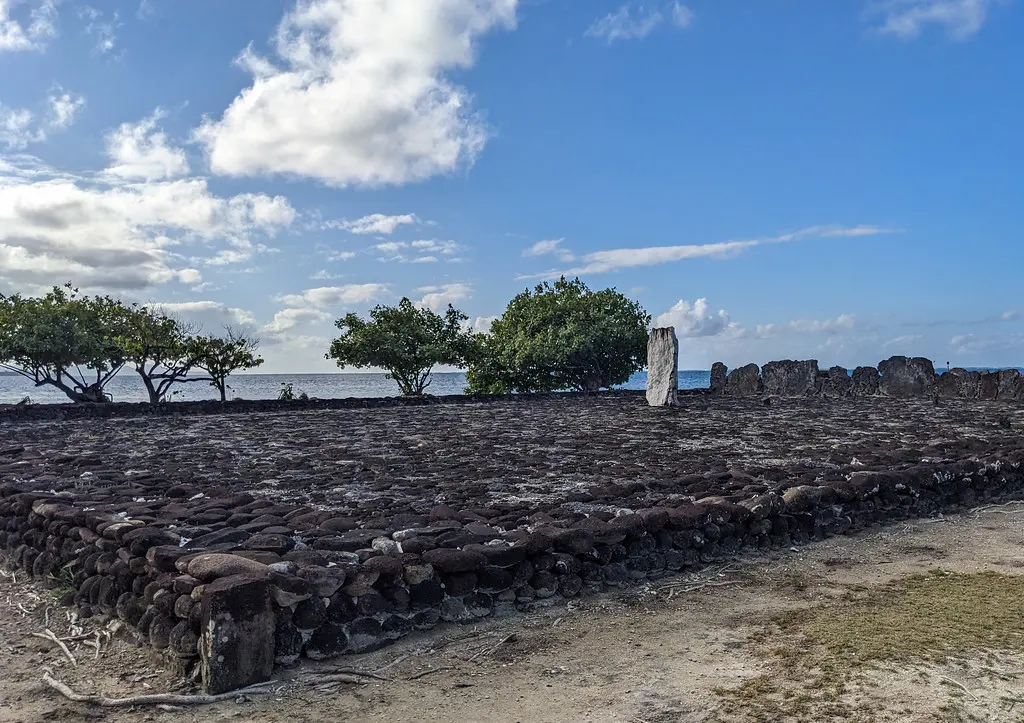
Marae Taputapuātea
Opoa, Raiatea, Society Islands, Leeward Islands, French Polynesia
1010.5 km away

Maeva Archaeological Site
Maeva, Huahine, Society Islands, Leeward Islands, French Polynesia
1052.1 km away

Matapa Chasm
Hikutavake, Niue, Hikutavake, Niue
1076.1 km away
References
Sources consulted for this page. Source categories describe the publication, not a guarantee that every claim is verified. Traditional accounts and outside interpretations may differ.
- 01Tuoro | Cook Islands — Cook Islands Tourism CorporationofficialOfficial national tourism board page dedicated to the site; covers name meaning, archaeological significance (1.9-million-year-old basalt, Neolithic stone-working), and the spirit-departure tradition (ascent of pua tree, journey to Avaiki), explicitly drawing the comparison to Cape Reinga in Aotearoa.
- 02Nikao — Wikipedia — Wikipedia contributorsacademicConfirms Black Rock's exact location (Nikao beach, across from Rarotonga Golf Club) and restates the oral tradition of spirits departing for Avaiki from this point.
- 03Heaven and Hell in the Eyes of Cook Islands Maori: A Comparative Review of Three Time Periods — Religious Studies Center, Brigham Young UniversityacademicAcademic comparative-religion source tracing Cook Islands Māori afterlife cosmology across pre-contact, missionary-contact, and modern periods. Describes the goddess Miru, the paradise Iva, and the coconut-kernel deception-of-Miru motif. Does not name Tuoro/Black Rock or 'Pō' directly, indicating this may document a related but distinct strand of Rarotongan afterlife belief from the Avaiki/Tuoro departure-point tradition; useful for corroborating that Cook Islands Māori afterlife belief was reshaped substantially after 1821 LMS missionary contact.
- 04Our History and People | Cook Islands — Cook Islands Tourism CorporationofficialGeneral official tourism-board overview of Cook Islands history and cultural identity, used as supporting context for how heritage sites are framed by the national tourism authority.
- 05Turanga Māori: A Cook Islands Conceptual Framework (Nga Vaka o Kāiga Tapu) — Pasefika Proud / Cook Islands community contributorsSource contextCommunity/government-affiliated Pacific cultural-framework document authored with Cook Islands Māori community input, used to ground the discussion of tapu, ariki authority over sacred matters, and how traditional Cook Islands spiritual concepts are applied in contemporary community contexts (not site-specific but authoritative on the living meaning of tapu today).
- 06Storyboard explains the story of Tuoro — Cook Islands NewsSource contextLocal Cook Islands news outlet; article about the unveiling of an interpretive storyboard/panel at the site. Direct fetch returned 403 (site likely blocks bots), so content here is drawn from search-engine summary only, not full independent verification. Confirms the site now carries an official on-site interpretive panel for both visitors and locals, indicating active heritage-preservation interest rather than a forgotten legend.
- 07Tapu (Polynesian culture) — Wikipedia — Wikipedia contributorsacademicGeneral reference on the pan-Polynesian tapu/noa framework, used for background on how sacredness and restriction concepts operate across Polynesian cultures including the Cook Islands.
- 08Black Rock | Rarotonga, The Cook Islands | Attractions — Lonely PlanetSource contextReputable travel publisher entry; corroborates the basic spirit-departure narrative and visitor-facing description of the site as a swimming/snorkeling spot with cultural significance.
- 09Black Rock | Free Activity in Cook Islands — Cook Islands Pocket GuideSource contextLocally-run Cook Islands travel guide; corroborates location, Neolithic stone-working history, and the spirit-departure legend, and notes the on-site interpretation panel.
- 10File:Black Rock (Tuoro) (souls leave for Avaiki), Rarotonga, Cook Islands.jpg — Wikimedia Commons contributorSource contextCrowd-sourced media file caption; used only as corroborating evidence that the 'souls leave for Avaiki' framing is a widely repeated, standard description of the site rather than a single source's invention.
- 11Avaiki: The Sacred Underworld Beneath Creation — MythlokSource contextGeneral mythology-reference website (not academic or indigenous-authored); used cautiously for background on Avaiki cosmology (the goddess Varima-te-takere, the coconut-shell underworld structure) and for corroborating that Black Rock is widely cited online as the best-known real-world departure point associated with Avaiki. Treat mythological details here as popular synthesis rather than primary ethnographic record.
Share a photo
Help visitors recognize Tuoro. Every submission is reviewed before publication.