Point Conception
The Western Gate where Chumash souls depart for paradise across the sea
Santa Barbara County, United States

Plan this visit
Practical context before you go
Not applicable
No physical access to Point Conception. Appropriate engagement is through education, respect for Chumash traditions, and supporting protection efforts.
At a glance
- Coordinates
- 34.4486, -120.4716
- Type
- Sacred Natural Site
- Suggested duration
- Not applicable
Pilgrim tips
- Not applicable for Point Conception itself. If visiting nearby coastal areas, dress appropriately for California coast conditions.
- Not applicable for Point Conception itself. If visiting nearby areas like Jalama Beach, be respectful and aware that the broader landscape holds sacred significance.
- Do not attempt to access Point Conception, which is on private land. Respect that specific ceremonial practices are private matters for Chumash people. Avoid treating the site's spiritual significance as mere curiosity or tourism opportunity.
Overview
Point Conception marks the most sacred boundary in Chumash cosmology: the Western Gate through which souls of the dead depart the earthly realm for Similaqsa, the heavenly paradise across the sea. Known as Humqaq, meaning 'The Raven Comes,' this dramatic coastal headland represents the threshold between worlds. According to traditions recorded from Chumash elders, three days after burial a soul rises from the grave and wanders for five days among the places it knew in life before making its way here, to the wild and stormy cliffs where the Santa Barbara Channel meets the Pacific Ocean, to begin its celestial journey along the Milky Way.
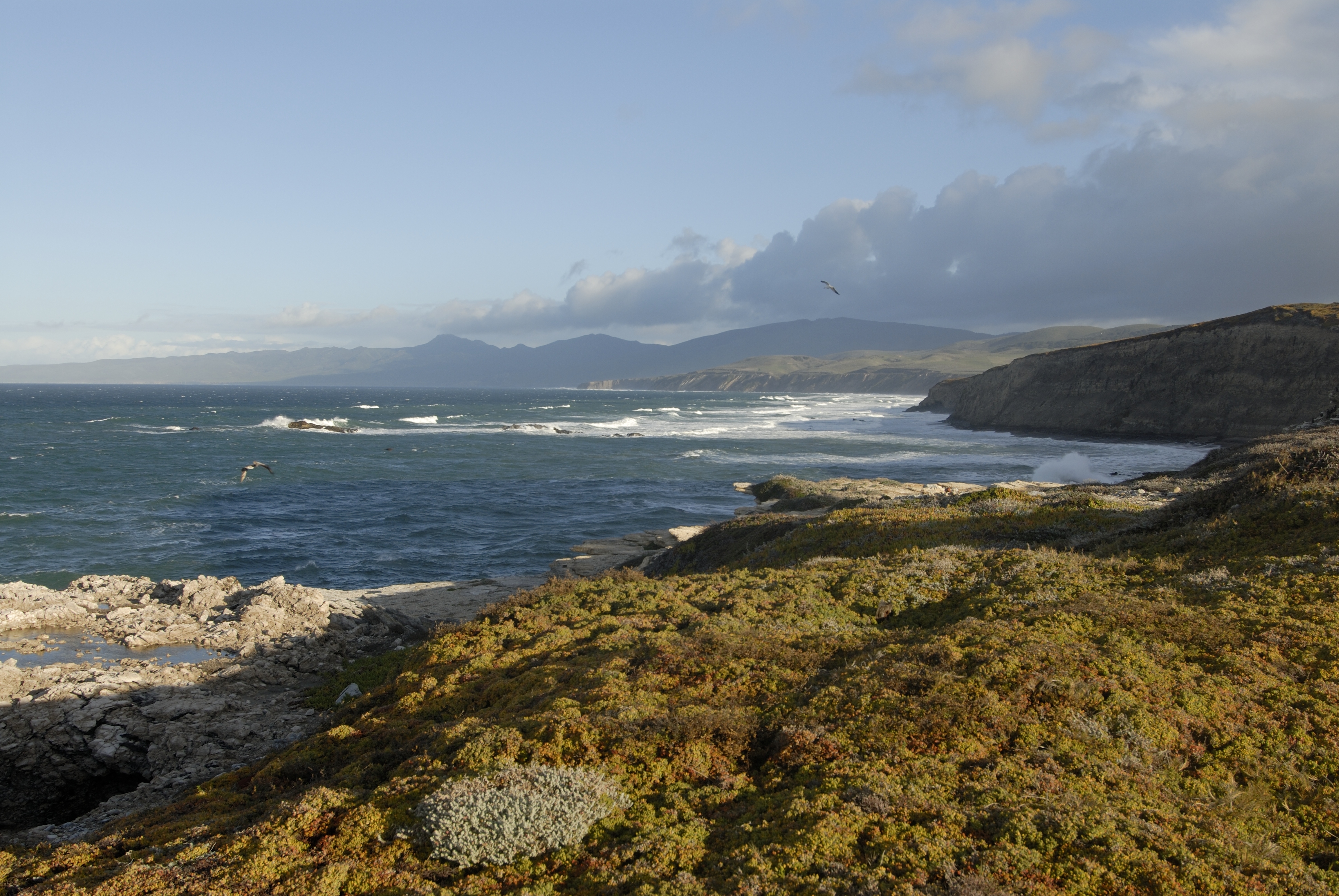
In the Chumash spiritual geography mapped across 18,000 years of continuous presence on the central California coast, no place holds greater sacred significance than Humqaq. This is where souls complete their earthly existence and depart. The name itself reveals the site's nature: 'The Raven Comes.' In Chumash cosmology, the Raven plays an essential role in the transition between worlds, giving departing souls the celestial eyes they need to travel the Path of the Dead, the Milky Way, toward Similaqsa, the paradise from which souls eventually return through reincarnation. Traditional accounts describe a pool at the base of the cliffs at Humqaq where souls bathe before departing. The footprints of women and children are said to be visible in the stone there. In ancient times, no one ever went near Humqaq out of respect for its sacred nature. This was not prohibition from taboo but reverence for threshold. You do not casually approach the doorway between worlds. The geography itself seems to declare the site's significance. Here the California coastline makes a sharp turn, the point where the east-west trending Santa Barbara coast meets the north-south run of the Pacific shore. The collision of currents and climates creates a boundary between ecological regions, a biological transition zone that mirrors the spiritual one. The waters are wild, the winds strong, the cliffs dramatic. Even without knowledge of Chumash tradition, one senses something liminal about this place. Point Conception cannot be visited in any ordinary sense. The point itself lies on private land, now the Dangermond Preserve managed by The Nature Conservancy, surrounded by military installations and closed to the public. This inaccessibility aligns with the traditional practice: the sacred is best honored from a distance. The 2024 designation of the Chumash Heritage National Marine Sanctuary, the first Indigenous-nominated national marine sanctuary in U.S. history, represents a modern form of protection for this ancient threshold.
Context and lineage
According to traditions recorded from Maria Solares, a Samala Chumash historian, souls undertake a specific journey after death. Three days after burial, the soul rises from the grave in the evening. It spends five days wandering the places it frequented in life before returning to the grave to oversee the destruction of its property. Then it departs for Point Conception, Humqaq, which is wild and stormy. In ancient times no one ever went near Humqaq. There is a place below the cliff reachable only by rope where a pool receives continuously dripping fresh water. In the stone can be seen the footprints of women and children. From this threshold, the soul must discard its earthly eyes and receive celestial eyes from the Raven before it can travel the Path of the Dead, the Milky Way, to Similaqsa, the paradise across the sea from which souls are eventually reincarnated.
Point Conception exists within the broader Chumash sacred geography that includes the Channel Islands, coastal villages, sacred mountains like Owotoponu (Grass Mountain), and the network of sacred sites throughout the Central California coast. The site's significance connects to similar concepts of western gates and afterlife journeys found in other California Indigenous traditions.
Maria Solares
J.P. Harrington
Jack and Laura Dangermond
Why this place is sacred
Point Conception is thin in the original sense of thin places: a location where the barrier between this world and another grows permeable. For the Chumash, this was not metaphor but cosmological fact. Souls of the dead literally passed through here on their journey to Similaqsa. The departure was not instantaneous but structured. Maria Solares, a Samala Chumash historian whose knowledge was recorded by ethnographer J.P. Harrington in the early twentieth century, described the soul's journey in precise terms. Three days after burial, the soul rises from the grave in the evening. Between the third and fifth day, it wanders the world visiting places it knew in life. On the fifth day, it returns to the grave to oversee the destruction of its property, then departs for Humqaq. At the point, in a place below the cliffs reachable only by rope, a pool of fresh water continuously drips. The soul bathes here before the final departure. The geography reinforces the sense of boundary. Point Conception marks where two worlds of coastline meet. North of here, the Pacific runs cold; south, currents bring warmer waters. Ecosystems that characterize northern and southern California both reach their limits at this point. Marine biologists recognize Point Conception as one of the most significant biogeographic boundaries on the Pacific coast. What the Chumash understood spiritually, science now confirms ecologically: this is a place of transition, where one realm gives way to another. That the site cannot be visited heightens rather than diminishes its sacred character. The Western Gate was never meant for casual approach. Its power lies precisely in its status as threshold, a place one passes through on the way to somewhere else. To try to visit Point Conception as a tourist destination would miss the point. But to know of it, to understand what the Chumash understand about this landscape, to honor the souls who departed here across eighteen thousand years, this is the access that matters.
Threshold between worlds in Chumash cosmology. Place where souls depart for the afterlife.
Sacred use documented for 18,000 years. Traditional practices restricted Spanish colonial intrusion. 1978 occupation by Chumash and allies prevented LNG facility development. 2017 Dangermond Preserve acquisition protected the land. 2024 Chumash Heritage National Marine Sanctuary designation established first Indigenous-nominated marine sanctuary in U.S. history.
Traditions and practice
Ancient Chumash traditions describe the soul's journey to Point Conception as the final stage of leaving the earthly realm. At Humqaq, the soul bathes in the sacred pool before departing for Similaqsa. The Raven provides celestial eyes needed for the journey along the Path of the Dead. In ancient times, the site's sacredness meant no one approached it. Winter solstice ceremonies (Kakunupmawa) in Chumash communities honor the cosmic order that includes the soul's journey, though specific ceremonies at Point Conception itself are private tribal matters.
Contemporary Chumash practice includes honoring Point Conception's significance through advocacy, education, and protection efforts. The successful campaign for the Chumash Heritage National Marine Sanctuary represents active spiritual stewardship of the sacred seascape. Winter solstice ceremonies continue in Chumash communities. Specific ceremonial practices at Point Conception remain private matters for Chumash practitioners.
Learn about Chumash cosmology and the significance of the Western Gate. Support protection efforts for the Chumash Heritage National Marine Sanctuary. If visiting nearby areas like Jalama Beach, approach with awareness that the broader landscape holds sacred significance. Do not attempt to access Point Conception itself. Honor the site through understanding rather than physical presence.
Chumash Western Gate Tradition
ActivePoint Conception is the Western Gate (Humqaq) through which souls of the dead pass on their journey to Similaqsa, the heavenly paradise. The site represents the threshold between the earthly world and the afterlife in Chumash cosmology, one of the most sacred places in Chumash territory.
Traditional accounts describe the soul's bathing in the sacred pool before departure, the Raven's gift of celestial eyes, and the journey along the Path of the Dead (Milky Way). Contemporary Chumash practice includes advocacy and protection efforts, ceremonial observances in the broader region, and transmission of oral traditions. Specific practices at Point Conception itself remain private.
Experience and perspectives
Unlike most sacred sites, Point Conception does not offer a visitor experience in the conventional sense. The point itself is on private land, the Dangermond Preserve managed by The Nature Conservancy, with no public access. Surrounding areas include Vandenberg Space Force Base and private ranches. The State Marine Reserve can be reached only by boat. There are no tours, no interpretive signs, no designated viewpoints. This inaccessibility should not be understood as failure but as appropriateness. In ancient times, no one approached Humqaq. The site's sacredness required distance. Modern restrictions, however different in origin, achieve a similar effect: the Western Gate remains apart from ordinary access, encountered primarily through knowledge rather than presence. What can be experienced is the broader sacred landscape of which Point Conception is the culmination. Jalama Beach County Park, north of the point, provides public coastal access where the dramatic California coastline can be felt if not the precise threshold. The Chumash Heritage National Marine Sanctuary encompasses waters that hold their own sacred significance. Understanding the Chumash cosmological geography, the soul's journey from grave to gate, the Raven's gift of celestial eyes, the Path of the Dead along the Milky Way to Similaqsa, this is the experience available to those who cannot and should not approach the physical site. For Chumash people, Point Conception remains spiritually accessible in ways that do not require physical presence. The continued advocacy for the site's protection, the successful sanctuary designation, the ongoing transmission of oral traditions, these constitute relationship with the Western Gate that transcends tourism. Outsiders can honor this by learning, by supporting protection efforts, and by recognizing that some sacred places are best approached through reverence rather than visitation.
Point Conception is located where the Santa Barbara Channel meets the Pacific Ocean. The point itself is not publicly accessible. Jalama Beach County Park to the north provides the closest public coastal access. The Chumash Heritage National Marine Sanctuary encompasses surrounding waters.
Point Conception exists at the intersection of Chumash cosmology, California sacred geography, and ongoing Indigenous advocacy for sacred site protection.
Archaeological research confirms over 18,000 years of human presence at Point Conception, with at least 50 documented archaeological sites including shell middens, villages, and rock art. The academic article 'Cultural Keystone Places and the Chumash Landscapes of Kumqaq' establishes the site's significance using the Cultural Keystone Place framework. Analysis of J.P. Harrington's ethnographic fieldnotes suggests that historical Chumash beliefs about Point Conception may have been more diverse across different communities than sometimes represented, though the site's sacred significance is not disputed.
For Chumash people, Point Conception remains the Western Gate, a sacred threshold of profound spiritual significance where souls depart for the afterlife. This is not historical belief but living spiritual reality honored through contemporary practice, advocacy, and the successful establishment of the Chumash Heritage National Marine Sanctuary. Traditional teachings emphasize that in ancient times, the site's sacredness meant no one approached it, a principle that some would argue modern access restrictions appropriately maintain.
Some non-Indigenous spiritual seekers have expressed interest in Point Conception as a 'thin place' or gateway between worlds. However, it is essential that such interest not lead to cultural appropriation or disrespect. The site's significance belongs to the Chumash people, and any spiritual engagement by outsiders should be informed by and respectful of Indigenous teachings and wishes.
The full extent of oral traditions regarding the soul's journey beyond what was recorded by Harrington remains unknown. The complete archaeological record of the restricted area has not been documented. The exact location and nature of the sacred pool described in traditional accounts is not publicly known. How beliefs and practices at Humqaq varied among different Chumash villages and language groups cannot be fully reconstructed.
Visit planning
Jalama Beach County Park has campground. Lompoc and Santa Barbara offer hotel options.
No physical access to Point Conception. Appropriate engagement is through education, respect for Chumash traditions, and supporting protection efforts.
Not applicable for Point Conception itself. If visiting nearby coastal areas, dress appropriately for California coast conditions.
Not applicable for Point Conception itself. If visiting nearby areas like Jalama Beach, be respectful and aware that the broader landscape holds sacred significance.
Offerings and ceremonies are private matters for Chumash practitioners, not appropriate for general visitors.
No public access to Point Conception (private land). Respect that this is an active Indigenous sacred site. Do not attempt to access restricted areas. Honor Chumash requests regarding site protection. Avoid treating the site's spiritual significance as tourism content.
Plan your visit
Address
Point Conception, California 93436, USA
Hours, fees, and access can change — verify on the official source before you travel. Practical details last checked Jun 2026.
Nearby sacred places
Sacred places within a half-day’s reach. Pilgrims often visit them together: walk one, stay for the other.
Point Conception, California
Santa Barbara County, California, United States
0.0 km away
Mount San Jacinto, California
Riverside County, California, United States
356.1 km away
Mount Diablo, California
Contra Costa County, California, United States
403.1 km away
Tecate Peak, California
Tecate, California, United States
413.8 km away
References
Sources consulted when researching this page. Independent verification by readers is welcome.
- 01Cultural Keystone Places and the Chumash Landscapes of Kumqaq', Point Conception, California — American Antiquity, Cambridge University Presshigh-reliability
- 02Point Conception and the Chumash Land of the Dead: Revisions from Harrington's notes — ResearchGate / eScholarshiphigh-reliability
- 03Sacred Sites — Northern Chumash Tribal Councilhigh-reliability
- 04Chumash Heritage National Marine Sanctuary — NOAA Office of National Marine Sanctuarieshigh-reliability
- 05Chumash Heritage National Marine Sanctuary — Chumash Heritage National Marine Sanctuary Foundationhigh-reliability
- 06How the Chumash Tribe Secured the First Indigenous-Led Marine Sanctuary in U.S. History — David and Lucile Packard Foundationhigh-reliability
- 07Protecting Point Conception, California—Maps and Sensors Aid Science — Esrihigh-reliability
- 08GPS coordinates of Point Conception — Latitude.tohigh-reliability
- 09Exploring California's MPAs: Point Conception State Marine Reserve — California Department of Fish and Wildlifehigh-reliability
- 10Chumash Hutash Honoring Project and Winter Solstice Celebration — Tribal Trust Foundationhigh-reliability
Key questions
What pilgrims usually ask
- Why is Point Conception considered sacred?
- Learn about Point Conception, the sacred Western Gate in Chumash cosmology where souls depart for the afterlife. The first Indigenous-nominated U.S. marine sanc
- What should I wear at Point Conception?
- Not applicable for Point Conception itself. If visiting nearby coastal areas, dress appropriately for California coast conditions.
- Can I take photos at Point Conception?
- Not applicable for Point Conception itself. If visiting nearby areas like Jalama Beach, be respectful and aware that the broader landscape holds sacred significance.
- How long should I spend at Point Conception?
- Not applicable
- What offerings are appropriate at Point Conception?
- Offerings and ceremonies are private matters for Chumash practitioners, not appropriate for general visitors.
- What etiquette should visitors follow at Point Conception?
- No physical access to Point Conception. Appropriate engagement is through education, respect for Chumash traditions, and supporting protection efforts.
- What is the history of Point Conception?
- According to traditions recorded from Maria Solares, a Samala Chumash historian, souls undertake a specific journey after death. Three days after burial, the soul rises from the grave in the evening. It spends five days wandering the places it frequented in life before returning to the grave to oversee the destruction of its property. Then it departs for Point Conception, Humqaq, which is wild and stormy. In ancient times no one ever went near Humqaq. There is a place below the cliff reachable only by rope where a pool receives continuously dripping fresh water. In the stone can be seen the footprints of women and children. From this threshold, the soul must discard its earthly eyes and receive celestial eyes from the Raven before it can travel the Path of the Dead, the Milky Way, to Similaqsa, the paradise across the sea from which souls are eventually reincarnated.
- Who is associated with Point Conception?
- Maria Solares, J.P. Harrington, Jack and Laura Dangermond