Pobull Fhinn
An oval of ancient stones on a hand-cut terrace, named for a mythological hero who never left
Understand sacred places, explore living traditions, and learn how to engage respectfully with Pilgrim Map.
Access has not been verified. Check current local guidance before planning a visit.
Lochmaddy, Scotland, United Kingdom
Read the sources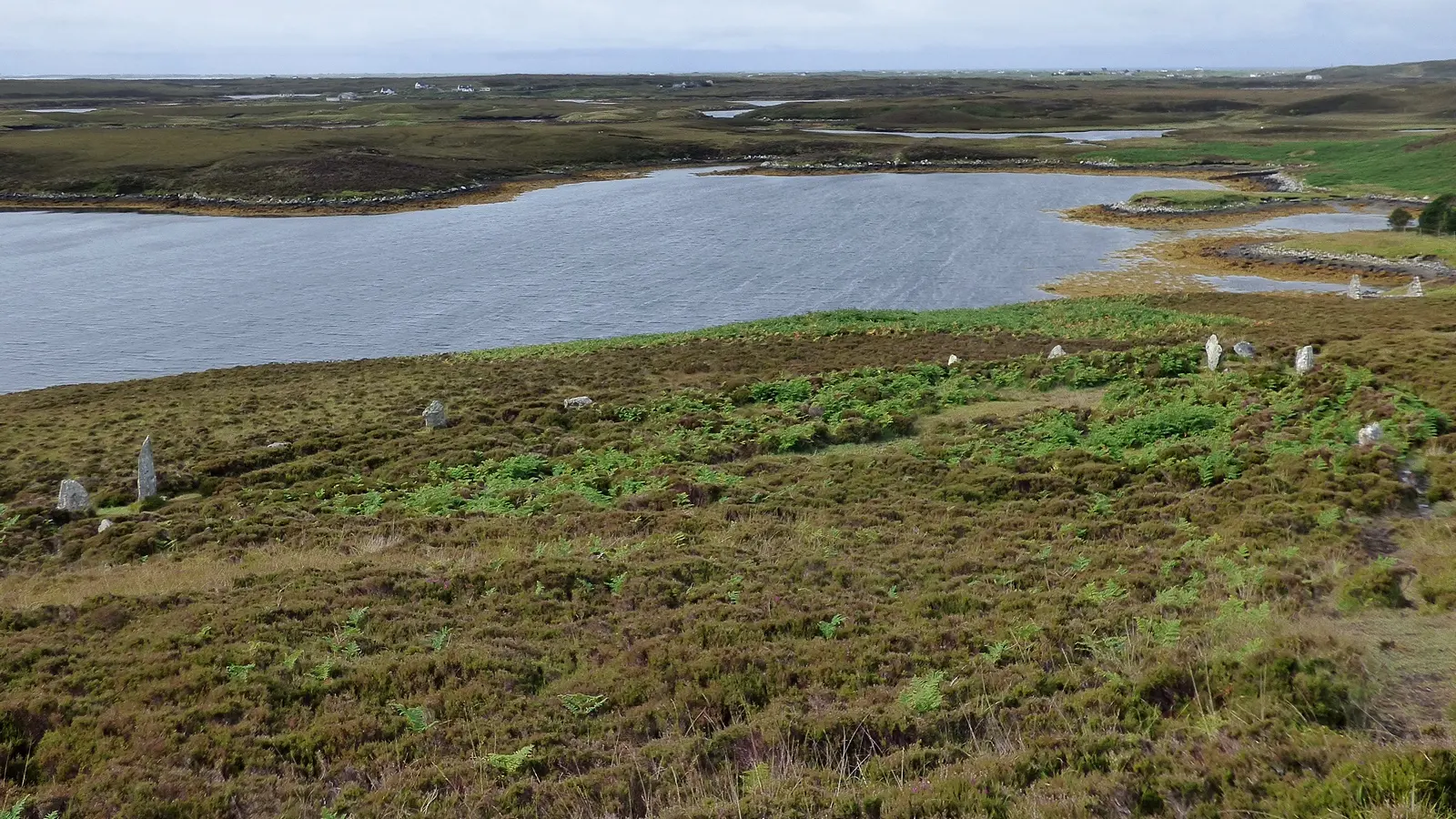
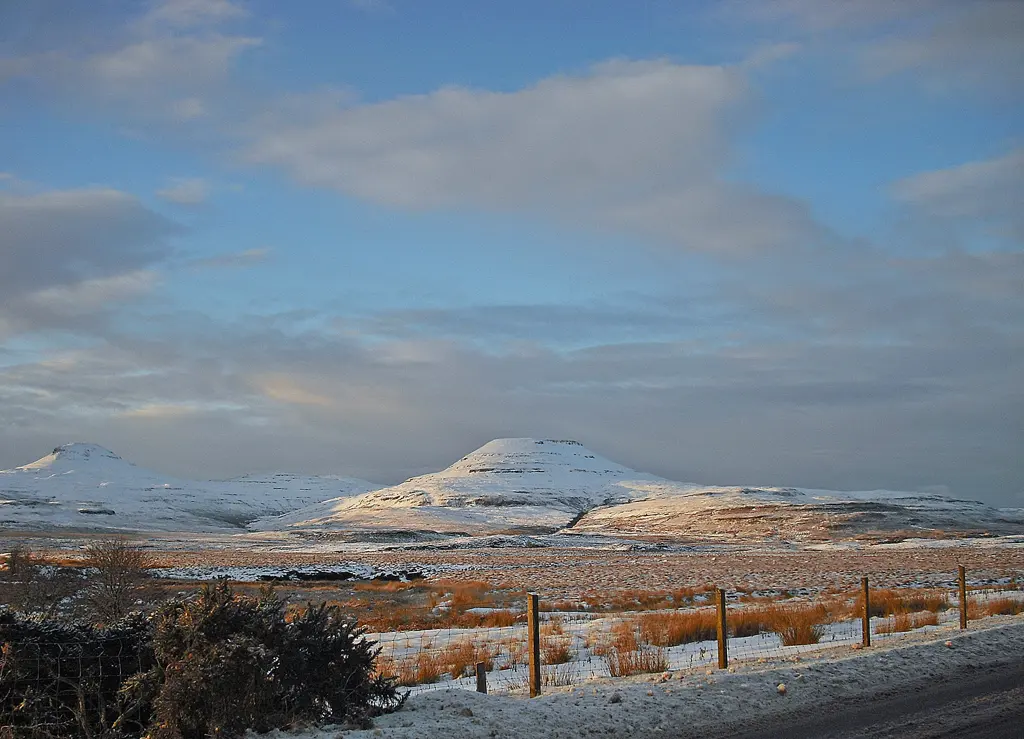
Image of Pobull Fhinn. Image source · CC-BY-SA-2.0
Visit essentials
A quick read before you go
- Duration
- 1 to 2 hours including the walk and time at the stones
- Etiquette
- Respect the Scheduled Monument.
Overview
You approach Pobull Fhinn from below. The path rises through moorland and bracken on the flank of Ben Langass, and the stones appear gradually against the sky, jagged and irregular, silhouetted against the waters of Loch Langass stretching east toward Eaval. The setting alone would justify the walk. But what distinguishes this place is what you cannot immediately see: the ground beneath the stones is not natural.
Sometime during the second millennium BCE, a community cut approximately four feet into the hillside and used the excavated earth to build up the southern edge, creating a level terrace on which they set their stones in an oval roughly thirty-seven metres across.
The labour required was considerable. These were not people idly arranging rocks. They reshaped the earth itself to make a platform for what mattered to them, and what mattered has been lost. No archaeologist has ever dug here. The stones have never yielded a radiocarbon date or a diagnostic artefact. What they have yielded is names. The Gaelic-speaking communities who came after called this place Pobull Fhinn, the people of Fionn mac Cumhaill, the legendary hero of the Fenian cycle.
They called it Puball Fhinn, Fionn's tent, as though the great warrior had pitched camp on this hillside during his endless wanderings. They called it Sornach Coir' Fhinn, the fireplace of Fionn's cauldron, placing a cooking fire among the stones. And they called it Sornach a' Phobaill, the fireplace of the People, shifting the emphasis from the hero to the community itself.
Each name tells a different story about the same stones. Together they describe a place of gathering, of nourishment, of shelter and belonging. The original builders left no written record of their intentions, but the names their successors gave speak of exactly the things a community gathers for: warmth, food, stories, the presence of others. Half a mile away, on the opposite slope of Ben Langass, the Neolithic chambered cairn of Barpa Langass held the community's dead.
Between the cairn and the circle, the living and the dead shared the same hillside for millennia.
Why this place is sacred
The thinness of Pobull Fhinn operates through absence. No one knows why the stones are here. No excavation has established a date, a purpose, or even an accurate count of the original stones. Estimates range from twenty-four to forty-eight, depending on whether you count the partially buried, the fallen, and the uncertain. The oval may have been a complete circuit or may always have had gaps.
The low wall along the northern edge may be part of the original design or a later addition. Nearly everything about this site exists in a state of not-quite-knowing.
This uncertainty is not a failure. It is a condition of the place. The stones do not explain themselves. They stand in their oval on their manufactured terrace and look out across the loch, and the questions they provoke have no confirmed answers. For a visitor willing to sit with that, the experience becomes something other than education. It becomes an encounter with the limits of knowledge, with the silence that surrounds even the most carefully surveyed monument.
The Gaelic names add a different dimension. By calling the stones Fionn's people, Fionn's tent, Fionn's fireplace, later communities did not explain the monument. They transformed it. The stones became characters in a mythology that stretched across Scotland and Ireland, part of the Fenian cycle that is one of the great narrative traditions of Gaelic literature. The transformation was itself an act of meaning-making: when you cannot know what a place was, you can still decide what it means.
The names chose warmth, companionship, heroic wandering. The stones became a campsite of the Fianna, a place where legendary warriors gathered around a fire beneath the open sky. That image has outlasted whatever ceremony the builders intended.
The Hebridean landscape completes the effect. The light here is never still. Cloud, sun, rain, and wind cycle through in combinations that can shift the appearance of the stones within minutes. The water of Loch Langass reflects and absorbs light differently at every hour. Eaval changes colour with the weather. The remoteness of the Outer Hebrides means that these changes play out without the intrusion of modern noise.
What you hear at Pobull Fhinn is wind, water, birds, and your own breathing. The silence is not empty. It is the accumulated quiet of four thousand years of the same wind crossing the same stones.
Unknown. The substantial engineering of the platform and the deliberate oval arrangement of stones indicate communal ceremonial use during the Bronze Age. The proximity to Barpa Langass, a Neolithic communal burial cairn on the opposite slope of Ben Langass, suggests the wider landscape served interconnected ritual and funerary purposes spanning at least a millennium. No excavation has been conducted, so all interpretations of original function remain conjectural.
The original Bronze Age use is undocumented. At some point, Gaelic-speaking communities incorporated the monument into the mythology of the Fenian cycle, attributing it to Fionn mac Cumhaill and the Fianna. Erskine Beveridge provided one of the first detailed descriptions in his 1911 publication on the archaeology of North Uist. The RCAHMS survey of 1928 established the formal archaeological record. The monument was scheduled in 1991 under the Ancient Monuments and Archaeological Areas Act 1979.
In 2009, a gravel footpath was constructed to improve visitor access, with a watching brief that found no significant archaeological material. The site is now one of the most visited locations on North Uist, positioned on the Hebridean Way long-distance walking route.
Experience and orientation
The walk from the road takes about fifteen minutes. You leave the A867 near Langass Lodge and follow a gravel path that climbs the southern flank of Ben Langass through open moorland. The path was built in 2009, and it does the practical work of keeping your feet above the bog, but it also does something less tangible: it slows you down. The gradient is modest but steady, and the landscape opens around you as you climb.
Loch Langass appears to the east, its surface reflecting whatever the sky is doing. Bracken and heather press close to the path. In summer, the moorland flowers.
The stones announce themselves before you reach them. They are not tall in the way that the megaliths of Callanish or Brodgar are tall, but they are unmistakable against the sky, a ragged line of Lewisian gneiss breaking the smooth contour of the hillside. As you approach, the engineering becomes apparent. The ground beneath the stones is level in a way that the hillside around it is not.
The terrace was cut from the slope, and the excavated earth was deposited on the downhill side to extend the platform southward. Someone decided that this specific elevation on this specific hillside needed to be flat, and made it so.
Inside the oval, the scale becomes intimate. Thirty-seven metres is not vast. You can see every stone from the centre. Some stand upright and sharp-edged, especially on the northern half where eight prominent stones rise above the rest. Others lean or lie flat. The tallest stone, at the southeast, exceeds two metres. A possible portalled entrance on the east side faces the loch and the mountain beyond it, though whether this alignment is deliberate or coincidental has not been determined.
The view east is the heart of the experience. Loch Langass stretches toward Eaval, and beyond Eaval the waters of Loch Eport wind toward the sea.
The composition of stone, water, and mountain has a quality that photographs capture but cannot fully convey, because what the photographs miss is the movement of the air, the shifting of the light, and the particular silence of a Hebridean hillside in the middle of a landscape that has not fundamentally changed since the stones were set.
If you continue on the path that leads over the shoulder of Ben Langass, you reach Barpa Langass in about twenty minutes. The Neolithic chambered cairn sits on the opposite slope, its massive stone cairn visible from a distance. The walk between the two monuments crosses the ridge of the hill, and for a few minutes you stand at a height from which both the circle and the cairn are visible, the living and the dead sharing the same view.
This circular walk, returning to the road by a different path, takes two to three hours and is the full experience of the ritual landscape of Ben Langass.
Pobull Fhinn sits on the southern slope of Ben Langass, a hill on the Isle of North Uist in the Outer Hebrides. The oval of stones faces generally east, looking across Loch Langass toward the mountain Eaval and the sea loch Eport beyond. The access path approaches from the southwest, rising from the A867 road near Langass Lodge. Barpa Langass chambered cairn lies approximately half a mile to the northeast, on the opposite slope of Ben Langass.
Context and lineage
Sometime during the second millennium BCE, the communities of North Uist chose the southern slope of Ben Langass for a monument. They cut approximately four feet into the hillside, creating a level terrace from the excavated earth, and upon this platform they erected an oval arrangement of standing stones in local Lewisian gneiss. The stones were not uniform. Some were tall and angular, others lower and broader. The oval measured roughly thirty-seven metres east-west and twenty-eight metres north-south.
A possible entrance on the east side may have aligned with the view across Loch Langass toward Eaval.
They were not the first to mark this hillside as significant. On the opposite slope of Ben Langass, the chambered cairn of Barpa Langass had already stood for a thousand years or more, a communal burial monument of the Neolithic period. The stone circle and the cairn together formed a landscape of the living and the dead, connected across the ridgeline of Ben Langass.
Centuries later, when Gaelic-speaking peoples inhabited the Outer Hebrides, they encountered the stones and wove them into their mythology. The circle became Pobull Fhinn, the people of Fionn mac Cumhaill, the legendary hero of the Fenian cycle. Fionn and his warrior band the Fianna wandered the wild places of Scotland and Ireland, hunting and fighting and feasting beneath the open sky. The stone circle became their campsite: Puball Fhinn, Fionn's tent. Sornach Coir' Fhinn, the fireplace of Fionn's cauldron.
These names were not idle invention. They were a way of understanding the ancient in terms of the familiar, of giving the inexplicable stones a story that made them part of the living culture. A fourth name, Sornach a' Phobaill, the fireplace of the People, suggests an alternative or parallel tradition that placed community rather than hero at the centre of the site's meaning.
Pobull Fhinn belongs to the tradition of oval and circular stone settings that proliferated across the British Isles during the late Neolithic and Bronze Age. In the Outer Hebrides, it exists in dialogue with the far larger and more elaborate Callanish Stones on the Isle of Lewis, some forty miles to the north. Callanish, with its cruciform plan, avenue, and radiating stone rows, represents the monumental end of the tradition.
Pobull Fhinn represents something quieter: a community-scale gathering place, ambitious in its engineering but intimate in its dimensions. The Fenian cycle mythology that gave the site its name connects it to a network of Gaelic place-names across Scotland and Ireland, where Neolithic and Bronze Age monuments were consistently attributed to Fionn and the Fianna, creating a mythological geography layered upon a prehistoric one.
Fionn mac Cumhaill (Finn MacCool / Fingal)
Erskine Beveridge
RCAHMS (Royal Commission on the Ancient and Historical Monuments of Scotland)
Traditions and practice
Original practices are entirely unknown. No excavation has been conducted, and no documentary record survives from the period of the site's construction or primary use. The substantial engineering of the platform and the deliberate arrangement of stones indicate communal ceremonial activity, but its specific nature cannot be determined.
The Gaelic naming tradition suggests that later communities understood the site as a gathering place, a fireplace, a campsite, but whether these interpretations preserved any memory of original use or represented wholly new mythological attributions is unknown.
Pobull Fhinn functions as a heritage destination and contemplative site. Visitors walk the footpath from the road, explore the stone circle, and often continue on a circular walk to Barpa Langass chambered cairn. The site's position on the Hebridean Way long-distance walking route brings regular foot traffic. Photography is a significant draw, as the combination of standing stones, loch, and mountain creates compositions that respond dramatically to changing light and weather.
Some visitors engage in quiet contemplation or meditation at the stones.
Begin at the path near Langass Lodge. Walk slowly. The gradient gives you time to leave behind whatever you were doing before. As the path rises, the landscape opens. Let it.
When the stones appear, approach without hurrying. Note the difference between the level ground of the terrace and the natural slope surrounding it. Someone made this flatness. The earth was cut and moved to create a platform, and that effort was not casual. Stand at the edge of the oval and take in its shape before entering.
Inside, move among the stones. Touch them if you wish. The Lewisian gneiss is among the oldest rock on Earth, formed nearly three billion years ago, long before any life existed on land. The stones were ancient before the builders chose them. Notice the variation: tall and angular on the north, lower and more scattered on the south. The tallest stone at the southeast stands over two metres.
A possible entrance on the east side frames the view across Loch Langass to Eaval.
Find a place to sit. The centre of the oval offers the fullest view of the stones against the sky. If the weather allows, stay for a while. The light changes constantly in the Hebrides, and the stones change with it. What looks grey under cloud becomes golden in late sun, dark and sharp against rain.
If time and energy permit, continue over the shoulder of Ben Langass to Barpa Langass. The walk between the stone circle and the chambered cairn crosses the ridge where both monuments are visible simultaneously. The experience of moving between a place of the living and a place of the dead, connected across a single hillside, is the fullest way to understand this landscape.
Return by a different path to complete the circuit. The full walk takes two to three hours and returns you to the road with a sense of having traversed not just a hillside but a span of time reaching back five thousand years.
Neolithic/Bronze Age Ceremonial Practice
HistoricalPobull Fhinn likely dates to the second millennium BCE and occupies a deliberately engineered platform within a broader ritual landscape that includes the Neolithic Barpa Langass chambered cairn. The engineering effort, the oval stone arrangement, and the proximity to funerary monuments indicate sustained ceremonial significance across at least a millennium of prehistoric use.
Original practices unknown. The platform engineering, oval arrangement, and possible portalled entrance suggest ceremonial gatherings that may have been linked to seasonal cycles, ancestral veneration, or community assembly.
Fenian Cycle Mythology (Gaelic Oral Tradition)
HistoricalThe site's primary names connect it to Fionn mac Cumhaill and the Fianna, figures of the Fenian cycle, one of the four great cycles of Gaelic literature. The attribution of ancient monuments to Fionn and the Fianna is a widespread pattern across Gaelic Scotland and Ireland, representing a centuries-long tradition of mythological custodianship of the landscape.
No surviving ritual practices documented. The naming tradition itself constitutes a form of cultural stewardship: by attributing the stones to the Fianna, Gaelic communities ensured the monument's continued significance through storytelling.
Gaelic Place-Naming and Cultural Heritage
ActiveThe multiple Gaelic names for the site represent an active layer of cultural heritage in the Outer Hebrides, where Scottish Gaelic remains a living community language. The names encode different interpretive perspectives on the monument: communal, heroic-mythological, and domestic-functional.
Gaelic language education, heritage interpretation, and cultural events in the Outer Hebrides maintain awareness of the site's Gaelic names and their mythological significance. Taigh Chearsabhagh Museum and Arts Centre in Lochmaddy provides interpretation of the archaeological and cultural landscape of North Uist.
Contemporary Heritage Visiting and Contemplative Walking
ActivePobull Fhinn has become one of North Uist's most significant heritage destinations. The combination of the ancient stone circle, the dramatic Hebridean landscape, and the proximity to Barpa Langass creates a contemplative walking experience that draws heritage tourists, archaeology enthusiasts, and those seeking connection with ancient places.
Walking the footpath, contemplative time at the stones, photography, combining the visit with Barpa Langass on a circular walk, and travelling the Hebridean Way long-distance route.
Perspectives and open questions
Pobull Fhinn is understood through three converging lenses: the archaeological record of an unexcavated Bronze Age monument, the Gaelic mythological tradition that gave it its name, and the experiential encounter with a Hebridean landscape that has preserved the site's remoteness and atmosphere across millennia.
Scholarly perspective
Archaeological understanding of Pobull Fhinn relies entirely on surface survey, principally the work of Erskine Beveridge (1911) and the RCAHMS survey of 1928. No formal excavation has ever been conducted. The monument is generally assigned to the second millennium BCE based on typological comparison with similar stone circles across the British Isles.
The oval setting of at least twenty-four visible stones on a deliberately engineered platform is recognized as a significant communal construction, the platform having been created by cutting approximately 1.2 metres into the northern slope of Ben Langass and depositing the spoil on the southern side. Stone counts vary between sources, from twenty-four to forty-eight, depending on criteria for inclusion. Dimensions are recorded as approximately 37 metres east-west by 28 to 30 metres north-south.
A watching brief during footpath construction in 2009 found no significant archaeological material. The monument was scheduled in 1991 and is recorded as Canmore site 10237. The relationship between Pobull Fhinn and the Neolithic chambered cairn of Barpa Langass, approximately half a mile away on the opposite slope, remains a matter of conjecture, though both are understood as elements of a wider ritual landscape on Ben Langass.
Living and traditional perspectives
Gaelic-speaking communities attributed the stone circle to Fionn mac Cumhaill, the legendary hero of the Fenian cycle, one of the four great cycles of Gaelic literature. The Fenian cycle narrates the exploits of Fionn and his warrior band the Fianna, who spent their summers wandering the wild places of Scotland and Ireland, hunting, fighting, and feasting.
The attribution of Neolithic and Bronze Age monuments to the Fianna is a widespread pattern across Gaelic Scotland and Ireland, reflecting a practice of incorporating ancient landscapes into living mythology. The multiple names for Pobull Fhinn encode different aspects of this mythological interpretation: the communal (Pobull, people), the heroic (Fhinn, of Fionn), the domestic (Puball, tent; Sornach, fireplace), and the nourishing (Coir, cauldron).
The local name Sornach a' Phobaill, the fireplace of the People, may preserve an alternative or older folk tradition that foregrounds community rather than hero. In the Outer Hebrides, where Scottish Gaelic remains a living community language, these names are part of an ongoing cultural heritage, maintained through Gaelic language education and heritage interpretation.
Alternative interpretations
Some visitors approach Pobull Fhinn through a contemporary spiritual interest in megalithic sites and their perceived energetic or geomantic properties. The site's dramatic setting, its proximity to water and mountain, and its connection to the Fenian cycle mythology resonate with those who understand stone circles as places of concentrated earth energy or as thin places where the boundary between the material and the numinous is reduced.
No specific esoteric tradition is strongly associated with Pobull Fhinn, but the site's unexcavated status and the absence of definitive archaeological interpretation leave space for alternative readings.
Open questions
Nearly everything about Pobull Fhinn's origins remains uncertain. The precise date of construction has not been established through scientific methods. The original purpose of the oval stone setting is unknown. Whether the oval shape is a deliberate design or the result of later stone removal has not been determined. The portalled entrance on the east side may represent a deliberate alignment, astronomical or ceremonial, but this has not been studied.
The low wall on the north side may or may not be contemporary with the circle. The total number of stones in the original setting cannot be confirmed. The relationship between Pobull Fhinn and Barpa Langass, whether they were built by the same community, used contemporaneously, or served connected purposes, remains conjectural. No excavation is currently planned.
Plan your visit
Access and arrival
Langass Lodge hotel is immediately adjacent to the access path and offers accommodation and dining with views toward Ben Langass. Additional options are available in Lochmaddy, approximately 5 miles northeast. Self-catering cottages are available across North Uist. Booking ahead is advisable during summer months.
Respectful visit
Dress for exposed Hebridean moorland. Waterproof jacket and trousers are advisable year-round. Sturdy walking boots or shoes with good grip are necessary for the path, which can be muddy and uneven. Layers are important as temperature and wind can vary significantly even during a short visit. In summer, consider a head net or midge repellent.
Photography is permitted and the site is one of the most photographed locations on North Uist. The interplay of stone, loch, mountain, and sky creates compositions that reward patience and repeated visits. Dawn and dusk offer the most dramatic light. Stormy weather, when the stones stand dark against racing cloud, produces particularly striking images. The east-facing orientation of the possible entrance means morning light illuminates the stones from across Loch Langass.
Not traditionally associated with offerings. Do not leave objects at the site. Presence and unhurried attention are the appropriate responses to a place that has endured four thousand years without asking for anything in return.
Do not climb on the stones. Do not move, lever, or disturb any stones, whether standing, fallen, or partially buried. Do not dig or disturb the ground surface. Do not light fires. Do not camp within or immediately adjacent to the stone circle. Keep dogs under close control. Leave no trace of your visit.
The path can be boggy, especially after rain. Sturdy waterproof footwear is essential. The moorland beyond the gravel path is uneven and may conceal holes or soft ground. Midges can be severe in calm, warm conditions from June to August. There is no shelter at the site. Weather in the Outer Hebrides can change rapidly. Carry waterproofs regardless of the forecast.
Current practical details
Address
A867, Isle of North Uist HS6 5HA, UK
Hours
Hours, fees, and access can change — verify on the official source before you travel. Practical details last checked Jun 2026.
Location
Map loads as you approach this section.
Pilgrim reflections
A portrait of encounter, not a score
Pilgrims describe what they felt, how present they could become, and whether the place would shape a journey. There are no stars and no ranking of traditions.
No reviewed reflections yet
The first pilgrims can help describe the character of being here.
Share a reflection
Available after an account-backed “Been there.” Every reflection is reviewed before publication.
Nearby sacred places
Explore other sacred places in the region. Proximity does not establish access or travel time; check each place’s guidance.
References
Sources consulted for this page. Source categories describe the publication, not a guarantee that every claim is verified. Traditional accounts and outside interpretations may differ.
- 01North Uist, Ben Langass, Pobull Fhinn — Canmore (Historic Environment Scotland)officialOfficial national record of the historic environment for Scotland
- 02POBULL FHINN, BEN LANGASS, NORTH UIST (Monument No. 1070) — Comhairle nan Eilean Siar Historic Environment RecordofficialWestern Isles local authority historic environment record
- 03Barpa Langass & Pobull Fhinn — CEUT / Northern HeritageofficialCommunity heritage partnership for Uist archaeology
- 04North Uist Archaeological Survey Records — RCAHMS (Royal Commission on the Ancient and Historical Monuments of Scotland)academicOfficial survey records including Beveridge 1911 and RCAHMS 1928 descriptions
- 05The Outer Hebrides: Archaeology & Pre-history — Taigh Chearsabhagh Museum & Arts CentreofficialNorth Uist museum and arts centre providing local archaeological context
- 06Pobull Fhinn — WikipediaencyclopediaWell-referenced encyclopedia article with archaeological survey details and Canmore references
- 07Pobull Fhinn [Ben Langass] Stone Circle — The Megalithic PortalSource contextSpecialist megalithic site database with visitor ratings and coordinates
- 08Deep Digs: Pobull Fhinn and its Multi-Vocal Landscape — AshWood Candles / Archaeology BlogacademicDetailed archaeological analysis with alternative name explanations and landscape context
- 09Pobull Fhinn Stone Circle — Visit Outer HebridesguideOfficial tourism authority for the Outer Hebrides
- 10Pobull Fhinn Stone Circle, North Uist — Britain ExpressguideHeritage travel guide with visitor information and site description
Share a photo
Help visitors recognize Pobull Fhinn. Every submission is reviewed before publication.