Healabhal Mhor, Isle of Skye, Scotland
A flat-topped mountain on Skye where Bronze Age builders, Norse settlers, and Highland chiefs recognized holy ground
Understand sacred places, explore living traditions, and learn how to engage respectfully with Pilgrim Map.
Access has not been verified. Check current local guidance before planning a visit.
Dunvegan, Scotland, United Kingdom
Read the sources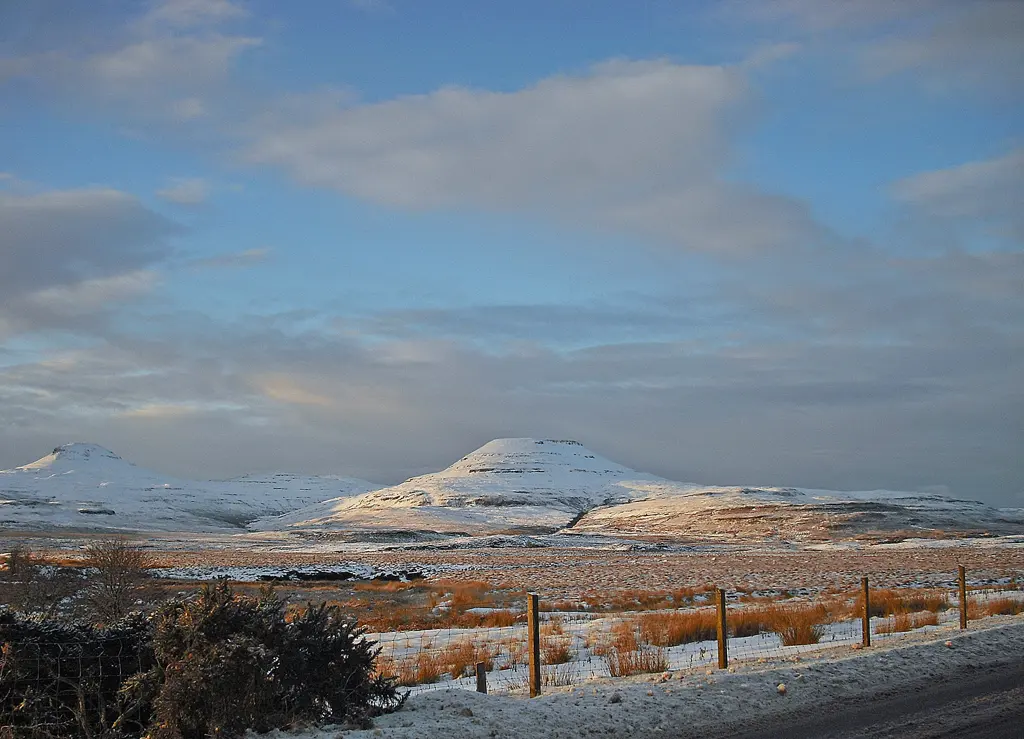
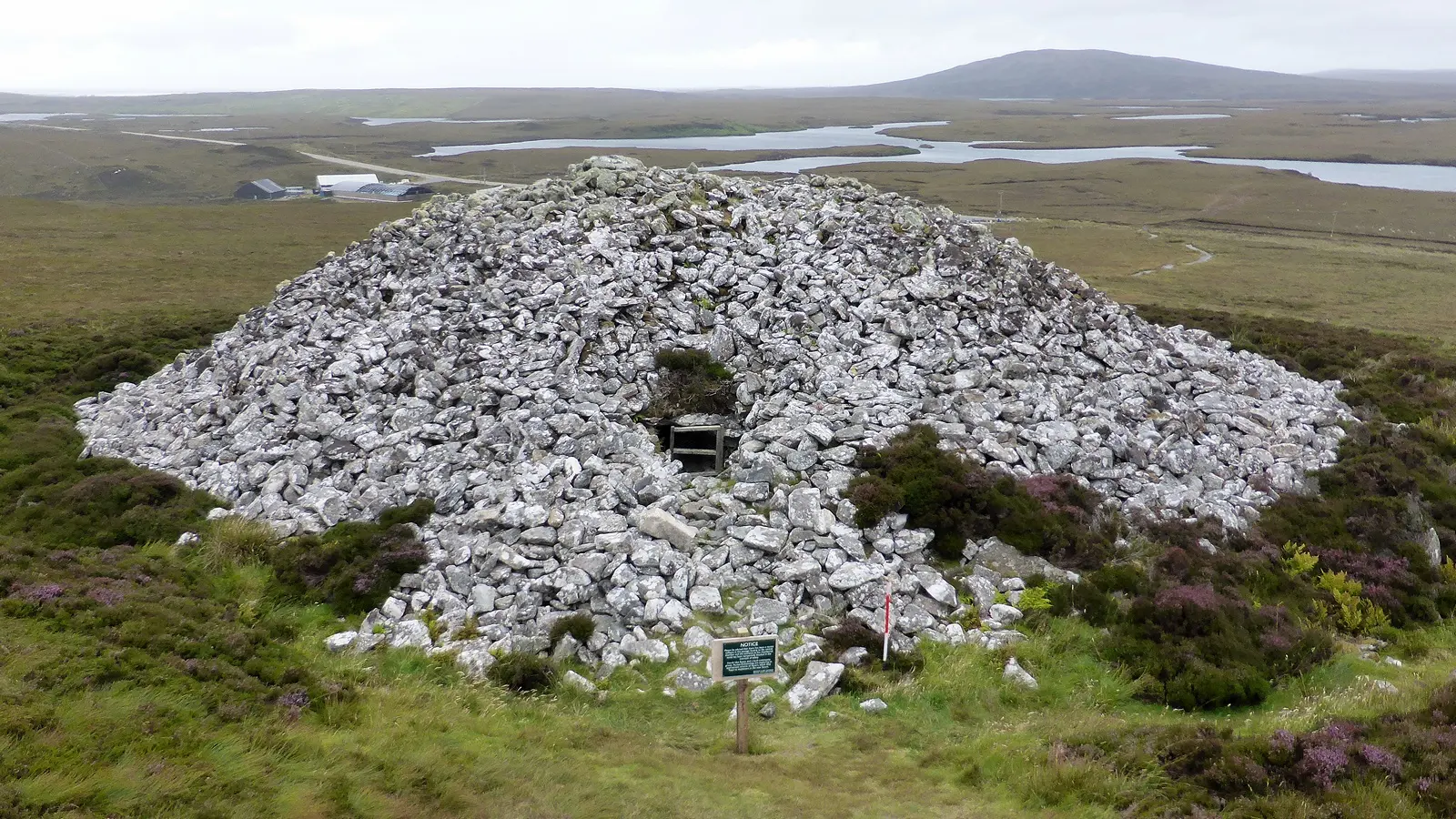
Image of Healabhal Mhor, Isle of Skye, Scotland. Image source · CC-BY-SA-2.0
Visit essentials
A quick read before you go
- Duration
- Five to six hours to climb both Healabhal Mhor and its twin peak Healabhal Bheag
- Etiquette
- Healabhal Mhor requires no formal protocols but asks for respect befitting a site of natural…
Overview
Healabhal Mhor's flat summit forms a horizontal line over Skye's Duirinish peninsula, shaped from fifty-eight-million-year-old lava flows by ice into an altar-like plateau. Bronze Age people climbed to build a cairn at its edge, though their names and beliefs are unknown. A later Norse name may have been Helgi Fjall, “Holy Mountain,” but the derivation remains uncertain; flat-topped peaks have nonetheless drawn sacred attention across cultures.
Centuries later, after Edinburgh courtiers mocked his remote home, Alasdair Crotach boasted of Scotland's grandest table and finest candles, then hosted a summit feast beneath torch-bearing clansmen. No formal practice continues. The wild climb and unexpected level summit still lead visitors to report stillness and attention toward what cannot be named.
Why this place is sacred
Some mountains declare themselves through drama—sheer cliffs, jagged ridges, peaks that pierce clouds. Healabhal Mhor makes a different statement. Its summit arrives not as a point but as an expanse, a plateau so broad and level that standing there feels less like arrival at a peak than entry into a space.
Flat-topped mountains appear in sacred geographies worldwide. They serve as natural altars, platforms between earth and sky, places where the human stands exposed to whatever watches from above. The Inca built on them. Tibetan traditions recognize them. Even without inherited cosmology, something in the human psyche responds to the form.
The Bronze Age cairn at the summit's southeastern edge confirms that people recognized this quality long ago. We know nothing of the builders except their choice: to carry stones up steep slopes, across trackless bog, to mark this specific location. Bronze Age cairns typically served as burial sites or ritual markers, often both. Their builders understood certain landscapes as appropriate for communication between the living and the dead, the human and the larger forces that shaped existence.
The possible Norse etymology adds another layer. If Healabhal derives from Helgi Fjall—Holy Mountain—then Viking settlers who arrived on Skye in the ninth century recognized what earlier peoples had known. This is speculative, but the resonance is worth noting: across centuries and cultures, attention kept returning here.
The approach itself contributes to the site's quality. There is no path. The moorland is boggy, the navigation challenging, the effort considerable. This is not a place you arrive at casually. The climb becomes a small pilgrimage, intention made physical through exertion. By the time you reach the summit, you have earned whatever the mountain offers.
The original purpose of the Bronze Age cairn remains unknown. It may have served as a burial monument for a significant figure, a territorial marker visible from the surrounding landscape, or a site for rituals connected to ancestors or sky-watching. Its placement at the summit's edge, with views toward Loch Bracadale and the Black Cuillin, suggests the builders chose the location with care for what could be seen from it—and what could see it.
The mountain's sacred significance likely evolved through multiple phases. Bronze Age peoples established it as a marked location. Norse settlers may have recognized it within their own framework of holy mountains. The Christianizing legend of St Columba—in which divine intervention supposedly sliced off the peak to provide the saint a bed and table—represents an attempt to claim the site's power for a new tradition while acknowledging that power already existed.
Clan MacLeod later incorporated the mountain into their identity, the legendary banquet serving as a story of pride and belonging. Today, the mountain functions primarily as a heritage landscape, but seekers still climb it, still report something particular about standing on that plateau.
Experience and orientation
The experience begins before the summit. The approach across pathless moorland requires constant attention—navigation, route-finding, the careful placement of feet in boggy ground. This absorption in physical effort creates its own kind of meditation, clearing the mind of what was carried from ordinary life.
Then the summit arrives, and it does not arrive as expected. After climbing, the body anticipates a peak—something pointed, somewhere to stand above everything else. Instead, the ground levels out into a plateau so broad you could stage the MacLeod banquet yourself. The relief of arrival meets the surprise of space.
Visitors often describe a particular quality of stillness here. The wind blows—this is Skye, the wind always blows—but something beneath the wind holds steady. Part of this is simply the landscape's grandeur: the Black Cuillin to the east, the Outer Hebrides strung along the western horizon, the sea in multiple directions. Part of it is the sense of standing where others have stood with intention, where a Bronze Age cairn still marks something someone thought worth marking.
Those who come in search of the MacLeod legend often find themselves reconstructing the scene: hundreds of clansmen holding torches around the plateau's edge, the chief and his guests feasting in the starlight, the whole display designed to prove that even remote Skye could match anything Edinburgh offered. The story becomes vivid here, held by the very ground that held it.
Healabhal Mhor rewards those who come prepared—both practically and in disposition. The practical preparation involves proper hiking equipment, navigation skills, and realistic assessment of conditions. The dispositional preparation is simpler: come with genuine curiosity about what the mountain might offer rather than a checklist of what you expect to find.
Consider timing your ascent for dawn or dusk, when the light transforms the landscape and the likelihood of solitude increases. The summit plateau offers no shelter, so conditions matter—low cloud eliminates the views that make the climb worthwhile, and wet weather makes the boggy approach considerably harder. But when conditions align, the experience of standing on that flat expanse as light changes over sea and mountains produces something worth the effort.
Context and lineage
The mountain's form tells a story of fire and ice. During the Paleogene period, fissure volcanoes deposited horizontal layers of basaltic lava across what would become Skye. These layers, each ten to fifteen meters thick, built up to over a kilometer in height. When the volcanic era ended and ice ages began, glaciers carved the accumulated lava into the stepped, flat-topped mountains visible today.
The human story is harder to date precisely. Sometime during the Bronze Age—perhaps between 2500 and 500 BCE—people built a cairn on the summit. The motivation is lost to time: burial, ritual, territorial marking, or some combination. The effort required to construct it here speaks to the site's importance.
Centuries later, legend attached St Columba to the mountain. According to the story, when the Irish missionary visited Skye and was refused hospitality by the local chief, he preached a sermon about having nowhere to lay his head. As he spoke, divine intervention sliced off the mountain's pointed peak, providing Columba with both table and bed. The legend, whatever its origins, acknowledges the mountain's prior sacred status while claiming it for Christianity.
The name MacLeod's Tables emerged from the famous banquet story. Alasdair Crotach, eighth chief of Clan MacLeod and one of its most celebrated leaders, was educated, cultured, and proud. When courtiers at the royal court mocked his remote domain, he turned the mountain itself into a demonstration of Highland grandeur—a story that has attached the MacLeod name to the peaks ever since.
St Columba
Irish missionary associated with the Christianization of Scotland. The legend attributing the flat summits to his divine aid represents early Christian engagement with pre-existing sacred geography, though there is no historical evidence Columba actually visited the mountain.
Alasdair Crotach
Eighth Chief of Clan MacLeod, known for diplomacy, culture, and fierce clan pride. The banquet legend may have historical basis—Alasdair was documented as a man who would make such a gesture. He also founded the MacCrimmon piping school, establishing a musical legacy that lasted centuries.
Leod
Progenitor of Clan MacLeod, son of the last Norse King of Man. Inherited lands on Skye when the Hebrides were ceded to Scotland in 1266, founding the line that would make MacLeod's Tables a symbol of clan identity.
Traditions and practice
Historical practices at the site remain largely unknown. The Bronze Age cairn builders likely performed funerary or ritual activities, but specific practices are not documented. Seventeenth-century accounts record that cairns throughout Skye were still visited on pilgrimages, with 'antient inhabitants' worshipping 'about them,' suggesting some continuity of practice long after the original meanings were lost. The MacLeod banquet, whether historical or legendary, represented a display of clan power and hospitality rather than religious ritual.
Today, those who climb Healabhal Mhor come primarily for the walk and the views. No organized ceremonies take place. However, the site's qualities—its remote approach, its summit stillness, its long history of human attention—naturally invite personal practice. Some visitors sit in quiet meditation. Others simply stand in the presence of the landscape, allowing whatever arises to arise. The Bronze Age cairn draws attention and respect as a tangible link to ancient recognition of this place.
If you come seeking more than exercise, consider approaching the mountain as the Bronze Age builders might have: with intention. The climb itself becomes the practice—attention focused on each step, mind gradually clearing as the body works. Upon reaching the summit, resist the impulse to immediately photograph. Instead, find a place to sit—perhaps facing the cairn, perhaps toward the Cuillin or the western sea—and simply be present. Notice what the mountain holds, and what you bring to it.
The plateau is large enough for solitude even when others are present.
Bronze Age Ritual Practice
HistoricalThe presence of a Bronze Age cairn on Healabhal Mhor's summit indicates that prehistoric peoples recognized this location as significant enough to warrant the considerable effort of construction. Bronze Age cairns in Scotland typically served as burial monuments for important individuals, territorial markers visible across the landscape, or sites for rituals connecting the living with ancestors and larger cosmic forces. The cairn's placement at the plateau's edge, with views toward Loch Bracadale and the Black Cuillin, suggests intentional positioning within a broader sacred geography.
Specific practices are unknown. The cairn may have been associated with sky-watching, ancestor veneration, or ceremonies marking significant calendar moments. Its elevated position suggests possible connection to beliefs about communication between earth and sky that appear throughout Bronze Age Britain.
Gaelic Sacred Landscape
HistoricalWithin native Gaelic cosmology, the landscape was understood as alive with meaning. Mountains, waters, and burial places each held their own significance in a world where boundaries between natural and supernatural were permeable. The possible Norse derivation of Healabhal from 'Helgi Fjall' (Holy Mountain) suggests that the peak's sacred quality was recognized across the cultural transition from Celtic to Norse settlement. Seventeenth-century accounts document that cairns throughout Skye continued to be visited for pilgrimage, with 'antient inhabitants' worshipping 'about them.'
Specific historical practices at Healabhal Mhor are not documented. Broader Gaelic tradition included pilgrimage to significant landscape features, offerings at cairns and wells, and recognition of certain times and places as particularly potent for contact with the otherworld.
Clan MacLeod Heritage
ActiveMacLeod's Tables take their English name from the legendary banquet of Alasdair Crotach, eighth chief of Clan MacLeod. When mocked at the royal court for his remote domain, the chief boasted of having the grandest table and finest candles in all Scotland. He made good on this claim by hosting a feast atop one of the Tables, the plateau serving as his table and his clansmen holding flaming torches around the rim. Whether historical or legendary, the story has attached the MacLeod name to the mountains for five centuries. The peaks remain visible from Dunvegan Castle and feature prominently in clan identity and tourism.
The mountains serve today as symbols of Clan MacLeod heritage rather than sites of active ceremony. Clan gatherings are held at Dunvegan Castle every four years, with the Tables forming a dramatic backdrop. Some visitors climb the mountains specifically to connect with the banquet legend, imaginatively reconstructing the scene on the summit.
Perspectives and open questions
Healabhal Mhor invites interpretation across multiple frameworks—geological, archaeological, folkloric, and experiential. These perspectives need not compete. The same mountain can be understood through the lens of volcanic processes, Bronze Age ritual, clan legend, and contemporary seeking. What makes the site compelling is how these layers accumulate without canceling each other out.
Scholarly perspective
Geologists understand MacLeod's Tables as products of Paleogene volcanic activity, when fissure eruptions deposited horizontal basalt layers that subsequent glaciation carved into their current form. The stepped appearance results from the erosion-resistant nature of each lava layer. Archaeologically, the Bronze Age cairn on Healabhal Mhor's summit indicates prehistoric ritual or funerary use, though specific practices remain unknown.
The cairn's placement at the plateau's edge, with views toward significant landscape features, suggests intentional siting for visual relationship with the broader sacred geography. Historians note that Alasdair Crotach, the MacLeod chief of banquet legend, is a well-documented figure whose character—proud, cultured, diplomatic—makes the story plausible even if unverifiable.
Living and traditional perspectives
In Gaelic tradition, the landscape is not inert matter but a living presence imbued with meaning. Mountains, wells, trees, and burial cairns each hold their own significance within a cosmology that understood the world as animate and relational. While specific pre-Christian beliefs about Healabhal Mhor are not documented, the mountain fits patterns of sacred high places throughout Celtic lands.
The St Columba legend represents a Christianizing response to this existing geography—acknowledging the mountain's power while attributing it to divine intervention rather than inherent sacredness. Clan MacLeod tradition emphasizes the mountains as symbols of the ancestral homeland's grandeur, the banquet story serving as a foundational narrative of pride and belonging.
Alternative interpretations
Contemporary spiritual seekers sometimes approach Skye as a 'thin place' where the boundary between ordinary and numinous experience becomes permeable. While no specific esoteric claims about Healabhal Mhor appear in the literature, the mountain's altar-like summit and its possible 'Holy Mountain' etymology resonate with those who interpret landscape through frameworks of sacred geometry, earth energies, or telluric currents. These interpretations are not endorsed by archaeological evidence but often emerge from genuine experiences visitors have on the mountain.
Open questions
Several genuine mysteries surround the site. The specific purpose of the Bronze Age cairn—whether burial monument, ritual site, territorial marker, or something else—remains unknown. Whether 'Healabhal' truly derives from Norse 'Helgi Fjall' (Holy Mountain) is suggested but not confirmed by linguists. What pre-Christian Celtic beliefs were associated with the mountain is not documented. Whether the MacLeod banquet actually occurred or represents elaborated legend cannot be determined.
Even the naming paradox—why Healabhal Mhor ('big') is actually the smaller of the two peaks—lacks clear explanation.
Plan your visit
Access and arrival
Dunvegan offers bed-and-breakfast accommodation, self-catering cottages, and The Dunvegan hotel with views toward MacLeod's Tables. The Three Chimneys, a celebrated restaurant with rooms, lies nearby. Dunvegan Castle offers holiday cottages on the estate. More extensive options are available in Portree, approximately thirty kilometers away.
Respectful visit
Sturdy hiking boots with ankle support are essential—the terrain includes steep grass, loose rock, and deep bog. Waterproof layers are necessary regardless of the forecast; Skye weather changes rapidly. Carry more warm clothing than seems necessary. Navigation equipment—map, compass, and GPS if available—is not optional on this pathless route.
Photography is welcome throughout. The summit offers exceptional views of the Cuillin Ridge, Outer Hebrides, and surrounding seascape. Consider, however, whether capturing images serves your experience or substitutes for it. The mountain will not record itself; only you can decide whether to be present or busy.
No traditional offering practice is documented for this site. If you feel moved to leave something, let it be attention rather than objects. A stone placed with intention, a moment of silence, gratitude expressed internally—these honor the site without altering it.
No formal restrictions apply. The site is always accessible under Scottish access rights. However, winter conditions can make the route dangerous without ice axe, crampons, and experience. Low cloud eliminates visibility on the pathless approach. Wet conditions make the boggy moorland extremely challenging. Self-assessment of ability and conditions is essential.
The Bronze Age cairn should be treated with respect as an archaeological monument. Do not disturb or remove stones. If you feel moved to leave any offering, ensure it is small, natural, and biodegradable—the landscape should remain as you found it.
Current practical details
Address
Healabhal Mhor, Isle of Skye IV55 8WQ, UK
Hours, fees, and access can change — verify on the official source before you travel. Practical details last checked Jun 2026.
Location
Map loads as you approach this section.
Pilgrim reflections
A portrait of encounter, not a score
Pilgrims describe what they felt, how present they could become, and whether the place would shape a journey. There are no stars and no ranking of traditions.
No reviewed reflections yet
The first pilgrims can help describe the character of being here.
Share a reflection
Available after an account-backed “Been there.” Every reflection is reviewed before publication.
Nearby sacred places
Explore other sacred places in the region. Proximity does not establish access or travel time; check each place’s guidance.
References
Sources consulted for this page. Source categories describe the publication, not a guarantee that every claim is verified. Traditional accounts and outside interpretations may differ.
- 01Macleod's Tables — Edinburgh Geological SocietyofficialDetailed geological information about the basalt lava formations
- 02Healabhal Mhor (Round Cairn) — The Modern AntiquarianacademicArchaeological documentation of Bronze Age cairn on summit
- 03Clan MacLeod — The Associated Clan MacLeod SocietiesSource contextOfficial clan organization with historical information
- 04Dunvegan Castle - Clan MacLeod — Dunvegan CastleofficialOfficial castle website with clan history
- 05Landscape Character Assessment: Skye and Lochalsh — NatureScotofficialOfficial Scottish natural heritage body
- 06Healabhal Mhor — WikipediaencyclopediaBasic geographical and historical information
- 07Macleod's Tables — WalkHighlandsguideComprehensive hiking guide with route information
- 08Macleod's Tables — The DunveganofficialLocal tourism information with legend details
- 09MacLeod's Tables - the arrogance of Alasdair MacLeod — MyHighlandsguideDetailed account of the MacLeod banquet legend
- 10MacLeod's Tables, Glendale, Isle of Skye — Glendale SkyeofficialLocal tourism with St Columba legend details
- 11Weather & Seasons — Isle of Skye GuideguidePractical visitor weather information
- 12Pilgrimage and Sacred Landscape in Scottish Gaelic Tradition — Gaelic Michael (Substack)blogDiscussion of sacred landscape in Gaelic tradition
Share a photo
Help visitors recognize Healabhal Mhor, Isle of Skye, Scotland. Every submission is reviewed before publication.