Pedra do Ingá
Four hundred symbols carved into a riverbed stone, undeciphered across millennia
Understand sacred places, explore living traditions, and learn how to engage respectfully with Pilgrim Map.
Access has not been verified. Check current local guidance before planning a visit.
Ingá, Paraíba, Brazil
Read the sources
Visit essentials
A quick read before you go
- Duration
- Thirty minutes provides a cursory look.
- Access
- The site is located near the city of Ingá, approximately 96 kilometers west of João Pessoa, the…
Overview
Something was said here, and no one alive can read it. Pedra do Ingá is a wall of dark gneiss rising from a riverbed in Paraíba, northeastern Brazil, covered with more than four hundred carefully carved symbols: abstract spirals, concentric circles, repeating geometric forms, and figures that might be animals, stars, or something without a modern category. Pecked and then polished rather than hastily scratched, they were probably worked across millennia.
Researchers have proposed a solar calendar, a map of Orion and the Milky Way, or shamanic formulas for altered states of consciousness. Each interpretation illuminates something, but none convinces entirely. For thousands of years the petroglyphs have remained a statement whose grammar is lost.
People come for the weight of that question rather than an answer: to confront the limits of knowing and the presence of minds whose meaning cannot be decoded. The river still passes the rock, and the carvings keep their silence.
Why this place is sacred
Most sacred sites thin the boundary between worlds through accumulated prayer, architectural intention, or the presence of living tradition. The Pedra do Ingá does something different. It thins the boundary between knowing and not-knowing.
The rock formation sits in the bed of the Ingá River, a geological fact that itself carries weight. This was not a wall built and placed; it was a surface found and chosen. The river flowed past it then as now. Whoever carved these symbols did so in relationship with water, with the seasonal rhythms of flow and exposure. The rock emerges from the landscape as something both natural and inscribed — a page the earth offered and humans filled.
The carvings themselves bear the marks of sustained attention. The technique — pecking followed by careful polishing — required time and skill. The grooves are not random; they follow internal logics that researchers can trace but not translate. Spirals repeat with variations that suggest system rather than decoration. Concentric circles appear in relationships that imply meaning.
What some researchers identify as the constellation Orion appears alongside what may be the arc of the Milky Way — if they are right, this wall held a mirror to the sky.
The Spanish engineer Francisco Pavía Alemany spent decades studying what he identified as a solar calendar built into the stone, where capsular depressions and a gnomon system tracked the sun's daily path. If his interpretation holds, the rock served as an instrument linking earth-time to celestial time — a bridge between the immediate and the vast.
But the deepest thinness may be simpler than any theory. Someone stood where you stand, looked at this rock, and decided it needed to hold something. They returned, or their descendants did, for thousands of years. Whatever they said in stone, they meant it. And it persists, speaking in a language that has outlived every ear that could hear it.
The original purpose of the Pedra do Ingá carvings remains genuinely unknown. Evidence of lithic workshops and temporary camps nearby suggests organized activity associated with the site over a long period — possibly from 10,000 BC to 1,400 AD. The scale and care of the carvings indicate this was not casual expression but sustained cultural practice with serious intent. Researchers have proposed ceremonial use, astronomical observation, shamanic ritual, territorial marking, and cosmological mapping.
The coexistence of diverse symbol types — geometric, possibly zoomorphic, possibly astronomical — suggests the site's purpose may have evolved across the millennia of its use, or may have held multiple functions simultaneously.
The Tupi-Guarani peoples who later inhabited the region gave the carvings the name itacoatiara — writing on stone — indicating they recognized the site as a place of inscribed meaning, even if the original creators and their intentions were already lost. The term entered Portuguese as a general word for rock engravings across Brazil.
In 1944, IPHAN — Brazil's cultural heritage agency — registered the Pedra do Ingá as a protected monument, the first piece of protected rock art in the country. This early recognition speaks to the site's power to arrest attention. Since then, the stone has drawn archaeologists, amateur theorists, documentary filmmakers, and visitors seeking contact with deep time.
Each generation brings new interpretive tools and new questions, but the fundamental encounter remains the same: a human being standing before marks made by other humans, unable to close the distance.
Experience and orientation
The first thing that registers is scale. The carved surface extends across the rock wall in a density that photographs understate. Standing close, individual symbols resolve — a spiral here, a set of concentric circles there, forms that seem to gesture toward meaning without arriving at anything you can name. Stepping back, the totality reasserts itself: hundreds of marks covering stone in a pattern that feels organized but resists comprehension.
The river setting intensifies everything. This is not a wall in a museum or a stone relocated to a park. The rock sits where it has always sat, in the bed of the Ingá River, with the landscape pressing in from all sides. The carvings belong to this place in a way that cannot be separated from the sound of water, the quality of light, the heat of the semi-arid northeast.
Light matters here more than at most sites. Early morning and late afternoon send raking light across the carved surface, throwing each groove into sharp relief. At midday, the carvings flatten and nearly disappear. Visitors who arrive at the right hour watch the symbols emerge from the stone as the sun angle changes — a daily revelation that the original carvers almost certainly understood and may have designed for.
The on-site Natural History Museum provides context that enriches without resolving. Seeing the various theories laid out — star maps, shamanic codes, calendrical systems — prepares you for what the stone itself delivers: the understanding that all these readings are provisional, that the symbols have not surrendered their meaning, and that standing in the presence of what you cannot understand is itself a form of encounter.
Those who come during life transitions or periods of questioning sometimes find the experience particularly resonant. There is something clarifying about facing a question that has no answer — it recalibrates the relationship between the mind and mystery.
Arrive in the early morning if you can. The light at this hour does two things: it reveals the carvings in their fullest dimensionality, and it gives you the site in relative solitude, before the heat and the day's visitors accumulate.
Begin at a distance. Take in the full wall before approaching any individual symbol. Notice the density, the coverage, the sense that this surface was treated as a complete field rather than a collection of isolated marks. Then move closer and let your eye follow individual forms — trace a spiral from its center outward, follow the concentric circles, look for the figures that some researchers identify as constellations.
Resist the urge to decode. You will not solve in an afternoon what researchers have studied for decades. Instead, notice what happens when you stop trying to read and simply look. The symbols were made by hands. They were polished smooth by sustained contact between stone and stone. Someone returned here, again and again, to continue this work. Let that fact register in the body rather than the intellect.
Context and lineage
No origin story survives. This is itself significant — the Pedra do Ingá predates the arrival of the Tupi-Guarani peoples in the region, who themselves recognized the carvings as 'writing on stone' without claiming authorship. The creators left no oral tradition that has reached us, no text, no explanatory context. Only the stone.
What can be inferred is this: over a period spanning thousands of years, people came to this rock in the riverbed and carved. They used a consistent technique — pecking the surface with harder stone instruments, then polishing the grooves smooth. They worked within what appear to be shared symbolic conventions, even as styles may have evolved across centuries. Lithic workshops found nearby suggest organized activity, not solitary expression. Temporary camps indicate people traveled to this place and stayed.
The absence of origin story is not a gap to be filled with speculation. It is a feature of the site's character — a reminder that human cultures have spoken in forms that do not always leave translations behind.
The lineage here is broken — or rather, it runs underground like the river in dry season, present but inaccessible. The original carvers are unknown. The Tupi-Guarani who named the site came later and left the word itacoatiara as their contribution. Portuguese colonizers took note but did not study. Brazilian heritage authorities formalized protection in 1944.
Since then, archaeologists, engineers, documentarians, and visitors have taken up the question the stone poses, each adding a layer of interpretation without reaching the bedrock of original meaning.
Paraíba alone contains over five hundred documented rock art sites, placing the Pedra do Ingá within a broader tradition of stone inscription across northeastern Brazil. The Ingá Stone stands out for the density and elaboration of its carvings, but it did not exist in isolation — it was part of a landscape of marked and meaningful places whose full network remains only partially mapped.
Francisco Pavía Alemany
researcher
Spanish engineer who began a mathematical study of the Pedra do Ingá in 1976, publishing initial findings through the Instituto de Arqueologia Brasileira in 1986. He identified a potential solar calendar using a gnomon shadow system and star groupings resembling the Milky Way and the constellation of Orion — interpretations that remain influential and debated.
Roberto Salgado de Carvalho
researcher
Researcher who proposed a shamanic interpretation of the petroglyphs, suggesting that spiral shapes may represent trance journeys, concentric circles may be phallic symbols, and U-shapes may symbolize altered states of consciousness or entrances to supernatural realms. His work connects the carvings to broader traditions of South American shamanism.
IPHAN (Instituto do Patrimônio Histórico e Artístico Nacional)
conservation steward
Brazil's cultural heritage agency, which registered the Pedra do Ingá as a protected monument on May 29, 1944 — Case 330-T-43, Registration No. 301 in the Tombo Book of Fine Arts. This made it the first protected rock art site in Brazil, an act of recognition that preceded similar protections elsewhere in the country by decades.
The Unknown Carvers
original creators
The anonymous peoples who created the petroglyphs over thousands of years. Their cultural affiliation, language, cosmology, and specific identity remain unknown. What survives is their work — more than four hundred symbols executed with skill and evident purpose, outlasting every other trace of their existence.
Traditions and practice
The specific practices that accompanied the carving and use of the Pedra do Ingá are unknown. Evidence of lithic workshops and temporary camps suggests the site drew organized groups who stayed for extended periods. Researcher Roberto Salgado de Carvalho has proposed that the carvings relate to shamanic practice — that spirals encode trance journeys, that U-shapes represent doorways to supernatural realms, and that the site may have functioned as a formula for accessing altered states of consciousness.
If correct, the rock would have served as both instruction manual and threshold, guiding practitioners into states of awareness that the symbols simultaneously described and facilitated. This interpretation remains speculative but draws on documented shamanic traditions across South America.
The Pedra do Ingá functions today as an archaeological site and destination for cultural tourism. The on-site Ingá Natural History Museum provides interpretive context. No organized spiritual or ritual practices take place at the site. Visitors engage through observation, photography, and guided tours.
Stand at a distance where you can see the full extent of the carved wall. Let your eye move across it without trying to pick out individual symbols. Notice the density — the sense that this surface was treated as a complete composition, not a collection of separate marks. Stay with that impression before moving closer.
When you approach, choose one symbol and follow it. Trace a spiral from its center outward. Look at how the groove was made — pecked first, then polished smooth. Run your eye along the polish. Someone spent hours on this curve. What required that attention?
If you visit in the early morning or late afternoon, watch how the raking light transforms the surface. Carvings that were invisible at noon emerge in sharp relief as shadows fill the grooves. This is not incidental — the carvers worked on stone that sits in relationship with the sun, and they likely understood how light would animate their work.
Sit with the river. The rock and the water have coexisted far longer than the carvings. Listen to the sound the river makes passing the stone. The carvers heard this too. Whatever they inscribed, they inscribed it in the company of moving water.
If you have brought a question — about your life, about meaning, about what persists — hold it here without expecting an answer. The Pedra do Ingá has held questions for thousands of years without resolving them. There is something to be learned from that patience.
Pre-Columbian Indigenous Rock Art Tradition
HistoricalThe Pedra do Ingá represents one of the most significant and elaborate petroglyph sites in the Americas, with more than four hundred symbols carved into gneiss rock using a pecking-and-polishing technique. The carvings are part of a broader tradition of rock engraving across northeastern Brazil — Paraíba alone contains over five hundred documented sites — but the Ingá Stone stands out for its density, elaboration, and the scale of the carved surface. The site appears to have been used over thousands of years, with evidence of lithic workshops and temporary camps suggesting organized cultural activity rather than casual mark-making.
Specific practices are unknown. The evidence suggests sustained and organized engagement with the site over millennia. Researcher Roberto Salgado de Carvalho has proposed shamanic interpretations in which spirals represent trance journeys, concentric circles serve as phallic symbols, and U-shapes symbolize altered states of consciousness or portals to supernatural realms. If correct, the site would have functioned as both a record and instrument of shamanic practice. The coexistence of diverse symbol types suggests evolving ritual use over centuries.
Archaeoastronomical Research
ActiveA significant body of research proposes that the Pedra do Ingá encodes astronomical knowledge. Francisco Pavía Alemany's mathematical study, begun in 1976 and first published in 1986, identifies capsular depressions that form a solar calendar operated by gnomon shadow, and petroglyph groupings that correspond to recognizable constellations — most notably the Milky Way and Orion. If confirmed, this would give the site exceptional significance as both a practical timekeeping instrument and a cosmological map.
Active research continues into the astronomical dimensions of the petroglyphs. The methodology involves mathematical analysis of spatial relationships between symbols, correlation with known stellar positions, and study of how light and shadow interact with the carved surface at astronomically significant dates. This tradition of inquiry, while modern in its methods, seeks to recover knowledge that may have been embedded in the rock thousands of years ago.
Heritage Conservation and Archaeological Stewardship
ActiveThe Pedra do Ingá was the first rock art site protected by IPHAN in Brazil, registered on May 29, 1944. This early act of recognition reflects the site's evident power to command attention and respect across cultural boundaries. The site's inclusion on Brazil's UNESCO World Heritage Tentative List further confirms its international significance. Ongoing conservation ensures the survival of carvings that have already endured thousands of years.
Active heritage management includes site monitoring, visitor management, maintenance of the on-site Ingá Natural History Museum, and coordination with UNESCO requirements for Tentative List status. Archaeological research continues, with Brazilian universities conducting studies on the petroglyphs and their regional context.
Perspectives and open questions
The Pedra do Ingá has attracted interpretations from archaeologists, engineers, shamanic researchers, and fringe theorists — each seeing something different in the same four hundred symbols. No interpretation has achieved consensus. This is not a failure of scholarship but a feature of the site: it is genuinely, irreducibly mysterious, and honest engagement requires sitting with that condition rather than resolving it prematurely.
Scholarly perspective
Archaeological consensus holds that the Pedra do Ingá is one of the most significant petroglyph sites in the Americas, with carvings executed in a pecking-and-polishing technique over a period spanning thousands of years. Evidence of lithic workshops and temporary camps nearby confirms sustained human activity associated with the rock. The carvings are predominantly non-figurative and geometric, though some zoomorphic and phytomorphic figures have been identified.
The site was registered as Brazil's first protected rock art monument by IPHAN in 1944 and is included on Brazil's UNESCO World Heritage Tentative List. The UNESCO submission emphasizes the site's outstanding universal value as a testimony to cultural traditions of pre-Columbian peoples and as a concentration of rock art of exceptional density and elaboration.
Scholars agree on the site's significance while acknowledging that the symbols remain undeciphered. The full catalogue of all four hundred-plus petroglyphs has not been published in a single comprehensive work, and precise dating of individual carvings has not been established — estimates range from six thousand years to ten thousand years before present.
Living and traditional perspectives
No surviving indigenous oral tradition speaks directly to the meaning of the Pedra do Ingá carvings. The Tupi-Guarani peoples, who arrived in the region after the carvings were made, recognized the site as itacoatiara — writing on stone — a term that acknowledges inscription and meaning without claiming to read it. This linguistic trace is itself telling: later peoples understood they were encountering the work of predecessors whose language they did not share.
The absence of traditional interpretation is not the same as the absence of traditional significance. The name itself preserves a relationship of recognition across cultural distance — the acknowledgment that someone wrote here, even if the writing can no longer be read.
Alternative interpretations
Several alternative interpretive frameworks have been applied to the Pedra do Ingá. Francisco Pavía Alemany's archaeoastronomical analysis identifies a solar calendar and star map, including representations he considers nearly identical to the Milky Way and Orion. Roberto Salgado de Carvalho reads the symbols through a shamanic lens, proposing that spirals encode trance journeys and U-shapes represent entrances to supernatural realms.
More speculative proposals have drawn comparisons to Phoenician writing, Egyptian demotic script, and Easter Island's rongorongo script. A PBS documentary explored possible Carthaginian connections. None of these cross-cultural theories have been substantiated by mainstream archaeology, and the apparent similarities more likely reflect the limited vocabulary of geometric forms available to any culture carving into stone.
What these alternative readings share is the conviction that the symbols are coherent and purposeful — that they can be read if the right key is found. Whether or not any specific interpretation proves correct, this conviction seems well-founded: the care and consistency of the carvings argue against random or decorative intent.
Open questions
The honest list of what is not known about the Pedra do Ingá is longer than what is known. The identity and cultural affiliation of the carvers remain unknown. The meaning of the four hundred-plus symbols has not been deciphered. Whether the petroglyphs represent a coherent writing system, accumulated symbolic expression across millennia, or something that does not map onto either category is unclear. The precise dates of individual carvings are not established.
The relationship between this site and the broader network of over five hundred rock art sites in Paraíba is only partially understood. Whether the site served as an astronomical observatory, a shamanic threshold, a sacred calendar, a territorial marker, or something entirely outside modern categories of classification remains an open question.
This degree of genuine mystery is rare among well-known archaeological sites. Most famous ruins have been at least partially decoded. The Pedra do Ingá resists — not because it lacks information, but because the information it contains is in a language that died with its speakers.
Plan your visit
Access and arrival
The site is located near the city of Ingá, approximately 96 kilometers west of João Pessoa, the capital of Paraíba state. Access is by car via well-maintained roads. Public transportation options to the site itself are limited — most visitors arrange private transport or drive. The site sits in the bed of the Ingá River, requiring a short walk from the parking area. No mobile phone signal information was available at time of writing; check locally for current conditions.
For emergency services, the city of Ingá is immediately adjacent to the site.
The city of Ingá provides basic services and some lodging options. João Pessoa, 96 kilometers to the east, offers full tourist infrastructure including hotels at all price points, restaurants, and transport services. The site can be visited as a day trip from João Pessoa. No dedicated retreat or contemplative accommodation exists near the site.
Respectful visit
No formal requirements. Comfortable shoes suitable for uneven terrain near the riverbed are essential. Sun protection — hat, sunscreen, light layers — is strongly advisable in Paraíba's semi-arid climate, especially during the dry season when temperatures are high and shade is limited.
Photography is permitted and the site is particularly photogenic. Early morning and late afternoon produce the raking light that reveals the carvings in their fullest dimensionality — plan your visit around these hours if photography is a priority. Midday light flattens the surface and renders many carvings nearly invisible, which is itself instructive about how the carvers understood their medium.
No offering tradition exists at this site. Physical offerings would constitute litter at a protected archaeological monument. If you wish to mark your visit with intention, do so internally.
Do not touch or climb on the rock formation. Do not remove any material from the site. The site is open during daylight hours. Some sources report a sign-in book at entry. The on-site museum has its own hours which may differ from site access.
Do not touch, climb on, or make any marks on the petroglyphs. The site is a protected cultural heritage monument under IPHAN. The carvings have survived thousands of years; they require protection from the accumulated effect of modern visitation. Do not remove any stone fragments or archaeological material. The semi-arid climate brings intense midday heat — bring water and sun protection.
Current practical details
Address
S/N Rodovia PB-090 Zona Rural, Ingá - PB, 58380-000, Brazil
Phone
Hours
Hours, fees, and access can change — verify on the official source before you travel. Practical details last checked Jun 2026.
Location
Map loads as you approach this section.
Pilgrim reflections
A portrait of encounter, not a score
Pilgrims describe what they felt, how present they could become, and whether the place would shape a journey. There are no stars and no ranking of traditions.
No reviewed reflections yet
The first pilgrims can help describe the character of being here.
Share a reflection
Available after an account-backed “Been there.” Every reflection is reviewed before publication.
Nearby sacred places
Explore other sacred places in the region. Proximity does not establish access or travel time; check each place’s guidance.

Juazeiro do Norte, Colina do Horto
Juazeiro do Norte, Ceará, Brazil
410.0 km away
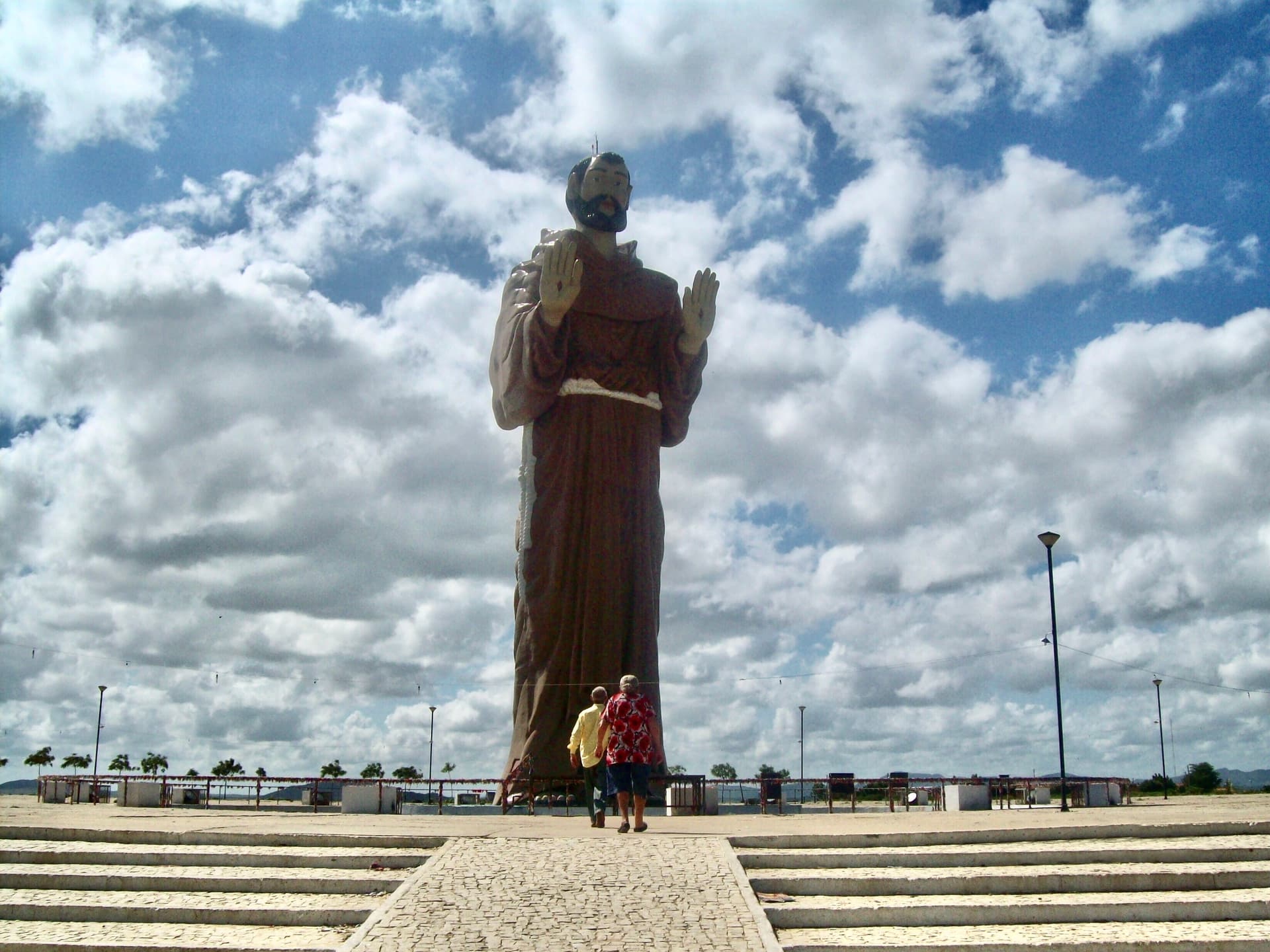
Caninde, Estátua de São Francisco
Canindé, Ceará, Brazil
520.5 km away

Salvador, Nosso Senhor do Bonfim Church
Salvador, Bahia, Brazil
703.8 km away

Salvador, Nossa Senhora da Conceição da Praia
Salvador, Bahia, Brazil
709.2 km away
References
Sources consulted for this page. Source categories describe the publication, not a guarantee that every claim is verified. Traditional accounts and outside interpretations may differ.
- 01Itacoatiaras of Ingá River - UNESCO World Heritage Centre — UNESCOofficialOfficial UNESCO Tentative List entry submitted by Brazil; provides authoritative description and justification of outstanding universal value
- 02A Pedra do Ingá: Itacoatiaras na Paraíba - UFCG Digital Library — Universidade Federal de Campina GrandeacademicAcademic thesis/dissertation on the Pedra do Ingá petroglyphs from Brazilian federal university
- 03Ingá Stone - Wikipedia — Wikipedia contributorsencyclopediaComprehensive overview with references to academic studies; provides key dimensions, historical context, and archaeoastronomical hypotheses
- 04Ingá Stone - History and Facts | History Hit — History HitofficialHistorical overview with visitor-oriented facts
- 05The Pedra do Inga Enigmatic Petroglyphs - The Ancient Connection — The Ancient ConnectionacademicDetailed analysis of petroglyph interpretations including shamanic and astronomical hypotheses
- 06Message from Outer Space? The Mysterious Indecipherable Script of the Inga Stone — Ancient OriginsacademicCovers multiple theories about the stone's meaning; includes references to Roberto Salgado de Carvalho's shamanic interpretation
- 07The Mystery of Brazil's Ancient Ingá Stone Might Have Just Been Solved — Earthly MissionacademicDiscusses recent astronomical interpretation theories
- 08Pedra do Ingá Rock Art - The Megalithic Portal — The Megalithic PortalofficialCommunity megalithic research database with coordinates and site details
- 09Carthage's Lost Warriors - Examining the Petroglyphs on the Rock of the Ingá — PBS / Secrets of the DeadguidePBS documentary segment examining the petroglyphs and proposed Phoenician connection
- 10Written in Stone: The Inga Stone—an ancient monument depicting a rare Star Map — The Ancient CodeacademicDetailed discussion of Francisco Pavía Alemany's archaeoastronomical research
Share a photo
Help visitors recognize Pedra do Ingá. Every submission is reviewed before publication.