Juazeiro do Norte, Colina do Horto
Where millions of Nordestino faithful climb to meet their Padim Ciço on sacred ground
Understand sacred places, explore living traditions, and learn how to engage respectfully with Pilgrim Map.
Access has not been verified. Check current local guidance before planning a visit.
Juazeiro do Norte, Ceará, Brazil
Read the sources
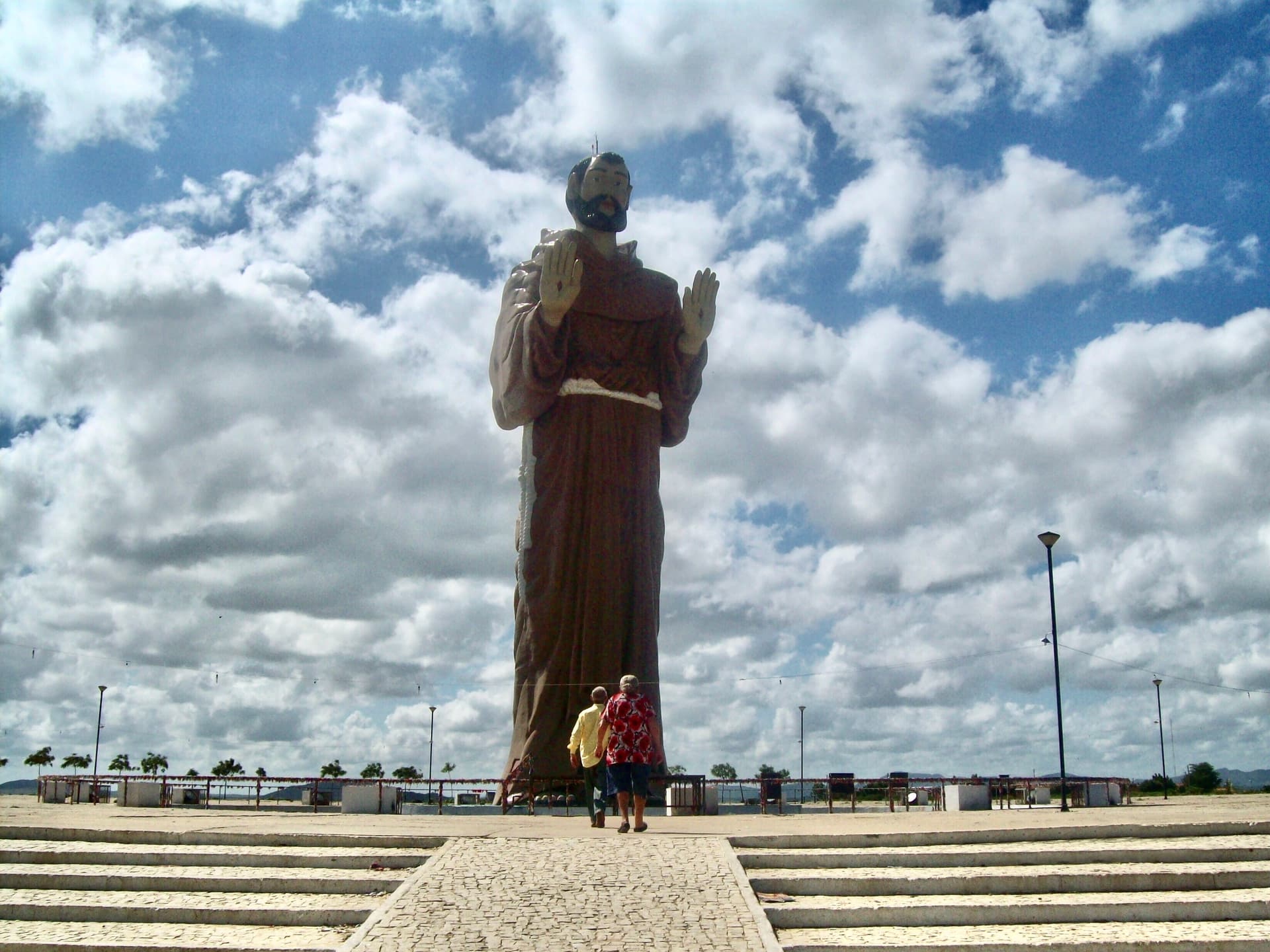
Image of Juazeiro do Norte, Colina do Horto. Image source · CC-BY-SA-3.0
Visit essentials
A quick read before you go
- Duration
- A visit focused on the statue, Museu Vivo, and the immediate complex takes two to three hours.
- Access
- The cable car (teleférico) operates Thursday through Sunday from 9:00 AM to 5:00 PM.
Overview
Pilgrims call him Meu Padim Ciço—My Little Father Cícero—and come by the millions: by bus or on foot, from the sertão and distant-city favelas, from lives shaped by drought, scarcity, and a faith that outlasted attempts to contain it.
Colina do Horto, three kilometers from central Juazeiro do Norte in southern Ceará's Cariri region, holds Brazil's largest statue dedicated not to Christ but to a parish priest. The Catholic hierarchy silenced Padre Cícero and stripped his faculties; the faithful carved wooden limbs in thanks for healings, walked for days to touch the ground where he prayed, and made him their saint before any Vatican process.
In 2022 Pope Francis authorized his beatification cause, naming him Servant of God after more than a century of Nordestino veneration. Pilgrims come not for architecture or antiquity but for a popular faith that created a city, survived ecclesiastical opposition, and continues to produce what they understand as miracles. Its concentrated devotional weight is unmistakable.
Why this place is sacred
Thin places are often described in terms of silence and remoteness — ancient stones standing alone in empty landscapes. Colina do Horto offers a different kind of thinness, one that emerges not from stillness but from intensity.
The hill is where Padre Cícero retreated for prayer during his lifetime. The Santo Sepulcro on its grounds was designed to mirror the Holy Sepulchre in Jerusalem — a conscious translation of the world's most sacred Christian pilgrimage into a landscape accessible to people who would never cross an ocean. For the Nordestino faithful, climbing this hill is their Jerusalem.
The ex-votos tell the story most clearly. In the Museu Vivo do Padre Cícero, thousands of carved wooden body parts — hands, legs, heads, hearts — hang from walls and fill glass cases. Each represents a prayer answered, a healing claimed, a life that turned when it seemed it could not. Photographs of the sick and the saved sit beside handwritten letters of gratitude.
The accumulation is overwhelming — not as curiosity but as evidence of a faith so immediate it demands physical expression.
Pilgrims who have walked for days arrive at this hill and weep. They touch the ground. They pray aloud in voices hoarse from the road. The boundary they cross is not between the material and the ethereal but between desperation and hope, between suffering and the conviction that someone hears.
The 27-meter statue of Padre Cícero stands above it all, arm raised in blessing, visible from across the city he brought into being. At its base, the faithful gather in numbers that transform individual prayer into something collective and tidal.
Padre Cícero used the Horto hill as a place of prayer and retreat during his lifetime. The land held spiritual significance to him personally, and beatos — lay devotees who followed his teachings — established hermitages and small chapels on the hillside. The Santo Sepulcro was built along a trail from the main complex, creating a localized passion devotion that allowed the faithful of the sertão to participate in the Jerusalem pilgrimage tradition.
The hill became sacred through use: through the prayers said there, the penances walked there, the faith that concentrated there around a single figure.
The devotion survived Padre Cícero's death in 1934 and intensified in the decades that followed. The ecclesiastical sanctions that silenced him in life did nothing to diminish the popular cult — if anything, the Church's opposition deepened the faithful's identification with a priest they saw as persecuted for holiness. The 27-meter statue, inaugurated in 1969, gave the devotion a monumental focal point. The Museu Vivo, opened in 1999, institutionalized the ex-voto tradition that had been accumulating organically for decades.
The most significant recent shift came in December 2015, when Padre Cícero was officially reconciled with the Catholic Church, and then in 2022, when Pope Francis authorized his beatification cause. The gap between popular devotion and institutional recognition, which had defined the site for over a century, began to close. The hill's meaning has not changed for the faithful — they always knew.
But the formal process has added a new dimension, drawing attention from beyond northeastern Brazil and potentially reshaping how the site is understood within global Catholicism.
Experience and orientation
During the great romarias — particularly the Romaria de Finados in late October and early November, when over 350,000 pilgrims converge — Colina do Horto becomes something closer to a living organism than a tourist site. The road up the hill fills with humanity. Vendors sell miniature statues and religious images alongside food and children's toys. The air carries the sound of cantoria — traditional devotional singing that weaves through the crowd in overlapping waves.
At the statue's base, the press of bodies creates its own kind of intensity. Pilgrims touch the pedestal, pray with arms raised, collapse in tears. Some have walked for days from remote communities in the sertão. The physical exhaustion and the emotional release merge into something that resists observation from a comfortable distance. You are in it or you are watching it, and watching feels inadequate.
The Museu Vivo offers a different register. Inside the old Casarão do Horto, life-sized figures depict Padre Cícero's life alongside cases overflowing with ex-votos. The sheer volume of carved limbs and handwritten letters communicates duration — this is not a single generation's enthusiasm but a devotion renewed across more than a century. The carved wooden heads, each representing a mind healed or a worry lifted, carry an intimacy that formal religious art rarely achieves.
The trail to the Santo Sepulcro stretches 2,650 meters from the main complex. Walking it is an act of physical devotion — the path is exposed, the Ceará sun relentless. At the end, two small chapels hold candles lit by pilgrims, the wax pooling and layering in forms that record the passage of thousands of hands.
The burial site of one of the beatos who lived during Padre Cícero's time is here, connecting the present pilgrimage to the first generation of devotees.
Outside the romarias, the hill is quieter but not empty. A steady stream of visitors arrives year-round, and the cable car inaugurated in 2023 has made the ascent accessible to those who cannot walk. The 7.5-minute ride covers two kilometers and 200 meters of elevation gain, arriving at the hilltop with the Chapada do Araripe escarpment visible in the distance.
The geological age of the hill itself — approximately 650 million years, among the oldest rocks in the Cariri region — adds a dimension of time that dwarfs even the devotion concentrated here.
How you approach Colina do Horto depends on what you are seeking. If you come during a romaria, surrender to the crowd. Do not try to observe from outside — the experience is in the immersion, the collective intensity of faith that no individual encounter can replicate. Let yourself be carried by the movement of thousands toward the statue.
If you come in a quieter period, take the cable car up and begin at the statue. Stand at the base and look out over Juazeiro do Norte — the city Padre Cícero's presence created. Then walk to the Museu Vivo and spend time with the ex-votos. Do not rush past them. Each carved limb was made by someone in need. Each photograph was placed by hands that trembled. Let the accumulation work on you.
The Santo Sepulcro trail is best walked in early morning or late afternoon, when the heat is less punishing. Walk it as the pilgrims do — slowly, with intention. You need not share their faith to feel what happens when you move through a landscape shaped by a century of prayer.
Context and lineage
On 1 March 1889, during a mass celebrated by Padre Cícero in the small chapel of Juazeiro, a communion host reportedly transformed into blood in the mouth of a laywoman named Beata Maria de Araújo. The phenomenon recurred 138 additional times over nearly two years. News of the Milagre da Hóstia spread rapidly through the sertão, and pilgrims began arriving in numbers that would transform the settlement permanently.
The Catholic hierarchy investigated and rejected the miracle. Padre Cícero was suspended from celebrating mass and faced escalating ecclesiastical sanctions. But the faithful did not waver. To the Nordestino poor — communities shaped by drought, poverty, and the hard indifference of distant institutions — Padre Cícero was already their saint. He had championed their interests, promoted the development of Juazeiro, and in 1911 secured its independence as a municipality separate from Crato.
His political and spiritual influence grew in tandem. The Sedição de Juazeiro of 1914, a local armed conflict, left battle walls on the Horto whose remains are still visible. Through it all, Padre Cícero remained both priest and patriarch, spiritual father and civic leader — categories that, in the world of the sertão, were never separate.
He died on 20 July 1934 in Juazeiro do Norte. The city he had built continued to grow around his memory. The devotion he had inspired only deepened with his absence.
The devotion to Padre Cícero descends through a lineage of popular Catholicism shaped by the particular conditions of the Brazilian Northeast — communities geographically and economically distant from institutional power, for whom the local priest served as intercessor not only with God but with the forces of the material world. The beatos who established hermitages on Colina do Horto during Padre Cícero's lifetime represent the first generation of a devotional community that has renewed itself continuously for over a century.
The ex-voto tradition has deep roots in Iberian Catholicism, carried to Brazil by Portuguese colonists and adapted by Nordestino communities into a practice distinctly their own. The romaria tradition similarly draws on Iberian pilgrimage culture but has been reshaped by the realities of the sertão — long distances traveled on foot through semi-arid terrain, collective movement as both spiritual and social act.
Since the 2022 opening of the beatification cause, the lineage has entered a new phase. What was always a living tradition now has official institutional momentum. The question of whether Padre Cícero will be formally beatified remains open, but the process itself represents a recognition that the faithfulness of millions over more than a century constitutes something the Church can no longer ignore.
Padre Cícero Romão Batista
founder/saint
Born 24 March 1844 in Crato, Ceará. Parish priest, civic leader, and popular saint of northeastern Brazil. His association with the 1889 eucharistic miracle and his lifelong championing of the Nordestino poor made him the most venerated figure in Brazilian popular Catholicism. Died 20 July 1934. Beatification cause opened 20 August 2022; currently holds the title Servant of God.
Beata Maria de Araújo
historical/visionary
Laywoman (1862-1914) in whose mouth the communion host reportedly transformed into blood during Padre Cícero's mass on 1 March 1889. The phenomenon recurred 138 times. Her role in the founding miracle has made her a figure of growing devotion, with a romaria on January 17 commemorating her death.
Armando Lacerda
artist
Sculptor of the 27-meter statue of Padre Cícero inaugurated on 1 November 1969. The statue became the defining visual symbol of the devotion and of Juazeiro do Norte itself, visible from across the city.
Pope Francis
institutional
Authorized the opening of Padre Cícero's beatification process on 24 June 2022 through the Dicastery for the Causes of Saints, formally bridging a century-long gap between popular devotion and institutional recognition.
Nossa Senhora das Dores
patron
Patron of the basilica in Juazeiro do Norte founded by Padre Cícero in 1875. Her patronal feast in September is one of the major romarias in the annual pilgrimage cycle, connecting Marian devotion with the cult of Padre Cícero.
Traditions and practice
The core practice is the romaria itself — pilgrimage undertaken collectively, often on foot over great distances, as both spiritual devotion and social act. The Romaria de Finados, falling between October 29 and November 2, is the largest, drawing over 350,000 faithful who come to honor the dead and to visit Padre Cícero's tomb at the Capela do Perpétuo Socorro in the city center before ascending to the Horto.
The March romaria around Padre Cícero's birthday on March 24 features the Semana Padre Cícero — a week-long celebration with processions, masses, novenas, cantorias, theatrical presentations, flower processions, and a birthday cake stretching nearly 200 meters.
Ex-voto offerings form a devotional practice as old as the cult itself. Pilgrims who have received what they understand as miracles — healings, protections, provisions — commission carved wooden representations of the healed body part, or bring photographs, personal objects, and handwritten testimonies. These are deposited at the Museu Vivo on the Horto, creating an ever-growing archive of answered prayer.
The Santo Sepulcro trail, stretching 2,650 meters from the main complex, is walked as an act of penance and devotion. Some pilgrims walk it on their knees. At the trail's end, two chapels receive candles and prayers. The practice explicitly mirrors the Via Dolorosa, creating a Nordestino Jerusalem on the hilltop of the Cariri.
The annual cycle of romarias structures the devotional year. Beyond the great pilgrimages — Finados, the March birthday, the July death anniversary — the calendar includes romarias for Beata Maria de Araújo (January 17), São Sebastião (January 18-20), Nossa Senhora das Candeias (January 29 to February 2), Nossa Senhora das Dores (September 10-15), and São Francisco (September 24 to October 5).
Each draws its own community of devotees, and taken together they ensure that the hill is animated by organized pilgrimage throughout most of the year.
The 2023 inauguration of the cable car has not diminished the devotional intensity but has made it accessible to elderly and disabled pilgrims who could not previously reach the hilltop. Processions from the Basílica de Nossa Senhora das Dores in the city center up to the Colina do Horto remain a central ritual of the romarias, with thousands moving together through the streets in prayer.
If you come during a romaria, participation is the practice. Join the procession from the basilica to the Horto. Let the cantorias carry you — the traditional devotional singing creates a sonic envelope that dissolves the distance between observer and participant. At the statue, stand among the faithful and feel the weight of collective prayer.
If you come in a quieter time, walk the Santo Sepulcro trail in the relative cool of early morning. Move slowly. The trail was designed for penance, not efficiency. At the chapels, light a candle if the gesture feels honest. Spend time in the Museu Vivo with the ex-votos — not as a museum visitor cataloging curiosities, but as a witness to the depth of human need and the persistence of hope.
From the statue's vantage point, look out over the city and the Chapada do Araripe escarpment beyond. Consider that everything you see below — the city, its economy, its identity — exists because one priest and the faith of the poor proved more durable than the institution that tried to silence them.
Popular Catholicism (Devotion to Padre Cícero)
ActiveThe devotion to Padre Cícero is the dominant spiritual tradition at Colina do Horto and one of the largest popular religious movements in Brazilian history. Padre Cícero functions as an intercessor — a figure to whom the faithful direct prayers with the expectation of miracles, particularly healings and protections. The devotion predates and exists independently of institutional Catholic approval, though the 2022 opening of his beatification cause has begun to bring the two into alignment.
Pilgrims undertake romarias — collective pilgrimages — to Juazeiro do Norte throughout the year, with the Romaria de Finados and the March birthday celebration as the principal gatherings. At the Horto, devotees pray at the statue, deposit ex-votos at the Museu Vivo, walk the Santo Sepulcro trail, and light candles at the chapels. Cantorias, processions, novenas, and masses structure the romaria periods. The fulfillment of promessas — vows made in exchange for divine intervention — is central to the practice.
Roman Catholicism
ActiveJuazeiro do Norte's ecclesiastical infrastructure — the basilica, the chapels, the formal liturgical calendar — belongs to the institutional Catholic Church. Padre Cícero was a priest operating within, and eventually sanctioned by, this institution. The Church's relationship with the Horto devotion has shifted from opposition to cautious embrace, marked by the 2015 reconciliation and the 2022 beatification process.
Masses are celebrated at the Igreja do Senhor Bom Jesus do Horto and at the basilica in the city center. The annual romaria calendar is organized in coordination with the archdiocese. The beatification process itself — investigating Padre Cícero's life, writings, and attributed miracles — is an active institutional practice that will unfold over coming years.
Marian Devotion (Nossa Senhora das Dores)
ActiveThe basilica founded by Padre Cícero in 1875 is dedicated to Our Lady of Sorrows, and the patronal feast in September is one of the major romarias. Marian devotion interweaves with the cult of Padre Cícero — the faithful do not separate their love of the Virgin from their love of their priest-saint. The Romaria of Nossa Senhora das Candeias in January-February adds further Marian dimension to the pilgrimage calendar.
The September romaria of Nossa Senhora das Dores features processions, masses, and devotional activities centered on the basilica. Marian imagery is prominent throughout the pilgrimage landscape, and prayers to the Virgin are part of the devotional fabric alongside prayers to Padre Cícero.
Northeastern Brazilian Folk Catholicism
ActiveThe devotion at Colina do Horto exists within the broader tradition of Nordestino folk Catholicism — a form of Catholicism shaped by geographic isolation, economic marginalization, and the creative adaptation of Iberian religious practices to the conditions of the sertão. The beato tradition, the ex-voto practice, the cantoria, and the romaria itself all belong to this wider cultural-spiritual framework.
Cantorias — traditional devotional singing — accompany processions and gatherings. The beato tradition, in which lay devotees live lives of ascetic devotion outside formal religious orders, shaped the early community on the Horto. The practice of making and fulfilling promessas — personal vows exchanged with saints for divine intervention — structures the relationship between the faithful and the sacred.
Perspectives and open questions
Colina do Horto sits at the intersection of popular faith, institutional religion, politics, and cultural identity. Understanding it requires holding multiple perspectives simultaneously — the devotion of the faithful, the Church's evolving position, the scholarly analysis of popular religion, and the cultural significance of Padre Cícero as a Nordestino icon. None of these perspectives alone captures what happens on this hill.
Scholarly perspective
Scholars of Brazilian popular religion understand the cult of Padre Cícero as one of the most significant expressions of folk Catholicism in Latin America. The devotion exemplifies a pattern common across the region: charismatic religious figures who serve as intermediaries between marginalized communities and both divine and worldly power. Research emphasizes how Padre Cícero combined spiritual authority with political agency, serving as both intercessor with God and advocate for the Nordestino poor in a system that systematically excluded them.
The 1889 eucharistic miracle and its ecclesiastical rejection reveal the persistent tension between popular and institutional Catholicism in Brazil. Scholars note that the Church hierarchy's condemnation did not diminish the devotion but rather strengthened it — the faithful interpreted the sanctions against Padre Cícero through a martyrdom framework that deepened their identification with him.
The ex-voto tradition at the Horto has been studied extensively as material evidence of vernacular theology: an embodied, transactional spirituality in which divine favor is acknowledged through physical objects that serve simultaneously as thanksgiving, testimony, and petition.
The geopark designation adds another scholarly layer. The Colina do Horto, comprising rocks approximately 650 million years old, sits within the Araripe UNESCO Global Geopark — the first in the Americas — connecting geological deep time with the relatively recent emergence of a devotional landscape.
Living and traditional perspectives
For the faithful — predominantly working-class and rural communities of northeastern Brazil — Padre Cícero is not a figure under scholarly analysis but a living intercessor. They address him as Meu Padim Ciço with the familiarity of family. His portrait hangs in homes alongside images of the Virgin Mary and Christ. Prayers to him are offered daily, not only during romarias but in the ordinary emergencies of life: illness, unemployment, drought, danger.
The Colina do Horto, in this understanding, is sacred ground because Padre Cícero sanctified it with his presence and prayer. The ex-votos are not artifacts but evidence — proof that prayers are heard and answered. The romaria is not festival but obligation fulfilled with joy: the fulfillment of promises made in moments of desperation, the maintenance of a relationship between the living and the holy dead that defines Nordestino spiritual life.
The 2022 opening of the beatification cause was received by the faithful not as vindication — they never needed the Church's permission to venerate their saint — but as the world finally recognizing what they had always known.
Alternative interpretations
Some observers frame the Padre Cícero phenomenon primarily in socio-political terms: a charismatic leader who channeled the frustrations of marginalized communities, whose cult serves as a form of resistance against institutional power. Others emphasize the syncretic dimensions, noting how Nordestino popular Catholicism absorbs elements from Indigenous and African-derived traditions into its devotional practice.
Cultural critics have examined how the devotion has been commercialized — the shops along the road to the statue, the miniature Padre Cícero figurines, the tourism economy that now depends on the pilgrimage cycle. The cable car, inaugurated in 2023, represents the latest tension between accessibility and the penitential tradition of walking the hill. Some pilgrims welcome it; others see it as a dilution.
The environmental perspective also merits attention. The geopark designation positions the hill within a framework of geological heritage and conservation, creating a second layer of significance — and potentially a second set of stakeholders — alongside the devotional community.
Open questions
Genuine questions persist. The nature of the 1889 eucharistic miracle remains unresolved — the Church rejected it in the 19th century but has now opened a process that will necessarily re-examine the evidence. What the beatification investigation will conclude, and how that conclusion will affect the devotion, is uncertain.
The exact character of Padre Cícero's political involvement — particularly his role in the 1914 Sedição de Juazeiro — remains a matter of historical debate. The relationship between his spiritual authority and his temporal power is complex, and hagiographic accounts from the faithful and critical accounts from historians do not always align.
How the devotion will evolve if formal beatification occurs is also unknown. Popular saints who become official saints sometimes see their cults change in character — institutionalized, regularized, brought under clerical control. Whether the raw, unmediated faith that has defined the Padre Cícero devotion for over a century can survive formalization is an open question.
Plan your visit
Access and arrival
The cable car (teleférico) operates Thursday through Sunday from 9:00 AM to 5:00 PM. Its 26 air-conditioned cabins carry eight seated passengers each, covering 2 kilometers with a 200-meter elevation gain in approximately 7.5 minutes. This is the recommended means of ascent, as ride-sharing services and taxis generally do not serve the hilltop. During romarias, pilgrims walk the road from the city center, and joining the walking procession is an integral part of the experience.
Along the road to the statue, shops sell religious items, miniature statues, and handcrafted goods, with restaurants and snack bars also available. Juazeiro do Norte is served by Aeroporto Orlando Bezerra de Menezes with direct flights from several Brazilian cities. Mobile phone signal is generally available at the hilltop complex. No specific information was available regarding signal coverage along the more remote Santo Sepulcro trail; check locally for current conditions.
Juazeiro do Norte offers accommodations at various price points in the city center, within easy reach of both the basilica and the cable car station. During major romarias, hotels fill well in advance — booking early is essential for the Finados period. Many pilgrims stay with family or in informal lodgings organized by local communities, a tradition that reflects the social dimensions of the romaria. The nearby cities of Crato and Barbalha in the Cariri region offer additional options.
Respectful visit
Modest dress appropriate for a religious site is expected, though no strict dress code is formally enforced. Shoulders and knees should be covered, particularly if entering chapels or the church. Comfortable walking shoes are essential for the Santo Sepulcro trail and the uneven terrain of the hilltop complex. A hat and sun protection are practical necessities in the Cariri heat.
Photography is generally permitted in outdoor areas of the complex and at the statue. Exercise discretion inside the Museu Vivo and the chapels — these are devotional spaces, not exhibitions. Never photograph individual pilgrims in states of deep prayer or emotional distress without their explicit consent. During romarias, wide shots of the collective gathering are generally accepted; close-ups of faces in anguish or ecstasy are not.
Ex-voto offerings are the traditional form of devotional expression here and remain a living practice. If you wish to leave an offering in gratitude or supplication, carved wooden body parts and other religious items are available from vendors along the road to the statue. Candles may be lit at the Santo Sepulcro chapels. These practices are open to all who approach them sincerely.
The cable car operates Thursday through Sunday, 9:00 AM to 5:00 PM. During major romarias, access arrangements may change and crowds will be significant. No specific areas of the complex are restricted to visitors, though certain spaces may be temporarily closed for masses or ceremonies. Ride-sharing cars and taxis generally do not go to the hilltop — the cable car is the recommended means of ascent for those not walking.
The romarias generate enormous crowds, and the emotional intensity is genuine. Pilgrims in states of religious fervor may not be aware of their surroundings. Move carefully and with respect for those in prayer. Do not treat moments of devotional ecstasy — weeping, prostration, calling out — as spectacle. These are private acts made public by the crush of the crowd.
The heat in the Cariri region is significant, particularly along the exposed Santo Sepulcro trail. Bring water and sun protection. During peak romarias, services and infrastructure are stretched thin.
The ex-votos in the Museu Vivo are not artifacts for casual handling. They are sacred objects representing intimate exchanges between the faithful and their intercessor.
Current practical details
Address
Av. Padre Jezú Flor - Horto, Juazeiro do Norte - CE, 63012-170, Brazil
Hours
Hours, fees, and access can change — verify on the official source before you travel. Practical details last checked Jun 2026.
Location
Map loads as you approach this section.
Pilgrim reflections
A portrait of encounter, not a score
Pilgrims describe what they felt, how present they could become, and whether the place would shape a journey. There are no stars and no ranking of traditions.
No reviewed reflections yet
The first pilgrims can help describe the character of being here.
Share a reflection
Available after an account-backed “Been there.” Every reflection is reviewed before publication.
Nearby sacred places
Explore other sacred places in the region. Proximity does not establish access or travel time; check each place’s guidance.


References
Sources consulted for this page. Source categories describe the publication, not a guarantee that every claim is verified. Traditional accounts and outside interpretations may differ.
- 01Geossítio Colina do Horto - Geopark AraripeSource context
- 02Colina do Horto: a fé que movimenta o turismo no Cariri - Governo do Estado do CearáSource context
- 03Estátua de Padre Cícero na Colina do Horto - Prefeitura de Juazeiro do NorteSource context
- 04História - Horto do Padre Cícero (Official Site)Source context
- 05Religious Tourism in Juazeiro do Norte and in Northeast Brazil - Bahia.wsSource context
- 06Híbridos - Padre Cícero RitualsSource context
- 07Romaria de Padre Cícero - InfoEscolaSource context
- 08From Bloody Heretic To Catholic Saint - The Beatification Of Brazilian Folk Saint Padre Cicero - PatheosSource context
- 09Brazil - Process of Beatification of Fr Cícero Romão Batista opens - ANSSource context
- 10Sociobiodiverse Cultural Basin of the Chapada do Araripe - UNESCO World Heritage CentreSource context
Share a photo
Help visitors recognize Juazeiro do Norte, Colina do Horto. Every submission is reviewed before publication.