Caninde, Estátua de São Francisco
A wounded saint towers over the sertão, drawing millions who see their suffering mirrored in his
Understand sacred places, explore living traditions, and learn how to engage respectfully with Pilgrim Map.
Access has not been verified. Check current local guidance before planning a visit.
Canindé, Ceará, Brazil
Read the sources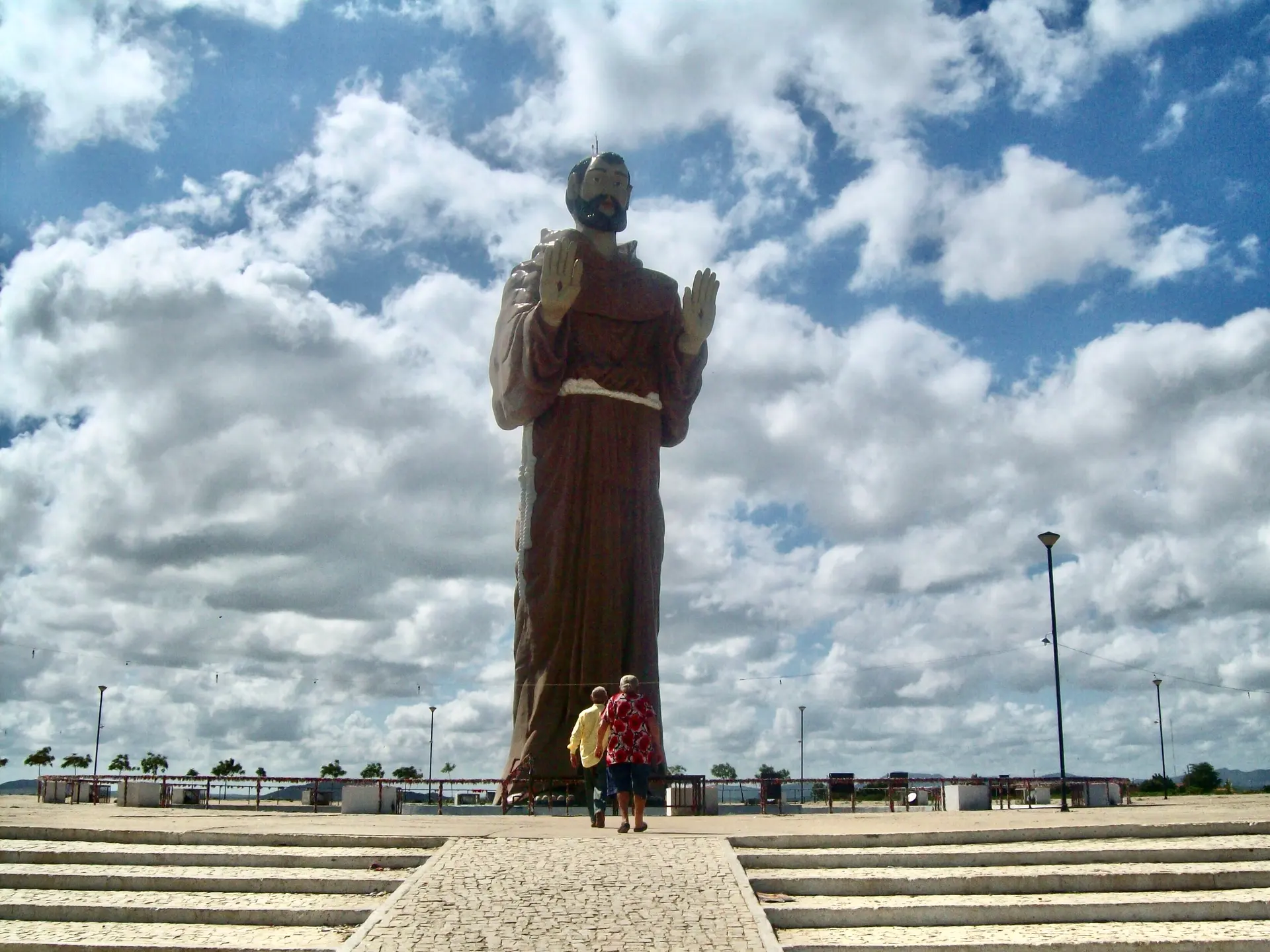
Image of Caninde, Estátua de São Francisco. Image source · CC-BY-SA-3.0
Visit essentials
A quick read before you go
- Duration
- Allow two to three hours to visit the statue (including the 125-step climb), Casa dos Milagres,…
- Access
- Canindé is located approximately 110-120 kilometers southwest of Fortaleza, Ceará.
Overview
Visible from every point in Canindé, the thirty-metre iron-and-cement statue stands on Alto do Moinho with open arms and the wounds that name this devotion: chagas, the stigmata St. Francis received on Mount Alverno in 1224. Inaugurated in 2005, it is the newest expression of a devotion begun in 1775, when a Portuguese settler built a chapel beside the Canindé River to fulfil a promise to the wounded saint.
Reports of healings soon drew pilgrims across Northeast Brazil's vast, drought-prone sertão.
The sanctuary now receives over 1.5 million visitors during the October festival alone, and the Brazilian Federal Senate recognized its romaria as intangible cultural heritage in 2024. For sertanejo people, this remains where the wounded are heard: Francis chose poverty, received Christ's wounds, preached to animals, and walked barefoot, so pilgrims approach him not as spectators but as kin returning to kin.
Why this place is sacred
The sertão of Northeast Brazil is one of the harshest inhabited landscapes in South America. Drought can last years. Poverty is structural. The people who settled this land learned a resilience that outsiders often romanticize and rarely understand.
Into this landscape came a devotion centered on a saint who chose to suffer — who asked for it, who received Christ's wounds as a gift. The resonance was immediate and has never faded. The people of the sertão do not venerate São Francisco das Chagas because they have been told to. They venerate him because they recognize him.
This recognition is the thin place. It is not a geological feature or an astronomical alignment. It is a relationship between human pain and divine compassion, expressed through two and a half centuries of unbroken walking, praying, and offering.
Every ex-voto left in the Casa dos Milagres — every carved wooden hand representing a hand healed, every photograph of a child who survived — is a marker of a moment when someone experienced the boundary between their suffering and something larger growing thin enough to cross.
The statue on the hill makes this visible at the scale of landscape. From the viewpoint at its summit, the city spreads below — basilica, Casa dos Milagres, the streets that fill with 1.5 million pilgrims each October. The panorama is not scenic in the conventional sense. It is the view of a faith so concentrated it has reshaped a city.
The devotion began with a single act of gratitude. Francisco Xavier de Medeiros, a Portuguese settler, built a chapel on the Canindé River in 1775 to fulfill a vow after receiving a grace from St. Francis. The primitive image he installed — affectionately called São Francisquinho — became the focus of a spontaneous pilgrimage as reports of healings spread across the sertão. The chapel was never designed to become a major sanctuary.
It became one because the need was already there, waiting for a form.
From a riverside chapel to the largest Franciscan pilgrimage in the Americas, the trajectory of Canindé traces the deepening of a devotion rather than its transformation. The chapel was completed in its definitive form by 1796. Franciscan friars assumed the parish in 1923, bringing institutional structure to what had been a largely popular phenomenon. The basilica received Minor Basilica status from the Holy See in 1925.
The statue, inaugurated on the Feast of St. Francis in 2005, was the work of Deoclécio Soares Muniz, a Ceará artist known as Bibi, later honored as a Living Treasure of the state.
Built with 18 tons of iron and 3,500 bags of cement, coated in ceramic-glass for the relentless sertão sun, it gave monumental form to a devotion that had always been intimate — the whispered prayer of a mother over a sick child, the silent promise of a farmer walking through drought.
Experience and orientation
Nothing prepares you for the Casa dos Milagres. Thousands of ex-votos fill the space — carved wooden arms, legs, heads, and torsos representing ailments healed. Photographs of loved ones. Locks of hair. Models of houses and cars. During the October festival, approximately one ton of objects are deposited. The effect is not quaint or folkloric. It is overwhelming.
You are standing inside the accumulated evidence of a quarter millennium of human desperation and gratitude, and it presses against you with a weight that has nothing to do with the physical objects.
The statue offers something different. The 125 steps inside the structure are a climb in both senses — physical effort and gradual ascent above the density of the pilgrimage below. The viewpoint at the top accommodates fifteen people. From here, Canindé reveals its geography: the sertão stretching in every direction, the sanctuary complex at the city's heart, the roads along which pilgrims have been walking for centuries.
During the Festa de São Francisco, the experience shifts entirely. Over 1.5 million people converge on a small city. The streets become procession routes. Masses are celebrated for specific communities — cowboys, cyclists, accordion players. Pilgrims arrive on foot after walking roughly 120 kilometers from Fortaleza over three to four days. Some arrive by motorcycle in the Moto Romaria, now in its 32nd edition.
The communal intensity is such that the entire city becomes the pilgrimage site, and the boundary between participant and observer dissolves.
The Blessing of the Animals on September 26 offers a gentler register — a ceremony rooted in St. Francis's love for all creatures, held in the zoo courtyard at eight in the morning. It is one of those moments where theology becomes tenderness.
If you come outside the October festival, you will find a sanctuary complex that rewards quiet attention. Walk the basilica first. Sit in the Casa dos Milagres long enough for the initial shock to settle into something more nuanced — notice the specificity of the offerings, the care with which they were made, the stories they imply but do not tell.
Then climb the statue. Let the physical effort be part of it. At the top, rather than reaching immediately for a camera, stand still and look. The landscape below is the landscape the pilgrims walk through — dry, vast, demanding. Understanding the distance they cover on foot changes what this place means.
If you come during the festival, surrender any expectation of solitary contemplation. The experience here is collective. Let yourself be carried by it. The processions, the singing, the sheer press of human devotion — these are the practice. Your presence among them is participation enough.
Context and lineage
Franciscan Third Order missionaries arrived in the Canindé sertão around 1758, working among the scattered settlements of the semi-arid interior. The devotion they carried — to São Francisco das Chagas, Francis bearing the wounds of Christ — found immediate resonance among people for whom suffering was not theological concept but lived reality.
In 1775, Francisco Xavier de Medeiros, a Portuguese citizen from nearby Baturité, built a chapel on the banks of the Canindé River. The founding narrative tells of a grace received — a favor from St. Francis answered, a vow now requiring fulfillment. The exact circumstances have been lost to oral transmission; what survives is the chapel and the primitive image of São Francisco das Chagas, the small statue called São Francisquinho, installed that year.
Reports of healings and answered prayers spread through the sertão. Pilgrims began arriving — first dozens, then hundreds, then thousands. The chapel underwent various transformations before reaching its definitive form in 1796. By the early twentieth century, the devotion had outgrown any single building. The Franciscan friars of the Order of Friars Minor assumed the parish in 1923, and the basilica was elevated to Minor Basilica status by the Holy See in 1925.
The statue was a late addition to an ancient devotion. Construction began in July 2002 with the foundation stone at Alto do Moinho. Deoclécio Soares Muniz sculpted the figure — 30.25 meters of iron and cement, later coated in ceramic-glass. It was inaugurated on October 4, 2005, the Feast of St. Francis. It is the largest statue of St. Francis in the world.
The lineage runs unbroken from the 1758 Franciscan missions through the 1775 chapel, the 1923 arrival of the Order of Friars Minor, the 1925 basilica elevation, and the 2005 statue. But the truest lineage is not institutional. It is carried in the feet of pilgrims who have walked this route for generations — grandmothers who walked it as children, parents who bring their own children now, families whose relationship with São Francisco is as personal and enduring as any kinship.
St. Francis of Assisi
saint
The 13th-century Italian friar who received the stigmata — the wounds of Christ — on Mount Alverno in 1224. In Canindé, he is venerated specifically as São Francisco das Chagas (Francis of the Wounds), an emphasis on his suffering that resonates profoundly with the hardships of the sertanejo people.
Francisco Xavier de Medeiros
historical
The Portuguese settler from Baturité who built the first chapel on the Canindé River in 1775, fulfilling a vow for a grace received from St. Francis. His act of individual gratitude set in motion what would become the largest Franciscan pilgrimage in the Americas.
Deoclécio Soares Muniz (Bibi)
artist
The Ceará sculptor who designed and created the 30.25-meter statue of São Francisco. Later honored as a Tesouro Vivo (Living Treasure) of the State of Ceará, his work gave monumental form to a devotion that had been expressed in intimate, handmade offerings for over two centuries.
Franciscan Third Order Missionaries
historical
The missionaries who evangelized the Ceará sertão from the 1750s onward, carrying the devotion to São Francisco das Chagas that would take root so deeply in Northeast Brazil. Their arrival prepared the cultural ground for the chapel, the healings, and the pilgrimage that followed.
Traditions and practice
The foundational practice is the romaria — the pilgrimage on foot. Traditionally, pilgrims walk from Fortaleza, roughly 120 kilometers through the sertão, over three to four days. The walk itself is the prayer. It is undertaken to fulfill a vow, to give thanks for a healing, or to carry an intention too heavy for ordinary prayer. The physical cost — the heat, the dust, the blistered feet — is not incidental. It is the point.
In a devotion centered on a saint who bore wounds willingly, suffering offered becomes a form of communion.
The ex-voto tradition is among the richest in Brazil. At the Casa dos Milagres, pilgrims leave objects representing answered prayers: carved wooden limbs corresponding to healed ailments, photographs of loved ones who survived illness, locks of hair, clothing, and models of houses and cars. These are not casual gestures. Each object carries a story of crisis and relief, laid down in a public space where individual suffering becomes communal testimony.
Periodically, the accumulated ex-votos are removed in a ceremony — sprinkled with holy water, blessed, and cleared to make room for the next wave of gratitude.
Animals were historically brought as offerings, a practice rooted in gratitude for livestock saved from drought or disease. This tradition gave rise to the sanctuary's zoo, which still operates within the complex.
The Festa de São Francisco das Chagas runs from September 24 through October 4, culminating on the Feast of St. Francis. Daily masses, processions with the panel of São Francisco, novenas, and social activities fill the ten days. The festival has grown to include themed celebrations: masses for cowboys, for cyclists, for accordion players — each community claiming its relationship with the saint.
The Blessing of the Animals on September 26 at eight in the morning honors St. Francis's love of all creatures. The Moto Romaria, a motorcycle pilgrimage from Fortaleza now in its 32nd edition, reflects the devotion's capacity to absorb new forms of movement without losing its essence. A Christmas pilgrimage in December draws a smaller but significant gathering.
Year-round, the sanctuary complex receives visitors and pilgrims. Regular masses at the basilica maintain the rhythm of devotion between the major festivals. The statue's viewpoint, accessed by 125 internal steps, is open to visitors throughout the year.
If you come as a seeker rather than a declared pilgrim, begin at the Casa dos Milagres. Do not hurry through it. Let the weight of what is gathered there settle. These are not artifacts — they are evidence of moments when people felt heard.
Climb the statue slowly. The 125 steps are not arduous, but taking them at the pace of intention rather than exercise changes the quality of arrival at the top. At the viewpoint, look out over the landscape the pilgrims walk through. Let the distance register.
If you are present during the festival, join a procession. You need not share the faith to walk alongside those who hold it. The communal rhythm — the singing, the movement, the heat — carries its own intelligence. Simply being present within it, without performing belief or withholding it, is a form of respect.
At the basilica, sit in the back during a mass. The liturgy here is shaped by centuries of sertanejo devotion. Even without understanding Portuguese, the tone communicates something about what this saint means to these people.
Roman Catholicism (Franciscan devotion)
ActiveThe statue and sanctuary represent the epicenter of Franciscan devotion in the Americas and the second most important Franciscan sanctuary in the world after Assisi. The devotion centers on São Francisco das Chagas — St. Francis bearing the stigmata, the wounds of Christ received on Mount Alverno in 1224. This emphasis on the saint's wounding creates a specific theological resonance with the suffering poor of Northeast Brazil, who find in the stigmatized Francis not a distant holy figure but a companion in their own experience of hardship.
The annual Festa de São Francisco das Chagas runs September 24 through October 4, encompassing daily masses, processions with the panel of São Francisco, novenas, the Blessing of the Animals, and themed masses for cowboys, cyclists, and accordion players. Pilgrims walk from Fortaleza and across the region to fulfill vows and offer thanks. Ex-votos are left at the Casa dos Milagres — carved wooden body parts, photographs, hair, clothing, and models. The 125-step climb inside the statue serves as a devotional act combining physical effort with contemplative ascent.
Brazilian Popular Catholicism (Sertanejo devotion)
ActiveThe devotion at Canindé represents one of the strongest expressions of popular Catholicism in Brazil — a form of faith that operates partly within and partly alongside institutional structures, driven by personal vows, reported miracles, and communal pilgrimage rather than by clerical direction. The sertanejo relationship with São Francisco is intimate, familial, and reciprocal: the saint is addressed as a kinsman, and the terms of exchange — vow, grace, fulfillment — are understood as binding in both directions.
The ex-voto tradition is the signature practice of this popular devotion. Pilgrims carve or commission wooden representations of healed body parts, bring photographs of loved ones, offer hair and clothing. The objects are specific, personal, and material — the faith they express is embodied, not abstract. The romaria on foot, enduring heat and exhaustion as a form of prayer, reflects a theology of the body in which suffering offered voluntarily becomes a language the saint understands.
Perspectives and open questions
Canindé sits at the intersection of colonial history, popular religiosity, and living faith. Scholarly, theological, and devotional perspectives each illuminate different dimensions of why this place holds the power it does. None alone is sufficient. The academic framework explains the conditions that made the devotion possible; the theological framework explains its structure; the devotional reality — millions of feet on dusty roads — explains why it endures.
Scholarly perspective
The 1959 study by the Instituto do Ceará traces the devotion's origins to 18th-century Franciscan Third Order missions in the sertão. Scholars of Brazilian popular Catholicism understand Canindé within a broader pattern: colonial-era devotions taking root in communities where institutional church presence was thin but popular religiosity was intense. The identification between the stigmatized saint and the suffering sertanejo population — drought, poverty, illness — is widely recognized as central to the devotion's persistence.
The ex-voto tradition at Canindé has attracted particular scholarly attention as one of the richest in Brazil. Projects like Projeto Ex-votos do Brasil document these objects as significant expressions of material culture and popular religiosity — artifacts that simultaneously function as prayer, art, and social history. The 2024 Federal Senate recognition of the romaria as intangible cultural manifestation reflects growing institutional acknowledgment of what scholars have long studied.
Living and traditional perspectives
In Franciscan theological understanding, the devotion to São Francisco das Chagas centers on the mystery of the stigmata — the moment when St. Francis's identification with the crucified Christ became inscribed in his body. The Canindé devotion emphasizes this wounding as the point of deepest communion between human and divine suffering. For practitioners, the ex-votos are not symbolic gestures but participations in this mystery: the offering of one's wound as an act of trust that it will be received.
The Franciscan Province of Brazil describes the devotion's strength in the Northeast as arising from the profound affinity between the saint's chosen poverty and the sertanejo's lived poverty. This is not a romanticization of suffering but a theological claim: that the God revealed through Francis is found precisely where pain is most acute, and that the pilgrimage — the walking, the heat, the physical cost — is a sacramental participation in that finding.
Open questions
The exact nature of the grace that led Francisco Xavier de Medeiros to build the first chapel in 1775 is not documented. Oral tradition attributes it to a favor received from St. Francis, but the specifics have been lost.
This lacuna is itself instructive: the devotion's foundation rests not on a verifiable miracle but on a personal experience of being heard — the same experience that continues to draw pilgrims 250 years later, and that resists the kind of documentation scholars prefer.
Plan your visit
Access and arrival
Canindé is located approximately 110-120 kilometers southwest of Fortaleza, Ceará. The drive takes roughly two hours. Regular bus service operates from Fortaleza. During the romaria, many pilgrims walk the distance over three to four days, and motorcycle and bicycle pilgrimages follow the same route. The statue stands at Alto do Moinho in the Alto Guaramiranga neighborhood, on a hilltop above the city center. Entry to the statue and the entire sanctuary complex is free.
No mobile phone signal information was available at time of writing; check with the Santuário de Canindé (santuariodecaninde.com) for current visitor details.
Canindé offers modest accommodation options that fill rapidly during the October festival. Booking well in advance is essential for the festival period. Fortaleza, two hours away, provides a full range of hotels and serves as the most practical base for visitors who prefer urban infrastructure. Many pilgrims camp or stay with local families during the romaria, a tradition of hospitality that is itself part of the pilgrimage culture.
Respectful visit
No formal dress code is published for the statue or outdoor areas of the sanctuary complex. Standard Brazilian Catholic norms apply inside the basilica: modest clothing covering shoulders and knees is respectful. For the statue climb, wear comfortable clothes and sturdy footwear — the 125 internal steps require practical preparation. During the festival, the October heat of Ceará demands sun protection, light clothing, and water.
No specific restrictions have been published. Photography is generally permitted at the statue and its viewpoint. Inside the basilica and during religious ceremonies, exercise discretion — the worship happening around you is not content. In the Casa dos Milagres, photograph with sensitivity; the objects represent real people's suffering and relief.
The traditional offering is the ex-voto, left at the Casa dos Milagres. These are deeply personal objects — carved wooden representations of healed body parts, photographs, hair, clothing. This practice belongs to pilgrims fulfilling specific vows. General visitors are not expected to leave offerings, though candles can be lit in the basilica. If you feel moved to offer something, a quiet prayer or moment of gratitude at the statue is appropriate.
The 125-step internal stairway of the statue may not be suitable for visitors with mobility limitations. No other specific access restrictions have been published. During the October festival, expect road closures, extreme crowding, and limited accommodation availability.
The ex-voto tradition is a devotional practice with deep personal significance. Observe with respect in the Casa dos Milagres — do not handle the offerings or treat them as curiosities. During the festival, the crowds are immense and the infrastructure of a small city is strained. Carry water, wear sun protection, and be prepared for conditions more demanding than typical tourist sites. The 125 steps inside the statue may be challenging for those with mobility limitations or claustrophobia.
Current practical details
Address
R. São Lucas, n - Alto do Moinho, Canindé - CE, 62700-000, Brazil
Phone
Hours
Hours, fees, and access can change — verify on the official source before you travel. Practical details last checked Jun 2026.
Location
Map loads as you approach this section.
Pilgrim reflections
A portrait of encounter, not a score
Pilgrims describe what they felt, how present they could become, and whether the place would shape a journey. There are no stars and no ranking of traditions.
No reviewed reflections yet
The first pilgrims can help describe the character of being here.
Share a reflection
Available after an account-backed “Been there.” Every reflection is reviewed before publication.
Nearby sacred places
Explore other sacred places in the region. Proximity does not establish access or travel time; check each place’s guidance.


References
Sources consulted for this page. Source categories describe the publication, not a guarantee that every claim is verified. Traditional accounts and outside interpretations may differ.
- 01História – Santuário de Canindé — Santuário de São Francisco das Chagas de CanindéofficialOfficial sanctuary website history page with founding and development details
- 02O Santuário – Santuário de Canindé — Santuário de São Francisco das Chagas de CanindéofficialOfficial sanctuary overview with complex description and facilities
- 03Santuário de Canindé, no Ceará, sedia a maior romaria franciscana das Américas — CNBB (Conferência Nacional dos Bispos do Brasil)officialBrazilian Bishops' Conference article confirming largest Franciscan pilgrimage in the Americas
- 04Romaria de São Francisco em Canindé (CE) é reconhecida como manifestação cultural — Senado Federal do BrasilofficialFederal Senate recognition of the pilgrimage as intangible cultural manifestation in 2024
- 05Festa de São Francisco reúne mais de 1,5 milhão de pessoas na cidade de Canindé (CE) — Ministério do Turismo do BrasilofficialBrazilian Ministry of Tourism reporting on attendance figures
- 06Festa de São Francisco, em Canindé, aquece o turismo religioso e eleva a ocupação hoteleira da cidade — Secretaria do Turismo do CearáofficialCeará State Tourism Secretariat report on the festival's economic and cultural impact
- 07A força da devoção a São Francisco das Chagas no Nordeste — Província Franciscana da Imaculada Conceição do BrasilspiritualFranciscan Province of Brazil article on the devotion's strength in Northeast Brazil
- 08Origem da devoção a S. Francisco das Chagas de Canindé — Instituto do Cearáacademic1959 academic article from the Instituto do Ceará on the origins of the devotion
- 09250 anos da imagem primitiva de São Francisco das Chagas — Santuário de CanindéofficialOfficial commemoration of 250 years of the primitive image, detailing 1775 origins
- 10Casa dos Milagres conta com grande presença de fiéis na Festa de São Francisco — Santuário de CanindéofficialOfficial article on the House of Miracles and its role during the festival
- 11The Feast of the Stigmata of St. Francis at Canindé (Brazil) — Order of Friars Minor (OFM)spiritualInternational Franciscan Order official article on the Canindé feast
- 12Estátua de São Francisco – Wikipédia, a enciclopédia livreofficialPortuguese Wikipedia article on the statue with construction details
- 13Festa de São Francisco, em Canindé, é uma das maiores manifestações franciscanas do mundo — Brasil de FatoofficialJournalistic coverage of the festival with historical context
- 14Estátua de São Francisco – Visita ao SantuárioguideVisitor guide with statue details and practical information
- 15Canindé – CE | Projeto Ex-votos — Projeto Ex-votos do BrasilacademicAcademic project documenting ex-voto traditions at Brazilian sanctuaries
- 16História da Estátua de São Francisco — História de Canindé (blog)spiritualLocal history blog with detailed construction narrative of the statue
Share a photo
Help visitors recognize Caninde, Estátua de São Francisco. Every submission is reviewed before publication.