Parthenon
A temple born from marble and mathematics, crowning Athens for twenty-five centuries
Understand sacred places, explore living traditions, and learn how to engage respectfully with Pilgrim Map.
Access has not been verified. Check current local guidance before planning a visit.
Athens, Attica, Greece
Read the sources
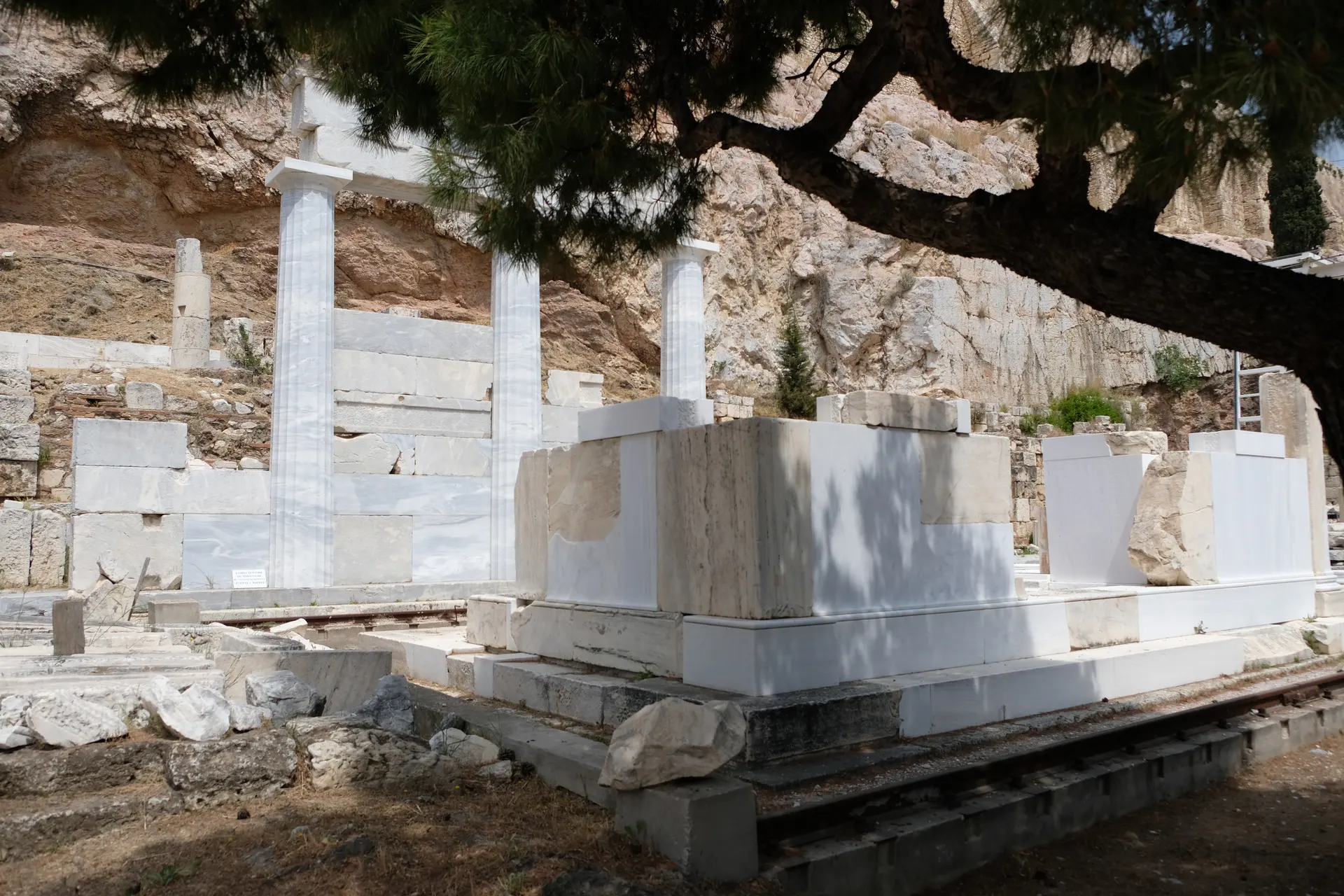
Image of Parthenon. Image source · CC-BY-SA-4.0
Visit essentials
A quick read before you go
- Duration
- Allow 2 to 3 hours for the full Acropolis visit, including the Parthenon, Erechtheion,…
- Access
- Main entrance from Dionysiou Areopagitou street, south slope.
Overview
The Parthenon is a Pentelic-marble Doric temple whose forty-six columns are neither truly straight nor vertical. Architects Ictinus and Callicrates calibrated their curves and lean to correct for human perception. The upward-curving stylobate, inward-leaning columns, and thickened corner pillars still work together beneath the surviving entablature.
For nearly a thousand years it held Phidias's twelve-meter gold-and-ivory Athena Parthenos, patron goddess of a city that treated wisdom as power. For almost another millennium it served as a Christian cathedral, then became an Ottoman mosque. In 1687, a Venetian mortar shell struck stored Ottoman gunpowder and collapsed the building's center.
Damaged, incomplete, and under active restoration, the Parthenon remains widely regarded as the Western world's most accomplished building. UNESCO inscribed the Acropolis as a World Heritage Site in 1987, recognizing it as a masterpiece of human creative genius.
Why this place is sacred
The quality that makes the Parthenon more than an architectural monument arises from the convergence of several factors, none sufficient alone.
The first is elevation. The Acropolis rises 150 meters above the Attic plain, a limestone outcrop that has served as a place of settlement and worship since the Neolithic period. Long before the Parthenon, there were altars here. The Mycenaeans fortified the summit. By the time Pericles commissioned the current temple, the rock had already accumulated millennia of sacred association. The Parthenon did not create the sanctity of the place. It concentrated what was already present.
The second is the architecture's relationship with perception. Every dimension of the Parthenon contains deliberate deviation from geometric regularity. The stylobate curves upward by approximately 6 centimeters. The columns lean inward by roughly 7 centimeters. The corner columns are slightly thicker than the others. These refinements, invisible to casual observation, create a building that appears more perfect than a geometrically perfect building would.
The effect is subliminal: visitors report a sense of rightness, of proportion, of something that exceeds what the eye can measure.
The third is the palimpsest. The Parthenon has been, in succession, the dwelling place of a goddess, a cathedral of the Virgin Mary, a mosque, a ruin, and a monument. Each identity has left its mark — the Christian apse cut into the eastern wall, the minaret base still visible, the scars of the 1687 explosion. The building does not belong to any single tradition. It belongs to the human impulse toward the sacred itself.
The fourth is simply the light. Athens receives over 2,800 hours of sunlight annually, and Pentelic marble responds with a warmth that changes through the day — pale gold at dawn, white at noon, amber at sunset. The marble does not merely reflect light. It seems to hold it.
The Parthenon was built to house the chryselephantine statue of Athena Parthenos — Athena the Virgin — the patron goddess of Athens. Commissioned by Pericles following the Greek victories over the Persian Empire, it served as both temple and treasury, holding the reserves of the Delian League. The building's dual function reflected the Athenian understanding that religion and civic life were inseparable.
To honor the goddess was to honor the city, and to build the most perfect temple possible was to declare Athens's place in the order of things.
The Parthenon's first transformation came in the late sixth century AD, when it was converted into a Christian church dedicated to the Theotokos — the Virgin Mary. The continuity was not accidental: the temple of the virgin goddess became the church of the Virgin Mother. An apse was built into the eastern wall, an iconostasis installed, and the interior adapted for liturgy.
For nearly a millennium, the Parthenon served as the principal church of Athens, first as an Orthodox cathedral, then as a Latin Catholic cathedral during the Frankish period.
Following the Ottoman conquest in the mid-fifteenth century, the building became a mosque. The apse became a mihrab, a minaret rose from the former bell tower, and Christian imagery was whitewashed. The building served Islamic worship until 1687, when a Venetian mortar shell struck the gunpowder stored inside and the center collapsed.
Centuries of decline, looting, and rediscovery followed. Lord Elgin removed a significant portion of the surviving sculptures between 1801 and 1812. Greek independence in 1832 transformed the Acropolis into an archaeological site. A restoration program begun in 1975 continues to the present day, with scaffolding removed in 2025 for the first time in over two decades.
The building now exists as a monument — no longer a temple, a church, or a mosque, but something that contains the memory of all three.
Experience and orientation
Begin at the base. The south slope of the Acropolis is visible from much of central Athens — the columns catch the light and hold it, announcing themselves above the roofline of the modern city. The approach from Dionysiou Areopagitou street is itself a kind of preparation: the wide pedestrian boulevard, the plane trees, the gradual incline that lifts you out of the noise of traffic and commerce.
The ascent proper begins at the entrance gate. The path is steep, the marble underfoot polished by millions of feet into a surface that demands attention. You climb through the Propylaea — the monumental gateway that Mnesicles designed to frame the arrival — and the Parthenon reveals itself not all at once but in stages. This was intentional.
Ancient visitors approaching from the west saw the building at an oblique angle, its full length foreshortened, the procession of columns compressed into a single visual chord. Only as they moved around the building did it open, section by section, into its full dimensions.
The modern visitor follows the same path, now channeled along designated walkways. You cannot enter the Parthenon. You cannot touch it. You walk around it at a distance of several meters, viewing the columns from the south, the east, the north. This enforced distance is, unexpectedly, part of the experience. The entasis of the columns — the slight convex swelling that prevents them from appearing concave — becomes visible only after sustained looking.
The way the fluting catches shadow changes with each step. The scale resolves: these columns are over ten meters tall, each drum weighing several tons, fitted without mortar to tolerances that modern engineering would respect.
What many visitors report is not a single moment of revelation but a gradual accumulation. The Parthenon does not overwhelm. It insists on being looked at carefully, on rewarding sustained attention, on revealing its intelligence only to those who slow down enough to receive it.
If you can find ten minutes of relative stillness, particularly in the early morning or late afternoon, the Parthenon's essential quality becomes available: the sense that human beings once cared this much about getting something right.
The views from the Acropolis plateau extend across Athens to the Saronic Gulf, to the mountains of the Peloponnese, to the islands visible on clear days. The Ancient Agora spreads to the northwest. From this height, the relationship between the city and its sacred center becomes legible: Athens arranged itself around this rock, and the rock arranged itself around this temple.
Arrive at 8:00 AM, when the gates open and the crowds are smallest. The morning light on the east pediment is the closest approximation to how the original builders intended the temple to be seen. Allow two to three hours for the full Acropolis visit. Wear sturdy shoes — the marble is slippery. Carry water. There is no shade on the summit.
The Acropolis Museum at the base of the hill deserves a separate visit of at least two hours, ideally on a different day when the visual memory of the Parthenon is still fresh.
Context and lineage
The Parthenon that stands today is not the first temple on this site. An earlier temple to Athena was under construction when the Persians sacked Athens in 480 BC, destroying everything on the Acropolis. For thirty years, the ruins remained untouched, possibly as a deliberate memorial.
It was Pericles who broke the silence. In the 440s BC, flush with Delian League wealth and the confidence of a city that had defeated Persia, he initiated a building program of extraordinary ambition. Construction began in 447 BC and proceeded with remarkable speed: the temple structure was completed by 438 BC, when the chryselephantine statue of Athena was dedicated, and the sculptural program was finished by 432 BC.
The deeper origin story is about a city-state of perhaps 250,000 people deciding it could produce a building that would express the highest possibilities of human civilization. The Parthenon was funded by allied tribute, designed by architects who understood that mathematical perfection had to be adjusted for the imperfections of human perception, and decorated by the greatest sculptor of the ancient world.
It was an act of collective will directed at a single question: what does it look like when a civilization builds the best thing it can build?
The Parthenon belongs to the tradition of Doric temple architecture that developed across the Greek world from the seventh century BC, but it transcended that tradition in nearly every respect. Its incorporation of Ionic elements, its unprecedented sculptural program, and its optical refinements placed it beyond comparison with any contemporary or subsequent Greek temple.
The building influenced Roman, Renaissance, Neoclassical, and modern architecture — the Nashville Parthenon (1897), the Brandenburg Gate (1791), and the British Museum facade (1852) among its most direct descendants. The Acropolis was inscribed as a UNESCO World Heritage Site in 1987.
Phidias (Pheidias)
Master sculptor who supervised the entire artistic program of the Parthenon, including the 160-meter Ionic frieze depicting the Panathenaic procession, the metopes, the pediment sculptures, and the colossal chryselephantine statue of Athena Parthenos. His vision unified the building's architecture and sculpture into a single coherent expression of Athenian ideals.
Ictinus (Iktinos)
Principal architect of the Parthenon, responsible for the innovative design that incorporated optical refinements — the curved stylobate, leaning columns, and varied column diameters — to create a building that appears more perfect than geometric perfection would allow. Also credited with the Temple of Apollo at Bassae.
Pericles
Athenian statesman who commissioned the Parthenon as the centerpiece of his building program on the Acropolis, directing Delian League funds toward what he envisioned as the supreme expression of Athenian civilization. His political leadership and cultural vision made the project possible.
Manolis Korres
Greek architect and archaeologist who has led the modern restoration of the Parthenon since the 1980s. His meticulous research into the original construction techniques has revealed the full extent of the ancient builders' sophistication and guided the restoration using methods faithful to the original.
Lord Elgin (Thomas Bruce, 7th Earl of Elgin)
British diplomat who removed approximately half of the surviving Parthenon sculptures between 1801 and 1812, transporting them to London where they remain in the British Museum. His actions, controversial from the beginning, initiated a repatriation debate that continues to shape how the world understands the relationship between cultural heritage and national identity.
Traditions and practice
The Parthenon's ritual life centered on the Great Panathenaia, the quadrennial festival that was the most important religious and civic event in ancient Athens. Every four years, a grand procession wound through the city and up to the Acropolis, bearing a newly woven peplos — an elaborately embroidered garment — to drape over the ancient wooden cult statue of Athena Polias in the Erechtheion.
The procession included citizens of every class: horsemen, charioteers, musicians, maidens, elders bearing olive branches, and the ergastines — noble girls chosen to weave the sacred peplos.
At the great altar east of the Parthenon, cattle were sacrificed and the meat distributed among the citizens. The festival also included athletic competitions, musical contests, and recitations of Homer. The Panathenaic frieze that once encircled the cella walls — 160 meters of carved marble depicting the procession — preserved the memory of this ritual in stone, though much of the frieze now resides in the British Museum.
Smaller annual Panathenaia maintained the cycle between the great festivals. The chryselephantine Athena inside the cella was not the object of regular worship — that role belonged to the older wooden statue in the Erechtheion — but the Parthenon itself served as the treasury of the goddess, holding the material wealth that was, in the Greek understanding, Athena's own.
No religious services are held at the Parthenon. Modern Hellenic polytheist organizations occasionally hold ceremonies at the base of the Acropolis, though not at the temple itself.
The ongoing restoration program, directed since the 1980s by architect Manolis Korres, represents a different kind of devotion. The painstaking work of identifying, cataloguing, and repositioning fallen marble blocks — using titanium dowels instead of the iron clamps that caused earlier damage — is itself a form of reverence: the slow, meticulous labor of returning a building to legibility.
The Parthenon was designed to be approached, circled, and contemplated. A visitor seeking more than a photograph might consider the following.
Arrive early, before the crowds thicken, and pause at the Propylaea before ascending to the summit. The ancient Athenians understood the approach as preparation: the gateway framed the transition from the secular city to the sacred precinct. Allow the ascent to serve a similar function. Walk slowly. Notice the shift in sound as the city falls away below.
On the summit, resist the impulse to photograph immediately. Stand at the southeast corner, where the relationship between the Parthenon and the Erechtheion is most visible, and simply look. The entasis of the columns, the play of shadow in the fluting, the faint warmth of the Pentelic marble — these details emerge only with patience.
At the east end, where the main entrance to the cella once stood, imagine the space as it was: Phidias's Athena towering in the dimness, twelve meters of gold and ivory catching reflected light from a shallow pool on the floor. The scale of that absent figure can be approximated by looking upward at the columns and understanding that the statue filled the space they define.
Visit the Acropolis Museum on a separate day. The Parthenon Gallery on the top floor displays the surviving frieze fragments in their original spatial arrangement, with the building itself visible through glass walls. The connection between carved procession and real temple becomes almost unbearably clear.
Ancient Greek Religion
HistoricalThe Parthenon was the supreme temple of Athena Parthenos, patron goddess of Athens, embodying wisdom, strategic warfare, and civilization. It housed the colossal chryselephantine statue by Phidias — approximately 12 meters of gold and ivory — and served as both the dwelling of the goddess and the treasury of the city. The temple was the focal point of the Panathenaic Festival, the most important religious and civic celebration in the ancient Athenian calendar.
Eastern Orthodox Christianity
HistoricalConverted into a church dedicated to the Theotokos (Virgin Mary) in the late sixth century AD, the Parthenon served as the primary church of Athens for nearly a millennium. The transition from temple of the virgin goddess to church of the Virgin Mother carried a theological continuity that early Christians likely recognized and intentionally cultivated.
Roman Catholicism
HistoricalDuring the Frankish period following the Fourth Crusade (1204), the Parthenon-church came under Latin Catholic authority and served as a Catholic cathedral, reflecting the political and religious division of the former Byzantine Empire.
Islam
HistoricalAfter the Ottoman conquest of Athens in the mid-fifteenth century, the Parthenon was converted into a mosque. A minaret was constructed from the earlier bell tower, and the interior was adapted for Islamic worship. The building served as a mosque until the Venetian bombardment of 1687.
Perspectives and open questions
The Parthenon has been interpreted through every lens that Western civilization possesses — as architecture, as politics, as theology, as symbol, as contested heritage. No single perspective exhausts it.
Scholarly perspective
The scholarly consensus holds the Parthenon as the supreme achievement of classical Greek architecture and among the most significant buildings in human history. Its optical refinements — documented in detail by researchers including Manolis Korres — demonstrate mathematical sophistication that was not fully understood until modern surveying techniques were applied. The sculptural program, overseen by Phidias, represents the highest point of classical Greek art.
The 160-meter Ionic frieze depicting the Panathenaic procession, placed unusually on the cella walls rather than the exterior, remains the subject of active scholarly debate: some scholars read it as a specific historical procession, others as an idealized composite, and still others as a mythological narrative. The building's dual function as temple and treasury reflects the connection between religion, politics, and economics in fifth-century Athens.
Living and traditional perspectives
For Greeks, the Parthenon is not a monument to antiquity but a living symbol of national identity and cultural continuity. The campaign for the return of the Parthenon Marbles from the British Museum is a matter of profound cultural significance. When the Acropolis Museum opened in 2009, the empty spaces where London-held frieze fragments would go were left deliberately visible: an architectural argument for reunification.
The Parthenon appears on Greek currency, official documents, and throughout the national consciousness, representing the continuity of Greek civilization across three millennia of disruption, occupation, and renewal.
Alternative interpretations
Sacred geometry enthusiasts and esoteric researchers have identified the golden ratio and other mathematical proportions in the Parthenon's design, though scholars debate whether these were intentional or emergent. Some researchers have noted alignments with astronomical phenomena, including the orientation of the temple's long axis.
Martin Gray, in his World Pilgrimage Guide, describes Athena as representing 'the highest order of spiritual development and the gifts of intellect and understanding,' reading the Parthenon as a temple not merely to a goddess but to the principle of wisdom itself. The building's influence on Freemasonic architecture and symbolism adds another layer of interpretive tradition, though one that postdates the original by over two millennia.
Open questions
Several aspects of the Parthenon resist definitive resolution. The exact nature of the rituals performed inside the cella remains debated — how the interior was lit, whether the public entered, and what the relationship was between the chryselephantine Athena in the Parthenon and the older wooden Athena in the Erechtheion.
The intended viewing experience of the Panathenaic frieze, placed high on the cella walls in deep shadow, remains unclear: was it meant to be seen by human eyes, or was it an offering to the goddess herself? The primary function of the building — temple, treasury, or civic statement — is still discussed.
And the full extent of the original polychromy is only partially understood: the Parthenon was not white but painted in vivid reds, blues, and golds, and the building the ancient Athenians knew looked strikingly different from the marble ruin that has shaped the Western aesthetic imagination.
Plan your visit
Access and arrival
Main entrance from Dionysiou Areopagitou street, south slope. Metro: Acropolis station (Line 2), five minutes to the entrance. Wheelchair-accessible elevator on the north slope. Timed entry tickets required — book online during peak season. Standard admission approximately 30 euros (2025). Combination tickets for the Acropolis and surrounding sites available. Summer hours: 8:00-20:00. Winter hours: 8:00-17:00. Mobile phone signal strong throughout. Emergency services at the entrance.
The Plaka and Monastiraki neighborhoods at the base of the Acropolis offer accommodations from hostels to boutique hotels, many with rooftop views of the illuminated Parthenon. Koukaki, south of the Acropolis, provides quieter options within walking distance. The metro places the site within reach of accommodation anywhere in the city.
Respectful visit
No formal dress code. Comfortable clothing suitable for walking and climbing is recommended. Sturdy, closed-toe shoes with good grip are essential: the ancient marble surfaces are polished smooth and become dangerously slippery when wet or in direct sun. A hat and sunscreen are advisable in summer.
Photography is freely permitted on the Acropolis, including the Parthenon. Flash photography is prohibited. Drones are prohibited. Commercial photography and filming require a permit from the Greek Ministry of Culture. Inside the Acropolis Museum at the base, photography is permitted without flash in most galleries.
Not applicable. The Parthenon is an archaeological site with no active worship. Leaving objects, flowers, or other offerings on or near the structures is not permitted.
Visitors must remain on designated paths at all times. No touching of marble surfaces. No sitting on ancient structures. No food on the summit. No large bags. No drones. Timed entry tickets required, priced at approximately 30 euros as of 2025. Combination tickets for the Acropolis and surrounding archaeological sites are available. Summer hours run 8:00 to 20:00; winter hours 8:00 to 17:00. The site closes during extreme weather events.
This is an archaeological site under active restoration. Visitors must remain on designated paths and may not touch any marble surface. The marble underfoot is extremely slippery, especially when worn by foot traffic. There is no shade on the summit, and summer temperatures regularly exceed 35 degrees Celsius. Dehydration and heat exhaustion are genuine risks during midday visits in July and August. Timed entry tickets are required and should be booked in advance during peak season.
Current practical details
Book a date- and time-specific e-ticket on the official Greek Ministry of Culture portal (hhticket.gr); the QR code is scanned from your phone at the gate, so buy online in advance.
Timed entry is mandatory (since 2024) and slots are capped — peak-season morning slots sell out, so book ahead. A combined ticket covering the Acropolis plus six other Athens sites is sold on the same portal; the Acropolis Museum is a separate ticket.
Buy / book ticketsHours, fees, and access can change — verify on the official source before you travel.
Location
Map loads as you approach this section.
Pilgrim reflections
A portrait of encounter, not a score
Pilgrims describe what they felt, how present they could become, and whether the place would shape a journey. There are no stars and no ranking of traditions.
No reviewed reflections yet
The first pilgrims can help describe the character of being here.
Share a reflection
Available after an account-backed “Been there.” Every reflection is reviewed before publication.
Nearby sacred places
Explore other sacred places in the region. Proximity does not establish access or travel time; check each place’s guidance.



References
Sources consulted for this page. Source categories describe the publication, not a guarantee that every claim is verified. Traditional accounts and outside interpretations may differ.
- 01Parthenon | Definition, History, Architecture — Britannica — Encyclopaedia BritannicaacademicAuthoritative encyclopedic source
- 02The Parthenon, Athens — Smarthistory — SmarthistoryacademicArt history academic resource
- 03Acropolis, Athens — UNESCO World Heritage Centre — UNESCOofficialOfficial UNESCO listing
- 04An introduction to the Parthenon and its sculptures — British Museum — British MuseumacademicScholarly analysis of sculpture and frieze
- 05Parthenon — Wikipedia — Wikipedia contributorsencyclopediaComprehensive overview with extensive citations
- 06Parthenon, Athens — World Pilgrimage Guide — Sacred Sites / Martin GrayspiritualPilgrimage and spiritual perspective
- 07How to Visit the Acropolis & Parthenon (Updated for 2026) — Earth TrekkersguideCurrent visitor guide with 2026 updates
- 08Athens' Parthenon free of scaffolding for first time in 20 years — Travel Tomorrow / Euronewsnews2025 restoration milestone
Photo gallery
3 curated photos
Share a photo
Help visitors recognize Parthenon. Every submission is reviewed before publication.