Asklepion shrine
Where ancient Athens brought its wounded to sleep, to dream, and to be healed by a god
Understand sacred places, explore living traditions, and learn how to engage respectfully with Pilgrim Map.
Access has not been verified. Check current local guidance before planning a visit.
Athens, Attica, Greece
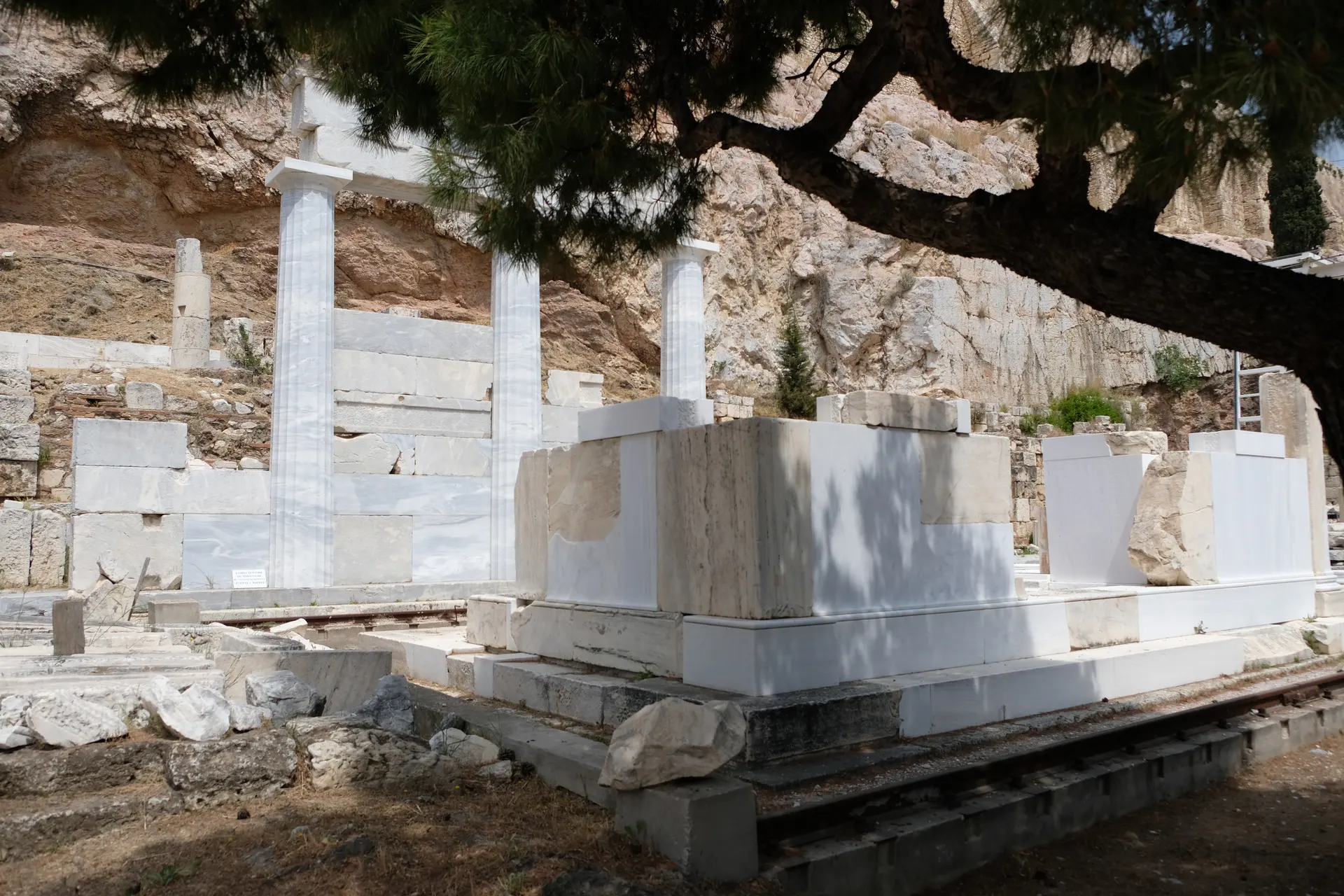
Image of Asklepion shrine. Image source · CC-BY-SA-4.0
Visit essentials
A quick read before you go
- Duration
- Thirty to forty-five minutes for the Asclepieion itself.
- Access
- The Asclepieion is within the Acropolis archaeological site on the south slope, between the…
Overview
On the south slope of the Acropolis, between the Theatre of Dionysus and the Stoa of Eumenes, low walls, column bases, and a cave mouth mark where ancient Athenians sought divine healing. Telemachos Acharneas founded the Asclepieion in 419 BC, amid the aftermath of the Plague of Athens, bringing the cult of Asclepius from Epidaurus. Patients purified themselves, sacrificed, and slept in the enkoimeterion in expectation of healing dreams.
Temple and altar foundations, the sleeping stoa, and the sacred spring still seeping from the cave preserve this encounter between suffering and hope beneath the Parthenon.
Why this place is sacred
The south slope of the Acropolis is a transitional zone. Above, the Parthenon embodies the classical Greek achievement of order, proportion, and civic pride. Below, the ground falls away toward the lower city. And in between, pressed against the rock face, the Asclepieion occupies a position that is neither fully of the heights nor fully of the world below. This in-between quality is not accidental.
It reflects the sanctuary's essential purpose: to hold open a passage between the waking world and the world of dreams, between human limitation and divine possibility.
The cave is the oldest element here, older than the sanctuary itself. Water seeps from the rock into a natural basin. In the ancient world, springs that emerged from the earth were understood as points of contact between the surface world and the subterranean realm of gods and spirits. The Athenians who came here to drink this water and bathe in it were not simply seeking hydration. They were participating in a ritual of contact with what lay beneath.
Dream incubation deepened this threshold crossing. To sleep in the enkoimeterion was to voluntarily surrender consciousness, to enter a state where the boundary between the self and the divine became permeable. The sick lay down in darkness with the expectation that Asclepius would come to them, that the god's hands would touch their wounds, that his voice would speak the cure.
Whether this was faith healing, the therapeutic effect of ritual and expectation, or something that resists modern categorization, the practice sustained itself for eight centuries.
The sanctuary was founded during the Plague of Athens, when rational medicine had no answers and the dead were stacked in temples. That origin in collective desperation gives the site a particular emotional weight. This was not a place built in prosperity or triumph. It was built in the space that opens when everything else has failed.
The Asclepieion was established in 419 BC by Telemachos Acharneas, a private Athenian citizen, as a healing sanctuary dedicated to Asclepius, god of medicine. Its founding coincided with or closely followed the Plague of Athens, which killed approximately one quarter of the population during the Peloponnesian War.
The cult was brought from the great Asclepieion at Epidaurus, and the Athens sanctuary functioned as both religious shrine and rudimentary hospital, offering healing through the practice of enkoimesis — dream incubation in the sacred dormitory.
For eight centuries, the Asclepieion operated as an active healing center. Patients arrived, underwent purification, made offerings, and slept in the sanctuary awaiting divine healing dreams that were then interpreted by temple priests. The playwright Sophocles played a personal role in welcoming the cult to Athens, reportedly housing the sacred snake of Asclepius in his own home before the sanctuary was ready. The sanctuary expanded over time, adding stoas, a dining hall, and the two-story dormitory.
In the late fourth century AD, the suppression of pagan worship under Christian emperors brought the sanctuary's active life to an end. The buildings fell into disuse and ruin. Archaeological excavation began in 1876, gradually revealing the sanctuary's plan and recovering votive offerings that record the hopes and healings of those who once slept here. Today the site is part of the Acropolis UNESCO World Heritage Site, inscribed in 1987.
Experience and orientation
Most visitors encounter the Asclepieion by accident, descending the south slope of the Acropolis after the Parthenon and the Erechtheion have claimed their attention. This is not the worst way to arrive. The shift from the monumental to the modest mirrors the shift that ancient patients would have experienced: from the civic grandeur of the upper Acropolis to the intimate, almost hidden sanctuary where they came to be vulnerable.
Approach from the east, passing the Theatre of Dionysus. The Asclepieion lies just west of the theatre, and the two sites share a slope and something of a shared logic — both are places where people came to undergo transformation, whether through dramatic catharsis or physical healing. The sanctuary's footprint is legible in the low walls and column bases.
The altar of Asclepius, the temple foundations, the remains of the stoas — these require imagination to reconstruct, but the site plan is well-marked.
The cave demands attention. It is a natural opening in the rock face, and the sacred spring that emerges from it was the sanctuary's oldest sacred element. Stand at the cave mouth if access permits. Water has been seeping from this rock for millennia. In a city as built and rebuilt as Athens, there are few places where you can encounter something so unchanged.
The water that touches the stone today follows the same path it followed when the first patient drank from it.
The stoa foundations mark where the enkoimeterion once stood — the dormitory where the sick lay down to sleep and dream. Try to hold the strangeness of this: a building where people came specifically to lose consciousness, trusting that a god would meet them in the vulnerability of sleep. In a culture that valued rational discourse and civic participation, this surrender to the unconscious was a remarkable act.
From the terrace, look south across the lower city. Then look up. The Parthenon is directly above, its columns catching the light. The Asclepieion sits in its shadow, literally and figuratively. Athena's temple celebrated the city's power and wisdom. Asclepius's sanctuary held its pain and its need for mercy. Both were necessary.
The Asclepieion is located on the south slope of the Acropolis, west of the Theatre of Dionysus and east of the Stoa of Eumenes. It is accessible with the standard Acropolis ticket. Approach from the theatre side to follow the ancient visitor's path. Allow thirty to forty-five minutes to explore the ruins, the cave area, and the terrace. Morning light is best, as the south-facing slope can be harsh at midday in summer.
The site has limited signage compared to the Parthenon, so reading about the sanctuary beforehand deepens the visit considerably. The Acropolis Museum has a dedicated section on the Sanctuary of Asklepios with artifacts including votive offerings — visiting the museum before or after the site itself creates a more complete understanding.
Context and lineage
In the years around 430 BC, the Plague of Athens swept through a city already under siege during the Peloponnesian War. The historian Thucydides, himself a survivor, described the dead lying unburied in temples, the living too demoralized to tend them. Rational medicine offered no remedy. The plague killed the statesman Pericles and perhaps a quarter of the city's population.
In the aftermath of this catastrophe, an Athenian citizen named Telemachos Acharneas undertook to bring the cult of Asclepius from Epidaurus, home of the greatest healing sanctuary in the Greek world, to Athens. In 419 BC, during the festival of the Epidauria, the god arrived — embodied, as was customary, in the form of a sacred snake.
The playwright Sophocles, by then elderly and revered, reportedly welcomed the snake into his own home to house it until the sanctuary on the south slope was ready. For this act of hospitality, Sophocles was later honored with the heroic name Dexion, meaning 'the one who received.'
Telemachos recorded the founding on a double-sided marble pillar known as the Telemachos Monument, which depicted the arrival of Asclepius and the establishment of the sanctuary. He chose the south slope of the Acropolis, a site already marked by a natural cave and sacred spring. The location placed the healing god in the shadow of Athena's great temple above — an arrangement that paired the city's wisdom with its need for mercy.
The Asclepieion of Athens belonged to a network of several hundred healing sanctuaries dedicated to Asclepius that spread across the Greek and later Roman world. The mother sanctuary at Epidaurus, founded centuries earlier, was the most prestigious and the model for all others. The Athens Asclepieion was among the most important urban sanctuaries in this network, serving the largest city in classical Greece.
The practice of enkoimesis — healing through temple sleep — connected these sanctuaries to older traditions of sacred dreaming found across the ancient Mediterranean. When the cult was suppressed in the late fourth century AD, some of its practices and ideas were absorbed into early Christian healing shrines, where saints replaced gods as intercessors and dreams remained a medium of divine communication.
Telemachos Acharneas
Athenian citizen who founded the Asclepieion in 419 BC, bringing the cult of Asclepius from Epidaurus to Athens. He commissioned the Telemachos Monument recording the event and personally oversaw the construction of the sanctuary.
Sophocles
The great tragedian who reportedly housed the sacred snake of Asclepius in his own home during the god's arrival in Athens. He was later honored with the name Dexion for this act of hospitality, and a hero shrine was established in his memory.
Asclepius
Son of Apollo and the mortal Coronis, trained in medicine by the centaur Chiron. He became the divine patron of healing throughout the Greek world. His cult offered an alternative to rational Hippocratic medicine — healing through faith, dream, and divine encounter.
Hygieia
Daughter of Asclepius and goddess of health and cleanliness. She was worshipped alongside her father at the Asclepieion, representing the preventive dimension of health. Her name survives in the modern word 'hygiene.'
Panagiotis Kavvadias
Greek archaeologist who led systematic excavations of the Acropolis south slope in the late 19th century, uncovering the Asclepieion's plan, the Telemachos Monument, and votive offerings that revealed the sanctuary's healing practices.
Traditions and practice
The healing process at the Asclepieion followed a deliberate sequence that moved the patient from the ordinary world into a state of receptivity. First came katharsis, or purification. This was not merely physical cleanliness but a comprehensive preparation of body and mind. Patients bathed, observed a restricted diet, and were encouraged to attend theatrical performances at the adjacent Theatre of Dionysus — where the emotional catharsis of tragedy was understood as part of the healing process.
The word katharsis itself bridges the medical and the dramatic.
After purification, the patient made sacrifice at the altar of Asclepius. The offering acknowledged the god's authority over the illness and formally requested his intervention. Then came the central act: enkoimesis, or incubation. The patient entered the enkoimeterion — the two-story dormitory that served as the sanctuary's sleeping hall — and lay down in darkness, in proximity to the sacred cave and spring, expecting the god to visit in sleep.
The dreams that came were understood as direct encounters with Asclepius. The god might touch the afflicted part of the body, prescribe a remedy, or perform surgery while the patient slept. Upon waking, the patient reported the dream to temple priests who interpreted its meaning and prescribed treatment. Those who were healed dedicated votive offerings — terracotta or marble replicas of the healed body part — which accumulated in the sanctuary as public testimony to the god's power.
Communal meals in the stoa dining hall brought patients together, creating a community of the suffering and the hopeful. The sacred spring provided water for ritual bathing and drinking, understood as carrying the healing properties of the earth itself.
No worship or healing practices continue at the Asclepieion today. The sanctuary exists as an archaeological site within the Acropolis precinct, its stones silent where voices once chanted and the sick once slept. The Acropolis Museum preserves artifacts from the sanctuary, including votive offerings that record the intimate details of ancient suffering and hope — terracotta legs, arms, eyes, and internal organs dedicated by those who believed they had been healed.
The legacy of the Asclepieion's practices, however, extends well beyond the ruin. The concept of healing through controlled sleep and dream interpretation anticipates modern psychotherapy, particularly Carl Jung's work on dream analysis and active imagination. The holistic approach — purification of body, emotional catharsis through art, sacred sleep, and priestly interpretation — resembles modern integrative medicine's emphasis on treating the whole person rather than the isolated symptom.
Visitors can engage with the Asclepieion's legacy by approaching the site as its ancient patients approached healing: with deliberate intention. Before visiting, spend time in the Theatre of Dionysus next door. The ancient Athenians understood dramatic catharsis as preparation for healing. At the cave, pause and listen for the spring. Water still moves through the rock.
Consider the experience of arriving here ill, frightened, having exhausted other options, and being asked to do the one thing that requires the most trust: to lie down, to close your eyes, and to wait.
The Acropolis Museum visit pairs powerfully with the archaeological site. The votive offerings are the most human artifacts in the collection — small terracotta models of feet, hands, and eyes, each one representing a specific person's pain and a specific person's gratitude. Standing before them, you are standing before twenty-four centuries of human vulnerability.
Cult of Asclepius — Ancient Greek Healing Religion
HistoricalThe Asclepieion was one of the most important urban healing sanctuaries in the ancient Greek world, serving Athens — the largest and most culturally influential Greek city — for approximately eight centuries. The cult of Asclepius represented the primary alternative to rational Hippocratic medicine, offering divine healing through dream incubation. The Athens sanctuary's founding during the Plague of Athens linked it to one of the ancient world's greatest public health catastrophes, giving it a particular association with collective trauma and communal healing.
Perspectives and open questions
The Asclepieion of Athens can be understood as an archaeological curiosity, as a forerunner of modern hospitals, as evidence of the ancient world's sophisticated approach to the mind-body connection, or as a place where the limits of human knowledge gave way to something larger.
Scholarly perspective
Archaeological and historical scholarship has established the Asclepieion's founding date, its relationship to the Epidaurus sanctuary, and its function within the broader network of several hundred Asclepieia across the Greek and Roman world. The Telemachos Monument provides rare contemporary documentation of a cult's introduction to Athens. Recent medical scholarship, particularly in peer-reviewed journals, has reexamined the Asclepieia as forerunners of medical tourism and integrative medicine.
The practice of enkoimesis is now studied not as primitive superstition but as an early recognition of the therapeutic role of sleep, suggestion, and the patient's psychological state in healing outcomes. The purification regime — diet, bathing, and emotional catharsis through theatrical performance — resembles modern protocols that address lifestyle and mental health alongside specific symptoms.
Living and traditional perspectives
For ancient Greeks, the Asclepieion was not a metaphor for healing but the place where healing happened. The votive offerings found at the site are not quaint folk art but the material record of encounters that the dedicators experienced as real. A terracotta leg dedicated to Asclepius meant that a specific person's leg had been healed, that the god had come to them in sleep and touched them.
The sacred snake that moved through the sanctuary was not a symbol of Asclepius but his living embodiment. The spring water was not merely refreshing but carried the healing power of the earth. To approach these beliefs as delusion is to misunderstand the framework within which they operated. Within the ancient Greek understanding of the world, the gods were present, responsive, and active in human affairs. The Asclepieion was simply the place where that presence was most reliably encountered.
Alternative interpretations
Contemporary practitioners of dream work, holistic healing, and contemplative psychology have found in the Asclepieion a precedent for modern approaches to healing that engage the unconscious mind. The practice of dream incubation — deliberately entering sleep with a specific question or need — has been revived in various therapeutic contexts.
Some see the sanctuary's combination of physical purification, emotional catharsis, sacred space, and dream work as an integrated healing protocol that modern medicine has only recently begun to reassemble from its separated disciplines. The cave and spring, as natural thresholds between the surface world and the underground, speak to an awareness of liminal spaces that transcends the specifically Greek religious context.
Open questions
Several questions about the Asclepieion resist definitive answer. The exact relationship between the sanctuary's founding and the Plague of Athens remains debated — was it a direct response to the plague, or did the timing merely coincide? The contents and possible pharmacological properties of the sacred spring have never been comprehensively analyzed.
Most fundamentally, the mechanism by which incubation produced its effects — whether through the power of suggestion, the restorative effects of the purification regime, genuine altered-state experiences, or some combination — remains open. The votive offerings record healings but not failures. We do not know what proportion of patients experienced relief, or how the priests understood and managed cases where the god did not come.
Plan your visit
Access and arrival
The Asclepieion is within the Acropolis archaeological site on the south slope, between the Theatre of Dionysus and the Stoa of Eumenes. Entry requires an Acropolis ticket, available at the main gate or as a combined ticket that includes other archaeological sites in Athens. The nearest metro station is Acropolis on Line 2, a short walk to the south slope entrance. The south slope paths are partially wheelchair-accessible but include uneven surfaces and gradients that may be difficult.
The cave area in particular may be inaccessible to those with mobility limitations. Mobile phone signal is available throughout the site.
Athens offers accommodation in every category, from budget hostels to luxury hotels. The neighborhoods of Plaka, Monastiraki, and Koukaki are closest to the Acropolis south slope entrance. Staying within walking distance eliminates the need for early-morning transit and allows for multiple visits to the site at different times of day.
Respectful visit
No formal dress code. Comfortable, closed-toe walking shoes with good grip are strongly recommended — the terrain includes uneven stone surfaces and slopes. In summer, light clothing with sun protection. A hat and sunscreen are advisable.
Photography is freely permitted at the outdoor archaeological site. Standard Acropolis photography rules apply — no tripods, no commercial photography without permit. Flash photography is restricted inside the Acropolis Museum. Drone photography is prohibited over the entire Acropolis area.
Not applicable. The Asclepieion is an archaeological site. Do not leave offerings, coins, flowers, or any objects on the ruins. The ancient votive offerings are preserved in the Acropolis Museum.
The site requires a valid Acropolis ticket for entry. The cave and sacred spring may have restricted access for conservation purposes. All areas behind barriers or rope lines are off-limits. The Acropolis site has specific opening hours that vary by season — check before visiting.
The Asclepieion is an archaeological site, not a place of active worship. Do not leave offerings, move stones, or perform rituals on the ruins. The cave and spring area may have restricted access for conservation reasons. Respect all barriers and signage. The site is part of the Acropolis UNESCO World Heritage property, and all heritage site regulations apply.
Current practical details
Address
Dionysiou Areopagitou 35, Athina 105 58, Greece
Hours
Hours, fees, and access can change — verify on the official source before you travel. Practical details last checked Jun 2026.
Location
Map loads as you approach this section.
Pilgrim reflections
A portrait of encounter, not a score
Pilgrims describe what they felt, how present they could become, and whether the place would shape a journey. There are no stars and no ranking of traditions.
No reviewed reflections yet
The first pilgrims can help describe the character of being here.
Share a reflection
Available after an account-backed “Been there.” Every reflection is reviewed before publication.
Nearby sacred places
Explore other sacred places in the region. Proximity does not establish access or travel time; check each place’s guidance.




Photo gallery
3 curated photos
Share a photo
Help visitors recognize Asklepion shrine. Every submission is reviewed before publication.