Paliani Monastery
A Cretan convent where an ancient myrtle tree holds a hidden icon of the Virgin
Understand sacred places, explore living traditions, and learn how to engage respectfully with Pilgrim Map.
Access has not been verified. Check current local guidance before planning a visit.
Paliani Municipal Unit, Crete, Greece
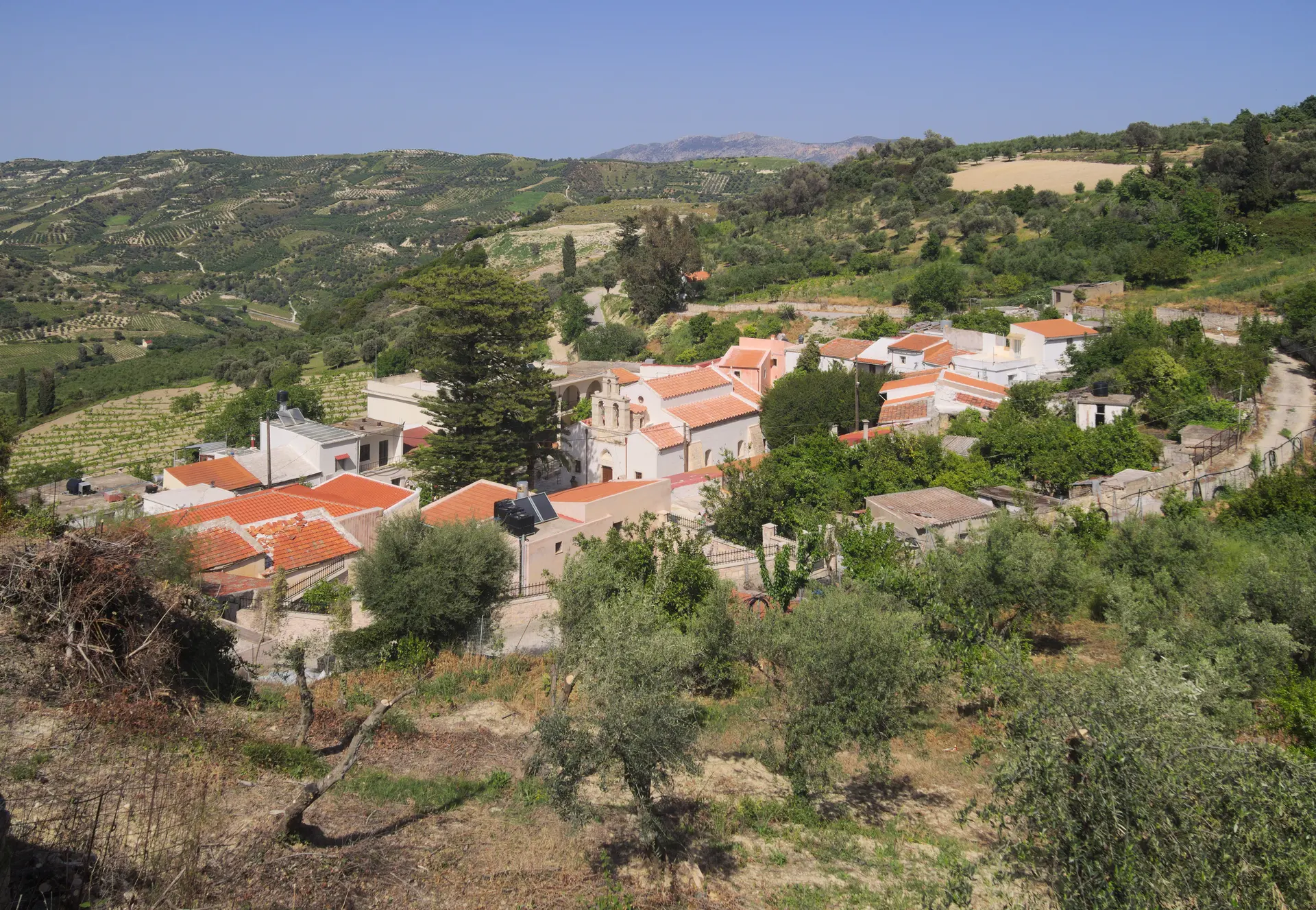
Image of Paliani Monastery. Image source · CC-BY-SA-4.0
Visit essentials
A quick read before you go
- Duration
- One to two hours for a thorough visit including the church, Holy Myrtle tree, courtyard with…
- Access
- Located 20 km southwest of Heraklion, near the villages of Venerato and Avgeniki, at an altitude…
Overview
In a small convent courtyard south of Heraklion, believers strip a myrtle's lower branches for healing leaves. Votive offerings hang from its limbs, and a candle burns beside it at all hours. Tradition says an icon of the Panagia Myrtidiotissa—Our Lady of the Myrtles—rests hidden in the trunk, visible only to children pure enough to perceive it.
Paliani Monastery has occupied this ground since Crete's early Christian centuries. A 632 CE chronicle mentions it; by 668 CE, a papal reference calls it Palaea Moni—the Old Monastery—from which 'Paliani' derives. Even fourteen centuries ago, it already carried considerable age. Beneath it, acanthus-capital columns, marble fragments, and granite inscriptions attest to an ancient temple and pre-Christian sacred presence whose exact nature remains unidentified.
Scholars understand myrtle veneration as a survival of Minoan dendrolatry, sacred-tree worship central to Bronze Age Cretan religion. Yet this is neither museum preservation nor revivalist reconstruction: it lives within Orthodox Christianity and veneration of the Theotokos. Nuns see no contradiction between their faith and caring for a tree that scholars connect to a religious world three thousand years older.
Endurance also marks the monastery: sixty-seven nuns were killed or enslaved in 1821, its buildings burned twice, and rebuilding persisted.
Why this place is sacred
Several conditions converge to make this place unusually permeable.
The first is temporal depth without interruption. Worship on this site predates the monastery itself. The architectural fragments scattered through the courtyard — Corinthian capitals, inscribed marble, granite designs — belong to a temple whose tradition and era have not been conclusively determined. The monastery was built on its ruins, and the transition from one form of worship to another appears to have been continuous rather than abrupt.
By the time the first surviving documents mention Paliani, it is already old. This accumulated duration, stretching from an unknown beginning through the Byzantine period, Venetian rule, Ottoman destruction, and modern restoration, creates a kind of temporal gravity. The ground has been prayed upon for so long that the practice has become intrinsic to the place.
The second is the myrtle tree itself. Sacred trees appear throughout religious traditions, but what distinguishes the Paliani myrtle is its active, embodied role in contemporary worship. Believers do not simply admire it or preserve it. They strip its leaves, burn them for healing smoke, hang offerings from its branches, and keep a flame lit beside it. The lower branches are bare to the height of an outstretched arm — a visible record of generations of hopeful hands.
The tree is not a relic. It grows, it changes, it participates in a relationship with the people who tend and petition it. Scholars identify this practice as a survival of Minoan dendrolatry, the sacred tree worship depicted in Cretan Bronze Age seals and frescoes. Whether the continuity is truly unbroken across three millennia or represents a later syncretistic adoption remains debated, but the effect is the same: standing before this tree, one stands at a junction between religious worlds.
The third is the hidden icon. The tradition holds that a miraculous image of the Virgin was found after a forest fire, placed in the church, and kept returning to the myrtle tree until the trunk grew around it. The icon is said to be invisible to adult eyes and perceptible only to children. This element of concealment introduces something unusual into the experience of the place. The sacred here is not displayed.
It is present but withheld, asking for a quality of perception rather than simply offering itself to be seen.
The fourth is the weight of suffering. On June 24, 1821, Ottoman forces destroyed the monastery, killing or enslaving sixty-seven of its seventy nuns. The rebuilding, led by Parthenia Neonaki — one of the three survivors — took over fifteen years. In 1866, the Ottomans burned it again. Each time, the community returned. The courtyard where visitors stand today is ground that has been sanctified by destruction and reclaimed by persistence.
The monastery was built on the ruins of an ancient temple to serve as a house of Christian worship, likely during the fifth or sixth century CE. Its dedication to the Dormition of the Theotokos — the Assumption of the Virgin Mary — placed it within the central current of Orthodox Marian devotion.
The 668 CE papal reference, using the name Palaea Moni, suggests that even at this early date the site's primary significance was its antiquity and the continuity of worship it represented.
The monastery reached its greatest material prosperity during the Venetian period, when it held patriarchal status and controlled extensive landholdings across Crete. Pope Clement IV expressed interest in the monastery due to its wealth and influence. The main complex of surviving buildings dates from the sixteenth century. Ottoman rule brought a long decline punctuated by catastrophic violence. The 1821 massacre and the 1866 burning reduced the monastery to ruins on two occasions. Each time, survivors rebuilt.
The current community is a functioning convent with resident nuns who maintain daily liturgical services, produce textiles and handicrafts, and operate a small museum housing icons, relics, and historical books. The veneration of the Holy Myrtle, with its separate feast day on September 24, has survived every destruction and represents the most distinctive thread of continuity linking the monastery's ancient past to its present.
Experience and orientation
You arrive from the road between Venerato and Avgeniki, at an altitude of 280 meters above the Cretan coastal plain. The approach gives no particular warning. The monastery sits among olive groves and agricultural land, its exterior modest, its presence understated compared to the larger and more touristic monasteries of Crete.
The courtyard is where the experience gathers. Ancient architectural fragments — columns, capitals carved with acanthus leaves, sections of inscribed marble — lie among the plants and paving stones. These are the remains of the pre-Christian temple on which the monastery was built, and encountering them here, unglassed and unroped, integrated into the daily life of the convent, creates an immediate sense of temporal layering. The past is not separated from the present. It furnishes it.
The katholikon, the main church, is dedicated to the Dormition of the Theotokos. Inside, icons line the walls in the Orthodox manner, illuminated by oil lamps and candle flame. The atmosphere is typical of a functioning Greek Orthodox church — dense with incense and visual richness — but scaled to the intimacy of a small convent rather than the grandeur of a cathedral.
If the church is open, time spent here allows the eyes to adjust and the details of the iconographic program to emerge.
Then the myrtle. It grows in the courtyard, and it is immediately apparent that this is not an ordinary tree. The lower branches, to the height of a raised arm, are entirely bare — stripped by the hands of believers taking leaves for protection, healing, and devotion. Above that line, the foliage is full and green. Tamata, small metal votive offerings, hang from the branches. A candle burns beside the trunk.
The contrast between the bare lower limbs and the living canopy above creates a visual record of human need meeting something that exceeds it.
Visitors who come with awareness of the tradition — that an icon of the Panagia Myrtidiotissa is believed to rest within the trunk, visible only to children — may find themselves looking at the tree differently than they look at other trees. The invitation is not to believe or disbelieve but to notice how the tree has been shaped by centuries of relationship with the people who approach it. The bare branches are not a symbol. They are evidence.
The monastery's small museum, housing historical icons, ecclesiastical relics, and old books, provides context for the site's long history. The nuns sell textiles and handicrafts they have produced, and purchasing these supports the community that maintains this place.
The entire visit can be completed in one to two hours, but the quality of attention matters more than the duration. Paliani rewards slowness.
Arrive in the morning, when the light is gentle and the heat of the Cretan summer has not yet intensified. Spend time in the courtyard before entering the church. Notice the ancient fragments among the paving. Approach the myrtle tree without haste. If liturgical services are underway, stand quietly at the threshold. After visiting the church and tree, explore the museum if it is open, and consider purchasing the nuns' handmade textiles as a way of supporting the community.
Bring water and sun protection in summer.
Context and lineage
The deeper origin story belongs to the myrtle tree rather than to the monastery's architecture. According to tradition, a fire swept through a nearby forest, and villagers heard a voice crying for help. When the flames were extinguished, a miraculous icon of the Virgin Mary was found among the charred thickets, painted with branches of myrtle surrounding her image. The icon was placed in the monastery church, but it would not remain there.
Each time it was removed from the tree and brought inside, it returned to the myrtle of its own accord. Eventually the trunk grew around the image, enclosing it. Children who visited the tree reported that the painted myrtle branches on the icon had sprouted into real growth, and the wood had gradually covered the Virgin's face.
The icon is said to remain present within the trunk to this day, but only those with the purity and faith of children can perceive it.
The name of the monastery itself carries its own origin narrative. Paliani derives from Palaea Moni — the Old Monastery — a designation that appears in the earliest surviving references. By 668 CE, when a papal document used this name, the monastery was already understood to be ancient. The implication is that the site's sacred continuity was recognized from the beginning as its defining characteristic.
Paliani belongs to the Eastern Orthodox monastic tradition, specifically the branch dedicated to Marian devotion under the Dormition of the Theotokos. Its lineage reaches back to the earliest centuries of organized Christian worship on Crete, and through the archaeological evidence of the underlying temple, to a pre-Christian sacred tradition whose specific identity has been lost. The monastery held patriarchal status during the Venetian period, indicating its recognition as a religious house of the highest importance.
The Myrtidiotissa veneration connects Paliani to a broader network of myrtle-associated Marian traditions in the Greek world, particularly the separate but related Myrtidiotissa tradition on the island of Kythera.
Parthenia Neonaki
One of three nuns who survived the Ottoman massacre of June 24, 1821, in which sixty-seven of Paliani's seventy nuns were killed or enslaved. Parthenia returned to the devastated monastery in 1826 and spent the next sixteen years traveling across Crete collecting donations for reconstruction. She completed the rebuilding of the cathedral in 1842, an act of solitary determination that ensured the monastery's survival.
Pope Clement IV
Thirteenth-century pope who showed interest in Paliani due to its extensive landholdings and influence during the Venetian period, when the monastery held patriarchal status and controlled numerous dependent religious houses across Crete.
Nikos Spanakis
Cretan historian whose research connected the veneration of the Holy Myrtle at Paliani to ancient Minoan dendrolatry, the worship of sacred trees that was central to Bronze Age Cretan religion. His analysis established the scholarly framework for understanding the tree as a point of religious continuity spanning millennia.
Saint Myrtidiotissa (Panagia Myrtidiotissa)
The specific epithet of the Virgin Mary venerated at Paliani — Our Lady of the Myrtles. While not a historical figure in the conventional sense, the Myrtidiotissa is the spiritual identity around which the monastery's devotional life is organized. Her feast day, September 24, is celebrated with particular intensity at Paliani, where the icon believed to reside within the myrtle trunk is the focus of veneration.
Gregory Nagy
Scholar at the Harvard Center for Hellenic Studies who has analyzed the Paliani Myrtidiotissa veneration within the broader context of particularized icon traditions in the Greek-speaking world, examining how specific epithets of the Virgin Mary create localized forms of devotion tied to place and landscape.
Traditions and practice
The devotional life of Paliani divides between the liturgical calendar observed in the katholikon and the distinct veneration centered on the Holy Myrtle in the courtyard.
The church follows the Orthodox liturgical cycle. The primary feast is the Dormition of the Theotokos on August 15, the day on which Orthodox Christians commemorate the Virgin Mary's passage from earthly life. This is the monastery's name day, celebrated with special services, processions, and communal gatherings that draw believers from across central Crete.
The myrtle tree holds its own feast, separate from the church calendar, on September 24. This day honors the Panagia Myrtidiotissa — the finding of the miraculous icon and the tree that shelters it. On September 24, a special liturgy is celebrated, the Myrtidiotissa icon is processed around the monastery grounds accompanied by music, and pilgrims are offered coffee and sweets.
The existence of a distinct feast day for the tree, independent of the monastery's primary dedication, underscores the independent sacred status that the myrtle holds within the community's devotional life.
The daily practices surrounding the tree are less formal but equally significant. Believers approach the myrtle and strip leaves from its lower branches — all branches within arm's reach have been bare for as long as visitors can remember. The leaves are taken home and burned as a form of incense, believed to carry healing properties derived from the presence of the holy icon within the trunk.
Tamata — small metal votive offerings shaped as body parts, houses, or figures — are hung from the branches as petitions for healing or thanksgiving for prayers answered. A candle is kept burning beside the tree at all times, tended by the nuns.
The resident nuns maintain the full daily cycle of Orthodox liturgical services. They receive pilgrims and visitors throughout the year, operating the monastery as both a functioning convent and a site of public devotion. The community supports itself through the production and sale of textiles and handicrafts, continuing a tradition of monastic self-sufficiency. A small museum within the monastery displays icons, relics, and historical books, providing visitors with context for the site's layered history.
The veneration of the myrtle tree continues without diminishment, with believers visiting year-round to take leaves, light candles, and hang offerings.
Visitors need not belong to any tradition to engage meaningfully with Paliani. The simplest practice is to stand before the myrtle tree in silence and observe it with care. Notice the bare branches below and the full canopy above. Notice the tamata hanging among the leaves, each one representing a specific human hope or gratitude. Notice the candle flame beside the trunk.
If taking a myrtle leaf feels appropriate and respectful, the tradition welcomes it — this is a practice sustained by centuries of open participation, not restricted to the faithful.
Inside the church, sit or stand quietly and allow the accumulated density of icons, incense, and candlelight to register. If a service is underway, remain still and attentive. The nuns' chanting, in the intimate scale of this small church, carries a quality of concentration that larger congregations rarely achieve.
After visiting the tree and church, spend time with the ancient architectural fragments in the courtyard. These columns and inscribed stones are the only surviving evidence of the temple that preceded the monastery, and their presence in open air, integrated into the daily life of the convent, is itself a statement about how this place relates to its own past.
Eastern Orthodox Christianity — Marian Devotion (Theotokos)
ActivePaliani is dedicated to the Dormition of the Theotokos and venerates the Virgin Mary under the specific epithet Myrtidiotissa — Our Lady of the Myrtles. This links the universal Orthodox devotion to the Mother of God with the site-specific veneration of the sacred myrtle tree. The monastery holds patriarchal status from the Venetian period and was one of the wealthiest and most important religious houses in Crete. Its current community of nuns maintains the full daily cycle of Orthodox worship.
Holy Myrtle Tree Veneration (Dendrolatry Survival)
ActiveThe veneration of the Holy Myrtle at Paliani is identified by scholars as a survival of ancient Minoan dendrolatry — the sacred tree worship that was central to Bronze Age Cretan religion. The myrtle, believed to contain a miraculous icon within its trunk, holds its own feast day (September 24), distinct from the monastery's primary feast (August 15), underscoring its independent sacred identity. This represents a rare and possibly unique instance of pre-Christian tree worship surviving within the living framework of Orthodox Christianity, creating a devotional practice that bridges several millennia.
Perspectives and open questions
Paliani Monastery sits at the intersection of several ways of seeing: as an archaeological palimpsest, as a living Orthodox convent, as evidence of pre-Christian religious survival, and as a site where the sacred is defined not by what can be seen but by what remains hidden.
Scholarly perspective
The scholarly consensus recognizes Paliani as one of the oldest monasteries on Crete, with documentary evidence placing it in the First Byzantine period. The architectural fragments in the courtyard — columns with acanthus-leaf capitals, inscribed marble, granite designs — confirm that the monastery was built on a pre-existing temple site, though the nature of that temple, whether Minoan, classical Greek, or Roman, cannot be determined from the surviving elements alone.
The historian Spanakis's identification of the myrtle veneration as a survival of Minoan dendrolatry is widely cited and has become the standard interpretive framework, though the gap between the end of Minoan civilization around 1100 BCE and the monastery's founding approximately 1,600 years later raises questions about whether the continuity is direct or represents a later syncretistic adoption. The monastery's patriarchal status during the Venetian period and the 1821 massacre are historically attested events.
Gregory Nagy, at the Harvard Center for Hellenic Studies, has examined the Paliani Myrtidiotissa within the broader context of particularized icon traditions, analyzing how specific epithets of the Virgin create localized devotional identities tied to place.
Living and traditional perspectives
Within the Orthodox Christian understanding, the Holy Myrtle is a miraculous phenomenon. The icon of the Panagia Myrtidiotissa was divinely revealed after a fire, and its repeated return to the tree and eventual enclosure within the trunk are understood as acts of divine providence — the Virgin chose this tree as her dwelling place. The healing properties attributed to the myrtle leaves derive from the icon's sacred presence within the wood.
The visibility of the icon only to children reflects Orthodox teaching about spiritual purity and perception: the capacity to see the sacred is not an intellectual achievement but a quality of the heart. The monastery's survival through repeated destruction is interpreted as evidence of the Theotokos's ongoing protection, and the nuns' daily life of prayer and labor is understood as a continuation of the devotion that has sustained this place since its founding.
Alternative interpretations
Feminist and goddess spirituality writers have interpreted the Paliani myrtle veneration as evidence of continuous goddess worship in Crete from the Minoan period to the present. In this reading, the Theotokos is a continuation of the Minoan Mother Goddess, and the myrtle tree, sacred to Aphrodite in classical Greek religion, carries an older feminine sacred identity beneath its Christian surface.
Some visitors from alternative spiritual traditions approach the site as a place where pre-Christian earth-based spirituality persists within the structure of Orthodox practice, seeing the nuns' care for the tree as an unconscious preservation of ancient ways of relating to the sacred feminine in nature.
Open questions
Several dimensions of Paliani resist resolution. The nature of the pre-Christian temple on whose ruins the monastery stands has not been identified — the surviving architectural fragments are insufficient to determine whether it was a Minoan, Greek, or Roman sacred site. The age of the myrtle tree itself is traditional claim rather than scientific measurement; its reputed thousand-plus years have not been verified through dendrochronology or other dating methods.
Whether the dendrolatry at Paliani represents genuine unbroken continuity from Minoan religion or a later syncretistic development cannot be established — the gap of over 1,500 years between the collapse of Minoan civilization and the monastery's founding is substantial. The icon said to reside within the trunk has never been scientifically examined, and its physical nature, if any material object exists, remains unknown.
The exact relationship between the Paliani Myrtidiotissa tradition and the separate Myrtidiotissa veneration on the island of Kythera is unclear — both involve myrtle-associated Marian icons, but the historical connection between the two has not been resolved.
Plan your visit
Access and arrival
Located 20 km southwest of Heraklion, near the villages of Venerato and Avgeniki, at an altitude of 280 meters. Accessible by car from Heraklion in approximately 30 minutes. Parking is available near the monastery entrance. Bus service from Heraklion to Venerato is available through the local KTEL network but runs infrequently — check current schedules before relying on public transport. The entrance is free of charge. Contact information should be confirmed through the Visit Heraklion tourism office.
Mobile phone signal is generally available in the area.
The village of Venerato and the surrounding area offer limited local accommodations. Heraklion, 30 minutes north by car, provides a full range of hotels and guesthouses. The monastery is most easily visited as a half-day excursion from Heraklion, combined with Vrondisi and Valsamonero for a full day exploring the monastic heartland of central Crete.
Respectful visit
Shoulders and knees must be covered. Long trousers or skirts below the knee, and shirts with sleeves, are appropriate. Hats should be removed inside the church. Comfortable walking shoes are sufficient.
Photography is generally permitted in the courtyard and exterior areas, including the myrtle tree. Photography inside the church may be restricted — always ask the nuns before photographing the interior, icons, or religious objects. Flash photography is typically prohibited inside the church. Never photograph the nuns themselves without their explicit consent.
Candles are available for a small donation and may be lit in the church or beside the myrtle tree. Tamata (small metal votive offerings) may be hung on the myrtle's branches. Monetary donations to the monastery are welcome and help sustain the community. Purchasing the nuns' handmade textiles and handicrafts is another meaningful form of support.
The monastery is open from sunrise to sundown. There is no entrance fee. Visitors should not enter areas that appear private or restricted to the monastic community. Do not disturb the nuns during prayer times. Food and drink are not permitted inside the church.
This is a functioning convent where nuns live, pray, and work. The monastery is not a museum or a tourist attraction, though visitors are warmly received. Keep voices low. Do not enter areas that appear private or restricted. Do not photograph the nuns without their explicit permission. If you are present during a service, do not walk through the church or take photographs.
The myrtle tree is deeply venerated — approach it with the same respect you would bring to any sacred object in any tradition.
Current practical details
Address
Epar.Od. Veneratou - Kiparissou 82, Venerato 700 11, Greece
Phone
Hours, fees, and access can change — verify on the official source before you travel. Practical details last checked Jun 2026.
Location
Map loads as you approach this section.
Pilgrim reflections
A portrait of encounter, not a score
Pilgrims describe what they felt, how present they could become, and whether the place would shape a journey. There are no stars and no ranking of traditions.
No reviewed reflections yet
The first pilgrims can help describe the character of being here.
Share a reflection
Available after an account-backed “Been there.” Every reflection is reviewed before publication.
Nearby sacred places
Explore other sacred places in the region. Proximity does not establish access or travel time; check each place’s guidance.
Share a photo
Help visitors recognize Paliani Monastery. Every submission is reviewed before publication.