Mt. Juktas Minoan Peak Sanctuary, Crete
Four thousand years of worship on a Cretan peak where a god sleeps in the shape of the mountain
Understand sacred places, explore living traditions, and learn how to engage respectfully with Pilgrim Map.
Access has not been verified. Check current local guidance before planning a visit.
Archanes Municipal Unit, Crete, Greece
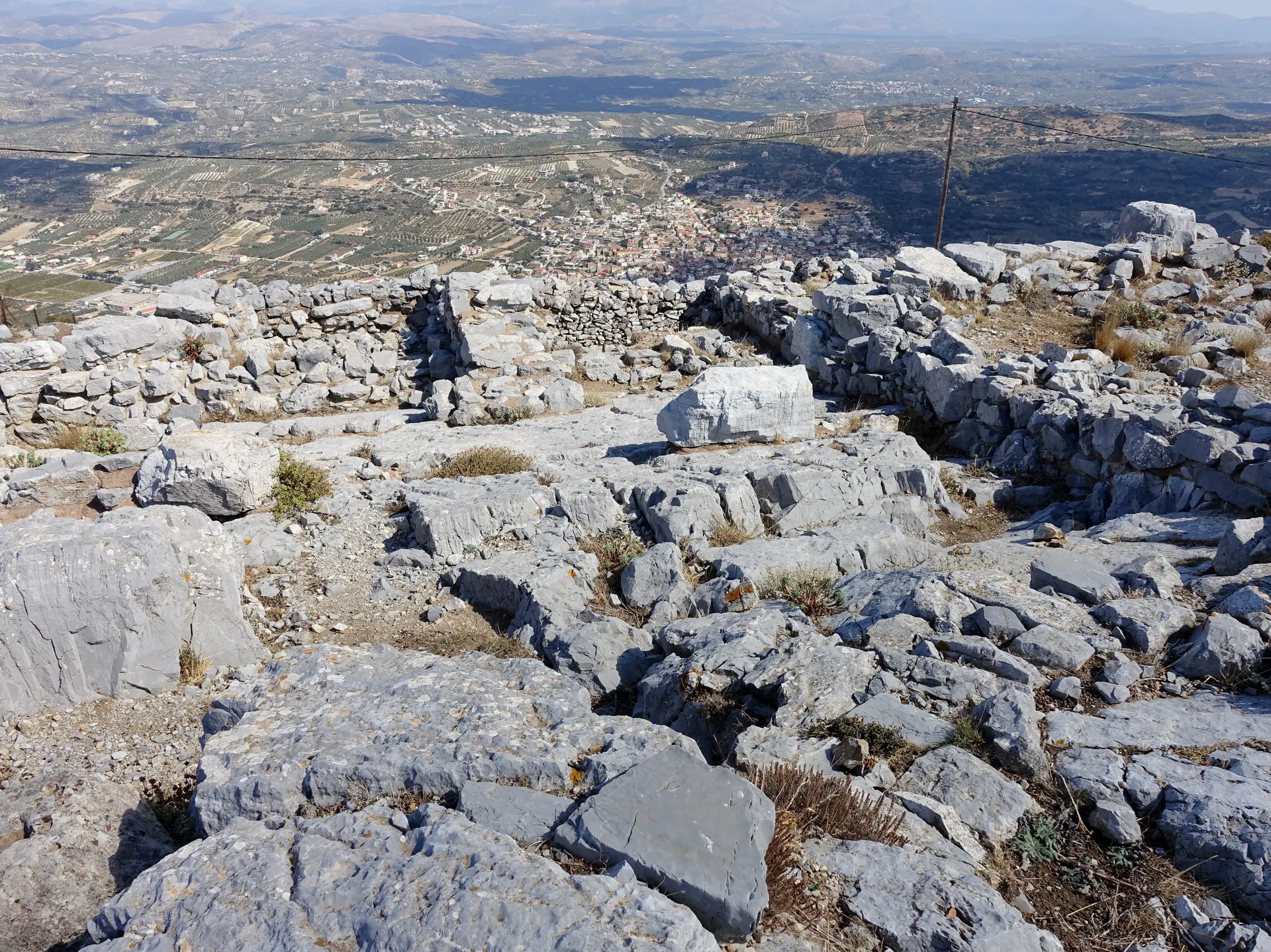
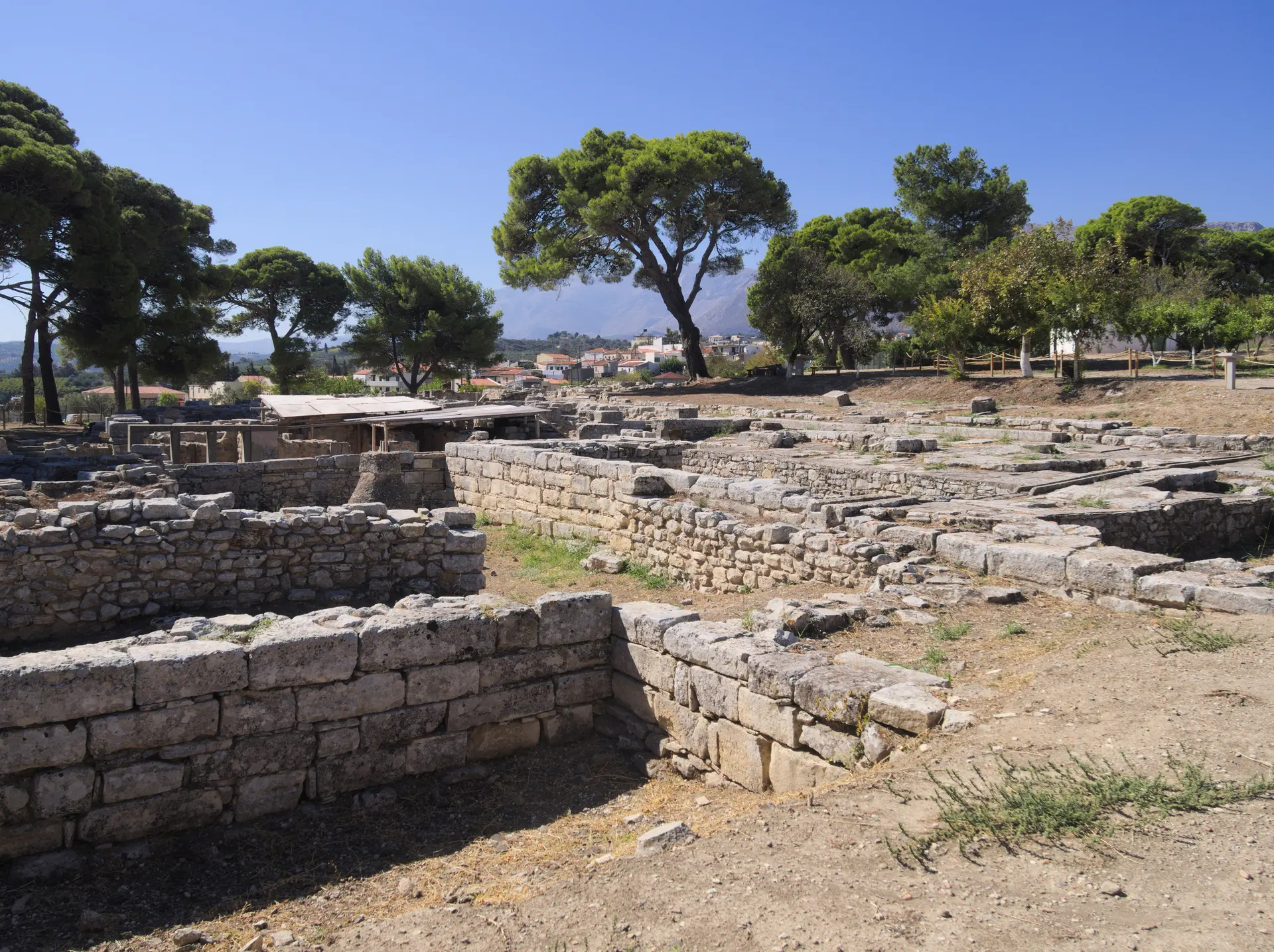
Image of Mt. Juktas Minoan Peak Sanctuary, Crete. Image source · CC-BY-3.0
Visit essentials
A quick read before you go
- Duration
- The circular hiking route from Archanes through Anemospilia, the peak sanctuary, and the summit…
- Access
- Mount Juktas is located 1 km north of Archanes village, which is 14 km south of Heraklion and 7…
Overview
From Knossos to the north, Mount Juktas resembles a sleeping profile: forehead, nose, and bearded chin. Ancient Cretans held that Zeus had died and was buried here, his face remaining as proof. The wider Greek world, which considered Zeus immortal, called them liars, but the tradition may have carried something older than Greek theology.
A thousand years before the mountain was called Zeus's tomb, Minoans climbed with clay figures of people and animals, bronze double axes, and stone horns of consecration. They deposited them at an open-air sanctuary whose stone altar stood beside a natural summit fissure linking sky and earth. Juktas was the principal mountaintop shrine of the Palace of Knossos, the Minoan world's largest and most powerful center, and was intervisible with the palace across thirteen kilometers.
Four sacred caves at the cardinal directions structured its wider religious geography, and Minoans worshipped here for perhaps seven hundred years. On the northern flank, Anemospilia produced fiercely debated evidence that human sacrifice may have been interrupted by an earthquake around 1700 BC.
Afendis Christos, a Greek Orthodox church founded during Venetian rule in 1443 and dedicated to Christ's Transfiguration, now occupies the summit, layering death and resurrection onto four millennia of sacred narrative. The NATURA 2000 protected area shelters 360 plant species. The archaeological site is fenced, the church open, and Zeus's profile still sleeps in the rock.
Why this place is sacred
What draws human beings to the same high places across millennia is not always explicable. Mount Juktas offers some clues. The summit commands panoramic views from Heraklion Bay to the Cretan highlands, and this visibility would have mattered to the Minoans, for whom peak sanctuaries were places where the settled world below could be surveyed from the threshold of the sky.
The open-air altar at the summit sat beside a natural rock fissure, a crack in the earth that appeared to connect the exposed summit to whatever lay beneath. This fissure may have bridged two forms of Minoan worship that are usually studied separately: the cult of the mountaintop and the cult of the cave. At Juktas, they met in a single geological feature.
Four sacred caves on the mountain's slopes, aligned roughly to the cardinal directions, extended this vertical axis into a horizontal sacred geography. The entire mountain, not merely the summit, appears to have functioned as a ritual landscape. This is unusual even among Minoan peak sanctuaries. Juktas was not simply a high place with an altar. It was a cosmological structure.
The Zeus profile adds something that is difficult to categorize in archaeological terms but impossible to ignore in experience. From the west and north, the mountain resembles a great bearded face lying on its back. Whether the Minoans saw this face, and whether it contributed to their selection of the site, is unknown.
What is documented is that the Greeks saw it and built an entire theology around it: the young god who dies and is resurrected, unique to Crete, possibly preserving a pre-Greek memory of a dying vegetation deity. When the Venetians placed a church dedicated to Christ's Transfiguration on the same summit, the layering of death-and-resurrection narratives became three traditions deep.
The thinness of Juktas, then, arises from convergence. Geological features that invite cosmological interpretation. A mountain profile that transforms landscape into theology. An unbroken accumulation of devotion from the early second millennium BC to the present day. And the Anemospilia temple on the northern slope, where an earthquake in approximately 1700 BC may have interrupted a human sacrifice, adding a layer of human extremity that deepens the mountain's weight beyond what contemplation alone can explain.
The peak sanctuary was established during the Middle Minoan IA period, approximately 2100 BC, making it likely the first peak sanctuary in Minoan Crete. Peak sanctuaries were open-air hilltop shrines central to Minoan religious practice, positioned at elevated points visible from palace and settlement below. Juktas served as the primary mountaintop worship site for the Palace of Knossos, thirteen kilometers to the north.
The sanctuary's function appears to have encompassed communal pilgrimage, votive offering, and ritual communication between the settled world and whatever the Minoans understood to reside at the summit. The natural rock fissure beside the altar suggests a connection between peak and chthonic worship.
The sanctuary was active from approximately 2100 BC through the Late Minoan period, an extraordinary span of continuous use encompassing the rise and fall of the Minoan palaces. During the Protopalatial period, it served a broad community. During the Neopalatial period, its relationship with the Knossian elite appears to have intensified, with the palace possibly exercising greater control over the sanctuary's rituals.
Around 1700 BC, the Anemospilia temple on the northern slope was destroyed by earthquake and fire, sealing its controversial contents. The sanctuary declined around 1450 BC, coinciding with the wider collapse of Minoan civilization. By the fifth century BC, the Greeks had reinterpreted the mountain as the tomb of Zeus, preserving a dying-and-resurrecting deity tradition that may carry Minoan echoes. The Orthodox church of Afendis Christos was founded in 1443 as part of a monastery during Venetian rule.
Arthur Evans first excavated the peak sanctuary in 1909. Alexandra Karetsou's systematic excavation from 1974 onward revealed the sanctuary's full complexity. The mountain is now within the NATURA 2000 network as an ecological and archaeological park.
Experience and orientation
Begin in Archanes. This prosperous village at the mountain's base, fourteen kilometers south of Heraklion and seven from Knossos, was itself a significant Minoan settlement. The walk north from the village toward Mount Juktas follows the ancient path of approach, and the mountain's profile resolves as you go, the sleeping face of Zeus becoming more legible the closer you come.
The circular hiking route, which takes approximately three to four hours, ascends the northern slope first. The terrain is Mediterranean scrubland, fragrant in spring with thyme and sage, sheltering some of the 360 plant species identified on the mountain, eighteen of them endemic to Crete or Greece. The path is moderately challenging, well-enough defined but unshaded and exposed. Carry water. There are no facilities on the mountain.
Anemospilia appears first, on the northern flank. The remains of this small Minoan temple are modest in scale but charged with meaning. In 1979, Yannis Sakellarakis excavated what he interpreted as a scene of human sacrifice interrupted by earthquake: the skeleton of a young man on a platform with a bronze implement across his body, a priestly figure fallen nearby, and a third skeleton crushed by the building's collapse.
Whether this represents sacrifice or accident remains one of the most debated questions in Aegean archaeology. Stand here and consider both possibilities. The ambiguity is part of the site's gravity.
Continue upward to the peak sanctuary itself. The two terraces of the Minoan sanctuary, separated by a natural chasm into which pottery was ritually deposited, are fenced and viewable but not accessible. Alexandra Karetsou's excavations revealed stepped terraces, an altar beside the natural rock fissure, and rooms that reinterpreted what Arthur Evans had identified in 1909 as a priest's house.
The finds included clay human and animal figurines, bronze double axes, stone horns of consecration, and Linear A inscriptions on offering tables, connecting this remote summit to the administrative apparatus of the Minoan palaces. The objects are dispersed among museums, but the terraces, the fissure, and the relationship between altar and sky remain.
The summit itself, a short distance further, is crowned by the church of Afendis Christos. Founded in 1443 as part of a Venetian-era monastery, the small church is dedicated to the Transfiguration of Christ. Old frescoes survive inside. The church is open to visitors, and Orthodox feast-day services are still held here: the Transfiguration on 6 August, Agia Zoni on 31 August, and several others. An annual flower procession brings people from the plains below up to the chapel.
From the summit, the views extend across the Cretan landscape in every direction. Heraklion Bay lies to the north. The highland mountains of central Crete rise to the south and west. On clear days the full sweep of the northern coastal plain is visible. This panorama is not incidental to the site's sacred function. It is the function.
The Minoans came here to stand at the highest accessible point in their immediate world and to make offerings at the place where the earth ended and the sky began. Four thousand years later, the view performs the same work of elevation.
Allow three to four hours for the circular route from Archanes through Anemospilia, the peak sanctuary, and the summit church. A shorter ascent by dirt track allows vehicles to reach near the summit, reducing the walk to thirty to forty-five minutes. Early morning visits in summer avoid the worst heat. The summit is fully exposed with no shade. Bring at least one and a half liters of water per person. Sturdy hiking shoes are essential.
Spring and autumn offer the most comfortable conditions and the clearest views. The Zeus profile is best observed from the north, toward Knossos, before or after the ascent rather than from the summit itself.
Context and lineage
The origins of sacred activity on Mount Juktas reach back to approximately 2100 BC, when the Minoans established what appears to have been the first peak sanctuary in Crete. Peak sanctuaries were a distinctively Minoan form of worship: open-air hilltop shrines where communities gathered to deposit votive offerings, burn sacrifices, and commune with deities at the boundary of earth and sky. Juktas was almost certainly the prototype.
The mountain's selection was not arbitrary. Thirteen kilometers south of Knossos, the most powerful palace in the Aegean, Juktas was intervisible with the palace complex. A worshipper standing at the summit altar could see Knossos below. A member of the palatial elite standing in the west court of the palace could see the peak of Juktas above. This visual axis between palace and peak was likely fundamental to both the sanctuary's religious function and its political significance.
The Anemospilia temple on the northern slope adds a darker strand to the origin narrative. When Efi Sapouna-Sakellaraki identified the site during a surface survey in early 1979, and her husband Yannis Sakellarakis subsequently excavated it, they uncovered a small tripartite temple destroyed by earthquake around 1700 BC.
Inside, the remains of at least four individuals and the arrangement of the final room generated an interpretation that has divided scholars for nearly half a century: that a young man was being sacrificed at the moment the earthquake struck, killing the priest who held the blade and collapsing the building on them all.
Whether this interpretation is correct or whether the scene can be explained by the earthquake alone, the find reveals the extremity of religious practice on this mountain at a moment of crisis.
Mount Juktas belongs to the tradition of Minoan peak sanctuaries that emerged across Crete around 2100 BC. It was the most significant of these sanctuaries, serving the palatial center of Knossos and likely functioning as the model for the approximately twenty-five other peak sanctuaries identified across the island. The tradition of peak worship appears to be distinctively Minoan, without clear parallels in contemporary Near Eastern or Egyptian practice.
After the decline of Minoan civilization, the mountain's sacred identity was absorbed into Greek mythology as the tomb of Zeus. The Cretan tradition of a dying and resurrecting Zeus, unique in the Greek world, may represent a Hellenized memory of a Minoan deity who died and was renewed. The Christian church of Afendis Christos, founded in 1443, represents the most recent layer of this lineage, placing a Transfiguration church on a site already associated with divine death and transformation.
The mountain has been recognized as sacred, continuously if not always in the same form, for approximately four thousand years.
Arthur Evans
The British archaeologist who first excavated the peak sanctuary in 1909, during the same period he was uncovering the Palace of Knossos below. Evans identified a temenos wall and a structure he interpreted as a priest's house, establishing the sanctuary's importance but leaving much of its complexity unrecognized.
Alexandra Karetsou
The Greek archaeologist who led systematic re-excavation of the peak sanctuary from 1974 onward. Her work revealed stepped terraces, the altar, rooms, and the natural chasm between terraces, fundamentally reinterpreting Evans's earlier findings and establishing the sanctuary's full architectural and ritual complexity.
Yannis Sakellarakis
The archaeologist who excavated the Anemospilia temple on the northern slope in 1979 and interpreted the scene within as evidence of human sacrifice at the moment of earthquake. His interpretation, published with his wife Efi Sapouna-Sakellaraki, sparked one of the most significant debates in Aegean archaeology.
Nanno Marinatos
A prominent classical archaeologist and critic of the human sacrifice interpretation at Anemospilia, who argued that the young man died in the earthquake rather than by ritual killing. Her counterargument represents the most sustained scholarly challenge to the Sakellarakis reading and demonstrates how the same evidence can sustain contradictory interpretations.
Epimenides of Knossos
The semi-legendary Cretan poet and seer of the seventh or sixth century BC, to whom is attributed the paradox 'The Cretans are always liars.' The saying referred in part to the Cretan claim that Zeus had died and was buried on Crete, a theological assertion centered on Mount Juktas that scandalized the wider Greek world and generated one of philosophy's earliest logical paradoxes.
Traditions and practice
The Minoan rituals at Juktas appear to have centered on the communal journey as much as on the destination. Worshippers climbed from the settlements below, carrying small clay figurines modeled in their own likeness or in the shape of their animals. These were offerings, but they were also proxies, left at the summit to maintain presence before the divine even after the worshipper descended. Bronze double axes, the most recognizable symbol of Minoan religion, were deposited alongside the figurines.
Stone horns of consecration, another persistent Minoan sacred motif, were placed at the altar. Offering tables inscribed in Linear A connected the summit rituals to the administrative and religious systems of the palaces below, though the script remains undeciphered and the contents of these inscriptions unknown.
The natural rock fissure beside the altar held particular significance. Pottery and other offerings were deposited into this crack in the earth, perhaps as communications sent downward to chthonic powers. The fissure physically linked the open sky of the summit to the underground world of the caves, creating a vertical axis of worship that encompassed the mountain's full sacred geography.
The four caves at each cardinal direction on the mountain's slopes were used for ceremonies, sacrifice, and the storage of offerings, extending the ritual landscape beyond the summit in a systematic way that has few parallels among Minoan sites.
At Anemospilia, the practices may have included something far more extreme. If the Sakellarakis interpretation is correct, the young man found on the raised platform was being offered in sacrifice to avert the earthquake that was already destroying the building. This would represent the only credible evidence of human sacrifice in Minoan Crete, a civilization generally characterized by more benign religious expression. The debate remains unresolved, and it is important to present both interpretations with equal weight.
The Greek veneration of Zeus's tomb likely involved pilgrimage to view the sleeping profile of the god and to honor the site where the king of heaven was said to lie. The specifics of this worship are not well documented, but the tradition was strong enough to persist for centuries and to generate one of the most famous philosophical paradoxes in Western thought.
Greek Orthodox worship continues at the church of Afendis Christos. Feast-day liturgies are held for the Transfiguration of Christ on 6 August, Agia Zoni on 31 August, the Holy Apostles on 30 June, and Saints Anargyri on 1 July. An annual flower procession brings people from the towns on the plains below up to the summit chapel, maintaining a pattern of ascent and offering that, in its broad outlines, echoes what the Minoans did here four thousand years earlier.
The ascent itself is the practice. Whether approached on foot from Archanes or by vehicle along the dirt track, the climb to the summit replicates the Minoan pilgrim's journey from settled ground to the threshold of the sky. Walk slowly. Notice the shift in vegetation, in temperature, in the quality of silence as the land falls away below.
At the fenced peak sanctuary, stand where the altar was and look down the fissure if it is visible. Consider the Minoans who stood here with their small clay figures and bronze axes, making offerings at a crack in the earth that opened toward the unknown. At the summit church, enter quietly if it is open. The frescoes and the small interior hold the accumulated devotion of centuries. Light a candle if the practice is meaningful to you.
Before or after the climb, find a vantage point to the north or west from which the Zeus profile is visible. The mountain becomes a face. The face becomes a god. The god becomes a story about death and what might follow death. This transformation of landscape into meaning is perhaps the oldest sacred practice on the mountain, older than any altar or offering table.
Minoan Peak Sanctuary Religion
HistoricalJuktas was the paramount peak sanctuary in Minoan Crete, serving as the primary mountaintop worship site for the Palace of Knossos from approximately 2100 BC through the Late Minoan period. It was likely the first peak sanctuary on the island and the model for the approximately twenty-five others that have been identified. The sanctuary's finds, including Linear A inscriptions, connect summit worship directly to palatial religious administration.
Ancient Greek Religion — Cretan Zeus Cult
HistoricalThe Greeks identified Mount Juktas as the tomb of Zeus, making Crete the only place in the Greek world where the king of the gods was said to have died. The Cretan tradition of a young, dying, and resurrecting Zeus contradicted mainstream Greek theology and may preserve pre-Greek memories of a Minoan vegetation deity. The tradition generated the famous paradox attributed to Epimenides: 'The Cretans are always liars.'
Greek Orthodox Christianity
ActiveThe church of Afendis Christos on the summit, founded in 1443 during Venetian rule and dedicated to the Transfiguration of Christ, represents the Christianization of a site sacred for millennia. The Transfiguration, in which Christ's divine nature was revealed on a mountaintop, layers a Christian death-and-resurrection narrative onto a peak already associated with the death and resurrection of Zeus.
Perspectives and open questions
Mount Juktas can be read as an archaeological site, as a case study in religious continuity, as the center of one of archaeology's most heated debates, or as a landscape where the geological and the theological have become inseparable.
Scholarly perspective
Archaeological scholarship recognizes Juktas as the most important peak sanctuary in Minoan Crete, a status derived from three factors: its direct connection to the Palace of Knossos, the exceptional quality and quantity of its finds, and the diachronic continuity of its sacred use across the Proto- and Neopalatial periods. Alexandra Karetsou's excavations from 1974 onward revealed a sophisticated sanctuary with stepped terraces, an altar, and rooms that fundamentally reinterpreted Evans's earlier work.
The natural chasm between the two terraces, found to contain deliberate deposits of pottery, raises questions about the relationship between peak worship and chthonic cult. The broader scholarly framework positions peak sanctuaries as extramural cult locales that complemented palace worship and cave worship in a complex Minoan religious landscape. The central unresolved question concerns agency: did the palace control the sanctuary, using it to legitimate political power, or did the sanctuary's pre-existing sacred authority confer legitimacy on the palace?
The Linear A inscriptions found at the site would likely shed light on this question, but the script remains undeciphered.
Living and traditional perspectives
The Cretan tradition of Zeus's death and burial at Mount Juktas represents one of the oldest continuously transmitted sacred narratives in Europe. First attested in the fifth century BC but likely much older, it preserved a theological position that contradicted mainstream Greek religion. Zeus, the immortal king of heaven, had died here. The Cretans venerated him as a young god who dies and is resurrected, pointing to the mountain's sleeping profile as evidence.
Many scholars believe this tradition preserves a Minoan memory of a dying vegetation deity, making it a rare thread of continuity across the Bronze Age collapse. The Christian Transfiguration church on the summit, whether consciously or not, continues the pattern: death and resurrection, divine transformation on a mountaintop. For Orthodox Cretans, the annual feast-day processions to Afendis Christos maintain an unbroken tradition of ascending this mountain with offerings, even if the theological framework has changed entirely.
Alternative interpretations
The human sacrifice debate at Anemospilia has generated interpretive positions that extend beyond archaeology into broader questions about how we understand ancient religion. Yannis Sakellarakis interpreted the scene as a sacrifice-in-progress, undertaken during an earthquake that the participants may have been trying to avert. Nanno Marinatos argued that the young man died in the earthquake itself, and that the bronze implement across his body was not a sacrificial blade but an ornate spearhead that fell from a shelf.
Dennis Hughes challenged even the identification of the implement as a weapon. The debate matters not only for what it reveals about Minoan religion but for what it reveals about the limits of archaeological interpretation. The same evidence, examined with equal rigor, sustains contradictory narratives. Juktas reminds us that certainty about the distant past is rarer than we sometimes acknowledge.
Open questions
Several significant questions remain open. The Linear A inscriptions from the sanctuary, likely containing information about the deities worshipped and the rituals performed, remain undeciphered. The exact nature of what was worshipped at the peak is unknown: a specific deity, a proto-Zeus, a mother goddess, or a more abstract divine principle. The function of the four sacred caves at each cardinal direction is not fully understood.
The relationship between peak cult and cave cult, connected by the summit fissure, requires further investigation. Whether the Minoans themselves saw the anthropomorphic profile in the mountain, or whether this perception was a later Greek projection, is unknowable with current evidence. And the pottery deposits in the chasm between the terraces, whether these represent deliberate ritual deposition, votive clearing, or some other practice, remain a subject of active study.
Plan your visit
Access and arrival
Mount Juktas is located 1 km north of Archanes village, which is 14 km south of Heraklion and 7 km from the Palace of Knossos. Multiple approach options exist. By foot: the Giouchtas Loop trail starts near Archanes and ascends the northern slope, passing Anemospilia. By vehicle: a dirt track signposted south of Archanes on the road toward Vathypetro winds 5 km up the mountain, accessible to high-clearance vehicles in dry conditions. No entrance fee. No facilities on the mountain.
Bring water, food, sun protection, and appropriate clothing. Nearest services, restaurants, and accommodations are in Archanes village. Mobile phone signal is generally available on the mountain, including at the summit. Emergency services would need to be contacted via phone, with access from the dirt track being the fastest route for evacuations. Approximate coordinates: 35.24 degrees N, 25.16 degrees E.
Archanes village, at the base of the mountain, offers guesthouses and small hotels in a charming setting among Minoan-era archaeological sites. The village has restaurants, cafes, and a small archaeological museum displaying finds from the surrounding area. Heraklion, fourteen kilometers north, provides the full range of accommodation from budget hostels to luxury hotels, and serves as the base for most visitors to Knossos and the surrounding region.
Respectful visit
Sturdy hiking shoes are essential for the ascent. Sun protection is critical as the summit and most of the hiking route are fully exposed. If visiting the church of Afendis Christos during services, modest dress is appropriate: shoulders and knees covered.
No restrictions apply at the archaeological site or along the hiking route. Be respectful when photographing inside the church, especially during services. Avoid using flash near frescoes.
Do not leave objects at or disturb the fenced Minoan archaeological site. At the church of Afendis Christos, candles may be lit in the traditional Orthodox manner if the church is open.
Do not enter the fenced sanctuary enclosure. Do not dig, remove stones, or disturb archaeological remains anywhere on the mountain. Respect the NATURA 2000 protections: do not pick plants or disturb wildlife. There is no entrance fee.
The Minoan peak sanctuary is fenced and protected. Do not enter the enclosed area, remove stones, or disturb any archaeological remains. The entire mountain is within a NATURA 2000 protected area. Do not pick plants or disturb wildlife. When visiting the church of Afendis Christos during services or feast days, dress modestly and maintain respectful silence. The summit is fully exposed and summer heat is severe. Carry sufficient water and sun protection.
Current practical details
Address
Archanes-Asterousia 701 00, Greece
Hours
Hours, fees, and access can change — verify on the official source before you travel. Practical details last checked Jun 2026.
Location
Map loads as you approach this section.
Pilgrim reflections
A portrait of encounter, not a score
Pilgrims describe what they felt, how present they could become, and whether the place would shape a journey. There are no stars and no ranking of traditions.
No reviewed reflections yet
The first pilgrims can help describe the character of being here.
Share a reflection
Available after an account-backed “Been there.” Every reflection is reviewed before publication.
Nearby sacred places
Explore other sacred places in the region. Proximity does not establish access or travel time; check each place’s guidance.
Share a photo
Help visitors recognize Mt. Juktas Minoan Peak Sanctuary, Crete. Every submission is reviewed before publication.