Knossos
Where Europe's oldest civilization built a palace that became a labyrinth of myth
Understand sacred places, explore living traditions, and learn how to engage respectfully with Pilgrim Map.
Access has not been verified. Check current local guidance before planning a visit.
Heraklion Municipal Unit, Crete, Greece
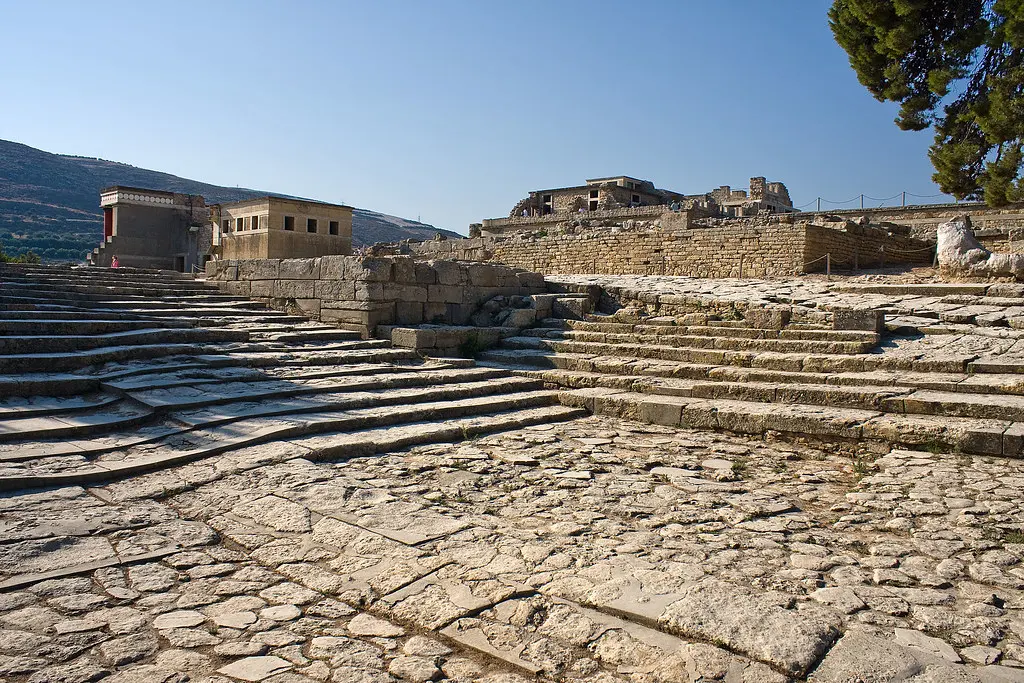
Image of Knossos. Image source
Visit essentials
A quick read before you go
- Duration
- Two to three hours for the main palace site and immediate surroundings.
- Access
- Located approximately 5 km south of Heraklion city center.
Overview
Knossos holds nine thousand years of continuous human presence. Around 7000 BCE, Neolithic farmers built wattle-and-daub huts where the Central Court would stand; Minoan priests later processed along the Royal Road; and in 1900 Arthur Evans began uncovering the administrative, religious, and ceremonial center of Europe's first advanced civilization.
Across a low hill in the Kairatos River valley, more than 1,300 palace rooms surround a central court and connect through corridors, stairs, and light wells. Pillar crypts received libations to chthonic deities, sunken lustral basins hosted purification, and the Throne Room's stone seat faces one across a narrow space. Frescoes of dolphins, lilies, and bare-breasted women carrying snakes place nature and the feminine at the center of its sacred imagination.
The sacred landscape extends to the Temple Tomb, where burial met continuing cult veneration; the House of the High Priest, with an altar flanked by double-axe bases; and the Royal Road, among Europe's oldest paved roads, both ceremonial and practical. UNESCO inscribed Knossos in 2025 as part of the Minoan Palatial Centres.
Places within this site
Why this place is sacred
What gives Knossos its particular quality is not spectacle but accumulation. The Neolithic levels beneath the palace reach down ten meters. Archaeologists have counted through seven thousand years of human habitation compressed into that vertical space, each layer a record of lives lived, rituals performed, and meanings made on this specific ground. Few places on earth contain such temporal depth in such a small area.
The Minoan civilization that built the palace complex possessed a religious sensibility that modern visitors can sense even in the ruins. The Minoans worshipped not only in enclosed temples but on mountain peaks, in caves, and in open-air sanctuaries. Their cult symbols, the double axe and the horns of consecration, appeared not as hidden esoterica but as public declarations embedded in architecture. The pillar crypts suggest worship directed downward, toward the earth, toward forces beneath the visible surface.
The lustral basins suggest purification as a daily practice, not an occasional event. The Snake Goddess figurines, found in the Temple Repositories around 1600 BCE, depict a female figure holding serpents with an expression of calm authority, as though the boundary between the human and the divine were permeable in ways that later civilizations would wall off.
Then there is the myth. Whether the Labyrinth was a real structure, a memory of the palace's bewildering corridors, or a purely literary invention, the fact remains that this place gave rise to one of the most psychologically resonant stories ever told. The descent into the maze, the encounter with the Minotaur, the thread that leads back to daylight: these are not merely Greek legends.
They are maps of the interior journey, descriptions of what happens when consciousness confronts what it has hidden from itself. That such a story should have its origin here, in these ruins, adds a layer of meaning that scholarship alone cannot fully account for.
The thinness of Knossos is the thinness of deep time combined with living myth. Standing in the Central Court, surrounded by Evans's reconstructions and the original Minoan stonework beneath, the visitor stands at the intersection of what happened and what it means, of archaeology and archetype, of the measurable and the immeasurable.
Knossos served as the sacred, political, and economic center of the Minoan civilization from approximately 1900 BCE. The palace complex housed the Central Palace Sanctuary in the West Wing, with shrines, pillar crypts, lustral basins, and the Temple Repositories where the Snake Goddess figurines were found.
The broader site encompassed a complete sacred landscape including the Temple Tomb, the House of the High Priest, processional ways, a theatral area for public ceremony, and connections to peak and cave sanctuaries in the surrounding hills. Worship centered on a Great Mother Goddess, a bull cult linked to death and rebirth, and snake goddess rituals associated with earth fertility and household protection.
The site's sacred function evolved through multiple civilizations. After the Mycenaean takeover around 1450 BCE, the palace continued as a religious center with modified practices. Linear B tablets record offerings to proto-Olympian deities, including Poseidon, Zeus, Hera, Athena, and Dionysus, marking the earliest documented transition from Minoan to Greek religion. In the Classical and Hellenistic periods, Knossos persisted as a Greek city-state with a temple of Rhea and coins featuring the Labyrinth motif.
Rome established Colonia Julia Nobilis Cnossus in the first century BCE, bringing Roman religious architecture. The early Christian period brought a bishop's seat and a basilica built on the Villa Dionysos site. The Arab invasion of 824 CE ended continuous settlement. After centuries of burial, Minos Kalokairinos began excavation in 1878, and Arthur Evans's systematic work from 1900 onward revealed the palace complex, named the Minoan civilization, and undertook the controversial reconstructions that shape the visitor experience today.
UNESCO inscription in 2025 recognized Knossos and five sister sites as collectively representing early writing systems, maritime networks, and advanced architecture.
Experience and orientation
Approach from the north, along the path that roughly follows the ancient Royal Road. The modern entrance channels visitors through an olive grove that descends gently toward the West Court, the first open space of the palace complex. Pause here. The West Court was where ancient visitors first encountered the ceremonial life of Knossos, walking along raised processional causeways that still mark the stone pavement.
Enter through the West Porch and follow the Corridor of the Procession, named for the frescoes that once lined its walls showing figures bearing offerings. The corridor turns and opens, and the Central Court appears. This is the spatial heart of Knossos: a rectangular open area roughly 50 by 25 meters, oriented north-south, flanked by the remains of multi-story buildings. The Minoans gathered here.
The bull-leaping frescoes suggest that athletic-ritual performances may have taken place in this very space, young men and women vaulting over the horns of charging bulls in a ceremony that compressed worship, spectacle, and mortal risk into a single act.
To the west of the Central Court lies the Throne Room. The space is small, intimate, almost domestic in scale. A stone seat, Europe's oldest known throne, faces a lustral basin across a narrow room. The walls bear frescoes of griffins, mythological guardians painted in restored colors. The juxtaposition of throne and lustral basin suggests that whoever sat here did so in the context of ritual, that authority and purification were twin aspects of a single function.
Some scholars believe this was a priestess's chamber rather than a king's.
Descend into the West Wing to find the pillar crypts, dim rooms where square pillars bear incised double-axe symbols. Libation vessels were found here. The darkness of these spaces, lit originally only by oil lamps, creates a quality of attention that the open courts do not. Something was worshipped downward, toward the earth, in these rooms.
The East Wing holds the so-called Royal Apartments, including the Hall of the Double Axes and the Queen's Megaron with its famous dolphin fresco. Evans's reconstructions are most visible here: painted concrete columns in red and black, rebuilt staircases and light wells. The reconstructions provoke strong reactions. Some visitors find them helpful, offering a sense of scale and color that bare ruins cannot convey. Others find them intrusive, an imposition of one man's imagination onto evidence that remains ambiguous.
Both responses are valid. The tension between reconstruction and ruin is itself part of the Knossos experience.
Leave the palace complex and walk south toward the Temple Tomb, approximately 630 meters along a path through olive groves. This structure, partly carved into a hillside and partly built above ground, combined burial with ongoing cult veneration. Its two-story facade, pillar crypt, and inner chamber represent a complete sacred architecture in miniature, less visited and more atmospheric than the palace itself.
Return to the northern entrance via the Royal Road. The paving stones, worn smooth by Minoan feet, create the most immediate physical connection to the ancient inhabitants. The theatral area at the road's western end, a stepped arrangement that could accommodate several hundred standing spectators, was likely the site of ceremonial performances and public gatherings.
Allow two to three hours for the main palace complex. Arrive at opening time, especially in summer, to experience the Central Court and Throne Room before the crowds arrive. If the Temple Tomb and outlying buildings are accessible, add an hour. The Heraklion Archaeological Museum, five kilometers north in the city center, houses the original frescoes, Snake Goddess figurines, and Linear B tablets found at Knossos. It is an essential companion visit. Allow a full day if combining both.
Carry water and sun protection in all seasons.
Context and lineage
The mythological layer at Knossos runs deeper than most archaeological sites can claim. In the beginning of the story that became the Labyrinth myth, King Minos prayed to Poseidon to send a bull from the sea as proof of his divine right to rule Crete. The bull came, magnificent and white, and Minos was to sacrifice it. Instead, he kept it.
The god's punishment fell not on the king but on his wife, Pasiphae, who was cursed with desire for the sacred bull. From that union came the Minotaur, a creature half-human and half-bull, embodying the monstrous consequences of breaking a vow to the divine.
Minos commissioned the master craftsman Daedalus to build the Labyrinth, a structure so complex that no one who entered could find the way out. The Minotaur was sealed inside. Athens, defeated by Minos in war, was forced to send seven young men and seven maidens every nine years as tribute. The Athenian hero Theseus volunteered, entered the Labyrinth, and slew the Minotaur, guided back to daylight by the thread given him by Ariadne, daughter of Minos.
The myth encodes real memory. The bull-leaping frescoes, the labyrinthine corridors of the palace, the double axe that gives the Labyrinth its etymological root in labrys, the human sacrifice suggested by some scholars at the Anemospilia shrine nearby: all these point to a civilization whose religious practices generated stories that would echo through the entire arc of Western imagination. Whether the Labyrinth was the palace itself, a quarry, or a purely literary invention remains debated.
The myth's power does not depend on the answer.
Knossos possesses the longest documented sacred lineage in Europe. Neolithic settlement began around 7000 BCE, making it contemporary with some of the earliest permanent settlements in the Mediterranean. The first palace rose around 1900 BCE and was destroyed by earthquake around 1700 BCE. The second palace, built on the ruins, ushered in the golden age of Minoan civilization.
Mycenaean Greeks took control around 1450 BCE, and Linear B tablets from this period record offerings to proto-Olympian deities, documenting the transition from Minoan to Greek religion in real time. The palace was finally destroyed by fire around 1375 BCE, but settlement continued. Classical Greeks built a temple of Rhea and minted coins with the Labyrinth design. Romans established a colony. Christians built a basilica and maintained a bishop's seat. The Arab invasion of 824 CE ended continuous occupation.
After a millennium of silence, Kalokairinos's excavation in 1878 and Evans's systematic work from 1900 began the long process of bringing Knossos back into the world's consciousness. UNESCO inscription in 2025 as part of the Minoan Palatial Centres formalized its recognition as a site of universal significance.
Sir Arthur Evans
The British archaeologist who excavated Knossos from 1900 to 1930, named the Minoan civilization after the legendary King Minos, and undertook extensive and controversial reconstructions of the palace using reinforced concrete. His vision shaped the modern understanding of the site but also imposed interpretive frameworks that subsequent scholarship has questioned. His reconstructions remain integral to the visitor experience, simultaneously revealing and obscuring the original architecture.
King Minos
The mythological king of Crete, son of Zeus and Europa, who ruled from Knossos and commissioned Daedalus to build the Labyrinth. According to Homer, Minos conversed with Zeus every nine years in the Dictaean Cave, receiving divine laws. Whether a historical figure, a dynastic title, or a purely legendary creation, Minos gave his name to the civilization that Evans uncovered and to the era's defining myth.
Minos Kalokairinos
The Cretan antiquarian who first excavated at Knossos in 1878, uncovering part of the west wing before Ottoman authorities halted the work. His discovery preceded Evans by over two decades and demonstrated that a major Bronze Age site lay beneath the surface, setting in motion the chain of events that would reveal the Minoan world.
Ariadne
Mythological daughter of King Minos who gave Theseus the thread to navigate the Labyrinth. Later traditions associate her with Dionysus, who married her after Theseus abandoned her on Naxos. Her name may derive from a Cretan goddess of the underworld, suggesting that the myth preserves a memory of Minoan religious figures absorbed into the Greek pantheon.
Daedalus
The mythological master craftsman and architect who designed the Labyrinth and built wings of wax and feathers for his son Icarus. Daedalus personifies the Minoan civilization's astonishing technical achievements: the advanced plumbing, the multi-story architecture, the engineered light wells, the ceremonial roads. His name in Greek means 'skillfully wrought,' and his legend encodes the wonder that later Greeks felt confronting the ruins of a civilization more technically advanced than their own.
Traditions and practice
The Minoans practiced a form of religion that left no written theology in any language we can read. Linear A, their earlier script, remains undeciphered. What we know comes from architecture, iconography, and the objects found in sacred contexts.
Goddess worship stood at the center. The Central Palace Sanctuary in the West Wing contained multiple shrines, and the Temple Repositories yielded the famous Snake Goddess figurines around 1600 BCE: faience statuettes of women holding serpents with bare breasts and calm, authoritative expressions. Whether these represent a single Great Goddess or multiple deities remains debated, but the feminine divine clearly held primacy.
Bull cult permeated the ceremonial life of Knossos. The frescoes depict young men and women vaulting over the horns of charging bulls, a practice that combined athletic prowess with religious significance. Bulls were sacrificed, their blood and bodies offered in rituals that symbolized the cycle of life, death, and rebirth. The horns of consecration, stylized representations of bull horns, crowned the rooflines of the palace and surrounding buildings.
Lustral basins, sunken chambers accessed by descending steps, appear throughout the palace and satellite buildings. Arthur Evans interpreted these as purification chambers, and their placement near entrances and throne rooms suggests ritual cleansing was integrated into the daily exercise of sacred and political authority.
The pillar crypts in the West Wing, with their incised double-axe symbols and evidence of libation, point to chthonic worship directed toward earth deities or underworld powers. Processional ceremonies along the Royal Road, depicted in frescoes showing figures bearing offerings, connected the city to the palace in ceremonial circuits that transformed movement through space into an act of devotion.
No religious practices currently take place at Knossos. The site functions entirely as an archaeological monument and UNESCO World Heritage Site. The Heraklion Archaeological Museum in the city center displays the major finds from the site, including the Snake Goddess figurines, bull-leaping frescoes, and Linear B tablets.
Enter the Throne Room slowly and stand in the space between the stone throne and the lustral basin. The room is small enough that the relationship between these two elements is immediately felt rather than intellectually understood. Whoever used this room moved between authority and purification, between the visible world and whatever the lustral basin opened onto.
In the pillar crypts, let your eyes adjust to the dimness. The double-axe symbols incised into the pillars were carved not for public display but for the darkness itself, for whatever was worshipped in these low, enclosed spaces. The quality of attention that emerges in near-darkness is different from the attention of the sun-lit courts above.
Walk the Royal Road and feel the paving stones underfoot. These are among the oldest paved surfaces in Europe. The Minoans who walked this road did so as part of processions depicted in the palace frescoes: slow, formal, bearing offerings. Match their pace. The road was not designed for speed.
If the Temple Tomb is accessible, descend into the inner chamber. The structure combines burial with ongoing veneration, suggesting that the Minoans did not draw a hard boundary between the living and the dead. The stillness of this space, away from the main tourist flow, offers the most contemplative experience at the site.
Minoan Religion
HistoricalKnossos was the primary religious center of the Minoan civilization, which developed one of the earliest complex religious systems in Europe. The palace complex housed the Central Palace Sanctuary with multiple shrines, pillar crypts, and lustral basins. The Snake Goddess figurines found in the Temple Repositories represent some of the most iconic artifacts of ancient religion. The broader sacred landscape included the Temple Tomb, the House of the High Priest, peak and cave sanctuaries, and processional routes. The double axe and horns of consecration served as the dominant cult symbols.
Mycenaean Greek Religion
HistoricalAfter the Mycenaean takeover of Knossos around 1450 BCE, the palace continued as a religious center with practices reflecting mainland Greek influences. Linear B tablets record offerings to deities who would become the Olympian gods, including Poseidon, Zeus, Hera, Athena, and Dionysus. The Shrine of the Double Axes dates to this period.
Classical Greek Religion
HistoricalIn the Iron Age and Classical periods, Knossos remained a Greek city-state with a temple of Rhea reportedly near the old palace site. The Labyrinth myth became central to Greek mythology and cultural identity. Knossos minted coins featuring the Labyrinth design, marking the transition of the site from active sacred center to mythological symbol.
Early Christianity
HistoricalIn the early Christian period, Knossos had its own bishop. A basilica was built on the site of the Villa Dionysos, and Christian burials appeared in the area. The bishops of Knossos maintained their title through the nineteenth century, long after the settlement was abandoned following the Arab invasion of 824 CE.
Perspectives and open questions
Knossos can be read as an archaeological site, a birthplace of European civilization, a wellspring of mythology, or a testament to a religious sensibility that honored the feminine divine and the natural world. Each reading reveals dimensions that the others cannot reach.
Scholarly perspective
Archaeological and historical consensus recognizes Knossos as the administrative, economic, and religious capital of Minoan Crete, and likely the largest city in the Aegean during the second millennium BCE. The broader site extended well beyond the palace to include elite residences such as the Little Palace and Royal Villa, religious structures including the Temple Tomb and House of the High Priest, commercial facilities including the Caravanserai, processional routes, and extensive cemeteries.
Arthur Evans's controversial reconstructions remain actively debated: they made the site interpretable to visitors but introduced speculative elements and cemented readings now questioned by scholars. The Minoan religion centered on goddess worship, nature sanctuaries, and bull symbolism, though exact theological content remains uncertain in the absence of decipherable texts. Linear B tablets from the late Mycenaean period show offerings to proto-Greek deities, indicating a gradual religious transition rather than an abrupt change.
The 2025 UNESCO inscription recognized Knossos and five other Minoan sites as collectively representing early writing systems, maritime networks, cultural exchanges, advanced architecture, urban planning, and vibrant frescoes.
Living and traditional perspectives
Modern Cretans maintain a strong cultural identification with the Minoan heritage. The figure of King Minos, the Labyrinth myth, and the concept of Knossos as the first European city are woven into Cretan regional identity. This identification is one of pride and historical consciousness rather than living religious practice. No continuous tradition of worship at the site connects the present to the Minoan past, but the sense that something foundational happened here pervades Cretan self-understanding.
Alternative interpretations
The goddess spirituality movement has claimed Knossos as evidence of a prehistoric matriarchal, goddess-worshipping society, drawing on the theories of archaeologist Marija Gimbutas. The Snake Goddess figurines are frequently cited as evidence of ancient feminine divine worship predating patriarchal religions. Labyrinth spirituality practitioners regard Knossos as the origin point of the labyrinth as a contemplative tool.
These interpretations, while culturally influential and emotionally resonant, are not fully supported by current archaeological scholarship, which views Minoan society as more complex and less categorically matriarchal than the goddess-spirituality reading suggests. The interpretive gap between what the evidence shows and what these movements claim is itself revealing: it speaks to a contemporary longing for evidence that alternative sacred arrangements once existed.
Open questions
The exact nature of Minoan religion remains unresolved. Whether the various goddess representations depict one deity or many, and the precise relationship between goddess worship and bull cult, is debated. The cause of the widespread destruction of approximately 1450 BCE that ended Minoan independence is uncertain: the Thera eruption, earthquake, invasion, and internal conflict are all proposed. Whether the Labyrinth was purely mythological, based on the palace layout, or referred to a separate physical structure remains actively contested.
The function of lustral basins, whether for purification, initiation, anointing, or something entirely unknown, is still argued. Linear A, the earlier Minoan script predating Linear B, remains undeciphered, meaning that the Minoans' own accounts of their beliefs, their prayers, their understanding of the sacred are locked in a language no one can yet read. This is perhaps the deepest mystery of Knossos: an entire civilization's inner life, recorded in signs we can see but cannot hear.
Plan your visit
Access and arrival
Located approximately 5 km south of Heraklion city center. Bus number 2 runs regularly from Heraklion Central Bus Station, a 15-minute ride. Free parking near the entrance. Wheelchair access is available from the entrance to the Central Court, though the site's terrain presents challenges for mobility-impaired visitors. Admission is approximately 15 euros full and 8 euros reduced (2025 prices; verify for 2026). Free for EU citizens under 25 with valid identification.
Online tickets are available at hhticket.gr with one-hour entry slots. Summer hours are approximately 8:00 to 18:00, with last entry at 17:45. Winter hours are approximately 8:30 to 17:00, with last entry at 16:45. Closed January 1, March 25, Easter Sunday, and December 25-26. Contact the Greek Ministry of Culture via the Odysseus portal for current information.
Heraklion, the nearest city, offers a full range of accommodations from budget hostels to luxury hotels. Staying in the city center places both Knossos and the Archaeological Museum within easy reach. The villages south of Heraklion along the road to Archanes offer quieter alternatives with access to the broader Minoan sacred landscape.
Respectful visit
No formal dress requirements. Comfortable walking shoes with good grip are essential due to uneven terrain, stone surfaces, and steps throughout the site. Sun protection, including hat and sunscreen, is critical in the warm months. The site is largely unshaded.
Photography is permitted for personal use throughout the site. Tripods and professional equipment may require special permission from the Greek Ministry of Culture. No drone photography without permit.
Not applicable. This is an archaeological site. Do not leave any objects or materials.
Stay on marked paths and walkways. Do not climb on, touch, or lean against ancient structures or Evans's reconstructions. Do not remove any stones, pottery fragments, or other materials. Some areas may be temporarily closed for conservation work or ongoing excavation.
Knossos is a heavily visited archaeological site. Peak season (June through August) brings extreme heat and large tour groups, especially between 10:00 AM and 2:00 PM. Early morning arrival is essential for a contemplative experience. Do not climb on, touch, or lean against any structures. Evans's concrete reconstructions are themselves now over a century old and are conservation objects in their own right.
Current practical details
Address
Knossos 714 09, Greece
Hours, fees, and access can change — verify on the official source before you travel. Practical details last checked Jun 2026.
Location
Map loads as you approach this section.
Pilgrim reflections
A portrait of encounter, not a score
Pilgrims describe what they felt, how present they could become, and whether the place would shape a journey. There are no stars and no ranking of traditions.
No reviewed reflections yet
The first pilgrims can help describe the character of being here.
Share a reflection
Available after an account-backed “Been there.” Every reflection is reviewed before publication.
Nearby sacred places
Explore other sacred places in the region. Proximity does not establish access or travel time; check each place’s guidance.
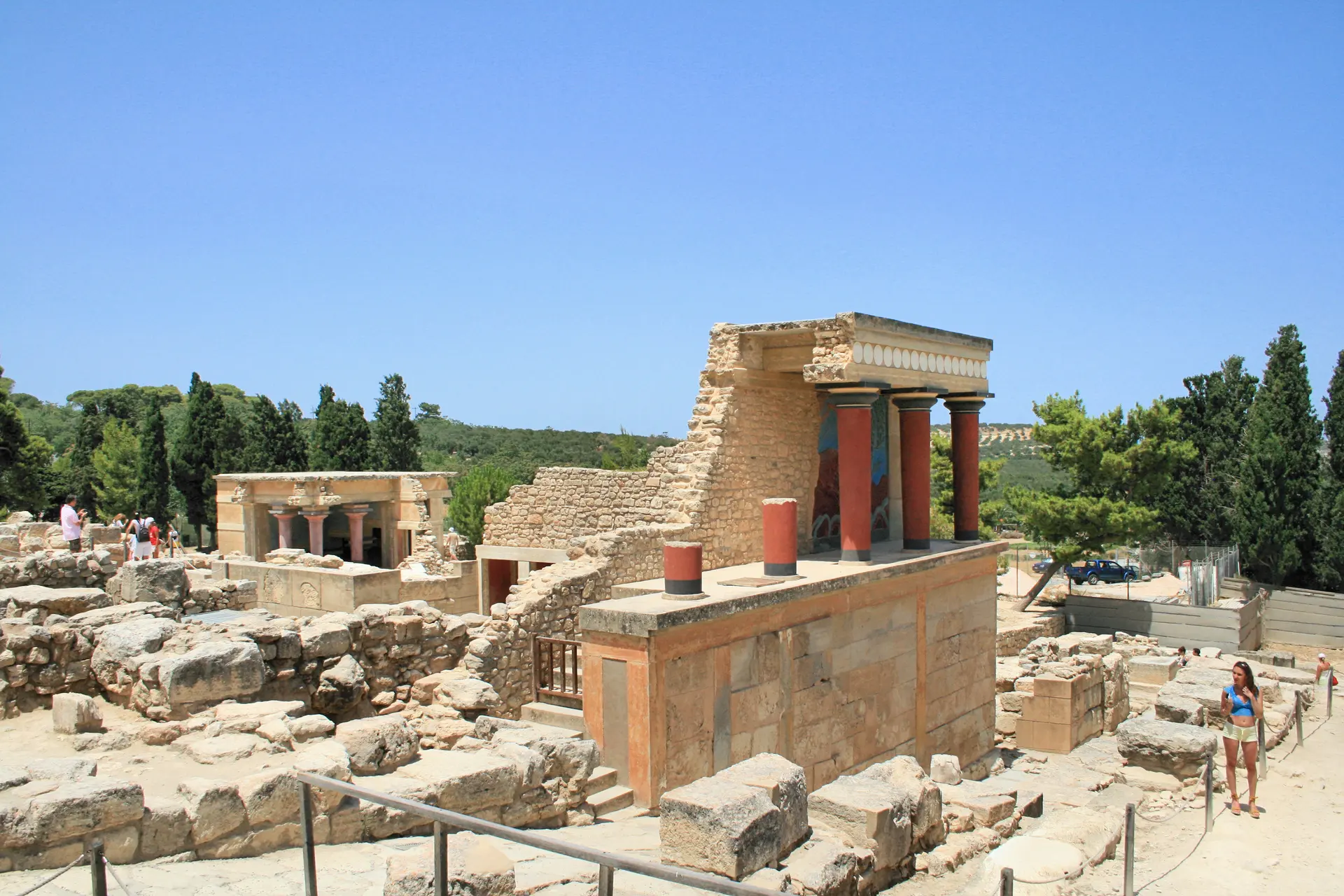
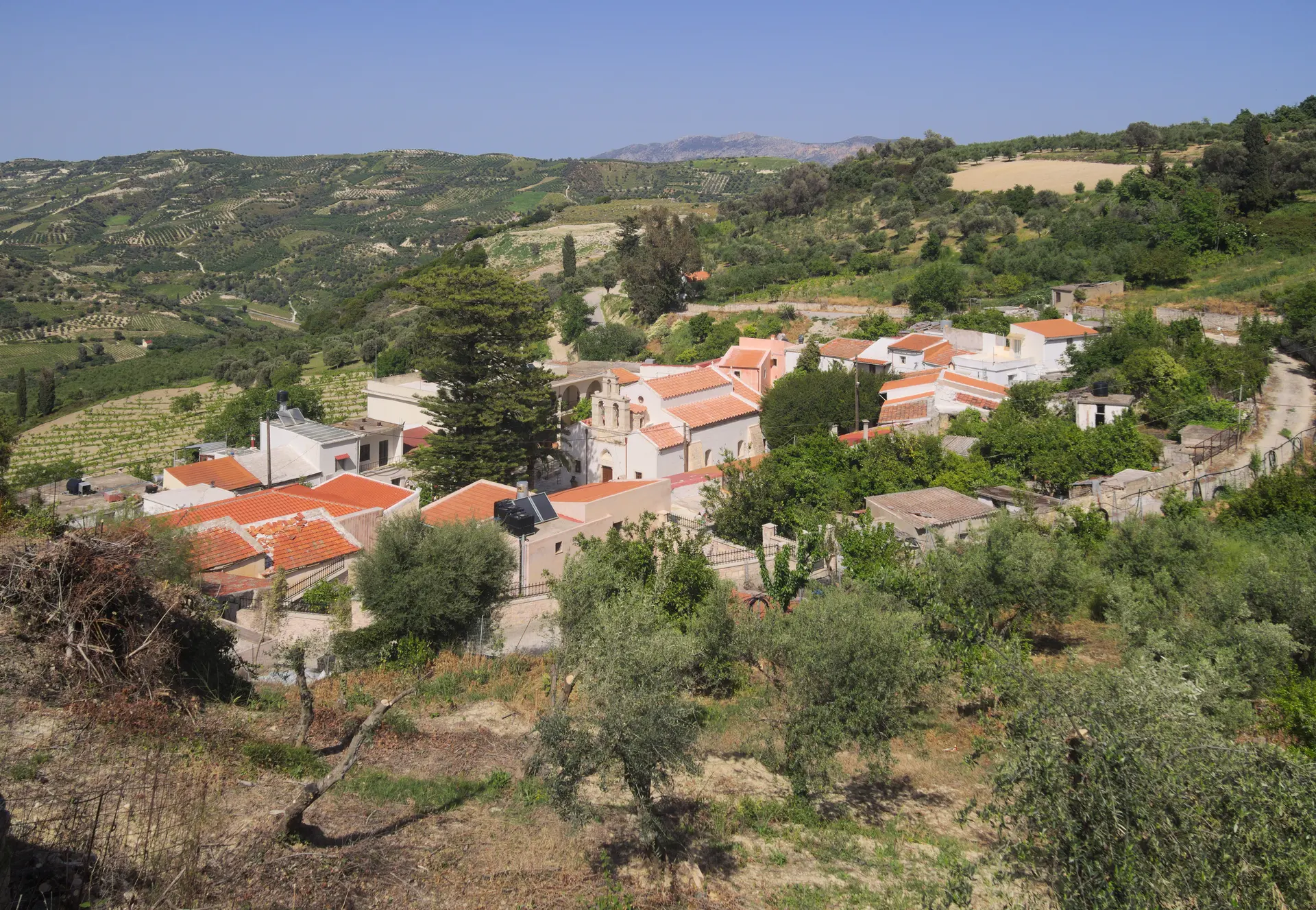
Photo gallery
3 curated photos
Share a photo
Help visitors recognize Knossos. Every submission is reviewed before publication.