Palaghju (Palaggiu) Alignment
The largest menhir alignment in the Mediterranean, standing witness through four millennia of silence
Understand sacred places, explore living traditions, and learn how to engage respectfully with Pilgrim Map.
Access has not been verified. Check current local guidance before planning a visit.
Sartène, Corse-du-Sud, France
Read the sources
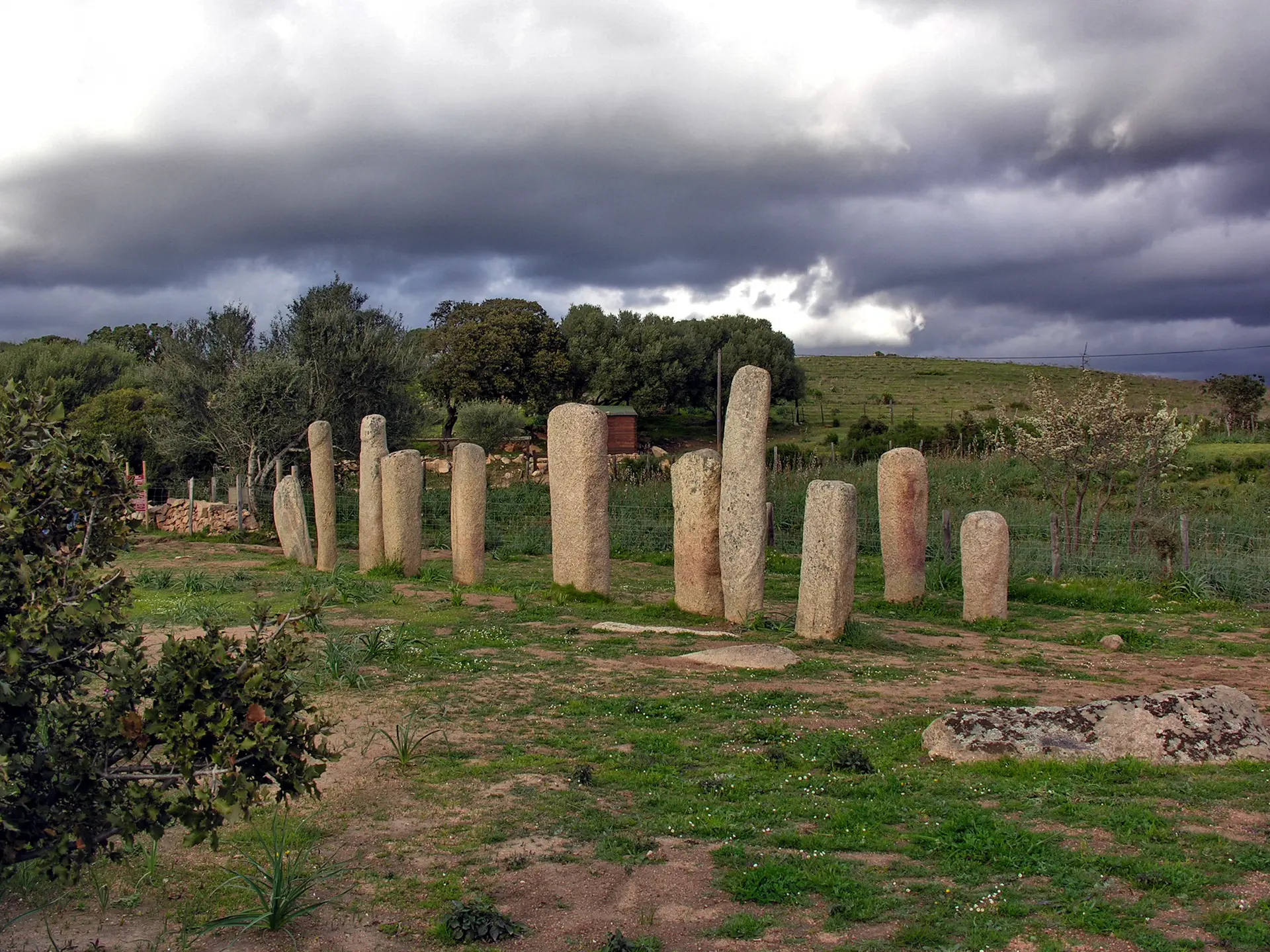
Image of Palaghju (Palaggiu) Alignment. Image source · CC-BY-SA-3.0
Visit essentials
A quick read before you go
- Duration
- One to two hours minimum for meaningful exploration, though the site's scale and wild condition…
- Access
- Located near Tizzano, inland from Sartene in southwest Corsica.
Overview
Palaghju stands between heritage and wilderness: 258 megaliths in seven predominantly north-south groups across a Corsican plateau. The Mediterranean's largest concentration of standing stones, it records a Bronze Age sacred landscape built from carried, shaped, precisely aligned granite; some stones bear the faces and weapons that make Corsican megaliths unique in Europe. Later inhabitants called it 'Campu di i Turchi,' cemetery of the Turks, preserving a recognition of death, memory, and sacred function after its builders were forgotten.
Largely unmaintained since 1972, many stones have fallen or emerge through the maquis. Some visitors experience this as loss; others encounter prehistoric intention returning, unmanicured, to the earth.
Why this place is sacred
Scale carries Palaghju's message: the sacred landscape must have been visible for miles, and moved granite measures how intensely this place mattered to its builders, even though its ceremonies and cosmology are lost. The shared north-south pattern suggests an earth-and-cosmos relationship, perhaps marking solstices or tracking stars that have since shifted in the sky, without establishing either.
The folk name 'Campu di i Turchi' shows later generations attributing the stones to mysterious others while still recognizing a place of death, ancestors, and memory. Vegetation may conceal further carved faces and weapons like those at Stantari.
Palaghju's wild condition creates another threshold. Unlike maintained Stonehenge or Carnac, fallen stones, encroaching maquis, and absent interpretation boards and gift shops leave the encounter less mediated. Time is visibly returning the stones to earth; witnessing that process offers a different mystery from preservation.
The original purpose of the Palaghju alignment remains uncertain. The scale suggests a major ceremonial center, the most important sacred site for communities across a wide region. The north-south orientation implies astronomical observation or ceremonial alignment with celestial phenomena. The folk memory of 'cemetery' may preserve accurate recognition of funerary or ancestor-related function. Some stones bear carved features similar to the statue-menhirs at Stantari, suggesting practices of ancestor veneration or commemoration.
The stones have stood through four millennia of Corsican history. Successive cultures encountered them without understanding their origin, eventually naming them 'Campu di i Turchi' in recognition of their sacred function if not their specific meaning.
Archaeological attention came in the twentieth century, but Palaghju has not received the excavation and maintenance granted to nearby sites. The last significant work was done in 1972. Since then, natural processes have continued, with many stones falling and vegetation encroaching.
The site is classified as a historical monument, acknowledging its significance if not adequately protecting it. Located on private property, access has been limited. The current condition reflects decades of neglect rather than active preservation.
Experience and orientation
Finding Palaghju is itself an experience. The site lacks the clear signage and facilities of better-maintained monuments. The path leads through overgrown terrain on private property, and visitors may need to search for the stones among the vegetation. For some, this difficulty is part of the meaning. What you must work to find holds different weight than what is handed to you.
The first encounter often brings a mixture of awe and sadness. The scale is undeniable, stone after stone emerging from the maquis, but so many have fallen. You are witnessing not just a prehistoric monument but its gradual dissolution, a process that began when the last builders walked away and continues today. This impermanence is honest in a way that restored sites are not.
Those who spend time here describe a sense of discovery. Each step may reveal another stone, another carved face, another element of a sacred landscape that has not been fully mapped or understood. The absence of interpretation boards leaves space for personal encounter. You must make sense of what you see rather than having meaning provided.
The wildness of the setting contributes to the experience. The Mediterranean light, the fragrance of the maquis, the absence of other visitors, the sense of standing where thousands stood four millennia ago, all combine into something more than the sum of historical facts.
Some visitors report frustration. They expected a maintained heritage site and found partial ruins in overgrown terrain. This is a valid response. Palaghju requires acceptance of conditions as they are, not as we might wish them to be. The site teaches impermanence to those willing to learn.
Coming to Palaghju requires adjustment of expectations. This is not a curated heritage experience but an encounter with a site that has been largely left to itself for decades. The stones are there, but so is the neglect.
Allow extra time and patience. Finding all seven groups of stones may require exploration through challenging terrain. Wear appropriate footwear and bring water. Consider the weather, as the exposed site can be uncomfortable in extreme heat or cold.
Approach the stones with awareness that you are witnessing both persistence and dissolution. Four thousand years of standing, and now the slow return to earth. Both aspects are part of the experience.
If you find carved features hidden in the vegetation, take time to observe them. These may be faces that have not been seen clearly in decades. The discovery is part of what Palaghju offers.
Consider combining with visits to the better-maintained sites at Stantari and Rinaghju. The contrast illuminates different aspects of encounter with the prehistoric past. What preservation gains in clarity it may lose in wildness. What neglect loses in accessibility it may gain in immediacy.
Context and lineage
The origins of Palaghju lie in the same Bronze Age tradition that created the statue-menhirs at Stantari and the alignments across the Cauria plateau. Approximately 4,000 years ago, communities began transporting and erecting granite megaliths here in numbers that dwarf any other Mediterranean site.
The scale suggests that Palaghju served as a major ceremonial center, perhaps drawing people from across a wide region for rituals we can no longer reconstruct. The seven groups of stones, the consistent north-south orientation, and the presence of some carved figures all speak to sophisticated organization and intention.
Later generations, having lost the specific meaning, named the site 'Campu di i Turchi,' attributing the monuments to a mysterious other people while recognizing their funerary or sacred function. This folk memory, passed down across centuries, preserves something genuine even as specific knowledge was lost.
No living tradition claims Palaghju. The Bronze Age practices that created and animated the site ended long before written history came to Corsica. Subsequent inhabitants encountered the stones as mysterious remnants of an earlier world.
Archaeological work in the twentieth century documented the site's significance, but conservation efforts have not been sustained. The 1972 maintenance represents the last major intervention. Since then, the stones have continued their slow surrender to gravity and vegetation.
The site's classification as a historical monument offers legal protection but has not resulted in practical preservation. Today, Palaghju exists in a liminal state between recognized heritage and neglected ruins.
Traditions and practice
The original ceremonies performed at Palaghju are unknown. The scale of the alignment suggests major regional gatherings, perhaps at astronomically significant times marked by the north-south orientation of the rows. The presence of some carved statue-menhirs indicates practices similar to those at Stantari, possibly including ancestor veneration or warrior commemoration. The folk memory of 'cemetery' may preserve accurate recognition of funerary function.
The site does not function as a managed heritage destination. No organized ceremonies or tourism activities take place here. Visitors who find their way to Palaghju do so for personal reasons, seeking encounter with the prehistoric past in a setting that has not been mediated by interpretation boards and visitor centers.
The wild condition creates space for whatever practice visitors bring. Some sit among the stones in contemplation. Others photograph the carved figures emerging from vegetation. The experience is self-directed rather than guided.
Come prepared to meet Palaghju on its present terms. Many visitors rush to photograph and leave; instead, spend time observing how light meets the stones, which have fallen, and which remain standing. Look carefully for carved figures hidden by vegetation. If sadness at the site's neglect arises, acknowledge it without turning damage into spectacle. Attending to what remains joins a long lineage of people who recognized this place as significant.
Corsican Megalithic Tradition
HistoricalPalaghju represents the largest expression of Corsican megalithic building, with 258 stones dwarfing any other Mediterranean site. The alignment belongs to the same Bronze Age tradition that created the carved statue-menhirs at Stantari and Filitosa, monuments unique in European prehistory. The scale of Palaghju suggests it served as a major ceremonial center for a wide region.
Original practices unknown. Evidence suggests astronomical observation, possible funerary or ancestor-related ceremonies, and gatherings that may have drawn people from across southern Corsica. The folk memory preserved in the 'Campu di i Turchi' name suggests recognition of sacred or funerary function even after specific meaning was lost.
Perspectives and open questions
Palaghju invites reflection on preservation, neglect, and what we owe the past. The largest menhir alignment in the Mediterranean has been largely abandoned to natural processes. Scholarly perspectives document its significance while lamenting its condition. The wild state creates a different kind of encounter than maintained sites offer, one that some visitors find more authentic if more melancholy.
Scholarly perspective
Archaeological consensus recognizes Palaghju as the largest megalithic alignment in the Mediterranean, constructed approximately 4,000 years ago during the Bronze Age. The site consists of 258 stones organized in seven groups, with rows running predominantly north to south suggesting astronomical significance. Some stones bear carved human features similar to the statue-menhirs at Stantari.
The site is classified as a historical monument, acknowledging its exceptional importance. However, maintenance has lapsed since 1972, and many stones have fallen or become hidden in vegetation. The gap between official recognition and practical preservation represents a failure of heritage management.
Comparison with better-maintained sites like Stantari and Filitosa illustrates what has been lost and what might be recovered with proper excavation and conservation.
Alternative interpretations
Some interpret the scale of Palaghju as evidence of advanced prehistoric civilization or connection to broader Mediterranean cultures. The astronomical alignment suggests sophisticated knowledge. The site is sometimes framed as marking major earth energy lines or as a prehistoric pilgrimage destination of exceptional power.
The neglected condition invites alternative explanations for why such a significant site has been allowed to deteriorate. Some see in this neglect evidence of suppressed knowledge or deliberate concealment of human prehistory.
These interpretations lack archaeological support but reflect genuine response to the site's undeniable significance and troubling condition.
Open questions
Much about Palaghju remains unknown. The original ceremonial function has been lost. The relationship between the seven groups of stones is not understood. The full extent of carved figures hidden in vegetation has not been documented. The meaning of the 'Campu di i Turchi' name beyond recognition of sacred function is unclear.
The current condition means that questions which could be answered with proper excavation remain open. What the site might reveal if properly studied is itself unknown.
Plan your visit
Access and arrival
Located near Tizzano, inland from Sartene in southwest Corsica. The site is on private property. Access arrangements should be confirmed before visiting. The terrain is overgrown and may require navigating through dense maquis. No facilities, signage, or maintained paths.
Hotels and guesthouses available in Sartene and Propriano. Sartene provides the most atmospheric base for exploring the southern Corsican megaliths.
Respectful visit
Practical hiking attire essential. Long pants recommended for moving through maquis vegetation. Sturdy closed-toe shoes required. Sun protection and water necessary given exposed terrain.
Permitted. The carved features make compelling subjects but may be difficult to locate in vegetation. Natural light only. Be prepared for challenging conditions.
Not traditional. Leave nothing at the site.
Private property. Access should be confirmed in advance. The site is not staffed or maintained. Visitors assume responsibility for their own safety.
Do not move or disturb fallen stones. They have fallen where they fell for reasons that may have meaning to future archaeologists.
Be careful in the terrain. The vegetation hides uneven ground and potentially hazardous conditions.
The site is on private property. Access arrangements should be confirmed. Respect any restrictions encountered.
Leave nothing behind. The site requires no further addition of human material.
Current practical details
Address
20100 Sartène, France
Hours, fees, and access can change — verify on the official source before you travel. Practical details last checked Jun 2026.
Location
Map loads as you approach this section.
Pilgrim reflections
A portrait of encounter, not a score
Pilgrims describe what they felt, how present they could become, and whether the place would shape a journey. There are no stars and no ranking of traditions.
No reviewed reflections yet
The first pilgrims can help describe the character of being here.
Share a reflection
Available after an account-backed “Been there.” Every reflection is reviewed before publication.
Nearby sacred places
Explore other sacred places in the region. Proximity does not establish access or travel time; check each place’s guidance.

References
Sources consulted for this page. Source categories describe the publication, not a guarantee that every claim is verified. Traditional accounts and outside interpretations may differ.
- 01Palaghju, site of menhirs and dolmens near Sartene — Corsica Travel GuideguideVisitor information
- 02The Menhirs of Paddaghju - Petit Futé — Petit FutéguideFrench travel guide
- 03Sacred Sites of Corsica - World Pilgrimage Guide — Sacred SitesguideSacred site perspective
- 04The Forgotten Prehistoric Site of Palaggiu — I Love JourneysguideVisitor account with conservation concerns
Share a photo
Help visitors recognize Palaghju (Palaggiu) Alignment. Every submission is reviewed before publication.