Our Lady of Rocamadour
InsideThe Sanctuary of Rocamadour
Where pilgrims climb toward heaven on a cliff face, and the Black Madonna receives the prayers of sailors and seekers
Understand sacred places, explore living traditions, and learn how to engage respectfully with Pilgrim Map.
Access has not been verified. Check current local guidance before planning a visit.
Rocamadour, Lot, France
Read the sources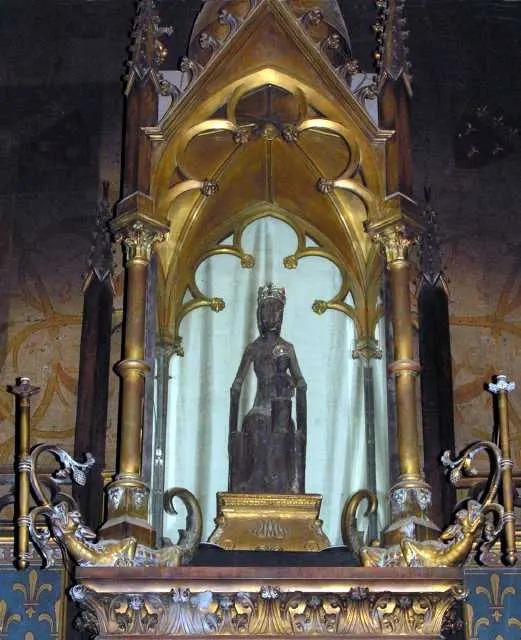
Image of Our Lady of Rocamadour. Image source · CC-BY-SA-3.0
Visit essentials
A quick read before you go
- Duration
- A minimum visit of two hours allows time to climb the Grand Escalier, visit the Chapel…
- Access
- Rocamadour is located in the Lot department of the Occitanie region, built into a 150-meter…
Overview
Rocamadour is approached through 216 steps hewn into the cliff, rising from the medieval village to the rock-face chapels. Medieval pilgrims climbed on their knees, reciting prayers at each step; many still do.
The sanctuary became one of Christendom's great pilgrimage destinations after a 12th-century incorrupt body was discovered near a small oratory. Henry II of England and Saint Louis of France came, as did sailors fulfilling storm vows and prisoners whose chains were removed after penance. Rocamadour once rivaled Jerusalem, Rome, and Santiago de Compostela in the medieval pilgrimage imagination.
In the Chapel Notre-Dame, a 12th-century walnut Virgin—barely more than two feet tall, darkened by candle smoke and centuries of veneration—wears silken robes changed with the liturgical seasons. Ship models, anchors, and chains record the gratitude of sailors and prisoners. Above her, an iron bell is said to ring without human hands when she performs a miracle.
Why this place is sacred
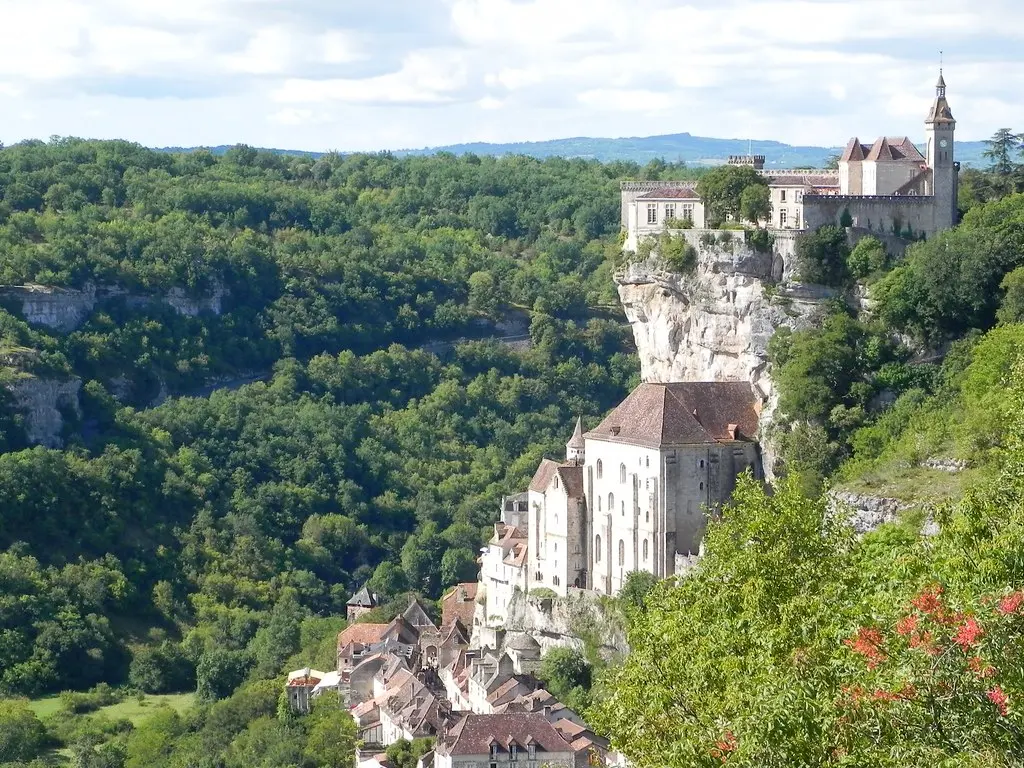
The cliff itself is the first teacher. Rocamadour rises in three levels: the village along the river, the sanctuary clinging midway up the rock face, and the chateau crowning the summit. This vertical organization mirrors the pilgrim's journey from ordinary life upward toward the sacred. The Alzou Valley spreads below; the sanctuary seems to hover between worlds.
The Black Madonna sits at the heart of this architecture, and her darkness is itself a teaching. Black Madonnas appear throughout medieval Europe—some 450 are documented, concentrated in France—and scholars continue to debate what the darkness signifies. Some point to candle smoke accumulated over centuries. Others note that many statues were intentionally darkened, the black perhaps representing the fertile earth, esoteric wisdom, or continuity with pre-Christian goddesses. The Song of Songs provides one frame: 'I am black but beautiful.'
Whatever the explanation, visitors consistently report that the statue's darkness makes her more approachable, more human, closer to the earth from which we all come.
The miracles add another layer. Between 1172 and 1173, monks compiled the Livre des Miracles documenting 126 cases: healings from paralysis and blindness, rescues of sailors in mortal danger, liberation of prisoners, assistance with fertility. The accounts are detailed, naming witnesses, specifying dates. Whether one accepts miraculous explanation or seeks naturalistic alternatives, the consistency of the reports across centuries suggests something happens here that exceeds ordinary expectation.
The bell that hangs in the Chapel Notre-Dame crystallizes this quality. According to tradition, it rings without human intervention when the Virgin performs a miracle—particularly for sailors in distress. A stone plaque lists fifteen occasions between 1385 and 1617 when this autonomous ringing was recorded. Priests reported that when rescued sailors arrived to fulfill their promised pilgrimages and told their stories, they could recall the exact hour the bell had tolled in Rocamadour.
These elements combine into something greater than their sum: a place where the boundary between human need and divine response has seemed, for nearly a millennium, thinner than elsewhere.
The earliest Christian presence at Rocamadour predates clear documentation. Local tradition speaks of a hermit named Amadour who retreated to this cliff in the first century, possibly the Biblical Zaccheus who met Jesus in Jericho. While this legend is hagiographic rather than historical, it points to an enduring intuition: this vertiginous place, suspended between earth and sky, river and heaven, seemed to call out for sacred use.
The documented pilgrimage site emerged in the 12th century, centered on veneration of the Virgin Mary. The discovery of an incorrupt body in 1166 near the cliff oratory—presented as Saint Amadour himself—transformed local devotion into international pilgrimage. By the late medieval period, Rocamadour functioned as a major station on routes to Santiago de Compostela, a place of penitential pilgrimage for those seeking forgiveness, and a shrine specifically associated with maritime protection.
The sanctuary has known glory and devastation. In its medieval peak, it ranked among Christianity's greatest pilgrimage destinations. Then came the Wars of Religion: in 1562, Protestant forces partly burned the sanctuary and destroyed the relics of Saint Amadour. The Revolution brought further decline. By the 19th century, the chapels were crumbling, the pilgrimage nearly extinguished.
Revival came through the efforts of the bishops of Cahors, who rebuilt much of the sanctuary in the mid-19th century. Today, Rocamadour receives approximately one million visitors annually. Some come as tourists, drawn by the dramatic architecture and medieval atmosphere. Many still come as pilgrims, climbing the steps to light candles before the Black Madonna, fulfilling promises made in moments of crisis. The sanctuary maintains daily mass and seasonal celebrations, particularly the feast of the Assumption in mid-August.
UNESCO recognition as part of the Santiago pilgrimage routes confirms Rocamadour's enduring place in the geography of sacred travel.
Experience and orientation
The climb changes everything. Whether you take the 216 steps at a walking pace or, as some pilgrims still do, on your knees, the ascent works on the body before the mind has time to construct defenses. By the time you reach the sanctuary parvis, you have earned your arrival. The breath comes short. The legs feel their labor. The sweeping view of the Alzou Valley offers itself as reward—and reminder that you have risen.
Entering the Chapel Notre-Dame produces a different quality of encounter. The space is small, carved partly from the living cliff. Light filters through old glass. The walls hold centuries of ex-votos: ship models given by rescued sailors, anchors, chains removed from prisoners, plaques recording gratitude for healings and deliverances. These are not museum pieces but evidence of a conversation between human need and something that responded.
The Black Madonna herself sits above the altar, smaller than most expect—69 centimeters of walnut wood, darkened and weathered, dressed in silken robes. Her face is not beautiful in conventional terms; it is ancient, worn, powerful in its very plainness. The Child on her knee has an unusually adult expression. Something about the roughness of the figure, after centuries of gilt and idealized Madonnas, feels more real. Visitors describe feeling met rather than observed.
The iron bell hangs overhead—the one said to ring when miracles occur. Whether or not you believe in such things, its presence shapes the atmosphere. This is a place where something extraordinary has been reported, repeatedly, for centuries. That accumulated expectation, that porousness to intervention, charges the air.
Many visitors report unexpected emotion: tears that arise without clear cause, a softening of defenses, a willingness to acknowledge what has been carried and not examined. The combination of physical exertion, vertical architecture, and the Black Madonna's worn presence seems to bypass the usual resistances. You do not have to believe anything particular to feel it. The place does its own work.
Rocamadour rewards those who approach it as pilgrimage rather than sightseeing. The difference is not about belief—it is about attention. A pilgrim arrives with something at stake: a question, a burden, a gratitude, a hope. That inner orientation changes what becomes visible.
Consider climbing the Grand Escalier on foot, even if lifts are available. The climb is the teaching. Let the exertion work on you. Notice how your breathing changes, how the view opens incrementally, how arrival feels different when it has been earned.
In the Chapel Notre-Dame, take time before approaching the statue. Let your eyes adjust to the dimness. Notice the ex-votos, the offerings of those who came before you with their storms and illnesses and imprisonments. You are not the first to bring your difficulties here.
If you carry a specific intention—a prayer, a question, a weight you wish to set down—offer it to the Black Madonna in silence. You need not believe she hears; you only need to notice what happens when you articulate, even internally, what you have been carrying. Sometimes the asking is itself the answer.
Context and lineage
The founding legend of Rocamadour reaches back to the Gospels themselves. According to tradition, Saint Amadour was Zaccheus of Jericho—the tax collector who climbed a tree to see Jesus passing by. After the crucifixion and resurrection, Zaccheus became a servant in the house of the Holy Family, eventually marrying Saint Veronica. When persecution drove them from Palestine, an angel guided their boat to the coast of Aquitaine.
Amadour, seeking solitude, withdrew to a wild spot in Quercy—the cliff that would bear his name (Roc-Amadour, the rock of Amadour). Here he carved a statue of the Virgin Mary, the image he had known in life, and built a small chapel in her honor. One version of the legend says he placed her image in a cave previously dedicated to pre-Christian goddesses, claiming the site for the new faith.
This story is hagiographic rather than historical—there is no documented evidence connecting the site to any first-century figure. But the legend shaped how pilgrims understood the place for centuries. To climb toward the Black Madonna was to approach an image carved by one who had known the Holy Family in the flesh, to enter a story that began in Jericho and ended on this French cliff.
The historical record begins more modestly. In 1166, excavation for a grave near the chapel entrance uncovered an intact, incorrupt body. Though its identity was unknown, it was presented as Saint Amadour himself—'the lover' of God or Mary. The discovery transformed a local shrine into a pilgrimage destination of international significance. By the late 12th century, when monks compiled the Livre des Miracles, Rocamadour was drawing pilgrims from across Europe.
Rocamadour's pilgrimage tradition has continued, with interruptions, for nearly nine centuries. Medieval pilgrims included kings, crusaders, and criminals sent to climb the steps as penance. The Wars of Religion brought devastation in 1562: Protestant forces burned portions of the sanctuary and destroyed the relics of Saint Amadour. The French Revolution brought further decline, with the chapels falling into ruin.
The 19th-century revival, led by the bishops of Cahors, restored both the buildings and the pilgrimage. The 20th century brought UNESCO recognition of Rocamadour as part of the pilgrimage routes to Santiago de Compostela. Today, the sanctuary receives approximately one million visitors annually—a number that approaches medieval accounts of the site's popularity. Daily masses continue. Pilgrims still climb the steps on their knees.
The Black Madonna receives candles and prayers as she has for eight centuries, her worn face bearing witness to the continuity of human longing.
Saint Amadour
founder (legendary)
The legendary founder whose incorrupt body was discovered in 1166. Tradition identifies him with Zaccheus of Jericho, though this attribution is hagiographic rather than historical. His name gives Rocamadour its identity: the rock of Amadour.
The Black Madonna
sacred object
A 12th-century walnut wood statue darkened by centuries of candle smoke and veneration. Scientific dating places her creation between 1160-1270, though legend attributes her to Saint Amadour himself. She is patroness of sailors and receives the prayers of pilgrims seeking intercession.
Henry II of England
historical pilgrim
The English king who made pilgrimage to Rocamadour in 1159 to give thanks for his recovery from illness. His visit established the sanctuary's royal credentials and drew attention throughout Christendom.
Saint Louis IX of France
historical pilgrim
The French king who visited Rocamadour twice, accompanied by his mother Blanche of Castile. His pilgrimage reflected the sanctuary's status as one of medieval Christianity's most important destinations.
Roland
legendary figure
The paladin whose legendary sword Durandal was said to be lodged in the cliff above the chapel entrance. According to the Song of Roland, the dying hero hurled his indestructible blade from Roncevaux Pass, and it flew through the air to rest at Rocamadour. A sword was displayed at the site until its theft in 2024—though historians suggest it was a replica dating from the 18th century.
Traditions and practice
The medieval pilgrimage to Rocamadour involved considerable physical ordeal. Pilgrims would begin the ascent of the Grand Escalier on their knees, reciting prayers or the rosary with each of the 216 steps. Some wore chains as additional penance. Upon reaching the sanctuary, pilgrims would venerate the Black Madonna, light candles, and leave offerings. Those who had fulfilled vows made during crisis—sailors rescued from storms, prisoners seeking absolution, the sick hoping for healing—would leave ex-votos as public testimony.
The Grand Pardon, a plenary indulgence granted on major feast days, drew extraordinary crowds. Historical accounts describe the 1546 pardon on Saint John's Day as so crowded that people were crushed. The sanctuary functioned as a station on routes to Santiago de Compostela, and many pilgrims combined both destinations in extended journeys of devotion.
Penitential pilgrimage could be mandated by ecclesiastical or civil courts. Criminals sentenced to Rocamadour would climb in chains, which were removed upon completion of the pilgrimage—hence the chains visible among the ex-votos in the Chapel Notre-Dame.
The sanctuary maintains daily mass, usually celebrated in the Chapel Notre-Dame or the Basilica Saint-Sauveur. The major liturgical celebrations draw larger crowds: the feast of the Assumption on August 15 is particularly significant, as is the September 8 nativity of Mary. Holy Week and Christmas bring special observances.
The Sacred Music Festival, held in mid-August, transforms the sanctuary for several days of sacred classical performances. Concerts take place in the Basilica Saint-Sauveur, the medieval architecture providing both acoustics and atmosphere for works spanning centuries of devotional music.
Many pilgrims still climb the Grand Escalier on their knees, particularly older French Catholics maintaining a tradition that has passed through their families. The practice is less common than in medieval times but has not disappeared. Even those who climb on foot often find the physical effort transforms their arrival.
Candles can be lit throughout the chapels. The Black Madonna continues to receive prayers and intentions. Some pilgrims walk the ancient route from L'Hospitalet, the small village on the plateau above, descending into Rocamadour as medieval pilgrims did.
Begin at the valley floor. Stand in the village and look up at the sanctuary clinging to the cliff face. Let the verticality register before you begin the climb.
If your body permits, climb the Grand Escalier on foot rather than taking the lift. The steps are worn smooth by centuries of pilgrims. As you climb, notice the labor, the breath, the view opening behind you. If you carry a specific intention or prayer, you might offer one repetition of whatever words feel authentic with each step.
In the Chapel Notre-Dame, take time with the ex-votos before approaching the Black Madonna. These ship models and chains represent real storms, real imprisonments, real crises that brought people here. Your own difficulties join a long lineage.
Light a candle if the gesture holds meaning for you. Sit in the chapel long enough for the silence to settle. The Black Madonna's worn face has received prayers for eight centuries. She has heard worse than whatever you carry.
If mass is being celebrated, you are welcome to attend regardless of your beliefs. The liturgy itself is a practice—words and gestures refined over centuries to open a channel between human and divine. Even as observer, you participate in something continuous.
Roman Catholicism (Marian/Black Madonna devotion)
ActiveOur Lady of Rocamadour has been venerated since at least the 12th century, when the first documented miracle occurred in 1148. The discovery of the incorrupt body of Saint Amadour in 1166 transformed Rocamadour into one of medieval Christianity's greatest pilgrimage centers, at times rivaling Jerusalem, Rome, and Santiago de Compostela. The Black Madonna is credited with 126 documented miracles compiled in the medieval Livre des Miracles, particularly healings, rescue of sailors, liberation of captives, and assistance with fertility. She is especially venerated as patroness of sailors due to numerous accounts of her intercession during maritime emergencies, symbolized by the miraculous bell that allegedly rings spontaneously during such miracles.
Pilgrims climb the 216-step Grand Escalier, traditionally on one's knees while reciting the rosary. At the Chapel Notre-Dame, they venerate the Black Madonna, light candles, and leave ex-votos of gratitude. Daily mass is celebrated in the sanctuary. Major celebrations occur on the Assumption (August 15), the nativity of Mary (September 8), and throughout the liturgical year. The site remains an important station on the Way of St. James pilgrimage routes. The annual Sacred Music Festival in August brings sacred classical music to the basilica.
Pre-Christian/Goddess Tradition (legendary)
HistoricalAccording to legend, the cliff site of Rocamadour was sacred before Christianity, dedicated to a trinity of pre-Christian goddesses. When Saint Amadour established his hermitage and chapel, he was understood to be Christianizing an already sacred place. Some interpreters see the Black Madonna tradition itself as preserving elements of pre-Christian earth-mother worship in Christian form. France has an unusual concentration of Black Madonnas, particularly in regions with documented pre-Christian sacred sites.
No documented practices survive from any pre-Christian use of this specific site. Claims of goddess worship rest on legend and comparative speculation rather than archaeological evidence. Contemporary neo-pagan or goddess-oriented visitors may approach the Black Madonna through this interpretive lens, but there are no organized practices associated with this tradition at Rocamadour.
Perspectives and open questions
Rocamadour invites multiple interpretations: scholarly, devotional, and esoteric. The site's long history has generated layers of meaning that need not be reconciled into a single narrative. Catholic pilgrims venerate the Black Madonna as powerful intercessor. Scholars examine the documented miracles within their historical context. Alternative interpreters see connections to pre-Christian goddess traditions. All respond to something real about this cliff-face sanctuary.
Scholarly perspective
Art historians and archaeologists have established that the Black Madonna statue dates to the late 12th or early 13th century, based on carbon-14 testing (1160-1270) and stylistic analysis. The statue was produced in Northern Europe and later modified with metal plates characteristic of early 13th-century goldsmiths. The intentional blackening of the wood appears to date from the 16th or 17th century, well after the statue's creation.
The identity of Saint Amadour remains historically unknown. The identification with Zaccheus of Jericho is hagiographic invention, part of a medieval pattern of connecting European shrines to biblical figures. The incorrupt body discovered in 1166 could have been any hermit or early Christian; the attribution to a first-century saint served the pilgrimage's development rather than historical accuracy.
The Livre des Miracles (1172-1173) is a valuable primary source for understanding medieval pilgrimage mentality. Its 126 documented cases—with names, dates, and witnesses—reveal what people of the period considered miraculous and how such experiences were recorded and transmitted. Historians read these accounts as evidence of social and religious patterns, whatever one concludes about their supernatural claims.
The Durandal sword displayed at the site was almost certainly a replica dating from the 18th century, installed to attract visitors. Its theft in 2024 removed an object of legend rather than genuine historical artifact.
Living and traditional perspectives
For Catholic faithful, Our Lady of Rocamadour is a powerful intercessor, particularly for those in danger at sea. The 126 documented miracles testify to her compassion and power. The Black Madonna's darkness is understood spiritually, often through the Song of Songs: 'I am black but beautiful.' This darkness associates her with humility, with the earth, with accessibility to ordinary people who might feel unworthy of approaching more idealized Madonnas.
The miraculous bell confirms heaven's continued attention to this sacred place. Its recorded ringings—without human intervention, at moments corresponding to rescues at sea—demonstrate the ongoing reality of divine intervention. The ex-votos lining the chapel walls are not historical curiosities but evidence of a living relationship between human need and divine response.
The penitential ascent of the Grand Escalier remains a meaningful devotional practice. The physical labor offered to God becomes itself a prayer, the body's exertion a form of sacrifice. Saint Amadour, whether Zaccheus or another holy hermit, represents the earliest Christian witness establishing this sanctuary for the veneration of Mary. His incorrupt body, even though now destroyed, testified to the sanctity of the place.
Alternative interpretations
Some interpreters understand Black Madonna sites like Rocamadour as preserving pre-Christian goddess traditions in Christianized form. The legend of Amadour placing Mary's image in a cave previously dedicated to pre-Christian goddesses, and reports of a druidic stone beneath the altar, suggest possible continuity with ancient earth-mother worship. The Black Madonna's dark coloring evokes Isis, Cybele, Artemis, and other dark goddesses associated with earth, fertility, and esoteric wisdom.
From this perspective, the cliff-face sanctuary represents a place where earth and sky meet, a natural threshold that various traditions have recognized as sacred. The vertical pilgrimage echoes initiatory ascent through levels of consciousness. The black statue, in contrast to the white Madonnas of conventional Catholic iconography, preserves an older, earthier, more feminine sacred.
The miraculous bell and the Durandal legend connect Rocamadour to both Arthurian/Carolingian mythology and to ideas of thin places where supernatural events occur more readily. The site sits at an intersection of legendary geography—Roland's sword, the Grail routes, the Santiago pilgrimage—that suggests significance beyond any single tradition.
Open questions
Genuine mysteries persist. Who was Saint Amadour actually? The Zaccheus identification is legendary; the true identity of the incorrupt body discovered in 1166 remains unknown and will likely never be established.
When and why was the Black Madonna statue intentionally darkened? Evidence points to the 16th or 17th century, but no documentation explains the reason. Was it devotional choice, accident, or response to accumulated candle smoke?
What, if any, pre-Christian sacred use existed at this specific cliff location? Claims of goddess worship rest on legend rather than archaeological evidence. The site may have been sacred before Christianity, or this may be retroactive mythmaking.
How did the miraculous bell phenomenon work? The recorded instances of spontaneous ringing have never been scientifically explained. Whether one attributes them to miraculous intervention, misperception, or fraud, the consistency of accounts across centuries invites wonder.
What happened to the original Durandal, if one ever existed at Rocamadour? Historical accounts mention Henry the Young King allegedly stealing the original in 1183. The sword displayed until 2024 was almost certainly a later replacement. The legend persists regardless of the physical evidence.
Plan your visit
Access and arrival
Rocamadour is located in the Lot department of the Occitanie region, built into a 150-meter cliff above the Alzou Valley. The nearest major cities are Cahors (60 km south) and Brive-la-Gaillarde (54 km north). By car, Toulouse is approximately 170 km, Bordeaux 210 km, Paris 500 km.
No direct train service reaches Rocamadour. The nearest stations are Rocamadour-Padirac (5 km, seasonal service) and Souillac (25 km, year-round). From these stations, taxi or car rental is necessary.
Parking is available at the valley floor (generally free) or at L'Hospitalet on the plateau above (paid). From the valley, you ascend to the village level, then climb the Grand Escalier to the sanctuary. Alternatively, two lifts connect the levels for those unable to climb: one from the valley to the village, one from the village to the sanctuary. Lift tickets are required.
Entry to the sanctuary and all chapels is free. Guided tours are available for additional fee.
The village of Rocamadour offers hotels and guesthouses at various price points, with the advantage of evening and early morning access when day-trippers have departed. L'Hospitalet on the plateau above provides additional options. The medieval atmosphere of staying within the village rewards those who can afford it.
For those seeking pilgrimage context, the sanctuary itself does not offer formal retreat programs, but the Lot region has various guesthouses catering to walkers on the Santiago routes. Combining Rocamadour with time in the surrounding Causses du Quercy Natural Regional Park allows for integration of the pilgrimage experience.
Respectful visit
Modest dress is required when entering the sanctuary area. Shoulders and knees should be covered. The standard is not rigorous—no one will be turned away for minor infractions—but respecting the expectation honors those for whom the space is sacred. Comfortable shoes are essential for the steep stairs and uneven terrain.
Photography is generally permitted in the sanctuary, though specific rules for the Chapel Notre-Dame should be confirmed on site. During religious services, photography is not appropriate. Flash photography disturbs both worshippers and the experience of other visitors.
Consider whether every moment needs documentation. The Black Madonna's power is not well captured by phone cameras. Some experiences are diminished by the impulse to record them.
Candles may be lit in the chapels; donation boxes are provided. Ex-votos—objects left in gratitude for answered prayers—are part of the sanctuary's tradition, though contemporary offerings should follow sanctuary guidelines rather than being left informally.
If you wish to make an offering that does not fit established forms, an internal prayer or silent intention is always appropriate and leaves no maintenance burden for the sanctuary.
The sanctuary opens daily with seasonal hours: summer approximately 7:00 AM to 10:00 PM, winter approximately 8:30 AM to 6:30 PM. Entry to the sanctuary and chapels is free. Religious services take precedence over tourism.
The Grand Escalier and sanctuary are accessible by foot or by lifts for those unable to climb. Using the lift is not considered lesser; the medieval pilgrims who could not climb were still pilgrims.
Religious services take precedence over tourism. If mass is being celebrated or a ceremony is in progress, wait quietly or return later. Do not photograph during services.
The tradition of climbing on one's knees is physically demanding and not appropriate for those with knee or joint problems. The practice holds meaning within a specific devotional context; attempting it as spectacle or performance misses the point. Those who undertake it should do so with sincere intention.
Be aware that some guides and tour operators may offer exaggerated claims about the site's miracles or history. The documented record is already remarkable; embellishment diminishes it.
Current practical details
Address
Adresse Postale :, Rue de la Mercerie, 46500 Rocamadour, France
Phone
Hours
Hours, fees, and access can change — verify on the official source before you travel. Practical details last checked Jun 2026.
Location
Map loads as you approach this section.
Pilgrim reflections
A portrait of encounter, not a score
Pilgrims describe what they felt, how present they could become, and whether the place would shape a journey. There are no stars and no ranking of traditions.
No reviewed reflections yet
The first pilgrims can help describe the character of being here.
Share a reflection
Available after an account-backed “Been there.” Every reflection is reviewed before publication.
Nearby sacred places
Explore other sacred places in the region. Proximity does not establish access or travel time; check each place’s guidance.


References
Sources consulted for this page. Source categories describe the publication, not a guarantee that every claim is verified. Traditional accounts and outside interpretations may differ.
- 01Rocamadour — Villes Sanctuaires en FranceofficialOfficial French sanctuary cities network
- 02Sanctuaire Notre-Dame de Rocamadour — Official Sanctuary WebsiteofficialOfficial sanctuary information
- 03The Black Madonna of Rocamadour, from the study of its condition report to its dating: a multidisciplinary approach — IAEA INISacademicScientific dating study of the statue
- 04Reading the Juggler of Notre Dame - The Jongleur and the Black Virgin of Rocamadour — Open Book PublishersacademicAcademic study including medieval miracle accounts
- 05Rocamadour — Wikipedia contributorsencyclopediaComprehensive overview with historical documentation
- 06Durendal — Wikipedia contributorsencyclopediaHistorical and legendary background of Roland's sword
- 07The Hidden Pilgrimage Site of the Black Virgin of Rocamadour — EWTNspiritualCatholic perspective on the shrine's religious significance
- 08The Black Madonna of Rocamadour — MaryPagesSource contextDetailed Marian devotion perspective
- 09Our Lady of Rocamadour (Notre-Dame de Rocamadour) — Interfaith Mary PageSource contextInterfaith perspective on the Black Madonna
- 10Rocamadour — World Pilgrimage Guide / Sacred SitesSource contextPilgrimage and sacred site perspective
- 11Rocamadour: The Vertiginous Citadel of Faith — French MomentsguideHistorical and visitor information
- 12The Legend of Durandal: Roland's Magic Sword in Rocamadour — French MomentsguideDetailed account of the Durandal legend
- 13Our Lady of Rocamadour — Catholic CulturespiritualCatholic doctrinal perspective
- 14Our Lady of Rocamadour, France — 206 ToursguidePilgrimage tour operator with practical information
- 15France's Mysterious Black Madonnas — France TodaySource contextCultural context of Black Madonnas in France
Share a photo
Help visitors recognize Our Lady of Rocamadour. Every submission is reviewed before publication.