Our Lady of Luján
InsideBasilica of the Virgin of Luján, Luján
Where a small terracotta Virgin chose to stay, and three nations came to call her Mother
Understand sacred places, explore living traditions, and learn how to engage respectfully with Pilgrim Map.
Access has not been verified. Check current local guidance before planning a visit.
Luján, Buenos Aires Province, Argentina
Read the sources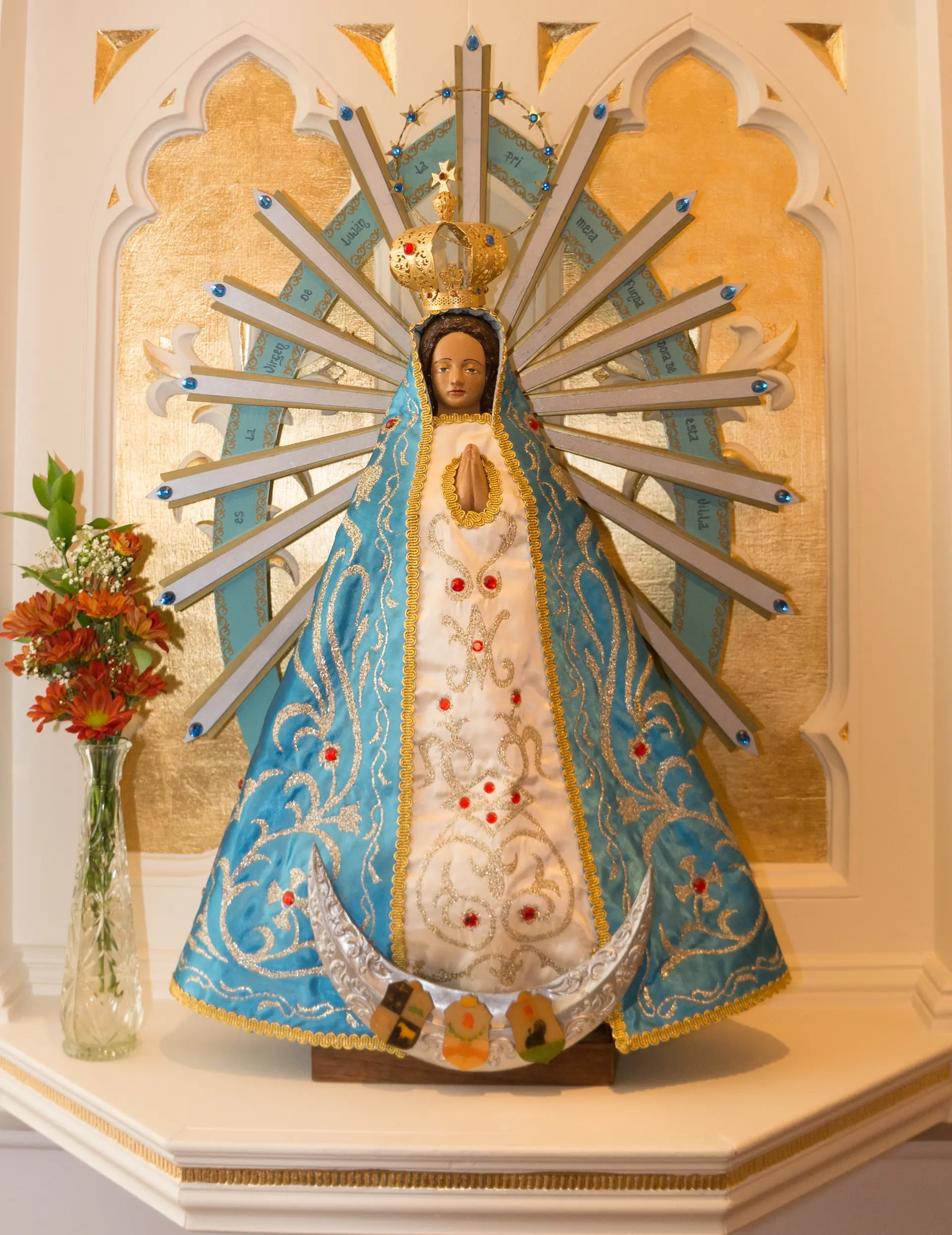
Visit essentials
A quick read before you go
- Duration
- A basic visit to the basilica takes two to three hours, allowing time to explore the sanctuary,…
- Access
- From Buenos Aires, Bus #57 departs from Plaza Miserere (Rivadavia side) and travels directly to…
Overview
At the Luján River in 1630, oxen inexplicably stopped a cart and moved only after a crate containing a small terracotta Immaculate Conception was lifted from it. The statue stayed, and a nation formed around her.
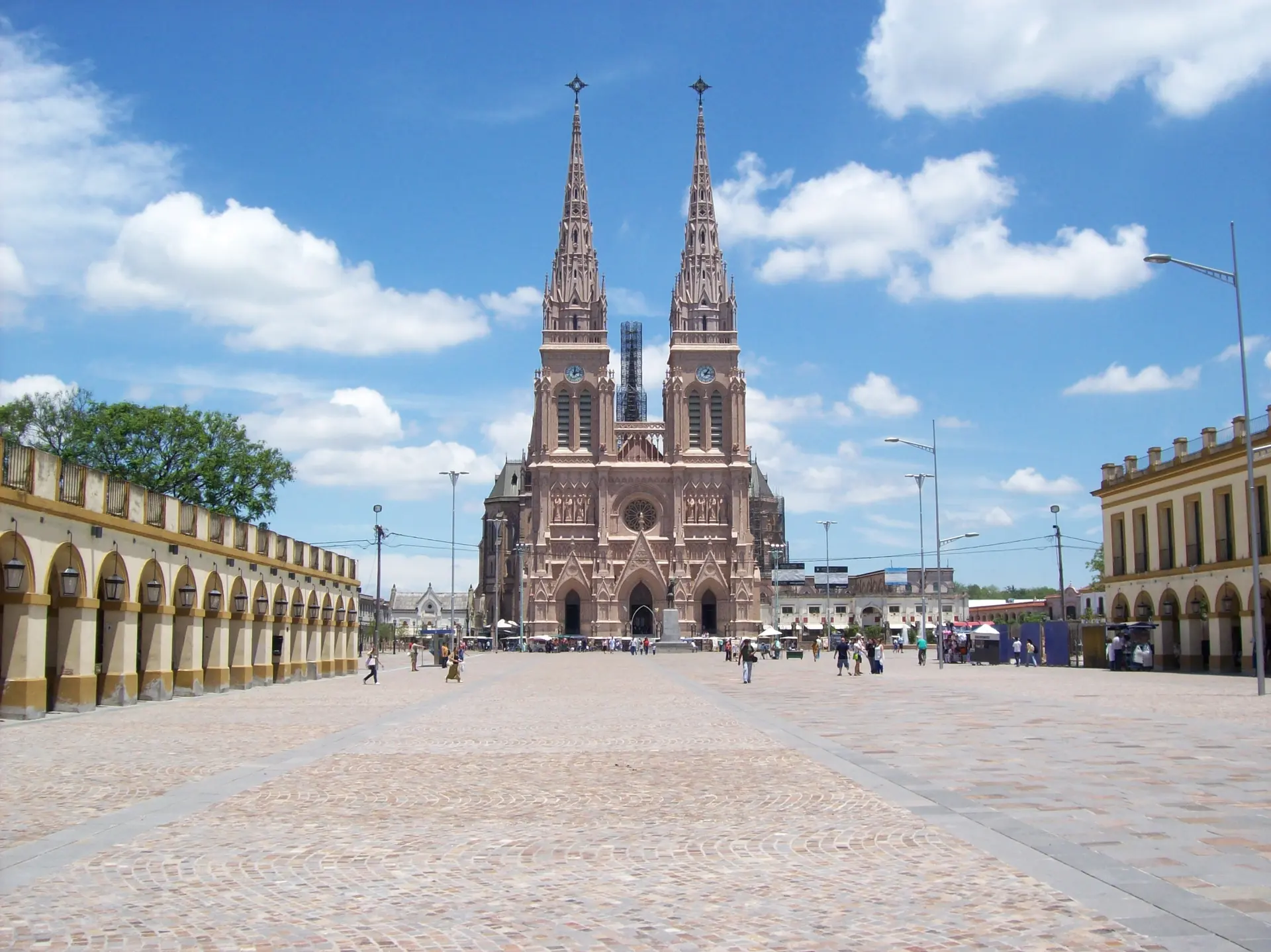
The ranch image at the Argentine pampas' edge became South America's most important Marian pilgrimage. Its neo-Gothic basilica has twin spires over 100 meters tall, visible for miles across flat grasslands. At its center remains the 38-centimeter figure, jeweled and silver-covered but still understood as the Virgin who chose this place.
Six million visitors come yearly. Some walk 68 kilometers overnight from Buenos Aires, arriving at dawn with blistered feet; gauchos arrive on horseback. Those unable to come send prayers to La Virgencita, the little Virgin who has heard Argentina's sorrows and celebrations for nearly four hundred years.
She is patroness of Argentina, Uruguay, Paraguay, highways, railways, and police. The figure has witnessed wars and reconciliations, epidemics and healings, and national identity's formation. Pope John Paul II came during the Falklands War; Pope Francis prayed here countless times as Archbishop of Buenos Aires. Yet her congregation is mothers seeking comfort, sick people seeking healing, and young people walking through the night toward something they cannot yet name.
Why this place is sacred
The thinness at Lujan has a different quality than at ancient sacred sites shaped by millennia. Here, the veil became thin at a specific moment in recorded history, when oxen refused to move and a faithful witness recognized the refusal as divine will.
Negro Manuel, the enslaved man who cared for the statue for forty years, understood something about this location that transcended the visible. According to tradition, he reported that the Virgin spoke to him, told him when he would die, and promised he would be buried at her altar's foot. His devotion was not to an object but to a presence he experienced as real. The thinness he encountered has persisted.
When scholars speak of accumulated sacred intention, they describe precisely what has happened at Lujan. Generation after generation has brought their deepest needs to this place. Mothers have prayed for sick children. The dying have sought peace. The desperate have walked through nights seeking hope. Each prayer, each tear, each candle lit adds to what already exists. The basilica's walls contain nearly four hundred years of human longing directed toward the divine.
Pilgrims consistently describe a quality they struggle to articulate. Some call it peace; others speak of maternal presence. Many report weeping without knowing why, as though something long held has finally found release. The statue itself, small and now almost invisible beneath silver and gems, seems somehow larger than its dimensions suggest. What visitors encounter is not a terracotta figure but the accumulation of every prayer ever spoken before it.
The original statue was commissioned by Antonio Farias de Saa, a Portuguese estate owner in Santiago del Estero, for a chapel he intended to build. The Brazilian artisan who crafted the 38-centimeter terracotta figure of the Immaculate Conception remains unknown. The image was never meant for Lujan; it was in transit when the miracle occurred. Its purpose, one might say, was determined not by human intention but by divine intervention. The Virgin chose her own location.
From a simple hermitage on a ranch to one of the Americas' most important pilgrimage sites, the shrine has grown with the devotion. Negro Manuel tended the first humble shelter. Dona Ana de Matos expanded it in 1671, providing lodging for the growing stream of pilgrims. By 1682, an entire city had formed around the shrine.
The current basilica, begun in 1887 and completed in 1935, represents the devotion's maturation into a national institution. Father Jorge Maria Salvaire's vision, rendered in French architect Ulrico Courtois's neo-Gothic design, created a structure that could hold the enormity of what the small statue had inspired. The 106-meter towers, the stained glass from Bordeaux, the capacity to hold thousands of pilgrims, all serve the same purpose as the original hermitage: to shelter the Virgin who would not leave.
Papal recognition came throughout the twentieth century. Canonical Coronation in 1887, designation as Patroness of three nations in 1930, the Golden Rose in 1982. But these honors merely recognized what the faithful already knew. The Virgin had been their mother long before Rome acknowledged her.
Experience and orientation
The experience begins before entering. The twin spires of the basilica rise above the pampas like a beacon, visible long before arrival. For those who have walked through the night from Buenos Aires, the first sight of those towers in the dawn light produces emotions that catch pilgrims by surprise. Exhaustion transforms into something closer to joy.
Inside, the scale shifts dramatically. The vast neo-Gothic interior, modeled on medieval French cathedrals, creates an atmosphere of cool quiet that contrasts with the bright plains outside. Light filters through Bordeaux stained glass, coloring the air itself. Yet the immensity directs attention not to itself but to the small figure at its heart.
Pilgrims consistently describe a maternal quality to what they encounter here. This is not the fierce sacredness of mountain peaks or the austere holiness of desert monasteries. The presence at Lujan feels, according to countless reports, like coming home to a mother who has been waiting. Tears are common, but they are often tears of relief rather than sorrow.
During major pilgrimages, the communal dimension intensifies the experience. To walk among a million young people through the October night, to arrive with blistered feet among thousands who share your exhaustion and your faith, creates bonds that persist long after the pilgrimage ends. The Virgin is mother not just to individuals but to the community formed in her name.
Those who come during quieter times report a different quality: intimacy. The small statue, despite its jeweled adornment, invites personal encounter. Pilgrims speak to her of their specific troubles, their particular griefs, their private hopes. They report, consistently, feeling heard.
Come with what burdens you. The Virgin of Lujan is a patroness of the ordinary struggles of life: health, family, work, the road ahead. She has heard four centuries of human need. Whatever you carry, bring it.
If possible, arrive early in the morning before the day's crowds gather. The basilica in the soft light of dawn holds a particular stillness. Find a place to sit in view of the altar and simply be present. You need not formulate prayers if words do not come. Presence is itself a form of prayer.
Notice what arises. Many report unexpected emotions: tears, relief, a loosening of something long held tight. Do not resist these responses. They are part of what draws six million people annually to this place.
If your visit coincides with a pilgrimage period, embrace the communal experience. The faith of others can carry you when your own wavers. To pray among thousands who pray the same prayers creates a solidarity that transcends individual isolation.
Context and lineage
In May 1630, a Portuguese estate owner named Antonio Farias de Saa awaited a delivery from Brazil. He had commissioned a friend to send a statue of the Virgin Mary for a chapel he planned to build in Santiago del Estero. The friend, knowing the uncertainty of such requests, sent two statues: one of the Madonna with Child, and one of the Immaculate Conception.
The caravan carrying the images stopped for the night at the ranch of Rosendo de Trigueros, near the Lujan River, some 60 kilometers west of what would become Buenos Aires. When the drivers tried to resume their journey the next morning, the oxen pulling the cart with the statues would not move. No amount of urging could persuade them. Loads were shifted, animals changed, everything attempted. The oxen refused.
Only when the crate containing the smaller statue, the Immaculate Conception, was removed did the animals consent to continue. The larger Madonna with Child proceeded to Santiago del Estero as intended. But the smaller Virgin stayed at the Lujan River, having chosen her location.
Among those who witnessed this was Manuel Costa de los Rios, known as Negro Manuel, an enslaved man who declared immediately that he would remain with the image. He spent the next forty years tending the hermitage that Rosendo built, dressing the statue, leading pilgrims in prayer, and maintaining vigil over the Virgin who had stopped the cart. According to tradition, she spoke to him, revealing the day of his death.
He died on the predicted date and was buried at the foot of her altar, as she had promised. His cause for beatification is now active.
The devotion has passed through four centuries of Argentine history, adapting to each era while maintaining its essential character. Negro Manuel established the pattern of humble, devoted service that continues in the priests and religious who staff the basilica today. Dona Ana de Matos inaugurated the tradition of lay benefactors supporting the shrine. Father Salvaire connected local devotion to universal Church recognition.
Papal honors have punctuated this lineage. Pope Leo XIII granted the Canonical Coronation in 1887, recognizing the Virgin's miraculous power. Pope Pius XI declared her patroness of three nations in 1930, with the document signed by Cardinal Pacelli, the future Pius XII. Pope John Paul II came during the Falklands War in 1982, bestowing the Golden Rose and demonstrating the universal Church's solidarity with Argentine suffering.
Pope Francis, who prayed countless times at the shrine as Archbishop of Buenos Aires, continues to send messages on her feast day, maintaining a papal connection to the devotion he first knew as a young Argentine.
The faith has been transmitted through families, parishes, and the rhythms of Argentine life. Children grow up knowing La Virgencita. Marriages are celebrated beneath her gaze. The dying ask to be commended to her care. This is not merely institutional Catholicism but a devotion woven into the fabric of national identity.
Virgin Mary
deity
The Mother of Jesus, venerated under the title of Our Lady of Lujan as patroness of Argentina, Uruguay, Paraguay, Argentine highways, railways, and police. The small terracotta statue representing her is understood not as a mere image but as a locus of her presence and intercession.
Manuel Costa de los Rios
guardian
Enslaved man who witnessed the 1630 miracle and devoted forty years to caring for the shrine. His life of humble devotion, reported mystical experiences, and holy death have made him a candidate for sainthood. If canonized, he would be the first Afro-Argentine saint.
Antonio Farias de Saa
historical
Portuguese estate owner who commissioned the statue from Brazil, unwittingly setting in motion the events that would create Argentina's most important Marian devotion.
Father Jorge Maria Salvaire
historical
The priest who promoted construction of the current basilica and championed the devotion's recognition by Rome. His efforts led to the Canonical Coronation of 1887 and transformed a regional shrine into a national institution.
Traditions and practice
The core traditional practice is pilgrimage itself. From the earliest years, when small groups walked from nearby estancias to the hermitage, through today's massive gatherings of over a million participants, the physical journey to Lujan has been the primary expression of devotion.
The feast day on May 8, commemorating the 1887 Canonical Coronation, draws the largest gatherings. Pilgrims from across Argentina and neighboring countries walk through the preceding night, arriving at dawn to join the celebrations. Mass, procession, and communal prayer fill the day.
The Gaucho Pilgrimage on the last Sunday of September brings a distinctly Argentine character to the devotion. Traditional horsemen in full gaucho attire ride to the basilica, their horses waiting outside while they venerate the Virgin within. The event connects the devotion to the culture of the pampas that surrounds the shrine.
The Youth Pilgrimage on the first Sunday of October may be the most remarkable of all. Up to one million young people walk the entire 68 kilometers from Buenos Aires through the night, arriving exhausted and exhilarated at dawn. This modern tradition, begun in the late twentieth century, has become one of the largest religious gatherings in the Americas.
The Nautical Pilgrimage on December 8, the Feast of the Immaculate Conception, brings devotees by boat along the Lujan River, echoing the proximity of water that marked the Virgin's original location.
Beyond the major pilgrimages, daily devotion continues at the basilica. Masses are celebrated throughout the day, drawing local parishioners and visiting pilgrims alike. The sanctuary where the statue resides remains open for prayer and veneration, with pilgrims approaching to offer petitions and thanks.
Candle-lighting remains a central practice. The accumulated light of thousands of candles creates an atmosphere of collective prayer made visible. Pilgrims purchase candles at the shrine and light them with specific intentions, physical symbols of prayers offered.
Tours of the basilica explain its history and architecture, connecting visitors to the centuries of devotion that produced this space. The crypt, the upper levels, and the towers (when accessible) offer different perspectives on the building and the faith it houses.
The nearby museums and monuments extend the experience beyond the basilica itself. The statue of Negro Manuel, inaugurated in 2022, invites reflection on the enslaved man's devotion and the advancing cause for his beatification.
If you come as a seeker rather than a practicing Catholic, you remain welcome. The Virgin of Lujan has been receiving visitors of all kinds for nearly four hundred years.
Consider arriving for morning Mass, even if you do not receive Communion. The rhythm of the liturgy, the responses of the congregation, and the focus on the altar create a contemplative structure that can hold any prayer, any intention, any grief.
Take time to simply sit with the statue. The jeweled covering and silver adornment can distract from what lies beneath: a small terracotta figure made by an anonymous Brazilian artisan nearly four centuries ago. Let the smallness of the original image teach you something about how the vast begins.
If you are physically able and your visit coincides with a pilgrimage period, consider walking at least part of the route from Buenos Aires. Even walking the final kilometers with arriving pilgrims connects you to the sacrificial dimension of the devotion. The feet matter. The effort matters.
Before leaving, light a candle with an intention. Be specific. Name what you carry, what you need, what you hope. The practice is not superstition but focus: a way of making your prayer visible to yourself.
Roman Catholicism
ActiveOur Lady of Lujan holds singular importance within Roman Catholic practice in South America. As patroness of Argentina, Uruguay, and Paraguay, officially declared by Pope Pius XI in 1930, she represents the Virgin Mary's maternal presence for three nations. Additional patronages include Argentine highways (1944), railways (1948), and the Federal Police (1946). The Canonical Coronation granted by Pope Leo XIII in 1887 and the Golden Rose bestowed by Pope John Paul II in 1982 represent the highest papal honors for Marian images. Pope Francis's deep personal devotion, developed during his years as Archbishop of Buenos Aires, continues the papal connection to the shrine.
Feast day celebration on May 8 with pilgrimages from across Argentina draws over 100,000 participants. The Annual Gaucho Pilgrimage on the last Sunday of September combines traditional culture with devotion, as horsemen in full gaucho attire ride to venerate the Virgin. The Youth Pilgrimage on the first Sunday of October brings up to one million young people walking 68 kilometers from Buenos Aires overnight. Nautical pilgrimages on December 8, the Feast of the Immaculate Conception, proceed by boat along the Lujan River. Daily masses and year-round veneration continue without interruption.
Perspectives and open questions
Our Lady of Lujan exists at the intersection of colonial history, popular piety, national identity, and living faith. Scholarly analysis, traditional Catholic understanding, and contemporary devotion offer different but complementary perspectives on what this place means and why it draws six million visitors annually.
Scholarly perspective
Academic scholarship recognizes Our Lady of Lujan as a foundational element of Argentine Catholic identity and one of the most significant Marian devotions in the Americas. The 1630 origin story exemplifies the transplantation of European Catholic devotion to the New World, with a statue commissioned from Brazil becoming the symbolic mother of nations that did not yet exist.
Historians note the complex racial dynamics embedded in the devotion's origins. Negro Manuel, an enslaved man, became the shrine's first guardian and a figure of popular veneration, now advancing toward sainthood. His story both reflects and complicates the colonial context from which the devotion emerged.
The adoption of Our Lady of Lujan as patroness of three nations in 1930 represents what scholars call the sacralization of national identity. The Virgin became not merely a religious figure but a symbol of Argentine, Uruguayan, and Paraguayan peoplehood. This fusion of faith and patriotism continues to shape the devotion's character.
Art historians note the basilica as one of the finest examples of neo-Gothic architecture in South America, with its French-designed towers and Bordeaux stained glass representing a distinctive moment in Latin American ecclesiastical building.
Living and traditional perspectives
From the perspective of Catholic teaching, Our Lady of Lujan represents a genuine apparition and ongoing miraculous presence. The Church has recognized the devotion through Canonical Coronation, papal honors, and formal designation of patronage. These are not merely ceremonial acknowledgments but theological validations of the Virgin's presence and intercession at this location.
The faithful understand the 1630 miracle not as legend but as historical fact: the Virgin chose this place, and her choice continues to bear fruit in healings, conversions, and answered prayers. The consistency of miraculous reports across nearly four centuries is understood as evidence of ongoing divine activity.
Negro Manuel's cause for beatification proceeds through official Church channels, with investigation into his life, virtues, and reported miracles. His potential canonization would represent the Church's formal recognition of a holy life lived in humble service to the Virgin.
For practicing Catholics, particularly in Argentina, Uruguay, and Paraguay, Our Lady of Lujan is not an artifact of the past but a living mother who intercedes for her children. The six million annual visitors are not tourists but pilgrims seeking a genuine encounter with the sacred.
Open questions
Genuine mysteries remain in the devotion's history. The Brazilian artisan who crafted the original statue is unknown, as are the specific circumstances of its creation. Why did Antonio Farias de Saa's friend send two statues rather than one? What exactly did Negro Manuel experience in his four decades of solitary devotion?
The complete catalog of miracles attributed to Our Lady of Lujan has never been compiled. Countless healings, interventions, and answered prayers have been reported over nearly four hundred years, but systematic documentation exists only for limited periods.
What happened in the cart in 1630 remains, strictly speaking, inexplicable. Why oxen would refuse to move until a specific crate was removed falls outside naturalistic explanation. Believers see divine intervention; skeptics see embellished folklore. The event itself, whatever occurred, lies beyond recovery.
Plan your visit
Access and arrival
From Buenos Aires, Bus #57 departs from Plaza Miserere (Rivadavia side) and travels directly to Lujan in approximately 1.5 hours. Multiple bus companies also operate from the Buenos Aires bus terminal. By car, National Route 8 leads west from the capital; the journey takes approximately 1 hour 15 minutes. The basilica is accessible to visitors with mobility limitations on the main level. Upper levels and towers may be challenging for wheelchair users.
Lujan offers various accommodation options, from simple hostels to comfortable hotels. During major pilgrimage periods, rooms book far in advance; reserve early if visiting around May 8, the October youth pilgrimage, or other major feast days. Buenos Aires, 1.5 hours away, provides unlimited accommodation options for day trips.
Respectful visit
Modest dress is required when entering the basilica. Avoid shorts, sleeveless tops, and revealing clothing. The standard is what you would wear to a solemn occasion where respect is expected. Comfortable walking shoes are essential, particularly if you plan to explore beyond the main sanctuary or if your visit coincides with pilgrimage periods requiring long walks.
Photography is generally permitted in the basilica and during public events. Be respectful during prayer services and masses. The jeweled adornment of the statue and the neo-Gothic architecture provide beautiful subjects. But remember that photography is not the purpose of your presence. See the site before you frame it. Experience before you capture.
Candles are the traditional offering and may be purchased at the shrine. Donations to support the basilica's maintenance and charitable works are welcome. Ex-votos, symbolic objects offered in thanksgiving for answered prayers, may be left at designated areas. Prayer itself is an offering. Bring what you carry and lay it before the Virgin.
Do not touch the sacred image. Follow directions from basilica staff, particularly during peak periods. Food and smoking are prohibited inside the church. Remove hats when entering the basilica.
During major pilgrimage periods, crowds can be overwhelming. The October youth pilgrimage draws up to a million participants, creating both spiritual intensity and practical challenges. Secure your belongings. Stay hydrated. Accept that this is a communal experience, not a private one.
If you join the walking pilgrimage, prepare physically. The 68 kilometers through the night require reasonable fitness and appropriate footwear. Many pilgrims develop significant blisters. Some interpretation sees this suffering as part of the offering; but practical preparation reduces unnecessary pain.
Most information and tours are available only in Spanish. If you do not speak the language, consider arranging a guide in advance or accepting that some dimensions of the experience will be inaccessible.
Do not touch the sacred image. Approach with reverence and physical restraint appropriate to any sacred object.
Current practical details
Address
San Martín 51, B6700CCU Luján, Provincia de Buenos Aires, Argentina
Phone
Hours
Hours, fees, and access can change — verify on the official source before you travel. Practical details last checked Jun 2026.
Location
Map loads as you approach this section.
Pilgrim reflections
A portrait of encounter, not a score
Pilgrims describe what they felt, how present they could become, and whether the place would shape a journey. There are no stars and no ranking of traditions.
No reviewed reflections yet
The first pilgrims can help describe the character of being here.
Share a reflection
Available after an account-backed “Been there.” Every reflection is reviewed before publication.
Nearby sacred places
Explore other sacred places in the region. Proximity does not establish access or travel time; check each place’s guidance.
Basilica of the Virgin of Luján, Luján
Luján, Buenos Aires Province, Argentina
0.0 km away

San Cayetano Sanctuary, Liniers
Buenos Aires, Buenos Aires, Argentina
54.9 km away

San Ramon Nonato Sanctuary, Buenos Aires
Buenos Aires, Argentina
57.2 km away

Basilica of Virgin of Itatí, Corientes, Argentina
Municipio de Itatí, Corrientes, Argentina
815.5 km away
References
Sources consulted for this page. Source categories describe the publication, not a guarantee that every claim is verified. Traditional accounts and outside interpretations may differ.
- 01Our Lady of Lujan - IVE America — Institute of the Incarnate WordofficialReligious order with deep connection to the devotion; detailed historical account
- 02Our Lady of Lujan - Servants of the Lord the Virgin of Matara — SSVM USAofficialReligious order dedicated to Our Lady of Lujan; authoritative source
- 03Where is Basilica de Nuestra Senora de Lujan — LatLong.netSource contextGeographic coordinates reference
- 04Basilica Nacional de Nuestra Senora de Lujan — Argentina.gob.arofficialOfficial Argentine government cultural heritage documentation
- 05Statue of Our Lady of Lujan brought to England after Falklands War returned to Argentina — Catholic Bishops' Conference of England and WalesnewsOfficial church documentation of the Falklands War statue exchange
- 06Pope Francis sends video message to Argentina for feast of Our Lady of Lujan — Catholic News AgencynewsContemporary papal connection to the devotion
- 07Our Lady of Lujan is a meeting point of Argentine Catholicism — CruxnewsAnalysis of the devotion's role in Argentine Catholic identity
- 08Nuestra Senora de Lujan — ACI PrensaspiritualSpanish-language Catholic news source with detailed history
- 09Our Lady of Lujan - Wikipedia — Wikipedia contributorsencyclopediaComprehensive overview with citations; cross-referenced with primary sources
- 10The History of Our Lady of Lujan — Pierced HeartsspiritualDetailed account of miracles and Negro Manuel's story
- 11Our Lady of Lujan | Salt + Light Media — Salt + Light MediaspiritualCatholic media coverage with historical details
- 12Argentina, Lujan: Basilica of Our Lady of Lujan — The Catholic Travel GuideguidePilgrimage-focused travel information
- 13Sanctuary of Lujan: A Shrine on the Pampas — PilgrimapsguideDetailed architectural and construction history
- 14Lujan, Argentina's Sacred City on the Pampas — Wander ArgentinaguidePractical visitor information and cultural context
- 15Mary, Our Lady of Lujan Basilica, Lujan, Argentina — Sacred SitesguideOverview of the site's sacred significance
Share a photo
Help visitors recognize Our Lady of Luján. Every submission is reviewed before publication.