Basilica of the Virgin of Luján, Luján
Argentina's spiritual heart, where four centuries of devotion gather at the Virgin's chosen ground
Understand sacred places, explore living traditions, and learn how to engage respectfully with Pilgrim Map.
Access has not been verified. Check current local guidance before planning a visit.
Luján, Buenos Aires Province, Argentina
Read the sources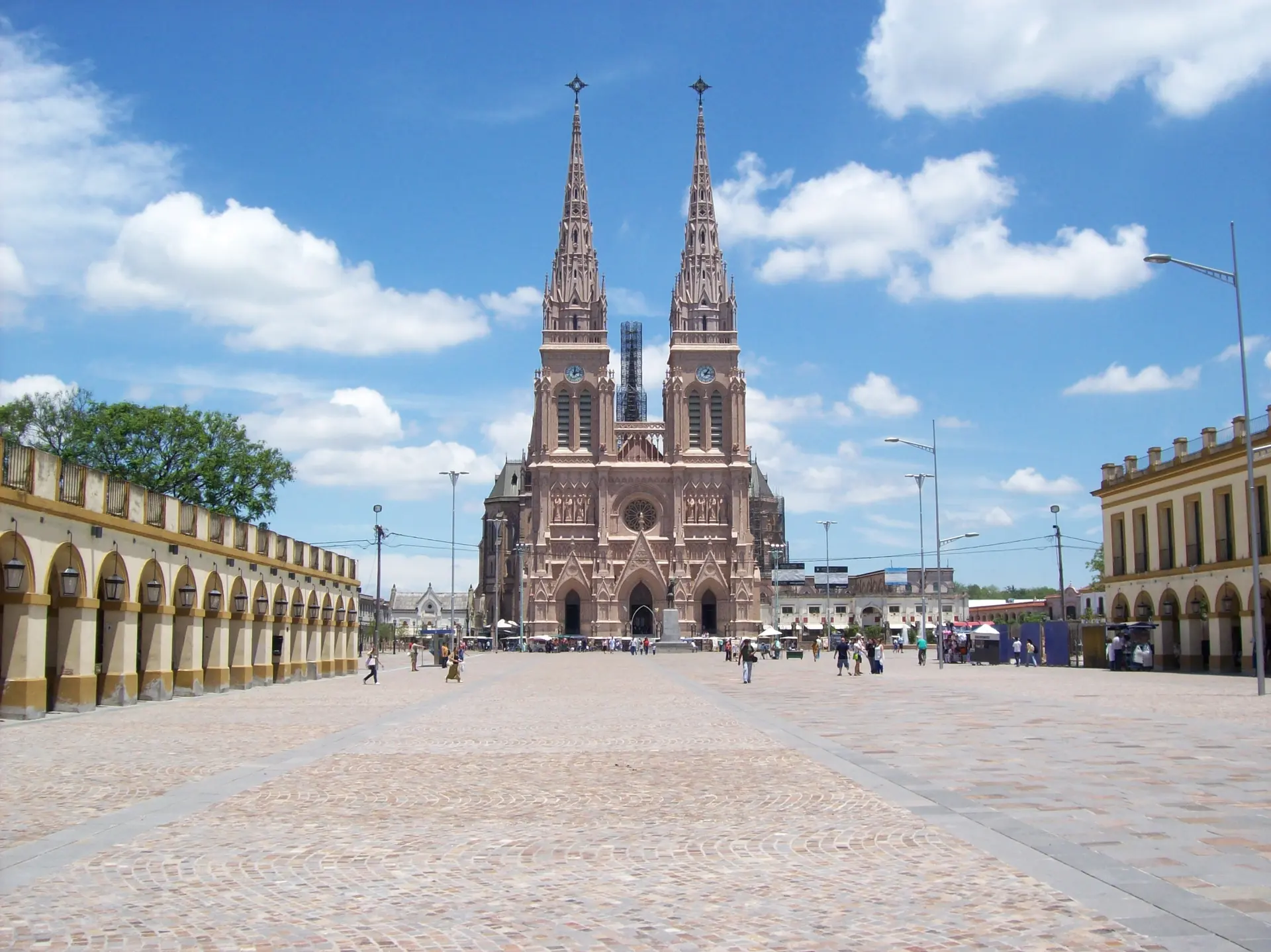
Image of Basilica of the Virgin of Luján, Luján. Image source · CC-BY-SA-3.0
Visit essentials
A quick read before you go
- Duration
- A focused visit to the basilica takes one to two hours, allowing time for the main sanctuary,…
- Access
- By car, take Route 7 from Buenos Aires, approximately one hour.
Overview
In 1630, a caravan carrying religious statues stopped near the Lujan River. The next morning, changing animals and unloading cargo could not move the cart holding a small terracotta Virgin; only removing her let the oxen proceed. Witnesses understood that she had chosen her home.
Nearly four centuries later, that choice draws millions. Built over decades, the basilica raises twin 106-meter towers above Argentina's flat landscape. Pope Pius XI declared Our Lady of Lujan patroness of Argentina, Paraguay, and Uruguay in 1930. Pilgrims still trek 68 kilometers from Buenos Aires and first meet its rose-colored spires.
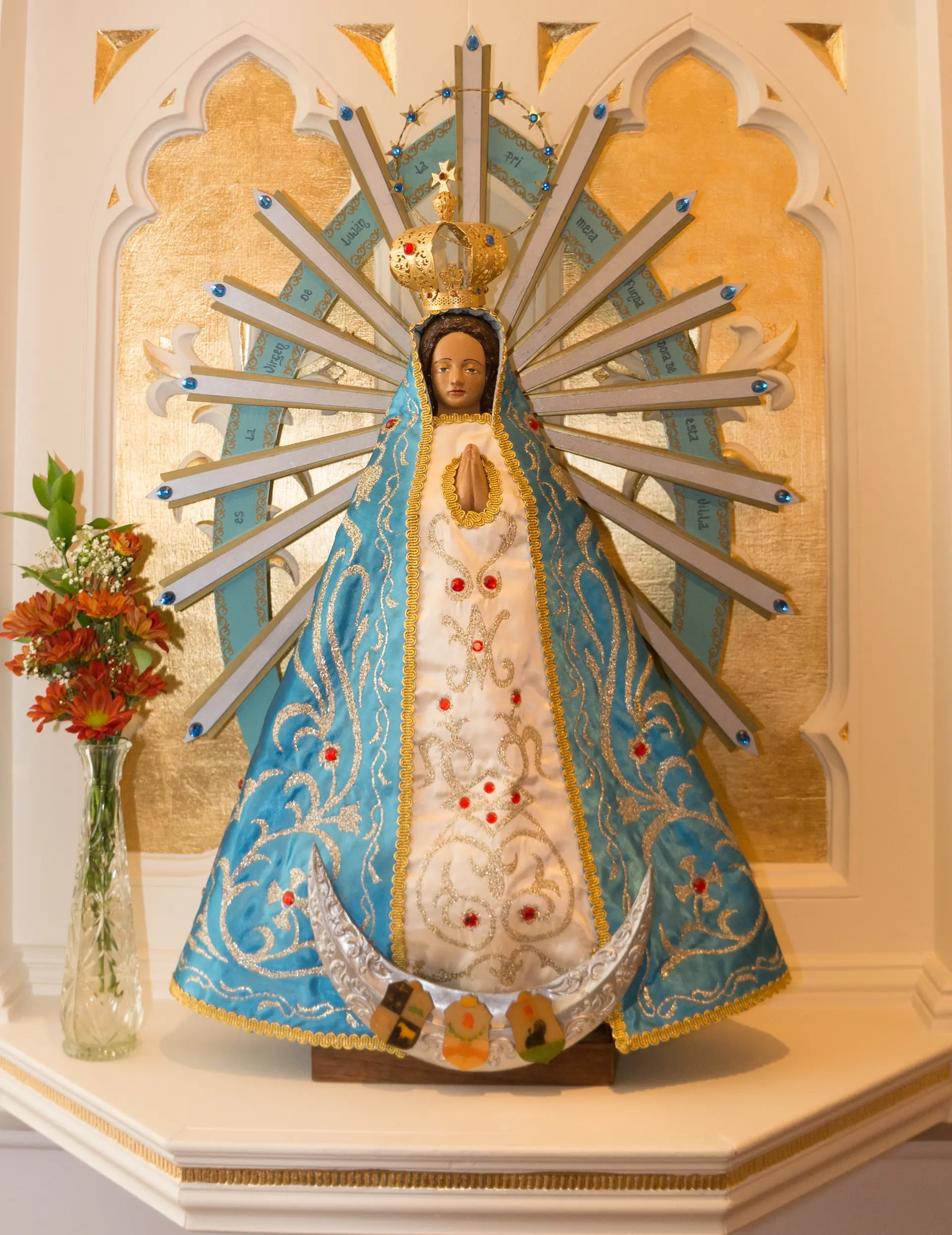
The statue is 38 centimeters of terracotta beneath an ornate gold-and-gem crown. Visible but unreachable in a high chamber behind the main altar, it creates intimacy through distance. In the Romanesque crypt, seventy Marian images from around the world form a silent congregation, as if called by the Virgin of Lujan. This is not only a monument to a past event but a place renewed every day and hour in pilgrims' prayers.
Sites inside
Why this place is sacred
Some places become sacred through age. Others through beauty, or isolation, or the memory of events now lost to certainty. Lujan became sacred through a refusal, an act of divine stubbornness in the reading of those who witnessed it, when oxen stopped at this unremarkable spot on the pampa and would not continue until a small clay statue was allowed to stay.
The thinness of this place cannot be separated from the millions who have come here seeking something. Catholic theology speaks of the Virgin as intercessor, a mother who hears. The testimonies accumulated over centuries, the answered prayers, the transformation that pilgrims report, these are not incidental to the site's power but constitute it. Each pilgrim who arrives adds their intention to the accumulated weight of devotion.
The Youth Pilgrimage each October brings nearly a million young people walking through the night, their footsteps a kind of prayer, their exhaustion a form of surrender. When they arrive at dawn and the basilica's towers come into view, something shifts. Those who have made the walk describe it not as arrival but as recognition, as though the destination had been waiting for them specifically.
The crypt beneath the main sanctuary holds over seventy images of Mary from countries around the world, each a different cultural face of the same devotion. Standing among them, the universal scope of Marian veneration becomes tangible. This is not merely an Argentine shrine but a node in a global network of those who turn to the Virgin in need.
Whether the thinness comes from the original miracle, from the prayers that have soaked these stones since 1630, from the physical sacrifice of the pilgrimage, or from some combination impossible to separate, the reports from visitors are consistent enough to take seriously. Something happens here that exceeds ordinary tourism.
The devotion at Lujan originated spontaneously from the 1630 event, when witnesses to the immovable oxen understood the Virgin's desire to remain at this location. The first structures were humble, a rustic chapel built by Don Rosendo Oramas in whose home the statue was initially placed. The purpose was simple: to honor what seemed to be a divine choice and to provide a place for veneration.
Over time, as word spread and pilgrims came in increasing numbers, the site evolved from private shrine to public sanctuary, its purpose expanding to meet the scale of devotion it inspired.
The small chapel gave way to a proper church in 1685, then a larger one in 1763 as pilgrim numbers grew. But it was Father Jorge Maria Salvaire's vision that created the current basilica. This French Vincentian priest, after a miraculous deliverance from captivity among indigenous peoples in 1875, promised the Virgin three things: to write her history, to spread devotion, and to build a worthy basilica.
He died in 1899 before seeing his vision completed, but the Neo-Gothic structure that rose between 1890 and 1935 fulfilled his vow.
The site's significance expanded beyond the personal and local. General Jose de San Martin laid his sword at the sanctuary after his independence campaigns. Captured enemy flags were placed here as offerings. The declaration in 1930 of Our Lady of Lujan as patroness of three nations, followed by papal recognition as a Minor Basilica, confirmed what popular devotion had long established.
Pope John Paul II's 1982 visit, during the Falklands War, and the personal devotion of Pope Francis, the first Argentine pontiff, have further woven this site into both national and global Catholic identity.
Healing traditions
Devotional healing ministry
Luján remembers Manuel, an African man brought to the Americas through slavery, as the early caretaker of the Virgin's image. Accounts describe him welcoming pilgrims and tending people who were ill with prayer and devotional oil or candle tallow. Healing stories became part of the community's remembrance of his service. Keeping Manuel in the account restores the human care behind the shrine's reputation, without treating those substances as medicine.
Ways to participate
Pray before the Virgin of Luján and remember the people who care for the sick, including those whose work is often overlooked. A public Mass, a personal intention, or a practical act of service can accompany the visit. Ask the basilica about blessings; do not apply hot wax or take oil from sanctuary lamps.
These accounts describe religious traditions and reported experiences. They do not promise a cure or replace medical care.
Experience and orientation
The first experience is often the towers. Rising 106 meters above the flat pampas, they announce the basilica long before arrival. For those who have walked through the night from Buenos Aires, their appearance at dawn marks a threshold, the end of one kind of effort and the beginning of another.
Inside, the scale shifts. The basilica's Neo-Gothic interior draws the eye upward, the rose-colored stone and French stained glass creating an atmosphere of luminous solemnity. But the true encounter awaits behind the main altar, where the small statue sits in its high chamber. Visitors frequently describe a moment of dissonance, the contrast between the massive building and the intimate figure it was built to house.
The Virgin of Lujan is only 38 centimeters tall, clothed in white and sky blue, crowned with gold and gems. Her size seems almost impossible given the devotion she has inspired.
Many report weeping without understanding why. The phenomenon is common enough that locals expect it, offering tissues with knowing nods. Something about the accumulation of centuries of prayer, the presence of fellow pilgrims in their own private moments, and the statue's modest scale beneath its ornate crown produces emotional responses that surprise those who experience them.
The crypt offers a different quality of encounter. Descending into the Romanesque space below the main sanctuary, visitors find themselves among Marian images from across the world. The Temple of the Americas, as it is called, holds depictions of the Virgin as understood by dozens of cultures. For some, this global congregation intensifies the personal; for others, it expands the devotional imagination beyond the local and familiar.
Those who participate in the major pilgrimages describe communal experiences that individual visits cannot replicate. Walking through the night with thousands of others, sharing water and encouragement, arriving exhausted but somehow lighter, these reports speak to transformation through shared effort. The Youth Pilgrimage in October has become a defining spiritual experience for many young Argentine Catholics, a rite of passage that marks their adult relationship with faith.
Come prepared for encounter rather than observation. The basilica welcomes tourists, but its rhythms are set by worship, not visiting hours. Arriving during Mass or the daily rosary at 6:00 PM offers context that empty-church visits cannot provide.
If the pilgrimage walk is not possible, consider at least approaching the basilica on foot from the town center. The final kilometers of the traditional route pass through streets lined with religious vendors and fellow seekers. This miniature pilgrimage shifts the body and mind into a different mode than arriving by car or bus.
In the basilica itself, resist the impulse to document before experiencing. Sit in the pews. Let your eyes adjust to the light filtering through the stained glass. When you approach the Virgin's chamber, do so as though visiting someone rather than viewing something. The statue has been receiving visitors for nearly four centuries. She is, in the understanding of those who pray here, accustomed to being seen.
The crypt deserves unhurried attention. Move slowly among the global Marian images, noting how different cultures have understood the same devotion. Consider which faces speak to you and why. This is not a museum; it is a gathering.
Context and lineage
In 1630, Antonio Farias de Saa, a Portuguese settler in Santiago del Estero, sent for a statue of the Virgin Mary from Brazil to establish a chapel in his region. A sailor friend sent two terracotta images: one of the Immaculate Conception and one of Mary holding the infant Jesus. The caravan transporting them stopped overnight near the Lujan River, at a place then without significance.
The next morning, the oxen refused to move. The drivers changed animals, unloaded cargo, tried everything they knew. The cart remained immovable. Finally, someone thought to remove the box containing the Immaculate Conception statue. Immediately, the oxen moved freely.
The witnesses understood this as the Virgin's choice. She wished to remain here, on this unremarkable stretch of pampa. The statue was placed in the home of Don Rosendo Oramas, who built a rustic chapel for veneration. The other statue, which had caused no trouble, continued to Santiago del Estero and eventually disappeared from history.
A second miracle is recorded from 1671. When the statue was moved to a location that would become the town of Lujan, it twice returned mysteriously to its original shrine overnight, reinforcing belief in the Virgin's attachment to this specific ground. Whether understood as divine intervention or as the determination of devotees who carried it back, the story speaks to a persistence that characterizes the entire devotion.
The Virgin's guardians form a lineage of devotion. Negro Manuel served for over forty years, succeeded by others whose names are less remembered. The Vincentian fathers have cared for the sanctuary since Father Salvaire's time. Each generation has added to what was received, from the humble chapel to the national basilica, from local devotion to patroness of three nations.
The papal connections reinforce this continuity. Pope Leo XIII blessed the crown placed on the statue in 1887. Pope Pius XI declared her patroness of Argentina, Paraguay, and Uruguay and elevated the church to Minor Basilica status in 1930. Pope John Paul II visited in 1982, bestowing the Golden Rose, one of the highest honors the papacy can grant to a shrine.
Pope Francis, the first Argentine pope, maintains documented personal devotion to Our Lady of Lujan, a relationship formed long before his election to the Chair of Peter.
Manuel Costa de los Rios (Negro Manuel)
guardian
Born in Cape Verde around 1604 and brought to Argentina as an enslaved person, Manuel witnessed the 1630 miracle and devoted the remaining forty years of his life to caring for the statue. Formally declared 'slave of the Virgin alone,' he established the model of humble service that characterizes Lujan spirituality. His cause for canonization is currently in progress in Rome.
Father Jorge Maria Salvaire
founder
French Vincentian priest (1847-1899) who promised the Virgin of Lujan three things after a miraculous deliverance from captivity in 1875: to write her history, to spread devotion, and to build a basilica. He fulfilled all three, though he died before seeing the building completed. His cause for canonization is in the diocesan phase.
Ana de Matos
benefactor
In 1671, Ana de Matos acquired the statue and the land, also purchasing Negro Manuel so he could continue his service. Her construction of a proper chapel transformed the devotion from private shrine to public sanctuary, establishing the foundation for the town of Lujan itself.
Ulderic Courtois
architect
French architect who designed the Neo-Gothic basilica with its distinctive twin 106-meter towers. His French Gothic-inspired vision, supported by Father Salvaire despite opposition, created one of Argentina's most impressive religious structures.
Traditions and practice
The central practice is the Mass, celebrated multiple times daily in a rhythm that has continued for centuries. The rosary, prayed communally at 6:00 PM each day, maintains the Marian focus that gives the site its identity. Veneration before the Virgin's image, whether in silent prayer or spoken petition, is the most personal of traditional practices.
The pilgrimage walk from Buenos Aires represents the fullest traditional engagement. Originating in 1975 when young people from a Buenos Aires parish decided to walk the sixty-eight kilometers to Lujan, the Youth Pilgrimage on the first Sunday of October now draws nearly a million participants. Walking through the night, arriving at dawn, encountering the basilica after physical sacrifice, this practice condenses the meaning of pilgrimage itself: transformation through effort, arrival as renewal.
The Gaucho Pilgrimage on the last Sunday of September honors the Virgin as patroness of rural Argentina. Riders on horseback process to the basilica, their traditional dress and bearing a living connection to the country's pastoral heritage. Nautical pilgrimages on the feast days of May 8 and December 8 bring boats along the Lujan River, statues of the Virgin carried in ceremonial procession.
Contemporary practice at Lujan spans the full range of Catholic devotion. Confession and spiritual direction are available. Guided tours offer historical and spiritual context. The crypt's collection of global Marian images invites contemplation of Catholicism's worldwide scope.
For many, the practice is simply coming. Sitting in the pews, watching others pray, allowing the accumulated devotion of centuries to work on consciousness. No formal ritual is required for this kind of engagement. The basilica's doors are open; the invitation is implicit.
Modern pilgrims increasingly document their journeys on social media, creating new forms of testimony that echo the miracle accounts of earlier centuries. Whether this represents dilution or extension of tradition depends on perspective. The young people walking through the night with phones in their pockets are still walking through the night.
For those seeking meaningful engagement beyond tourism, consider arriving for Mass or the evening rosary rather than between services. Participating in communal worship, even as an observer, provides context that empty-church visits cannot.
If the full pilgrimage walk is beyond your capacity, the basilica offers a smaller circuit: walk the perimeter of the building, pausing at each entrance. Enter through the main doors, proceed to the Virgin's chamber, then descend to the crypt. This movement from exterior to interior, from grandeur to intimacy, creates its own kind of journey.
Before leaving, sit in silence. Formulate whatever you came seeking as clearly as you can, whether petition or gratitude or something harder to name. Address it to the small figure in her high chamber, or to whatever you understand the divine to be, or simply to the accumulated hope of those who have come before. The form matters less than the sincerity.
Roman Catholic
ActiveThe Basilica is the most important Marian shrine in Argentina and one of the largest in South America. Our Lady of Lujan was declared Patroness of Argentina, Paraguay, and Uruguay by Pope Pius XI in 1930. The site represents nearly 400 years of continuous Catholic devotion, dating from the 1630 miracle. For Catholics, this is a place where the Virgin Mary herself chose to receive veneration, and where her intercession has been sought and, believers hold, granted across generations.
Daily Mass is celebrated multiple times (weekdays at 8:00, 11:00, 15:00, 17:00, 19:00; Sundays at 8:00, 9:30, 11:00, 13:00, 15:00, 17:00, 19:00). The rosary is prayed communally at 18:00 daily. Major pilgrimages include the Youth Pilgrimage on the first Sunday of October, the Gaucho Pilgrimage on the last Sunday of September, and nautical processions on the feast days of May 8 and December 8. Veneration before the Virgin's statue, confession, spiritual direction, and the lighting of votive candles form the ongoing devotional life of the sanctuary.
Perspectives and open questions
The Basilica of Lujan invites interpretation through multiple lenses: Catholic devotion, historical analysis, national identity, and the phenomenology of pilgrimage. These perspectives illuminate different facets of the same reality, each offering genuine insight while leaving questions that resist resolution.
Scholarly perspective
Historians recognize the Basilica of Lujan as Argentina's most significant Catholic pilgrimage site, with the devotion originating from an authentic historical moment in 1630 when the statue was established at this location. Whatever one makes of the miraculous interpretation, the fact of the shrine's founding and its subsequent growth is documented.
The Neo-Gothic basilica, completed in 1935, represents one of Argentina's finest examples of the style and a major 19th-century ecclesiastical construction project. Architectural historians note the French influence in the design and the remarkable achievement of construction in a period before modern equipment.
The site's entanglement with Argentine national identity is a subject of ongoing scholarly interest. The claimed connection between the Virgin's blue and white vestments and the national flag, while perhaps apocryphal, speaks to how deeply Lujan has been woven into Argentine self-understanding. The deposit of military trophies and the pilgrimages of national leaders reinforce this connection between spiritual devotion and civic identity.
Living and traditional perspectives
Catholic tradition holds that the Virgin Mary directly intervened through the miracle of the immovable oxcart, choosing this location for her veneration. The statue is understood as a channel of divine grace, with numerous miracles and answered prayers attributed to Our Lady of Lujan across nearly four centuries.
The papal declarations naming her Patroness of Argentina, Paraguay, and Uruguay, the elevation to Minor Basilica status, and the bestowal of the Golden Rose by Pope John Paul II confirm the Virgin of Lujan's special status within Catholic devotion. For believers, these honors recognize what popular faith had long established: this is a place of authentic encounter with the sacred.
The causes for canonization of both Negro Manuel and Father Salvaire suggest that the sanctity of Lujan extends beyond the miraculous statue to those who served it. The site is understood not merely as a monument to a past event but as an ongoing locus of grace, active in the lives of the millions who come seeking help.
Alternative interpretations
Some spiritual seekers view Lujan as an energy concentration point, noting the convergence of the river, the flat pampa geography that makes the basilica visible for miles, and centuries of concentrated devotional energy. The crypt's collection of Marian images from around the world is sometimes described as creating a unique convergence of global spiritual energies.
These interpretations lack institutional support from the Catholic Church but often emerge from genuine experiences visitors have at the site. The language of energy and convergence may represent attempts to describe something real that resists conventional vocabulary, or it may reflect the projection of expectations onto a powerful cultural site. The effect, whatever its source, is consistent enough across visitors to warrant acknowledgment.
Open questions
Genuine mysteries remain. The exact mechanism of the 1630 event, whether the oxen's behavior had a natural explanation or was genuinely supernatural, remains a matter of faith rather than historical determination. The witnesses interpreted it as miracle; the fact of their interpretation is certain even if its object is not.
Why the Virgin 'chose' this particular location, far from any pre-existing settlement or indigenous sacred site, has no clear answer. Whether the devotion would have formed anywhere the statue stopped, or whether something about this specific ground mattered, cannot be known.
The full story of Negro Manuel, the enslaved African who devoted his life to the statue's care, likely contains depths that surviving documentation cannot reveal. His cause for canonization proceeds on the evidence available, but the interior experience of his forty years of guardianship remains his own.
Plan your visit
Access and arrival
By car, take Route 7 from Buenos Aires, approximately one hour. By train, services run from Once station in Buenos Aires to Lujan. Regular bus services also connect the cities. The basilica itself is wheelchair accessible. Parking is available nearby but fills quickly on pilgrimage days.
The town of Lujan offers modest accommodations ranging from basic hostels to comfortable hotels. Most pilgrims arrive and return the same day. For those seeking to extend their experience, staying overnight allows for multiple visits to the basilica at different times, including early morning and evening when the sanctuary is quietest. Buenos Aires, an hour away, provides the full range of accommodation options.
Respectful visit
Modest dress is expected. Shoulders and knees should be covered. Avoid beachwear, revealing clothing, or items with offensive imagery. The standard is not formality but respect. Those arriving after the pilgrimage walk in practical clothing are not judged; the effort speaks for itself.
Photography is generally permitted inside the basilica except during services. Flash photography may disturb worshippers and should be avoided. Professional equipment and tripods require advance permission. The goal is to capture without disrupting, to document without dominating.
Consider whether photography serves your experience or substitutes for it. The basilica will be here after your visit; the question is whether you will have been here while you were here.
Votive candles can be lit as offerings and are available for purchase in the basilica. Religious articles from official shops can be blessed by the clergy. Monetary donations support the sanctuary's maintenance. Physical offerings beyond candles are not appropriate inside the basilica itself.
Mobile phones should be silenced upon entry. Consuming food or beverages inside the basilica is prohibited. Maintaining silence or quiet conversation is expected throughout. During services, remain in the pews or at the back if observing rather than participating.
Major pilgrimages involve crowd management that may restrict movement through certain areas. Follow instructions from sanctuary staff, particularly during the Youth Pilgrimage and feast days when attendance numbers in the hundreds of thousands.
The basilica is an active place of worship, not a museum. Timing your visit during services means encountering the site as intended but requires appropriate reverence. Do not photograph during Mass. Do not interrupt those in prayer.
Be aware that major pilgrimages transform the site dramatically. The Youth Pilgrimage in October and feast days in May and December bring crowds that make contemplative engagement difficult. For seekers wanting solitude, weekday mornings offer the quietest access.
Current practical details
Address
San Martín 51, B6700CCU Luján, Provincia de Buenos Aires, Argentina
Phone
Hours
Hours, fees, and access can change — verify on the official source before you travel. Practical details last checked Jun 2026.
Location
Map loads as you approach this section.
Pilgrim reflections
A portrait of encounter, not a score
Pilgrims describe what they felt, how present they could become, and whether the place would shape a journey. There are no stars and no ranking of traditions.
No reviewed reflections yet
The first pilgrims can help describe the character of being here.
Share a reflection
Available after an account-backed “Been there.” Every reflection is reviewed before publication.
Nearby sacred places
Explore other sacred places in the region. Proximity does not establish access or travel time; check each place’s guidance.
Our Lady of Luján
Luján, Buenos Aires Province, Argentina
0.0 km away

San Cayetano Sanctuary, Liniers
Buenos Aires, Buenos Aires, Argentina
54.9 km away

San Ramon Nonato Sanctuary, Buenos Aires
Buenos Aires, Argentina
57.2 km away

Basilica of Virgin of Itatí, Corientes, Argentina
Municipio de Itatí, Corrientes, Argentina
815.5 km away
References
Sources consulted for this page. Source categories describe the publication, not a guarantee that every claim is verified. Traditional accounts and outside interpretations may differ.
- 01Basílica Nacional de Nuestra Señora de Luján - Argentina.gob.ar — Government of ArgentinaofficialOfficial government heritage listing
- 02A 110 años de la inauguración de la Basílica de Luján — Ministerio de Cultura ArgentinaofficialOfficial cultural ministry article on 110th anniversary
- 03Santuario y Basílica Nuestra Señora de Luján - Official Website — Santuario de LujánofficialOfficial sanctuary website with mass schedules and visitor information
- 04Fr. Jorge Maria Salvaire – Virgen de Luján — Instituto de Estudios LujanensesofficialScholarly institute dedicated to Luján studies
- 05Shrine of Our Lady of Luján (Argentina) - Vincentiana — Congregation of the MissionacademicAcademic publication from DePaul University library
- 06Basilica of Our Lady of Luján - Wikipedia — Wikipedia contributorsencyclopediaComprehensive overview with verifiable facts
- 07Our Lady of Luján - Wikipedia — Wikipedia contributorsencyclopediaDetailed history of the devotion and miraculous origins
- 08Basilica of Our Lady of Luján, Argentina - Catholic Shrine Basilica — Catholic Shrine BasilicaofficialCatholic resource with detailed devotional information
- 09Basílica Nuestra Señora de Luján - Lonely Planet — Lonely PlanetguideReputable travel guide
- 10Our Lady of Lujan - IVE America — Institute of the Incarnate WordofficialCatholic religious order perspective
- 11Our Lady of Lujan – Servants of the Lord the Virgin of Matará — SSVMofficialReligious order with detailed devotional information
- 12Basilica of Our Lady of Luján - Pilgrimaps — PilgrimapsguidePilgrimage-focused resource with practical information
- 13Sanctuary of Luján: A Shrine on the Pampas - Pilgrimaps — PilgrimapsguideHistorical context and pilgrimage traditions
- 14An African slave and the origins of Lujan's pilgrimage - Pilgrimaps — PilgrimapsguideDetailed history of Negro Manuel
- 15Mary, Our Lady of Luján Basilica, Luján, Argentina — Sacred SitesspiritualSpiritual perspective on the site
- 16Luján, Argentina's Sacred City on the Pampas — Wander ArgentinaguideTravel guide with practical visiting information
- 17Argentina, Lujan: Basilica of Our Lady of Lujan - The Catholic Travel Guide — The Catholic Travel GuideguideCatholic pilgrimage travel resource
- 18History of Manuel, caretaker of Our Lady of Luján — Argentina governmentofficialSupports the attributed account or visitor practice in the healing section; not evidence of clinical efficacy.
- 19Manuel's story — Luján Porteño parishofficialSupports the attributed account or visitor practice in the healing section; not evidence of clinical efficacy.
Photo gallery
3 curated photos
Share a photo
Help visitors recognize Basilica of the Virgin of Luján, Luján. Every submission is reviewed before publication.