Our Lady of Lebanon, Harissa, Lebanon
Lebanon's great Marian shrine, a white statue with arms open over Jounieh Bay
Understand sacred places, explore living traditions, and learn how to engage respectfully with Pilgrim Map.
Access has not been verified. Check current local guidance before planning a visit.
Daraoun, Mount Lebanon, Lebanon
Read the sources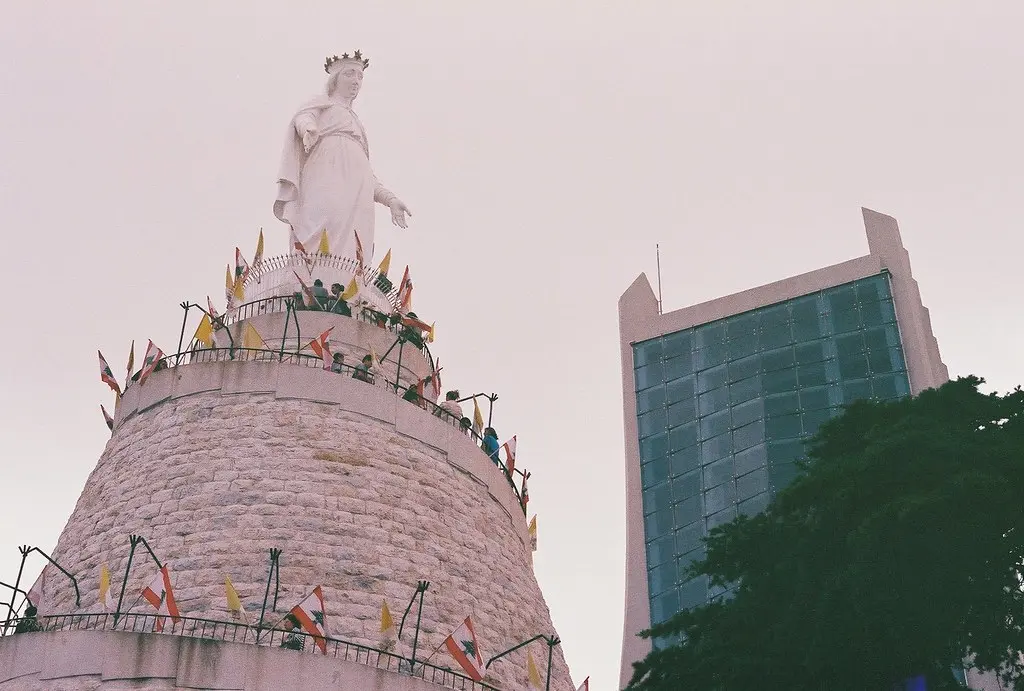
Image of Our Lady of Lebanon, Harissa, Lebanon. Image source
Visit essentials
A quick read before you go
- Duration
- 1-2 hours, including the cable car, statue ascent, and basilica.
- Access
- In Harissa, about 20 km north of Beirut above Jounieh, at around 650 metres elevation.
Overview
From below, a white figure at Harissa opens her arms toward Beirut and the Mediterranean. Up close, the roughly 8.5-metre statue crowns a tall pedestal encircled by a spiral stair, making ascent an act of prayer. Our Lady of Lebanon, the country's foremost Marian shrine, was conceived in 1904 for the 50th anniversary of the dogma of the Immaculate Conception and inaugurated in 1908. Its bronze was cast in Lyon and painted white, becoming a national landmark.
Maronites and other Catholics come to their patroness, joined by many Muslims, who honor Maryam in the Qur'an, and Druze. This shared hilltop veneration is rare in a divided country. Most visitors arrive by cable car from Jounieh, watching the bay open below, then enter a peaceful atmosphere held across faiths beside a modern basilica shaped like a Phoenician ship and tied to Lebanon's long story.
Why this place is sacred
As Lebanon's national Marian shrine, Harissa is the country's principal place of devotion to the Virgin Mary, proclaimed patroness of Lebanon, and the sense of a place set apart comes as much from openness as from height. The towering white statue with arms extended toward Beirut and the sea has become a sacred landmark and, unusually, a unifying symbol across the country's religious communities.
The factors that make it feel charged include the commanding hilltop at around 650 metres above Jounieh Bay, the dramatic white figure with arms open over the land, the shared devotion of Christian, Muslim and Druze visitors, the embodied ascent of the spiral stairway around the statue, and the modern basilica shaped like a Phoenician ship and cedar, fusing Lebanese identity with faith.
Built as Lebanon's national Marian shrine to honor the Virgin Mary as patroness of the country and to mark the 50th anniversary of the dogma of the Immaculate Conception.
The cable car from Jounieh opened in 1965, and a modern basilica designed by Pierre El-Khoury was begun in 1970, expanding the shrine into a major pilgrimage complex that now draws thousands of visitors daily and far larger crowds in May and on the Assumption.
Experience and orientation
For many, the visit begins with the cable-car ascent from Jounieh, the bay and coastline widening below as the car climbs to the hilltop. At the top the great white statue dominates, and visitors consistently describe the strength of its presence and the peaceful, prayerful atmosphere shared by people of many faiths.
The spiral staircase that winds to the base of the statue draws pilgrims into an embodied act of devotion, while the ship-shaped basilica nearby gathers the more formal worship. The combination of height, the openness to the sea, and the maternal figure of Mary tends to evoke consolation and hope, and many pilgrims speak of a strong sense of peace and of Lebanon's resilience. It is a place where private prayer and a wide public view sit together easily.
The shrine stands at Harissa, about 20 km north of Beirut above Jounieh, at around 650 metres elevation. The statue and its spiral stairway sit at the heart of the site, with the modern basilica alongside; the cable car from Jounieh is the most scenic approach.
Context and lineage
The shrine was conceived in 1904 by the Maronite Patriarch Elias Hoyek, together with the Nuncio Carlos Duval, to honor the 50th anniversary (1854-1904) of the proclamation of the dogma of the Immaculate Conception. The monumental statue of the Virgin was cast in Lyon, France, painted white, raised on the hill and inaugurated in 1908 at a Mass led by Patriarch Hoyek.
He designated the first Sunday of May as the feast of Our Lady of Lebanon, and the shrine grew into the nation's central Marian pilgrimage site, administered by the Maronite Patriarchate through the Congregation of Maronite Lebanese Missionaries. Sources differ on minor details, including the statue's weight and the identity of its anonymous French donor.
Maronite and Roman Catholic Marian devotion, administered by the Maronite Patriarchate, with a strong popular dimension that also draws Muslim and Druze devotion to Mary.
Patriarch Elias Hoyek
Maronite patriarch who initiated the shrine in 1904, led the 1908 inauguration Mass, and designated the first Sunday of May as the feast of Our Lady of Lebanon.
Nuncio Carlos Duval
Apostolic Nuncio who, with Patriarch Hoyek, helped found the shrine in 1904.
Pierre El-Khoury
Architect of the modern basilica, begun in 1970, designed in the form of a Phoenician ship.
Traditions and practice
Daily Mass and Eucharistic adoration, Marian prayers and the rosary, and the feast of Our Lady of Lebanon on the first Sunday of May, with Assumption celebrations on 15 August.
Year-round pilgrimage, averaging thousands of visitors daily and rising to as many as 20,000 in May and on the Assumption, with processions, candle offerings, and prayer at the statue and basilica.
Climb the spiral stairway around the statue slowly, letting the ascent become its own prayer, and pause at the top with the view open to the sea. The Marian month of May and the Assumption bring the fullest atmosphere, but a quieter day allows more space for reflection in the adoration chapel.
Maronite / Roman Catholicism (Marian devotion)
ActiveLebanon's foremost Marian shrine, crowned by an 8.5 m white-painted bronze statue of the Virgin cast in Lyon atop a tall pedestal at around 650 m above Jounieh Bay. Built to mark the 50th anniversary of the dogma of the Immaculate Conception and inaugurated in 1908, it is a national religious symbol and the focus of intense May devotion.
Daily Mass and Eucharistic adoration, Marian pilgrimage and ascent of the spiral stairway, the first-Sunday-of-May feast of Our Lady of Lebanon, and Assumption celebrations on 15 August.
Interfaith Marian devotion (Muslim and Druze)
ActiveThe shrine is revered well beyond Christianity: Muslims, who honor Mary (Maryam) as named in the Qur'an, and Druze also visit, making Harissa a symbol of Lebanese unity and coexistence.
Prayer and petition to Mary by visitors of multiple faiths, and pilgrimage and reflection at the statue.
Perspectives and open questions
Harissa is read as a monumental early 20th-century Marian shrine, a national patronal site, and a rare symbol of interfaith devotion to Mary.
Scholarly perspective
Historians and heritage scholars treat Harissa as an early 20th-century monumental Marian shrine expressing Maronite identity and French religious influence, which has since become a pan-Lebanese national and interfaith symbol.
Living and traditional perspectives
For Maronites and Lebanese Catholics, Our Lady of Lebanon is the patroness and protector of the nation; for many Muslims and Druze, Mary (Maryam) is a revered figure, making the shrine a point of shared veneration.
Alternative interpretations
No significant esoteric tradition is associated with the shrine; its power lies in mainstream Marian devotion and its symbolism of unity.
Open questions
Minor uncertainties persist over the statue's exact specifications, including its weight (given as 13 or 15 tons) and the precise relationship between its erection and 1908 inauguration, as well as the identity of its anonymous French donor.
Plan your visit
Access and arrival
In Harissa, about 20 km north of Beirut above Jounieh, at around 650 metres elevation. Reached by road or, most scenically, by the Téléférique cable car from Jounieh, which operates daily except typically Mondays.
Jounieh, below the shrine, offers a wide range of hotels and guesthouses, with further options along the coast toward Beirut.
Respectful visit
Modest dress covering shoulders and knees, appropriate for a place of worship.
Photography is welcome of the statue, grounds and views; avoid flash and disruption inside the basilica during services.
Candles, prayer intentions, and donations support the shrine.
Maintain quiet and reverence inside the basilica and adoration chapel, and do not disrupt Mass or worshippers.
The first Sunday of May and the Assumption are the most crowded times; those seeking stillness may prefer another day. Inside the basilica and adoration chapel, keep quiet and avoid disrupting worship.
Location
Map loads as you approach this section.
Pilgrim reflections
A portrait of encounter, not a score
Pilgrims describe what they felt, how present they could become, and whether the place would shape a journey. There are no stars and no ranking of traditions.
No reviewed reflections yet
The first pilgrims can help describe the character of being here.
Share a reflection
Available after an account-backed “Been there.” Every reflection is reviewed before publication.
Nearby sacred places
Explore other sacred places in the region. Proximity does not establish access or travel time; check each place’s guidance.


References
Sources consulted for this page. Source categories describe the publication, not a guarantee that every claim is verified. Traditional accounts and outside interpretations may differ.
- 01History & Information — Our Lady of Lebanon (ololb.org, official shrine)officialOfficial shrine site: founding 1904 under Patriarch Elias Hoyek and Nuncio Carlos Duval, Congregation of Maronite Lebanese Missionaries administration, statue dimensions.
- 02Our Lady of Lebanon, Harissa — Maronites.churchofficialMaronite Church source on the shrine's significance and devotion.
- 03Lady of Harissa — Museum With No Frontiers (Sharing History)academicHeritage database entry on the monument's history and architecture.
- 04Our Lady of Lebanon — Wikipedia contributorsencyclopediaOrigins (50th anniversary of the Immaculate Conception dogma), Patriarch Hoyek, statue cast in Lyon, 1908 inauguration, first Sunday of May feast, interfaith devotion.
- 05Our Lady in Lebanon — National Catholic RegisternewsReporting on visitor numbers (~3,400/day, up to 20,000 in May and on the Assumption), Muslim devotion, Pierre El-Khoury basilica design.
- 06Our Lady of Lebanon Harissa, Mount Lebanon — Come to Lebanon (tourism)officialTourism overview, statue and shrine details, location 650m above sea level.
- 07Our Lady of Lebanon, A Symbol of Unity for All Lebanese — CatholicShareguideInterfaith unity framing; Christian, Muslim and Druze veneration.
- 08Harissa Lebanon: Virgin Mary Statue, Views & Monastery — Lebanon Tours and TravelsguidePractical visitor info, Téléférique cable car from Jounieh (opened 1965).
Share a photo
Help visitors recognize Our Lady of Lebanon, Harissa, Lebanon. Every submission is reviewed before publication.