Monastery of Saints Sergius and Bacchus, Ehden, Lebanon
The Watchful Eye of Qadisha, a Maronite monastery raised over a Canaanite temple
Understand sacred places, explore living traditions, and learn how to engage respectfully with Pilgrim Map.
Access has not been verified. Check current local guidance before planning a visit.
Ehden, North, Lebanon
Read the sources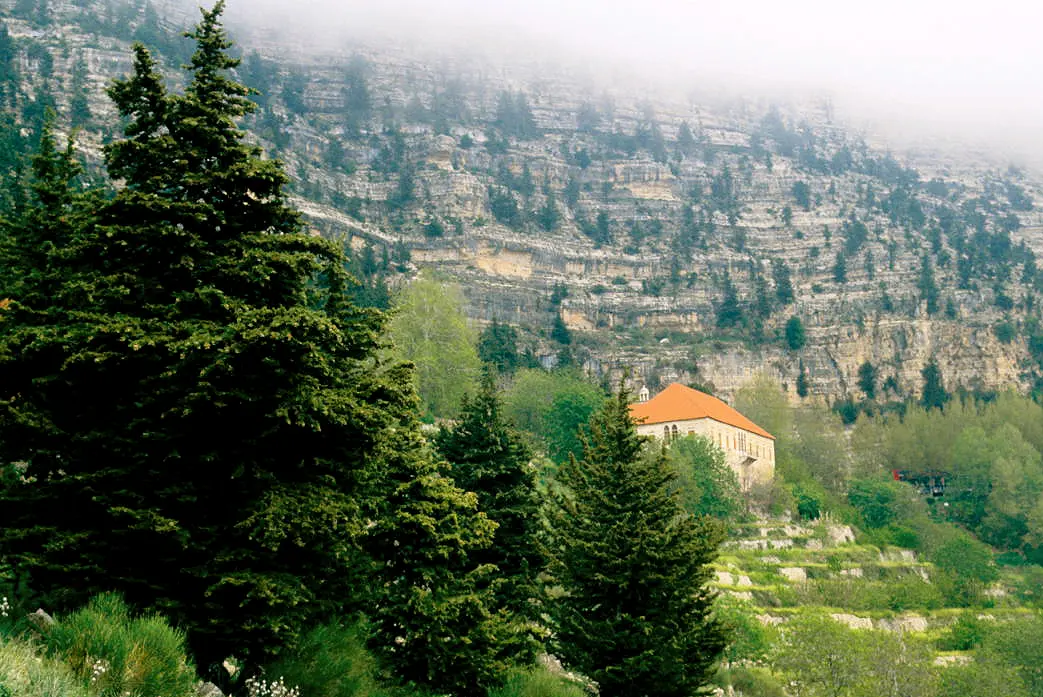
Image of Monastery of Saints Sergius and Bacchus, Ehden, Lebanon. Image source · CC-BY-SA-4.0
Visit essentials
A quick read before you go
- Duration
- 45-90 minutes, including the views and grounds.
- Access
- Above the town of Ehden in the Zgharta District, North Governorate, near the Qadisha Valley,…
Overview
The monastery stands where the river begins at Ras al-Nahr—the head of the water—on a ridge above Ehden at roughly 1,500 metres. The land falls into the Qadisha, the Holy Valley, while Mar Sarkis is known as the Watchful Eye of Qadisha.
The site's sacred associations predate Christianity. By tradition, the first church of Saints Sergius and Bacchus rose in the 8th century on the ruins of a Canaanite temple to a deity of agriculture and fertility, beside the spring that still feeds the valley; Ehden's name is itself linked to Adon, or Adonis. The monastery became Ehden's Episcopal See and entered the life of Maronite Patriarch Estephan El Douaihy, ordained here in 1656.
In 1739 it passed to the Lebanese Antonin Maronite Order. This Christian house of prayer therefore occupies an ancient sacred precinct above a valley that sheltered Maronites through centuries of persecution.
Why this place is sacred
What charges Mar Sarkis is its layering. The monastery was built over a far older sacred precinct, setting Christian holiness onto an ancient Canaanite cult site beside the Mar Sarkis spring. As a former episcopal seat and a place bound to Patriarch Douaihy, it is woven into the spiritual and national memory of the Maronite Church, overlooking the Holy Valley that sheltered Maronite monasticism through centuries of persecution.
The sense of a threshold gathers from several things at once: the commanding mountain setting at around 1,500 metres, the continuity of sacred use from a Canaanite temple to a Christian monastery, the spring of living water at the site, the cedar-clad landscape, and the long current of monastic prayer that has run through this place.
Built as a Christian church and later a monastery dedicated to Saints Sergius and Bacchus, on the ruins of an earlier Canaanite temple; it became the Episcopal See of Ehden.
A church of Our Lady was added in 1198; the monastery served as the Episcopal See of Ehden from roughly 1473 to 1739, when it passed to the Lebanese Antonin Maronite Order. An affiliated winter monastery at Zgharta was founded in 1854, and the communities merged in 1938.
Experience and orientation
The first thing visitors describe is the view. From the monastery's elevated perch the Qadisha Valley opens below, and the mountain air at around 1,500 metres is cool and clear even when the coast is hot. Cedars and greenery soften the setting, and the sense of Maronite heritage is strong, both in the architecture and in the knowledge of who has prayed here.
The site is most alive in summer, when Ehden fills with people and Mar Sarkis becomes a favored stop. The combination of altitude, ancient layered sanctity, and the silence of the Holy Valley below tends to draw visitors into a quieter frame of mind, a feeling of standing watch over a landscape that has been held sacred for far longer than the monastery itself has stood.
The monastery sits above the town of Ehden in the Zgharta District of Lebanon's North Governorate, on a ridge overlooking the Qadisha Valley, beside the Mar Sarkis spring at Ras al-Nahr.
Context and lineage
Tradition holds that the first church of Saints Sergius and Bacchus rose in the mid-8th century on the ruins of a Canaanite temple dedicated to a deity of agriculture and fertility, at Ras al-Nahr, the head of the river, where the Mar Sarkis spring feeds the valley. A church of Our Lady was added in 1198.
The monastery served as the Episcopal See of Ehden from roughly 1473 to 1739, was associated with the great Maronite Patriarch Estephan El Douaihy, who was ordained a priest here in 1656, and on 1 September 1739 was given to the Lebanese Antonin Maronite Order, founded in 1700 by Patriarch Gabriel Al Blouzani. Sources vary on the exact span of the episcopal period and on the framing of Douaihy's restoration work within the broader building campaign.
Maronite Catholicism in the Syriac-Antiochene tradition, under the Lebanese Antonin Maronite Order, on a site with a pre-Christian Canaanite layer.
Saints Sergius and Bacchus (Sarkis and Bakhos)
Roman soldier-martyrs, died around 307 AD, to whom the monastery is dedicated and whose feast falls on 7 October.
Patriarch Estephan El Douaihy
Major Maronite patriarch and historian, ordained a priest at the monastery in 1656 and central to its memory.
Lebanese Antonin Maronite Order
Religious order, founded in 1700 by Patriarch Gabriel Al Blouzani, that took stewardship of the monastery in 1739.
Traditions and practice
Maronite (Syriac-Antiochene) liturgy and the veneration of Saints Sergius and Bacchus, whose feast falls on 7 October, alongside Marian devotion at the medieval church of Our Lady.
Religious services and visitation are concentrated in the summer season, when Ehden is inhabited; quiet prayer and reflection take place at the monastery and its spring.
Come in summer when the monastery is active and the mountain climate is mild. Allow time to take in the view over the Holy Valley and to sit quietly by the spring, which carries the older life of the site, before or after entering the church.
Maronite Catholicism
ActiveOne of the spiritual landmarks of Ehden and the Qadisha (Holy) Valley region, perched at around 1,500 metres and known as the Watchful Eye of Qadisha. It served as the Episcopal See of Ehden for centuries, is tied to Patriarch Estephan El Douaihy, and has been stewarded by the Lebanese Antonin Maronite Order since 1739.
Maronite (Syriac-Antiochene) liturgy, veneration of Saints Sergius and Bacchus, Marian devotion at the church of Our Lady, and summer pilgrimage and visitation.
Perspectives and open questions
Mar Sarkis is read as a key Maronite monastery, a cherished link to monastic heritage, and a site of striking sacred continuity from a Canaanite temple.
Scholarly perspective
Historians recognize Mar Sarkis as an important medieval and early-modern Maronite monastery and former episcopal seat in the Qadisha region, illustrating the layering of Christian sanctity over pre-Christian Levantine cult sites and the central role of mountain monasticism in Maronite identity.
Living and traditional perspectives
For Maronites, the monastery is a cherished link to their monastic heritage, the Antonin Order, and Patriarch Douaihy, and a vantage point over the Holy Valley that preserved their faith.
Alternative interpretations
The Adon/Adonis etymology of Ehden and the Canaanite agricultural temple beneath the church draw interest in the continuity of fertility and seasonal death-and-renewal cults in the Levant.
Open questions
The exact nature and deity of the underlying Canaanite temple, and the precise medieval building sequence, remain only partly documented; details of any relics of Sts. Sergius and Bacchus held at the site are also unclear.
Plan your visit
Access and arrival
Above the town of Ehden in the Zgharta District, North Governorate, near the Qadisha Valley, reached by mountain road from Zgharta or Ehden, roughly 2.5 to 3 hours from Beirut. Winter access can be limited by the climate. Current visiting hours and whether the monastery is permanently inhabited year-round are not precisely documented; confirm locally.
Ehden is a summer mountain resort town with guesthouses and hotels nearby; Zgharta below offers further options.
Respectful visit
Modest dress covering shoulders and knees, appropriate for a monastery.
Generally permitted outdoors and of the architecture; avoid disrupting any service, and ask before photographing monks or interiors.
Candles and donations support the monastery.
Respect areas reserved for the monastic community, and maintain silence and reverence during prayer or liturgy.
Winter access can be limited by the harsh mountain climate, and the community historically wintered at the affiliated Zgharta monastery, so confirm before traveling in the cold months.
Location
Map loads as you approach this section.
Pilgrim reflections
A portrait of encounter, not a score
Pilgrims describe what they felt, how present they could become, and whether the place would shape a journey. There are no stars and no ranking of traditions.
No reviewed reflections yet
The first pilgrims can help describe the character of being here.
Share a reflection
Available after an account-backed “Been there.” Every reflection is reviewed before publication.
Nearby sacred places
Explore other sacred places in the region. Proximity does not establish access or travel time; check each place’s guidance.


References
Sources consulted for this page. Source categories describe the publication, not a guarantee that every claim is verified. Traditional accounts and outside interpretations may differ.
- 01Saint Sarkis and Bacchus Monastery — Visit EhdenofficialLocal/municipal tourism: altitude ~1500m, Antonin Maronite Order, founding date of the order (1700, Patriarch Gabriel Al Blouzani), Zgharta winter monastery.
- 02October 7 Feast of Saints Sarkis and Bacchus — Eparchy of Saint Maron of BrooklynofficialMaronite Church source on the saints, their martyrdom (c. 307 AD), and the 7 October feast.
- 03Mar Sarkis, Ehden — Wikipedia contributorsencyclopediaHistory: 8th-century church on a Canaanite temple, 1198 Our Lady church, Episcopal See, Antonin Order 1739, Patriarch Douaihy, 'Watchful Eye of Qadisha'.
- 04The Monastery of Saints Sergius and Bacchus, Éhden — Syriac PressnewsSyriac-Maronite focused account of the monastery's history and significance.
- 05Sergius and Bacchus — Wikipedia contributorsencyclopediaRoman soldier-martyrs, their veneration across Eastern and Western churches.
- 06Kadisha Valley — Wikipedia contributorsencyclopediaQadisha (Holy) Valley UNESCO context, Maronite monastic heritage, Diman patriarchal summer residence.
- 07Religious Ehden — LebanonUntravelled.comguideOverview of Ehden's religious sites and the Adon/Adonis etymology of Ehden.
- 0810 Things to Do in Ehden — Lebanon TravelerguideVisitor context for Ehden as a summer mountain resort and pilgrimage area.
Photo gallery
3 curated photos
Share a photo
Help visitors recognize Monastery of Saints Sergius and Bacchus, Ehden, Lebanon. Every submission is reviewed before publication.