Olba
The oldest Corinthian temple in Asia Minor rises from a Taurus mountain village that grew up inside a god's precinct
Understand sacred places, explore living traditions, and learn how to engage respectfully with Pilgrim Map.
Access has not been verified. Check current local guidance before planning a visit.
Mersin, Turkey
Read the sources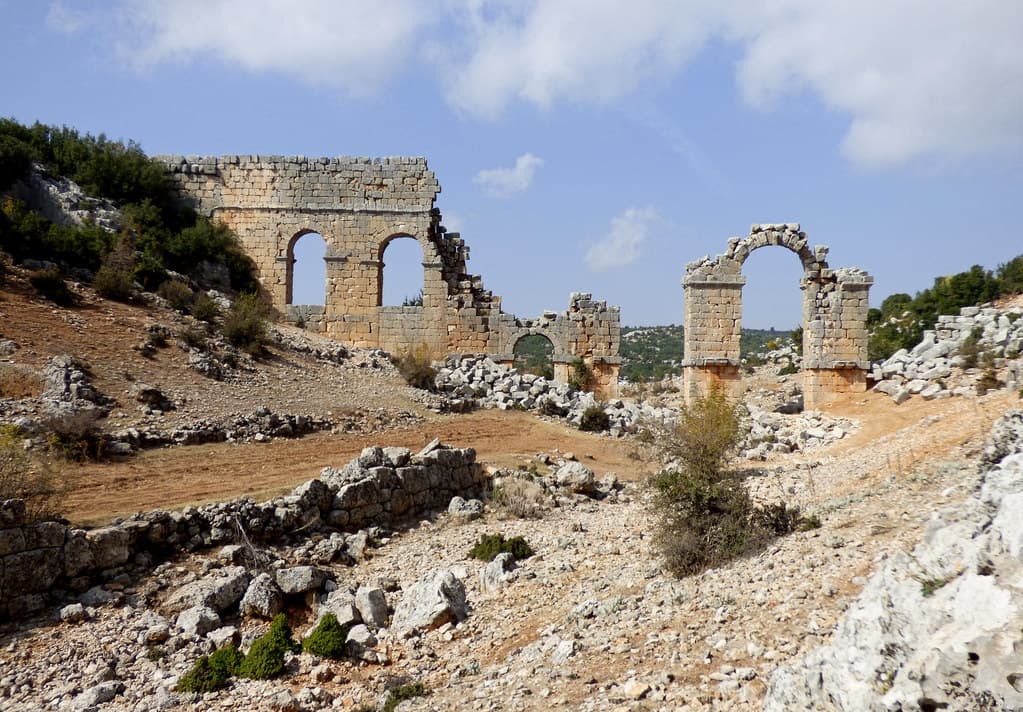
Image of Olba. Image source
Visit essentials
A quick read before you go
- Duration
- 2–4 hours for a full visit including temple, tower, gate, colonnaded street, and necropolis…
- Access
- Located 32 km north of Silifke (Mersin Province) via a mountain road.
Overview
Olba survives in an unusually intimate relationship with the modern mountain village of Uzuncaburç. At its center, five of the Temple of Zeus Olbios's original thirty-six Corinthian columns remain upright. Built in its present form around 300 BCE on the instructions of Seleucus I Nicator, it is Asia Minor's oldest peristyle Corinthian temple, though ancient tradition traced the sanctuary to mythological founders older than any Hellenistic king.
This was not merely a city with a temple but a theocracy. Local priest-kings styled tetrarchs fused religious and political authority over the sanctuary and surrounding Rough Cilicia. Zeus Olbios—the 'Blessed Zeus'—was understood as a specifically Cilician sovereign deity rather than the distant Olympian Zeus. Ancient comparisons with the Ionian oracle sanctuaries of Didyma and Claros suggest comparable regional prestige without establishing that Olba operated a formal oracle.
The site also holds a Hellenistic watchtower over twenty-two metres tall, a monumental gate, theatre, colonnaded streets, a Temple of Tyche, the goddess of fortune, and a necropolis gorge densely lined with sarcophagi and rock-cut graves. Byzantine churches and a monastery show continued sacred use after Christianization, including conversion of the Zeus temple into a church. At 950 metres amid cedar and carob, village and ruins sustain an unusually direct encounter with ancient Anatolian religious life.
Why this place is sacred
In much of the ancient world, the relationship between city and temple was one of adjacency: the temple stood within or near the city, receiving civic support and in turn providing divine legitimacy. At Olba, this relationship was inverted. The sanctuary came first; the city organized itself around it.
The priest-kings who governed the surrounding territory of Rough Cilicia — an area of steep mountains and isolated valleys that resisted easy administration — derived their authority from the temple, not from any external political dispensation. The epithet 'Olbios' — the Blessed — marked Zeus here as something more local and more immediate than the universal sky-father. This was a deity whose specific presence in this specific landscape was the source of regional order.
The Taurus Mountains at this altitude create a physical environment that reinforces that theological claim. The air is different at 950 metres — cleaner, cooler, with a quality of altitude that ancient religions consistently associated with proximity to the divine. The cedar forests that surrounded the sanctuary in antiquity are partially still present. The stone used for the temple's Corinthian columns has the colour of aged bone against the sky.
To stand within the surviving colonnade is to understand why a theocratic polity organized itself around this exact point.
The conversion of the Zeus temple to a Christian church in late antiquity is not a rupture in this story but a continuation. What changed was the name of the deity; what persisted was the understanding that this particular mountain location was where contact with the divine was most direct. Byzantine monks and priests maintained that claim through the same physical structure, their churches built partly from Zeus's own stones.
Theocratic sanctuary city organized around the cult of Zeus Olbios; regional religious, political, and legal center of Rough Cilicia administered by local priest-kings.
Sanctuary origins precede the Seleucid period; temple rebuilt c. 300 BCE. Priest-king theocracy continued into the Roman period. Zeus temple converted to church in late antiquity; site became an episcopal see. Byzantine occupation continued until medieval period. Modern village of Uzuncaburç now occupies the temple precinct; ongoing archaeological excavations since the 20th century.
Experience and orientation
The approach to Uzuncaburç from Silifke is itself part of the experience: thirty-two kilometres of winding mountain road through a landscape that has not changed its fundamental character since antiquity. The Taurus foothills are dry, rocky, planted with carob and cedar, and largely unpopulated.
By the time the village comes into view, you have already understood something about why a theocracy would locate itself here — far enough from the coast to be defensible, high enough to justify the epithet 'Olbios,' remote enough to require its own administration.
The village that grew over the temple precinct has not erased it but adapted to it with a matter-of-factness that is itself instructive. Columns stand in the middle of what are now yards and paths. The monumental city gate stands at the road's edge. Local residents have spent their lives within a few metres of Seleucid stonework. This is not a museum; it is a village that absorbed rather than displaced what came before.
The Temple of Zeus Olbios is approached through a gate and now has a small entrance fee. Five Corinthian columns survive upright; their capitals, though worn, still display the acanthus leaf work that made the Corinthian order synonymous with divine aspiration in the Hellenistic world. The scale of the temple — six by twelve columns, the standard Hellenistic peristyle proportion — is legible even in its reduced state.
Stand within the colonnade, look up at the surviving capitals, and consider what it would have been to approach this structure as a petitioner from the mountain valleys below.
Beyond the temple, the Hellenistic watchtower is the most vertically striking monument on the site: twenty-two metres of carefully fitted stone that has stood without mortar for over two thousand years. The monumental city gate preserves its full portal height. The necropolis gorge — a narrow valley cut into the limestone below the temple precinct — is lined on both sides with sarcophagi and rock-cut graves, their inscriptions worn but some still legible.
Late afternoon light in this gorge is low and angled, falling across the tomb facades in a way that makes the carved lettering briefly readable.
Enter through the village of Uzuncaburç. The Temple of Zeus Olbios has a ticket window; the fee is modest. The Hellenistic tower and monumental gate are visible from the temple area. The necropolis gorge requires a short walk downhill from the main precinct. Allow 2–4 hours for a thorough visit.
Context and lineage
The sanctuary's mythological founding was attributed to Ajax and Teucros, heroes of the Trojan War, who were said to have sailed to Cilicia after the fall of Troy and established the cult of Zeus Olbios. This founding myth placed the sanctuary within the broader cultural geography of the Greek heroic tradition while giving it a specifically Cilician character.
Historical records confirm that a sanctuary precursor existed before the Seleucid rebuilding: when Seleucus I Nicator rebuilt the temple around 300 BCE, he was renovating an already significant site rather than founding one. The Achaemenid period may have seen the first formalization of the priestly dynasty that would govern the territory into the Roman era.
Pre-Seleucid sacred precursor → Temple of Zeus Olbios rebuilt c. 300 BCE → Theocratic priest-king polity through Hellenistic and early Roman periods → Roman imperial religion and eventual conversion to Christianity → Byzantine episcopal seat and monastic presence → Medieval abandonment → Modern village of Uzuncaburç with ongoing archaeological excavations.
Traditions and practice
The Temple of Zeus Olbios was the center of a sacrificial cult administered by priest-kings who held both religious and political authority over the surrounding territory of Rough Cilicia. Sacrificial animals were offered at the temple; the practice likely included formal divination alongside sacrifice, though a formal oracle at Olba comparable to Claros or Delphi is not definitively confirmed in surviving sources.
The priest-kings — called tetrarchs — collected revenues from the surrounding villages, administered justice, and maintained the sanctuary, making Olba functionally a theocratic city-state. Pilgrims came from the mountain valleys and coastal cities of Cilicia to worship, petition, and participate in the sanctuary's festivals.
None. The temple and surrounding ruins are open to visitors; the site is partially managed by the Turkish Ministry of Culture. Ongoing archaeological excavations operate during the field season.
The most direct way to engage Olba's sacred character is through the physical act of approaching the surviving colonnade slowly. The Corinthian order was not merely decorative in the ancient world — it was understood as the most aspirational of the three orders, reserved for temples where the divine presence was most powerful. Five of the original thirty-six columns survive.
Walk around the perimeter of the temple foundation and try to reconstruct the full colonnade in your imagination: thirty-six columns, each approximately ten metres tall, arranged in a six-by-twelve peristyle. This was not a minor local shrine. It was a monument whose scale announced the theological claim of its builders with the same deliberateness that we use for cathedrals.
Then walk down to the necropolis gorge. The contrast between the temple's civic grandeur and the intimate scale of the rock-cut graves — many just large enough for a body, inscribed with names that no one has pronounced for fifteen hundred years — is Olba's most affecting teaching: the distance between a theocracy's grandest claims and the quiet persistence of individual human endings.
Ancient Greek / Hellenistic
HistoricalOlba was the regional religious and political center of Rough Cilicia, organized around the temple of Zeus Olbios. The priest-kings who governed the territory derived their authority directly from the sanctuary, creating a theocratic polity whose prestige was compared by ancient sources to the great oracle sanctuaries of the Ionian coast.
Sacrificial rites and likely oracle consultation at the Temple of Zeus Olbios; priestly administration of surrounding territory; pilgrimage from regional cities and villages.
Early Christian / Byzantine
HistoricalThe Temple of Zeus Olbius was converted to a church in late antiquity, continuing the site's sacred function under new theological management. Olba became an episcopal see; Byzantine churches and a monastery survive within the wider site.
Christian liturgy and monastic life; reuse of pagan temple architecture as sacred space.
Archaeological / Scholarly
ActiveOngoing excavations are documenting one of the best-preserved Hellenistic sanctuary complexes in Turkey. The Temple of Zeus Olbius, Temple of Tyche, Hellenistic tower, city gate, theatre, and necropolis together represent an exceptional concentration of ancient monument types in a small area.
Archaeological excavation, architectural documentation, and epigraphy during annual field seasons.
Perspectives and open questions
Olba is read primarily through archaeological and historical lenses as an exceptional example of ancient Anatolian theocratic organization; the physical survival of its monuments also supports a direct experiential approach.
Scholarly perspective
The Temple of Zeus Olbius is confirmed as the earliest peristyle Corinthian temple in Asia Minor, dated to c. 300 BCE on epigraphic and architectural grounds. The priestly dynasty of Olba — the Teucrid dynasty — held authority over Rough Cilicia from the Hellenistic period into the Roman era, a tenure unusually long for a local dynastic institution in an age of imperial expansion.
Scholars treat Olba as a significant case study in the persistence of theocratic governance under successive imperial powers. The possible connection between the sanctuary's pre-Seleucid foundations and earlier Achaemenid or even Luwian/Hittite sky-god traditions is an active area of research.
Living and traditional perspectives
Local Cilician tradition connected the sanctuary's founding to Trojan War heroes — Ajax and Teucros — a mythological charter that placed Olba within the heroic age and justified its exceptional sacred status. The 'Olbios' epithet, meaning 'Blessed,' distinguished this Zeus from the universal deity and made the god a specifically Cilician patron. The priest-kings who administered the sanctuary were understood not merely as officials but as the living intermediaries of the god's governance of the land.
Alternative interpretations
The high mountain location and the sky-deity association of Zeus Olbios connect Olba to widespread ancient traditions of sacred peaks as the preferred residence of sky gods — traditions that precede Greek religion in this landscape and may extend back to the Hittite period. The altitude of the sanctuary, its isolation, and the epithet 'the Blessed' suggest a theological geography in which closeness to the sky meant closeness to the divine source of all power.
Open questions
Whether a formal oracle operated at Olba — analogous to Claros or Didyma — is not definitively documented. Ancient comparisons to those oracle sanctuaries may reflect prestige rather than a structural parallel. The pre-Seleucid history of the sanctuary and its possible connection to Luwian and Hittite precedents remains almost entirely unresearched. The full extent of the Olba priestly dynasty's territorial and genealogical history across the Hellenistic period is incompletely known.
Plan your visit
Access and arrival
Located 32 km north of Silifke (Mersin Province) via a mountain road. By car, the road is driveable but winding. Some minibus services run from Silifke to Uzuncaburç, but schedules are infrequent. No formal entry gate to the village; the temple precinct within the village has a ticket window with a modest fee. GPS approximately 36.4733°N, 33.5117°E.
The village of Uzuncaburç itself has minimal accommodation — a guesthouse or two. Silifke, 32 km to the south, has a fuller range. The coastal town of Kızkalesi (Narlıkuyu area) offers beach resort options for those combining the mountain sanctuary with the coast.
Respectful visit
No formal requirements. Comfortable walking shoes with grip are recommended for the necropolis gorge path.
Photography is permitted throughout the site. Village residents are real people, not part of the heritage site — ask before photographing them.
Not applicable to the archaeological context.
Do not climb on the surviving temple columns or foundation stones. Do not enter active excavation areas. Respect the boundaries of private village property adjacent to the ruins.
The site is at 950 metres altitude in the Taurus Mountains; temperatures are more moderate than the coast in summer but can be cold in winter and spring. The necropolis gorge path requires care; do not climb on sarcophagi or tomb facades. Respect the boundaries between the archaeological site and the private property of village residents.
Location
Map loads as you approach this section.
Pilgrim reflections
A portrait of encounter, not a score
Pilgrims describe what they felt, how present they could become, and whether the place would shape a journey. There are no stars and no ranking of traditions.
No reviewed reflections yet
The first pilgrims can help describe the character of being here.
Share a reflection
Available after an account-backed “Been there.” Every reflection is reviewed before publication.
Nearby sacred places
Explore other sacred places in the region. Proximity does not establish access or travel time; check each place’s guidance.


References
Sources consulted for this page. Source categories describe the publication, not a guarantee that every claim is verified. Traditional accounts and outside interpretations may differ.
- 01Olba-Diocaesarea — Livius.org — Jona LenderingacademicScholarly ancient history reference site
- 02Olba — Turkish Archaeological News — Turkish Archaeological NewsacademicUp-to-date excavation and site news
- 03Olba (ancient city) - Wikipedia — Wikipedia contributorsencyclopediaGood overview of history from Achaemenid through Byzantine
- 04Olba-Diocaesarea — Following Hadrian Photography — Following HadrianguideDetailed photographic site documentation
- 05Olba / Diocaeserea Ancient City — ArticHaeology — ArticHaeologyacademicArchaeological summary with key monument descriptions
- 06Uzuncaburç (Diocaesarea-Olba), Turkey — Turkey Travel Planner — Turkey Travel PlannerguideComprehensive travel guide including access details
- 07Diocaesarea: Temple of Zeus Olbius — Bike Classical — Bike ClassicalblogFirst-hand visit with architectural observations
- 08Diocaesarea Ancient Site — Slow Travel Guide — Slow Travel GuideguideVisitor-oriented guide with access information
Share a photo
Help visitors recognize Olba. Every submission is reviewed before publication.