Adamkayalar
Faces carved into a Taurus gorge wall, watching from 2,000 years of stone
Understand sacred places, explore living traditions, and learn how to engage respectfully with Pilgrim Map.
Access has not been verified. Check current local guidance before planning a visit.
Mersin, Turkey
Read the sources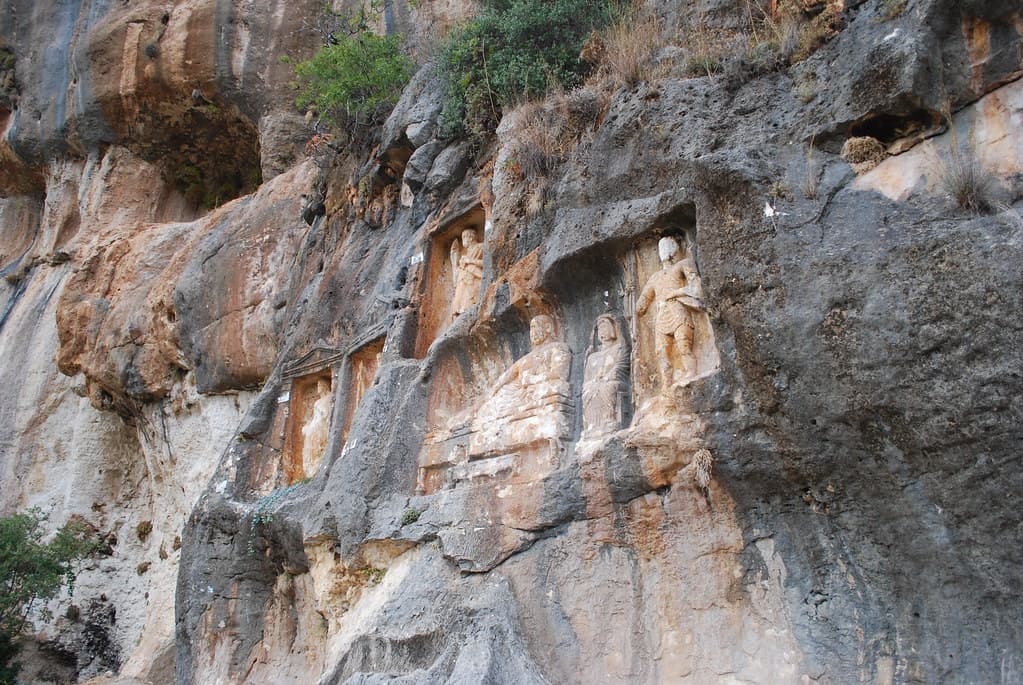
Image of Adamkayalar. Image source
Visit essentials
A quick read before you go
- Duration
- 2–3 hours including the 20-minute descent, viewing all nine niches, and the return ascent.
- Access
- Located approximately 7 km north of Kızkalesi, 32 km from Silifke, and 66 km from Mersin city.
Overview
Adamkayalar's reliefs were carved across roughly 250 years, from the 2nd century BC into the 2nd century AD, as successive generations commissioned niches and returned to them. Families honored the dead in stone, perhaps offering food or wine at the carved feasts and certainly looking again at their faces: ancestor commemoration as an ongoing relationship rather than a single burial. Şeytan Deresi gorge was remote then and remains so.
Reaching the reliefs requires a twenty-minute descent on slippery stone steps without safety infrastructure, through narrowing walls and the compressed acoustics of water and rock. Those conditions were chosen rather than incidental. Patrons could have placed their memorials nearer the Cilician coastal cities where they lived, but instead required an arduous canyon approach that marked a threshold between ordinary life and the ancestral dead.
Why this place is sacred
The mechanism of the Adamkayalar threshold is physical before it is conceptual. The descent into the gorge is steep enough to require attention; the stone steps are worn and slippery. By the time you reach the level of the niches, you have already crossed several ordinary thresholds — from the open plateau into enclosed terrain, from easy walking into careful footwork, from wide views into compressed walls. Then the faces appear in the rock.
The carved figures are not small or tentative: they fill their niches, they face outward, their expressions are those of people who expected to be looked at. The funerary feast scenes — the dead depicted reclining at table, with wine and food and family — were not decorative. They expressed the belief that the dead continue to eat, to drink, to require the presence of the living.
The eagle carved among the human figures is not imperial decoration; it is a figure of divine messenger and mountain presence. The mountain goat is the animal of this specific terrain. The canyon provided the religious imagination with its materials: height, stone, water, the birds that inhabit cliff faces, the animals that navigate vertical terrain. What the carvers added was the human face, the most powerful tool available for asserting presence across time.
The niches served as funerary memorials for the regional elite — possibly rulers and nobles of the Olba kingdom or wealthy citizens of Korykos — in a remote but deliberately chosen gorge location. The carved feast scenes were meant to sustain the ongoing relationship between the living and the dead through periodic commemorative return.
The carvings were made over approximately 250 years (2nd century BC – 2nd century AD), suggesting multi-generational use of the site. After the decline of the Olba kingdom and the Roman period, the site was gradually forgotten by its original communities. The gorge's remoteness preserved the reliefs from systematic destruction, though illegal treasure-hunting activity has caused documented damage in recent decades.
Experience and orientation
Park at the trailhead, which is marked with arrows carved into the rock (some are worn but legible). The descent begins immediately and is steeper and more demanding than it sounds from the descriptions. The steps are irregular limestone, worn smooth by millennia of use, and they require footwear with grip and full attention. The canyon walls rise on both sides as you descend, narrowing the sky.
Follow the arrows and the worn path downward until the gorge opens slightly at the level of the niches — you will see them before you reach them, the carved rectangular frames in the rock face ahead. Approach and stand in front of the first niche. Let your eyes adjust to the scale: the figures are larger than expected.
The carving quality varies across the nine niches — some are refined, some rougher — but all the faces were made with intent to be seen. Walk slowly from niche to niche, reading each composition: who is depicted, in what posture, with whom. The funerary feast scenes show the dead reclining as they would have at an actual feast — this is not symbolic shorthand but a realistic depiction of what the living hoped the dead were doing.
The military figures carry their attributes of rank and service. The family groups include children, which is the most intimate and most affecting of the categories. The non-human figures — the Roman eagle, the mountain goat — occupy their own niche with the same compositional seriousness as the human portraits. After visiting all nine niches, sit somewhere on the flat rock and be still. The gorge acoustics are noticeable when you stop moving.
Water, bird calls, and wind in the upper canyon create a soundscape that has not fundamentally changed since the last family came here to honour their dead.
Trailhead is approximately 7 km north of Kızkalesi. The descent takes approximately 20 minutes; allow the same for the return climb. The total visit — descent, viewing, ascent — takes 2–3 hours. Do not visit alone. Sturdy hiking footwear is essential. No facilities at the site; bring water. The descent is entirely unsuitable for children, elderly visitors, or those with any mobility limitation.
Context and lineage
The Olba kingdom was a theocratic state in Rough Cilicia — the rugged mountainous coastal territory between the Taurus and the Mediterranean — governed by priest-kings who derived their authority from the cult of Zeus Olbios. Within this kingdom, the commemoration of powerful ancestors was both a religious and political act: to carve the dead into permanent rock was to assert their continued authority and the legitimacy of their lineage.
The nine niches at Adamkayalar represent approximately 250 years of this practice, from the 2nd century BC through the 2nd century AD — a span that crosses from the Hellenistic into the Roman period without apparent disruption. The choice of Şeytan Deresi as the location was deliberate: the canyon provided a natural amphitheatre of stone, removed from the political activity of the coast, governed by its own physical conditions of remoteness and verticality.
The earliest niches may have established the precedent; later patrons chose to participate in the same space rather than carve elsewhere, creating a cumulative memorial gallery that grew more powerful with each addition.
Olba kingdom elite (Hellenistic period, 2nd century BC) through Roman-era Cilician elite (to 2nd century AD) → gradual abandonment after Roman period → rediscovery and documentation by modern archaeologists → current threat from illegal treasure hunters
Traditions and practice
Ancestor veneration in the ancient Mediterranean was not a passive or occasional act but an ongoing practice of relationship maintenance. The funerary feast scenes at Adamkayalar depict the dead at a meal precisely because the living were expected to come back and provide that meal — to pour libations, to place food at the carved threshold, to speak the names of the dead aloud. The canyon setting amplified this: the journey required effort, which gave the arrival its weight.
The carved faces watched from the rock as the living descended; when the living departed, the faces continued watching.
The site is visited by heritage tourists and occasionally documented by archaeologists. It has been the target of illegal treasure-hunting activity, with documented damage to carved surfaces. No organised cultural or religious programme is associated with the site.
The most honest approach to Adamkayalar is to treat the physical journey as part of the practice rather than a prelude to it. Begin attending to the site from the moment you start the descent: notice the narrowing of the sky, the change in temperature as you move into the shade of the gorge walls, the quality of the stone underfoot. Arrive at the niches without hurrying. Stand before the first carved face for longer than feels comfortable.
Then move from niche to niche as if reading a record — which is what these are. After viewing all nine niches, find a flat rock and sit in silence for ten minutes. The canyon will provide its own content: water, wind, birds. The faces will still be there when you look up.
If you are moved to acknowledge the dead in some way — by saying their nature aloud, by pausing before each face with deliberate attention — that is not sentimental. It is close to what the site was originally designed to receive.
Roman-era Funerary and Ancestor Veneration
HistoricalThe nine niches with their 17–19 carved figures represent approximately 250 years of elite funerary commemoration in the Olba/Korykos cultural sphere. The feast scenes, military portraits, and family groups reflect the ancient Mediterranean belief in ongoing relationship between the living and the dead. The site's remoteness was part of its design: it required deliberate return.
Commissioning of rock-cut relief niches; commemorative feasts and libations at the carved faces; periodic visits by descendants.
Archaeological Heritage
ActiveThe reliefs are listed in the Turkish Cultural Inventory (Kültür Envanteri) and are under Ministry of Culture oversight. Documentation and advocacy work has been prompted by the threat of illegal treasure hunting. The site represents a unique window into Rough Cilician funerary culture.
Academic documentation; cultural inventory listing; heritage tourism; conservation advocacy.
Perspectives and open questions
The Adamkayalar reliefs can be approached as funerary art, as a record of Cilician social hierarchy, as evidence for the theology of ancestral presence in the ancient Mediterranean, or as an active conservation problem — all four frames are relevant to a complete encounter with the site.
Scholarly perspective
Adamkayalar is understood as one of the finest surviving examples of Hellenistic-Roman funerary rock relief art in Rough Cilicia. The multi-generational carving period — approximately 250 years — demonstrates the site's persistent importance to the regional elite as a locus of ancestor commemoration. The iconographic programme (feast scenes, military figures, family groups, eagle and mountain goat) is consistent with Hellenistic–Roman funerary conventions while reflecting specifically Cilician regional culture. Current scholarly concern centres on the documented treasure-hunter damage to the reliefs.
Living and traditional perspectives
The Turkish name Adamkayalar — 'Man Rocks' or 'Man Stones' — is a direct description of the site's most distinctive visible feature, preserving an unbroken chain of recognition from ancient times to the present. Local awareness of the site's existence predates modern archaeology; the name itself is the folk scholarship.
Alternative interpretations
The eagle and mountain goat carved among the human figures at Adamkayalar have attracted attention from those interested in the ancient iconography of divine messengers and the realm between the earthly and celestial. In Anatolian traditions, the eagle carries souls between worlds; the mountain goat navigates the vertical terrain that separates the human from the divine.
That both appear in a funerary memorial suggests the carvers understood the site as a genuine threshold, not merely a storage place for the dead.
Open questions
The specific identities of all the carved figures remain unknown. The relationship between the Adamkayalar site and the ancient city of Korykos — whether these were Korykian, Olban, or mixed-origin patrons — has not been definitively established. The ritual practices that accompanied the original carving and subsequent commemorative visits are undocumented.
Plan your visit
Access and arrival
Located approximately 7 km north of Kızkalesi, 32 km from Silifke, and 66 km from Mersin city. Accessible by car to the trailhead (a small area where vehicles can be left); no public transport to the site. The descent follows arrows carved into the rock, some worn but generally legible. No admission fee; no facilities at site. Minimum two people required — do not visit alone.
The return ascent is more demanding than the descent; ensure you have the physical capacity for both before beginning.
Kızkalesi (~7 km south) is the most convenient base, with guesthouses and small hotels oriented to coastal and heritage tourism. Silifke (~32 km east) offers larger facilities and transport connections.
Respectful visit
Sturdy hiking footwear with grip is mandatory, not optional — the limestone steps are worn smooth and can be wet. Long trousers are recommended for the brush at the trailhead. Sun protection for the open terrain above the gorge; the gorge itself provides shade.
Permitted and strongly encouraged for documentation purposes — the more widely documented these reliefs are, the greater their institutional protection. Do not touch the carved surfaces while photographing. Do not use flash directly on the carved reliefs.
Not applicable. The ancient funerary feast tradition has no living continuation at this site.
Do not excavate, probe, or disturb any ground around the niches. Do not touch or lean on carved surfaces. Do not visit alone. Report any observed damage or illegal excavation activity to the Turkish Ministry of Culture (Kültür Bakanlığı). Take nothing from the site.
Do not visit alone. The descent is physically demanding and the terrain is entirely without safety infrastructure. The site is under threat from illegal treasure hunters who have caused documented damage to carved surfaces; report any observed damage or suspicious activity to the Ministry of Culture. Do not touch, clean, or attempt to photograph with flash the carved surfaces — the reliefs are already under conservation stress.
Location
Map loads as you approach this section.
Pilgrim reflections
A portrait of encounter, not a score
Pilgrims describe what they felt, how present they could become, and whether the place would shape a journey. There are no stars and no ranking of traditions.
No reviewed reflections yet
The first pilgrims can help describe the character of being here.
Share a reflection
Available after an account-backed “Been there.” Every reflection is reviewed before publication.
Nearby sacred places
Explore other sacred places in the region. Proximity does not establish access or travel time; check each place’s guidance.


References
Sources consulted for this page. Source categories describe the publication, not a guarantee that every claim is verified. Traditional accounts and outside interpretations may differ.
- 01Adamkayalar – Cultural Inventory — Kültür Envanteri (Turkish Cultural Inventory)officialTurkish Ministry of Culture and Tourism inventory listing
- 02Where is Adamkayalar & How to Go? — Unique Mersin (Eşsiz Mersin)officialProvincial tourism authority guide with directions
- 03Adamkayalar - Wikipedia — Wikipedia contributorsencyclopediaDescription of figures, dating, and cultural context
- 04Treasure Hunters Damage Ancient Rock Carvings After Non-existent 'Hidden Treasures' — Ancient OriginsSource contextDocuments recent treasure-hunter damage; useful for conservation context
- 05Ancient site 'Men of Rock' in Anatolia unveils unique reliefs — Daily SabahSource contextTurkish press coverage of the site's artistic significance
- 06Ancient reliefs become target of treasure hunters — ArkeonewsSource contextReports on damage and calls for protection
- 07Adamkayalar | Lonely Planet — Lonely PlanetguideTravel guide listing with access information
- 08The Man Rocks Of Mersin (Adam Kayalar) — HometurguideDetailed description of figures and funerary meaning
Share a photo
Help visitors recognize Adamkayalar. Every submission is reviewed before publication.