Elaiussa Sebaste
An island city absorbed by its own shore, its necropolis still visible among the lemon groves
Understand sacred places, explore living traditions, and learn how to engage respectfully with Pilgrim Map.
Access has not been verified. Check current local guidance before planning a visit.
Mersin, Turkey
Read the sources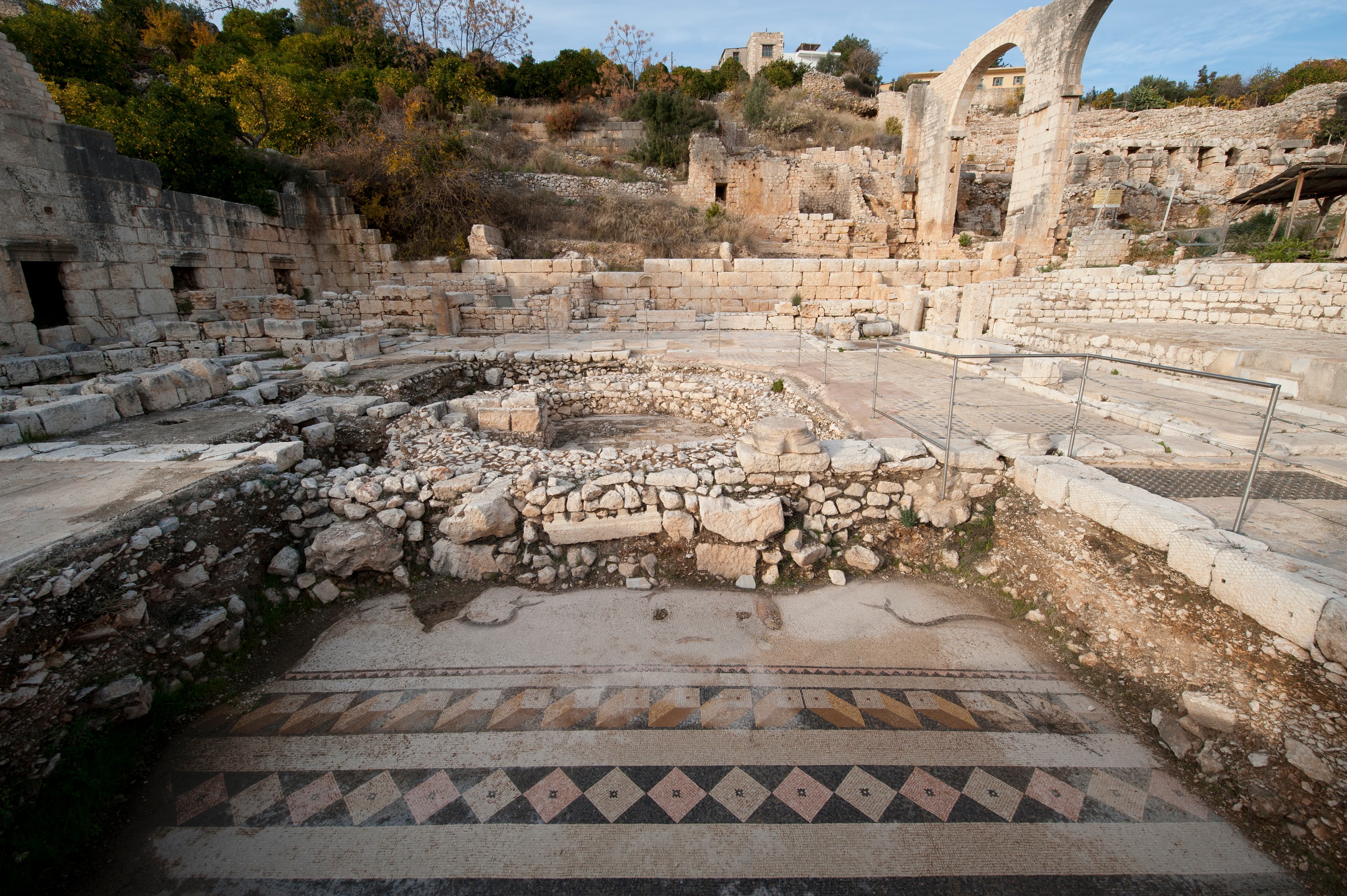
Visit essentials
A quick read before you go
- Duration
- 2–3 hours for a thorough visit: theatre, agora, aqueduct sections, and necropolis.
- Access
- Located at Ayaş village, Erdemli District, Mersin Province.
Overview
Elaiussa Sebaste's ruins stand within cultivated land, where olives and lemons shade broken walls as the same species, though not the same trees, did in antiquity. The coastal D400 now bisects the ancient isthmus, separating agora from necropolis, while agriculture continues around and between them.
Since 1995, the University of Rome La Sapienza's Italian archaeological mission, directed by Prof. Eugenia Equini Schneider, has uncovered the agora complex, theatre, aqueducts, and what is described as ancient Cilicia's richest necropolis: nearly 100 varied tombs along the Avenue of Graves.
The city's name references olive oil, and Mediterranean religious meanings made the olive more than agriculture: Athena's tree, a sign of peace, and fuel for temple lamps. Tombs among olive groves join land sacred in changing forms since the species was first cultivated. Surviving healing baths extend that dimension from burial to the body; their inscriptions record worshippers' prayers for health in a city sought for wellness as well as burial.
Why this place is sacred
The thin quality of Elaiussa Sebaste is not concentrated in a single feature — no sinkhole, no royal sanctuary, no miracle-shrine — but distributed across a landscape that has been inhabited, cultivated, and mourned over for more than two millennia. The necropolis is its most concentrated expression: nearly 100 tombs on a hillside, the dead arranged in formal procession along a path, surrounded by trees that predate any contemporary visitor by centuries.
The healing baths speak to a different register of sacred experience — the body in need of restoration, the inscription of a prayer into stone as an act of permanence, the belief that water and the divine can work together on a damaged body.
The olive itself, embedded in the city's name, is perhaps the most understated sacredness: in every Mediterranean culture that touched this coast — Greek, Roman, Byzantine, Ottoman — the olive tree marked the meeting point between the wild and the cultivated, the human and the divine.
To sit in shade cast by an olive near a Roman tomb is not a tourist experience; it is a participation in a Mediterranean spiritual economy that has been operating without interruption for three thousand years.
Founded as a trading and administrative city, Elaiussa Sebaste served as a port connecting Syria, Egypt, and Anatolia. Its religious infrastructure — temples, the healing baths, the necropolis — served the civic and spiritual needs of a prosperous Cilician community across several centuries.
The city was founded in the 2nd century BC on a small island. It was refounded and substantially expanded by the Cappadocian king Archelaus I under Augustus. The 1st and 2nd centuries AD, following the Roman suppression of Cilician piracy under Vespasian (AD 74), constituted its golden age. Sassanid raids under Shapur I beginning in 260 AD initiated decline. The city was gradually abandoned following Arab invasions of the mid-7th century AD.
The Italian archaeological mission has worked here since 1995.
Experience and orientation
Arrive by car along the D400 and park near the road. The agora complex extends on both sides of the highway, its columns and paving stones partly overgrown with the agricultural and wild vegetation that has established itself over fourteen centuries of abandonment. Begin on the south side of the highway, where the agora and theatre are located.
The theatre, 2nd century AD, holds 23 rows of seating and faces south; sit in the upper rows and look out — the sea is visible, the coast curves away in both directions, and the agricultural Cilician plain stretches inland. The view from the stage building was designed to be seen, but it also reveals: this is what a prosperous Roman Cilician city looked like from its own civic high point.
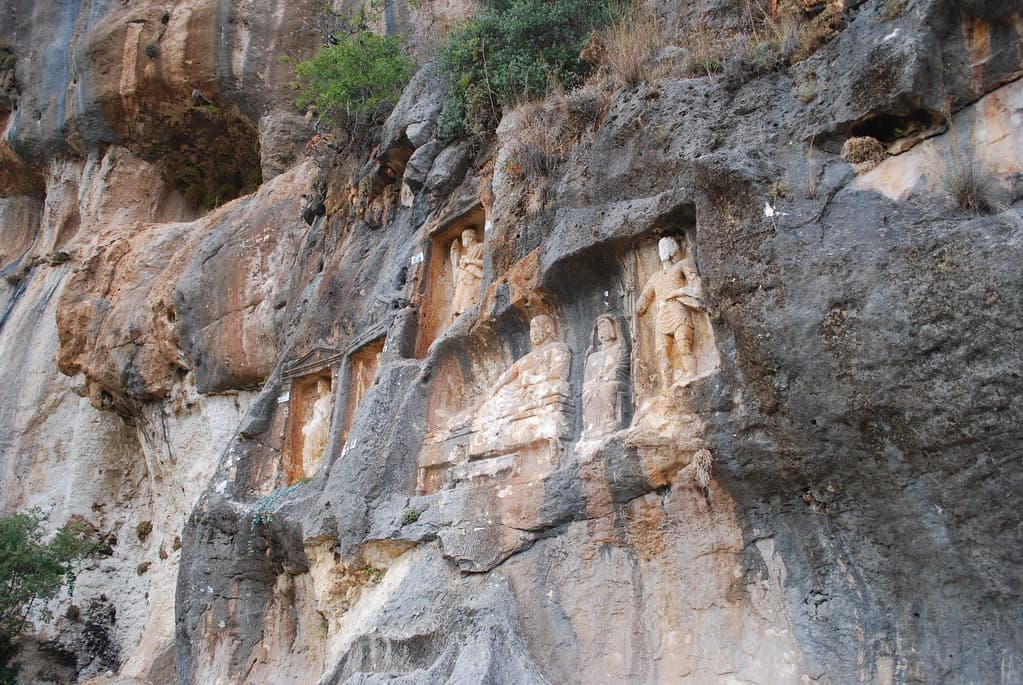
Move then to the northern hill where the necropolis begins. The Avenue of Graves — a path lined on both sides with roughly 100 tombs — runs through the hillside among lemon and olive trees. The tombs include various types: sarcophagi, hypogea (underground chambers), temple-tomb facades. Walk slowly. The quality of light here in the late afternoon, filtering through citrus leaves onto carved stone, rewards unhurried attention.
The healing baths, with their inscribed prayers, are worth a focused stop: the inscriptions are small and can be missed in a quick pass, but they represent the most intimate human voice left at this site — a person in pain, asking for restoration, carving their request into stone at the water's edge.
Two Roman aqueducts from the Lamos River still stand in sections; their engineering — carrying water from distant mountains to maintain a prosperous port — is a form of sacred attention to the body and the community.
Park near the D400 highway and work from the agora and theatre south of the road to the necropolis north of it. The full site visit — theatre, agora, aqueduct sections, and necropolis — takes 2 to 3 hours. Carry water; the site is exposed and can be warm even in spring. Free admission. Limited shade until you reach the necropolis hill.
Context and lineage
A small Hellenistic settlement existed on the island off the Cilician coast from the 2nd century BC. The transformation into a significant city came under Archelaus I of Cappadocia, a client king of Augustus, who refounded and expanded the city and gave it the honorific name Sebaste — the Greek equivalent of Augusta, the emperor's title — connecting it explicitly to Roman imperial authority.
The construction of an isthmus linking the original island to the mainland was the city's foundational act of urban ambition: turning an island into a peninsula, remaking the edge of the sea into a gateway. Vespasian's suppression of Cilician piracy in AD 74 unlocked the trade routes that allowed the city its golden age.
The healing baths and their inscribed prayer-texts date from the high Roman period, when the city's prosperity supported both civic and religious infrastructure at a high level. Sassanid raids from the third century onward began a long decline; Arab invasions of the mid-7th century finally severed the city's connection to the Mediterranean trade network that had sustained it.
Hellenistic island settlement (2nd century BC) → refoundation as Sebaste under Archelaus I (reign of Augustus) → golden age (1st–2nd century AD) → Sassanid raids and decline (3rd century onward) → Arab invasions and abandonment (mid-7th century AD) → Italian Archaeological Mission (1995–present)
Archelaus I of Cappadocia
Roman client king under Augustus who refounded the city as Sebaste and initiated its major urban development
Emperor Vespasian (r. AD 69–79)
Suppressed Cilician pirates in AD 74, enabling the city's golden age of prosperity and building
Shapur I of Persia
Sassanid raids beginning in 260 AD initiated the city's long decline
Eugenia Equini Schneider
Director of the Italian Archaeological Mission (Sapienza University of Rome) since 1995; primary scholarly authority on the site
Traditions and practice
The healing baths at Elaiussa Sebaste are the most personalised evidence of religious practice that survives. The inscribed health wishes — prayers carved into stone by individuals seeking recovery from illness — represent the most intimate level of Roman religious practice: not the civic sacrifice or the temple procession, but a person alone at the water, asking.
The necropolis, with its nearly 100 tombs, reflects the Roman Mediterranean's deep investment in funerary piety — the belief that the dead required proper care and commemoration, and that the living remained in relationship with their ancestors. The general framework of Roman civic religion (temples to the Olympian gods, imperial cult observance) would have been present throughout the city's golden age, though no specific cult centre has been conclusively identified at the site.
The Italian archaeological mission from Sapienza University of Rome has worked here annually since 1995. No active religious community uses the ruins. Free admission for visitors.
Begin in the late afternoon if possible, when the light falls at a low angle across the necropolis hill and the lemon groves cast long shadows onto the carved tomb facades. The Avenue of Graves rewards walking at the pace of a procession rather than a survey. Pause at each tomb type: notice the variety — some are simple chambers, some have carved decorative elements, some are clearly the work of greater resources than others.
This was a community's full social range, from the prosperous merchant to the minor official, all translated into stone. Spend time at the healing bath site and look carefully for the inscriptions. If you find one, sit near it for a moment: someone in this city, probably in the second century AD, was suffering, and they came here and carved their hope into the stone. At the theatre, climb to the upper rows and sit facing the sea.
This is where the city would have gathered for its great communal events — the performances and civic ceremonies that constituted public life. The view from this height integrates everything: sea, plain, ruins, groves.
Greco-Roman Polytheism and Imperial Cult
HistoricalAs a significant port city in Roman Cilicia, Elaiussa Sebaste hosted the full range of Roman civic and religious life. The healing baths with inscribed health wishes reflect Roman votive practices at a personal level. The city's development under Archelaus I — a Cappadocian king and client of Augustus — suggests close integration of royal and imperial religious traditions.
Votive offerings; imperial cult observances; use of ritual healing baths.
Archaeological Heritage
ActiveOngoing Italian excavations since 1995 led by Prof. Eugenia Equini Schneider have revealed the extensive agora complex, theatre, aqueducts, and the richest necropolis in ancient Cilicia. Multiple scholarly monographs have been published. Excavations continue and the site is in active scientific investigation.
Annual excavation campaigns; scholarly publication; site interpretation for heritage tourism.
Perspectives and open questions
Elaiussa Sebaste rewards multiple interpretive approaches: as a record of Roman Cilician urban ambition, as a landscape of Mediterranean funerary piety, as a site where the sacred ecology of the olive operates at a name level, and as an ongoing scientific excavation revealing new dimensions of ancient provincial life.
Scholarly perspective
Elaiussa Sebaste is understood as one of the most important ports in Roman Cilicia, functioning as a nexus of Mediterranean trade connecting Syria, Egypt, and Anatolia. The Italian Archaeological Mission (Sapienza, 1995–present) has substantially advanced understanding of the city's agora, infrastructure, and necropolis. The necropolis is described in scholarly literature as the richest in ancient Cilicia, with typological variety unmatched in the region.
The healing baths and their inscribed votive texts are considered significant evidence for understanding Roman religious life at a personal level.
Living and traditional perspectives
The modern village name Ayaş preserves a Turkish toponym at the site. Local fishermen and farmers have coexisted with the ruins for centuries, maintaining an informal relationship with the ancient structures as part of the agricultural landscape.
Alternative interpretations
The olive's sacred symbolism across Mediterranean religions — Athena's gift to Athens, the peace symbol of the Hebrew Bible, the oil that burns in Christian and Jewish liturgical lamps — combined with the city's name (elaion, olive oil), invites readings of the site as embedded in an ancient sacred ecology that is still present in the citrus and olive groves surrounding the ruins. The name of the city carried its theology in the word itself.
Open questions
The original island settlement — now buried under sand and the built isthmus — has barely been excavated. The full extent of the harbour infrastructure and the temples it may have housed remain unknown. The specific deities worshipped at the site's temples have not been conclusively identified. The island beneath the isthmus may contain the city's oldest sacred structures.
Plan your visit
Access and arrival
Located at Ayaş village, Erdemli District, Mersin Province. Approximately 18 km from Erdemli town and 55 km from Mersin city. Accessible via the D400 coastal highway (Mersin–Silifke direction). Free admission; no formal entrance gate. Parking available near the highway. Public transport: bus from Mersin to Erdemli (~15–20 TRY at recent rates), then dolmuş toward Ayaş (~5–10 TRY). Carry water; minimal shade on most of the site. The D400 highway crosses the site — take extreme care crossing.
Kızkalesi (~8 km east) is the closest tourist centre, with pensions, apartments, and small hotels oriented to coastal tourism. Erdemli (~18 km west) has more practical accommodation. Mersin city (55 km) provides full hotel options and transport connections.
Respectful visit
No specific dress requirement. Sun protection and sturdy footwear suitable for uneven archaeological terrain are strongly recommended.
Permitted and encouraged. The necropolis in late afternoon light and the theatre's sea-facing view both reward considered framing.
Not applicable. The ancient votive traditions have no living continuation at this site.
Do not disturb or enter active excavation areas, which may be marked with barriers or tape. Do not sit on, climb, or touch carved tomb surfaces. Take nothing from the site. Cross the D400 highway only at safe points.
The D400 highway bisects the site; cross with extreme care. The site is unenclosed and largely unsupervised — do not disturb active excavation areas, which may be marked with barriers. In summer, the exposed terrain can reach intense temperatures by mid-morning; carry at least 1.5 litres of water per person.
Location
Map loads as you approach this section.
Pilgrim reflections
A portrait of encounter, not a score
Pilgrims describe what they felt, how present they could become, and whether the place would shape a journey. There are no stars and no ranking of traditions.
No reviewed reflections yet
The first pilgrims can help describe the character of being here.
Share a reflection
Available after an account-backed “Been there.” Every reflection is reviewed before publication.
Nearby sacred places
Explore other sacred places in the region. Proximity does not establish access or travel time; check each place’s guidance.



References
Sources consulted for this page. Source categories describe the publication, not a guarantee that every claim is verified. Traditional accounts and outside interpretations may differ.
- 01Where is Elaiussa Sebaste Ancient City & How To Get There? — Unique Mersin (Eşsiz Mersin)officialTurkish municipal/provincial authority website with access details
- 02New term excavations start in Elaiussa Sebaste ancient city in southern Turkey — Anadolu AgencySource contextOfficial news agency report on ongoing excavations
- 03Elaioussa/Sebaste – Pleiades — Pleiades Ancient World Mapping CentreacademicAuthoritative gazetteer of ancient places with coordinates and bibliographic references
- 04Elaiussa Sebaste: A Port City Between East and West, An Archaeological Guide — Eugenia Equini SchneideracademicPublished archaeological guide by the Italian mission director; primary scholarly source
- 05Elaiussa Sebaste - Wikipedia — Wikipedia contributorsencyclopediaCovers founding, history under Archelaus, Roman golden age, and decline
- 06Elaiussa Sebaste | All About Turkey — All About TurkeyguideOverview of site structures and history for tourists
- 07Elaiussa Sebaste – Following Hadrian Photography — Following HadrianguideDetailed photographic documentation
- 08Elaiussa-Sebaste, a Roman city in Turkey — Turkey Travel PlannerguidePractical visitor guide
Share a photo
Help visitors recognize Elaiussa Sebaste. Every submission is reviewed before publication.