Nine Maidens stone ring, Cornwall
Nine granite sentinels on a Cornish ridge, keeping watch over four thousand years of seekers
St. Columb Major, England, United Kingdom
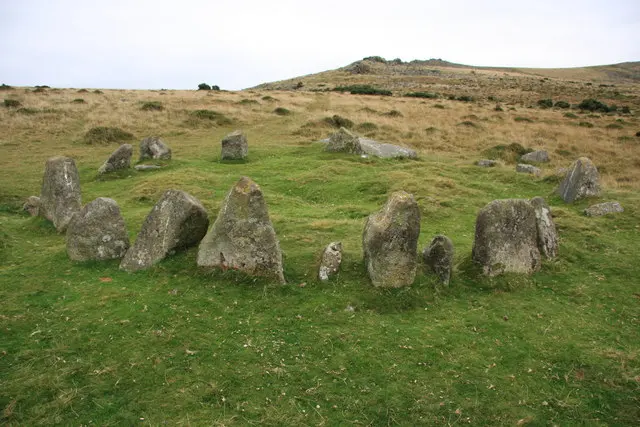
Image of Nine Maidens stone ring, Cornwall. Image source · CC-BY-SA-2.0
Visit essentials
Before you go
- Duration
- 2 hours allowing for contemplation at the circle
- Etiquette
- Respect the stones and the land.
Overview
The walk to the Nine Maidens teaches something before arrival. From the road between Madron and Morvah, you climb past the famous Men-an-Tol and continue uphill onto open moorland. The path grows rougher, the sky larger. Carn Galver's granite mass dominates the northern horizon. And then the stones appear: a rough circle of granite uprights on a ridge, survivors of a monument that once held more than twenty stones in its 69-metre embrace.
Six remain standing, others lie fallen or half-buried, but the circle's presence persists. The name 'Nine Maidens' appears throughout Cornwall, attached to multiple stone circles regardless of their actual count. Nine was magical, mystical—a number of power in the Megalithic imagination and in traditions that followed. Edward Lhuyd recorded this circle in 1700 as 'Meyn yn Dons,' stones in a dance, and something of that dance persists in the way the stones seem to move when clouds race overhead.
The Christian morality tale came later: young women frozen mid-step for breaking the Sabbath, the Fiddler Stone to the north marking their hapless musician. Such stories were tools for discouraging older practices, but they also preserved memory that these were places of gathering, of celebration, of something the Church found threatening enough to require cautionary legends. Today the Nine Maidens draw those who feel the pull of ancient places.
The moorland isolation, the wide sky, the company of stones that have watched four millennia of seasons—these combine into something that resists description but rewards presence.
Why this place is sacred
West Penwith concentrates megalithic monuments more densely than almost anywhere in Britain. Within a few miles of each other stand stone circles, standing stones, quoits, and barrows beyond counting. This was sacred ground long before anyone could explain why. The Nine Maidens occupy a ridge within this landscape, visible from a distance yet somehow hidden until you stand among them. What makes this particular spot thin?
The altitude helps—you stand at the top of the world, as one writer noted, with nothing between you and the sky. The isolation matters—the walk filters out those without genuine intention. The company of other monuments creates context; Men-an-Tol lies below with its famous holed stone, Men Scryfa stands nearby with its inscribed pillar. You enter a landscape that has been recognized as sacred for four thousand years. But the circle itself does something particular.
Visitors report that despite its exposed position and the fierce winds that sometimes blow, Boskednan retains warmth and welcome. The stones seem to have personality, to maintain relationship with those who visit them. Perhaps this is the accumulated effect of millennia of recognition. Perhaps it is something inherent in the stones or the place.
Perhaps it is simply the power of paying attention to stone and sky and the vast reaches of time that separate us from the hands that raised these granite blocks.
The Nine Maidens Stone Circle was erected in the late Neolithic or Early Bronze Age, roughly 2500-1500 BCE. Stone circles of this type likely served multiple functions: astronomical observation, seasonal ceremony, community gathering, and connection to ancestors. The presence of funerary remains nearby suggests the site's association with death and the realm beyond. The original number of stones (possibly 22-23) may have tracked the Metonic cycle—the 19-year period after which lunar and solar calendars realign.
The circle has weathered four millennia of change. Stone theft reduced its complement from more than twenty to today's ten survivors. The Christian period overlaid the site with its petrification legend, transforming dancers into sinners and celebration into cautionary tale. William Borlase documented the circle in 1754, beginning its modern antiquarian history. His descendant excavated nearby in the 1870s, finding Bronze Age burials.
Today the circle attracts contemporary pagans and spiritual seekers who have restored something of its original purpose as a place of gathering and recognition.
Experience and orientation
Begin at the car park near Men-an-Tol studio. The track climbs past farmland onto open moor. Men-an-Tol appears first, its famous holed stone drawing most visitors who then turn back. Continue uphill. The path becomes less defined. Gorse and heather line the way. The distinctive profile of Carn Galver grows larger as you gain altitude. Then, on the ridge ahead, the stones appear. They seem smaller than expected at first—the tallest surviving uprights stand about 1.2 metres—but size deceives.
These stones have stood here for four thousand years. Whatever cultural memory attached to Stonehenge or Avebury, the Nine Maidens knew none of it. They simply are, as they have been since Bronze Age communities raised them for purposes we can only guess. Walk the perimeter if the ground allows. Note which stones stand, which lie fallen, which emerge partially from the earth. The circle was never perfectly regular, and time has made it more irregular still.
Find a comfortable position—outside the circle, within it, wherever feels right—and sit. The moorland silence, punctuated by wind and distant sheep, settles around you. The sky, vast above the ridge, becomes a presence of its own. Time does something strange at sites like these. The four thousand years since construction collapse into now. The hands that raised these stones feel almost present. The boundary between ages grows thin, permeable, uncertain.
The Nine Maidens lie approximately 1.5 km up the track from the Men-an-Tol car park, on a ridge above the well-known holed stone. The approach takes 20-30 minutes each way depending on conditions. The circle itself is roughly 69 metres in circumference, with stones distributed unevenly around the perimeter.
Context and lineage
Sometime between 2500 and 1500 BCE, people of what archaeologists call the Megalithic culture gathered on this Penwith ridge. They chose granite blocks—local stone, heavy and enduring—and set them upright in a circle measuring roughly 69 metres around. How many stones originally stood here remains uncertain; estimates range from 19 to 23. The number 19 intrigues scholars because it corresponds to the Metonic cycle, the period after which full moons return to the same dates of the year.
Perhaps these stones tracked time on a scale we find hard to imagine—not hours or days but the slow dance of sun and moon across decades. Near the circle, burial remains have been found: cists and urns of the Early Bronze Age, suggesting that whoever built the circle associated it with death and the journey beyond. The circle accumulated names across centuries. Edward Lhuyd recorded it in 1700 as 'Meyn yn Dons'—stones in a dance.
Later came 'Nine Maidens,' though the number reflected mystical significance rather than actual count. The Christian legend followed, transforming dance into sin, celebration into punishment. But the stones themselves preceded all naming, all meaning. They simply stood, as they stand now.
The Nine Maidens belongs to the tradition of stone circles erected across Britain and Ireland during the Neolithic and Bronze Ages. In Cornwall alone, multiple circles bear the 'Nine Maidens' or 'Merry Maidens' name, all sharing the Christian petrification legend. The circle stands within the exceptionally dense concentration of megalithic monuments in West Penwith, which includes Men-an-Tol, Men Scryfa, the Merry Maidens, Lanyon Quoit, and numerous other sites.
William Borlase
Edward Lhuyd
William Copeland Borlase
Traditions and practice
The original practices of those who built and used the Nine Maidens Stone Circle are unknown. Scholarly interpretation suggests astronomical observation (perhaps tracking the Metonic cycle), seasonal ceremony marking solstices and equinoxes, community gathering for celebration or mourning, and rituals connected with death and ancestors. The name 'Meyn yn Dons' (stones in a dance) hints at movement, festivity, circular motion.
Contemporary pagans and spiritual seekers visit the Nine Maidens throughout the year. Some time visits to solstices, equinoxes, or cross-quarter days. Practices vary by individual: meditation, walking the circle's perimeter, sitting in silence with the stones. There are no organized gatherings or designated ceremonies. The site's power lies in its availability for personal encounter.
Walk to the circle consciously, letting the moorland approach become part of the experience. Arrive with intention but without agenda. Spend time simply being with the stones—notice their shapes, their positions, the gaps where companions once stood. If moved to circumambulate, do so. If drawn to sit, sit. The stones have waited four thousand years; they are not in a hurry. Before leaving, offer thanks—silently, inwardly, however feels authentic.
Bronze Age ceremonial practice
HistoricalThe original builders invested enormous labor in selecting, transporting, and erecting more than twenty granite stones. This effort indicates profound significance—astronomical, ceremonial, ancestral, or all three.
Unknown specifically. Likely included astronomical observation (perhaps tracking the Metonic cycle), seasonal gatherings, rituals connected with death and ancestors, and ceremonial movement suggested by the name 'Meyn yn Dons.'
Christian folklore
HistoricalThe petrification legend transformed the circle from a place of celebration into a cautionary tale, young maidens frozen mid-dance for breaking the Sabbath.
The story was told to discourage Sabbath-breaking, particularly among young women. It became part of authentic Cornish folk tradition despite its didactic origins.
Contemporary spiritual practice
ActiveModern seekers have restored the circle's function as a place of pilgrimage and practice, visiting for meditation, seasonal observance, and personal ritual.
Individual visits for quiet contemplation. Some time visits to astronomical events (solstices, equinoxes). Walking the perimeter. Sitting with the stones. Personal ritual as moved.
Perspectives and open questions
The Nine Maidens invite multiple readings: archaeological evidence, folk memory, contemporary spiritual encounter. None exhausts the meaning of stones that have stood four thousand years.
Scholarly perspective
Archaeologists place the circle in the late Neolithic or Early Bronze Age (2500-1500 BCE). The original stone count (possibly 22-23) may relate to the Metonic cycle. Funerary remains nearby indicate association with death and ancestors. The Christian petrification legend is understood as a later overlay designed to discourage pagan practice at sites that retained sacred character despite official disapproval. The circle belongs to a concentration of monuments suggesting West Penwith held particular ceremonial significance.
Living and traditional perspectives
Cornish tradition preserved the name 'Meyn yn Dons' (stones in a dance), suggesting folk memory of ceremonial use. The petrification legend, while Christian in origin, became authentic folklore passed through generations. The 'Nine Maidens' name itself carries folk significance—nine as a number of power and mystery, attached to circles regardless of actual stone count.
Alternative interpretations
Contemporary seekers often perceive West Penwith as energetically charged, with ley lines connecting ancient sites. The Nine Maidens' position on a ridge, in alignment with other monuments, suggests to some a deliberate energy grid. The number nine carries significance in numerology and various spiritual traditions. Visitors report distinctive sensations at the circle—warmth despite wind, presence despite solitude.
Open questions
The fundamental questions remain unanswered. Why this ridge? What ceremonies gathered here? Who were the dead buried nearby, and what relationship did they have to the circle? Why did communities invest enormous labor in raising stones that served no practical purpose? The mystery is not a failure of research but a feature of sites whose meaning exceeds what can be reconstructed from material remains.
Plan your visit
Access and arrival
Penzance offers full range of accommodation. Madron, closer to the site, has B&Bs. St Just and Zennor provide alternatives for those exploring West Penwith.
Respectful visit
Sturdy waterproof footwear is essential—wellington boots in wet seasons. Layers for changeable weather. No special attire required, but dress for the terrain rather than the occasion.
Photography permitted and often rewarding. The circle photographs well in varied conditions. Be mindful of others seeking quiet contemplation.
If moved to leave an offering, make it small, natural, and biodegradable. Better still, let your offering be attention, presence, gratitude.
Do not touch or climb on the stones. Stay on paths where visible to reduce erosion. Leave no trace of your visit.
The moorland can be muddy, rough, and disorienting in fog. Weather changes quickly. The site has suffered erosion from visitors; approach the stones carefully and do not climb on them.
Location
Map loads as you approach this section.
Pilgrim reflections
A portrait of encounter, not a score
Pilgrims describe what they felt, how present they could become, and whether the place would shape a journey. There are no stars and no ranking of traditions.
No reviewed reflections yet
The first pilgrims can help describe the character of being here.
Share a reflection
Available after an account-backed “Been there.” Every reflection is reviewed before publication.
Nearby sacred places
Explore other sacred places in the region. Proximity does not establish access or travel time; check each place’s guidance.



Share a photo
Help visitors recognize Nine Maidens stone ring, Cornwall. Every submission is reviewed before publication.