Merry Maidens Stone Circle
Nineteen granite maidens holding the old silence of West Cornwall for four millennia
Understand sacred places, explore living traditions, and learn how to engage respectfully with Pilgrim Map.
Access has not been verified. Check current local guidance before planning a visit.
Lamorna, England, United Kingdom
Read the sources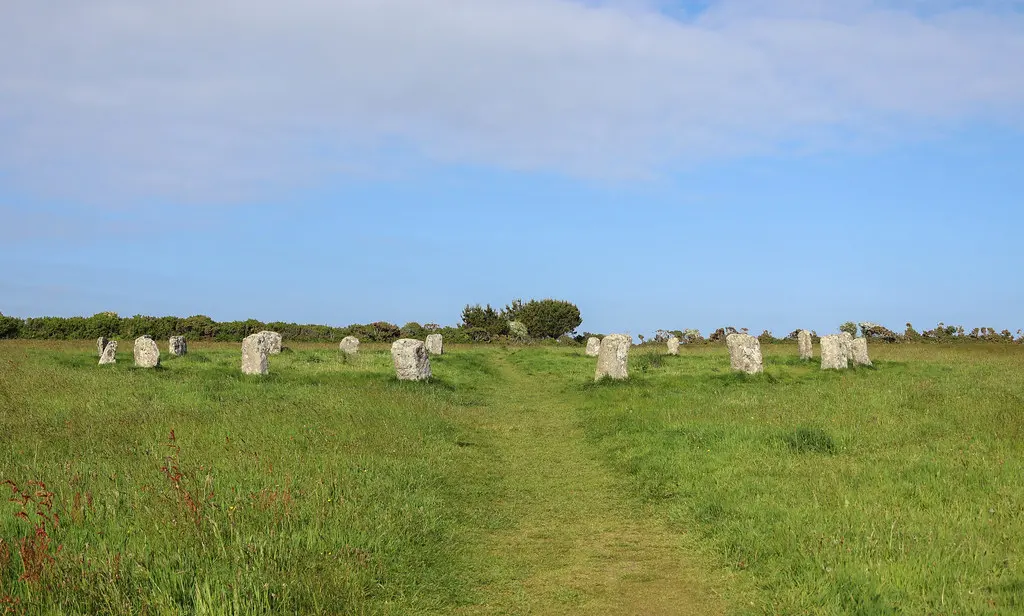
Image of Merry Maidens Stone Circle. Image source
Visit essentials
A quick read before you go
- Duration
- A brief visit takes thirty minutes.
- Access
- The circle is located on the south side of the B3315, approximately four miles from Penzance and…
Overview
Nineteen stones in near-perfect circle. Each one standing where Bronze Age hands placed it four thousand years ago. This is the Merry Maidens, and it has lost nothing to time.
In a region where stone circles were dismantled for farm walls and gateposts, the Merry Maidens survived intact. Perhaps something in the local understanding protected it. Perhaps the landowners who restored it in the nineteenth century acted on the same intuition that drew its builders here in the first place. Whatever preserved it, the circle stands complete, its granite megaliths graduated in height from southwest to northeast like a frozen wave, or a breath held across millennia.
The Cornish called all their stone circles 'Dawns Meyn'—the Stone Dance. Whether this name preserved memory of actual ritual movement or described how the stones seem to process around their invisible center, the name survived longer than any explanation for it. Legend claims these were maidens petrified for dancing on the Sabbath. But older names suggest different meanings: sacred stones, ceremony held in stone, a choreography of granite encoding knowledge we have forgotten how to read.
Today, practitioners of contemporary earth-based spirituality come to the Merry Maidens for solstice gatherings, meditation, and quiet communion. The Cornish Gorsedd has held ceremonies here, continuing the circle's role as a place where community gathers under open sky. The original purpose remains unknown, but the impulse to gather at these stones persists. Something about this particular arrangement of granite, this specific place in the landscape, continues to call.
Why this place is sacred
What makes certain places feel thin—permeable to something larger than the everyday—often defies explanation. At the Merry Maidens, several factors converge.
First, there is completeness. This circle has all its stones. In a landscape littered with the remnants of destroyed monuments, where farmers pulled standing stones for building material and parish authorities sometimes toppled them deliberately, the Merry Maidens survived whole. Visitors sense this integrity before they know its history. The circle feels finished, resolved, the way a chord properly struck holds the ear.
Then there is precision. Cornish stone circles are typically irregular, following the land's contours rather than geometric ideals. The Merry Maidens is different: nearly perfectly circular, its stones evenly spaced, its form suggesting compass and cord rather than intuitive placement. The builders measured here. They cared about exactness. This care remains visible four millennia later.
The graduated heights add another layer. Standing at the northeastern edge, you face the tallest stones to the southwest. Moving around the circle, the heights shift like a gentle tide. Some suggest this mirrors the waxing and waning of the moon. Others see it as drawing the eye toward significant horizons. Whatever the intention, the effect is dynamic stillness—movement frozen but still somehow animate.
The number nineteen persists across all five stone circles in West Penwith. This cannot be coincidence. The Metonic cycle, discovered by the Greeks but possibly understood earlier, relates lunar and solar calendars through a nineteen-year period. Whether Bronze Age Cornish builders tracked this astronomical pattern, we cannot know. But the number's repetition suggests encoded knowledge, a text we have lost the language to read.
Finally, there is the landscape itself. The Merry Maidens sits within sight of the sea, on gently sloping farmland that has been cultivated for millennia. Nearby stand the Pipers, two enormous menhirs said to be the musicians who played for the dancing maidens. The Tregiffian burial chamber lies a short walk west. This is dense sacred geography. The circle is not isolated but nodal—a point in a web of ancient monuments that once made meaning together.
The original purpose of the Merry Maidens, like all Bronze Age stone circles, remains uncertain. Archaeological consensus points toward ceremonial use, possibly including astronomical observation, seasonal celebration, and community gathering. The graduated stone heights may mark celestial alignments, the wider eastern gap may indicate an entrance oriented to significant risings, and the number nineteen may encode lunar knowledge. What ceremonies took place here, what songs were sung, what beliefs animated the builders—these have not survived.
The circle preserves intention without content, form without doctrine.
For most of its existence, the Merry Maidens stood in silence, its original uses fading from memory as Bronze Age culture gave way to Iron Age, Roman, Christian, and modern periods. By the time antiquarian William Borlase first documented it in 1769, the circle had become a curiosity rather than a functioning sacred site. A second stone circle once stood nearby; by the end of the nineteenth century, it had been entirely dismantled.
Lord Falmouth's restoration in the 1870s preserved the Merry Maidens from a similar fate, though the restoration may have adjusted some stone positions. In the twentieth and twenty-first centuries, the circle has returned to active use. Contemporary Druids, pagans, and practitioners of earth-based spirituality come for solstice celebrations and personal ceremony. The Cornish Gorsedd, the Bardic assembly reviving Cornish cultural traditions, has held ceremonies here. What was silent has begun to speak again, in new voices.
Experience and orientation
The word visitors use most often is peace. Not the peace of empty fields or quiet mornings, but something with presence to it. A peace that listens.
The Merry Maidens has a reputation for feeling benign. Where some ancient sites provoke unease or intensity, this circle seems to welcome. Visitors describe feeling lighter here, as though something that usually weighs on them has been set down at the entrance stile. The name 'Merry Maidens' may be folk etymology layered over older Cornish, but the merry quality persists in experience. Those who come often leave smiling, without quite knowing why.
Time behaves strangely within the circle. Minutes slip past without attention. The outside world—the road, the passing cars, the concerns carried in—recedes. This happens even when the circle is busy with other visitors. The space seems to hold multiple people without crowding, each finding their own quiet within the shared silence.
Some describe sensation in the stones themselves. Placing palms against the granite, they feel coolness that seems to draw from somewhere deep. Others notice nothing unusual but find themselves lingering longer than intended, walking the perimeter again, reluctant to return over the stile. The experience is subtle. It does not announce itself. It simply arrives when attention allows.
Those who visit at dawn or dusk often report the strongest impressions. With fewer people and raking light, the stones cast long shadows that shift as the sun moves. The graduated heights become more visible, the circle's geometry more apparent. In these liminal hours, the sense of standing in something ancient—and still active—deepens.
Contemporary practitioners who use the site for ceremony describe it as receptive. Rituals here feel supported, they say, as though the circle has been waiting for such use and responds to it. Whether this reflects psychological openness, accumulated centuries of human intention, or something the Bronze Age builders designed into the structure, the experience is consistent enough to take seriously.
The Merry Maidens rewards those who arrive without agenda. Bring no demands. Enter through the stile, cross the field, and simply stand within the circle. Notice where your feet want to stop. Notice which stones draw your attention. The circle may have had an entrance at its eastern gap, but you can approach however feels right.
Consider walking the perimeter before entering, the way one might circumambulate other sacred sites. Move slowly. Let your hand hover near the stones without touching unless it feels appropriate. When you do enter the circle, find a place to stand or sit. There is no required practice here, no protocol. The circle invites presence without prescription.
If you carry a question, a transition, or an intention, you might hold it lightly as you stand here. You need not speak it aloud or perform anything. Simply let the stones know you have come for more than photographs. Whether they respond—and what such response might mean—you will have to discover for yourself.
Context and lineage
No written records survive from the people who built the Merry Maidens. Their reasons, beliefs, and ceremonies can only be inferred from what they left in stone and earth. But the care taken in construction speaks clearly: this was not casual labor. Someone measured. Someone planned. Someone determined that exactly nineteen stones, graduated in height, placed with unusual precision, should stand on this particular slope facing the sea.
The Cornish name applied to all local stone circles, 'Dawns Meyn'—translated as 'stone dance' or possibly 'sacred stones'—suggests these places were understood as sites of ritual significance long after their original purposes were forgotten. The folk legend of maidens petrified for dancing on the Sabbath likely emerged from Christian attempts to discourage continued veneration of pre-Christian sites. But the persistence of the 'dance' association hints that some memory of ritual movement survived across millennia.
The circle stands within one of Britain's densest concentrations of prehistoric monuments. The Penwith peninsula holds dozens of stone circles, standing stones, burial chambers, and settlements from the Neolithic and Bronze Ages. These were not isolated monuments but elements of a sacred landscape, positioned in relation to each other and to features of the natural world—hills, waters, celestial risings—that have since lost their names and meanings.
The Merry Maidens has passed through many hands and understandings. Its Bronze Age builders knew purposes we can only guess. Medieval Cornish people knew it as a place of dance or sacredness, the distinction unclear. Early modern Christians cast it as a cautionary tale of Sabbath-breakers turned to stone. Antiquarians measured and documented it. Landowners restored it. Contemporary practitioners have returned ceremony to its center.
Today the site is protected as a Scheduled Ancient Monument under English Heritage, managed for both preservation and access. Visitors come from all traditions and none—some seeking spiritual encounter, others historical interest, others simply the experience of standing where people stood four thousand years ago. The circle holds all these uses without apparent preference.
William Borlase
historical
The Cornish antiquarian who first documented the Merry Maidens in 1769. His records note a second stone circle nearby, now entirely lost. Borlase's work preserved knowledge of the site and its context when such monuments were often dismissed or destroyed.
Lord Falmouth
historical
The nineteenth-century landowner who ordered the circle's restoration, reportedly to prevent it from suffering the fate of nearby monuments that had been dismantled. His intervention ensured the Merry Maidens' survival, though it may have slightly altered some stone positions.
The Pipers
mythological
Two enormous standing stones northeast of the circle, said to be the musicians who played for the dancing maidens. One stands 4.6 meters tall, making it Cornwall's tallest menhir. Their presence extends the circle's story into the surrounding landscape.
Traditions and practice
Original Bronze Age practices at the Merry Maidens are unknown. The site's astronomical features—graduated stone heights possibly tracking lunar phases, the larger eastern gap perhaps marking significant risings—suggest calendar-based ceremony. Seasonal gatherings at solstices and equinoxes seem probable. Community assembly for purposes both practical and sacred likely occurred. But the specific rituals, songs, offerings, and beliefs remain entirely conjectural. The stones have kept their silence.
Contemporary practitioners have returned ceremony to the Merry Maidens. The site sees use for solstice and equinox celebrations, when small groups gather at dawn or dusk to mark the turning of the year. Contemporary Druids and pagans hold rituals here, honoring the land and the ancestors who built the circle. The Gorsedh Kernow, the Cornish Gorsedd reviving Bardic traditions, has occasionally held ceremonies at the site, continuing its role as a place of cultural gathering.
Individual practice is perhaps more common than organized ceremony. Visitors come alone or in pairs to meditate within the circle, to sit in silence, to walk the perimeter in contemplation. Some leave small offerings of flowers or food, though this practice is discouraged by site stewards. Others simply stand, breathe, and attend to whatever arises. The circle seems to welcome both formal ritual and unstructured presence.
If you come to the Merry Maidens seeking something beyond tourism, consider these approaches. Arrive early or late, when crowds are thin and light is slanted. Enter through the stile and pause before crossing toward the circle. Let yourself slow down before you arrive.
Walking the perimeter before entering follows the practice of circumambulation found at sacred sites worldwide. Move clockwise or counterclockwise—traditions differ, and you might simply follow your feet. As you walk, notice each stone, its height, its texture, its lean. Notice the spaces between stones.
When you enter the circle, find a place to stand or sit that calls to you. There is no correct position. Let your attention settle. If you have brought a question or intention, you might speak it silently to the stones. If you have nothing in particular, simply be present. The circle does not require content from you.
Before leaving, pause at the stile. Turn back toward the circle. Offer silent thanks—to the builders, to the land, to whatever moved you to come. The form matters less than the sincerity.
Bronze Age Religion
HistoricalThe Merry Maidens was constructed during the late Neolithic or early Bronze Age as part of a sacred landscape in West Penwith. Its careful design, with nineteen stones arranged in near-perfect circle and graduated in height, suggests sophisticated ritual and possibly astronomical planning. The circle likely served as a site for seasonal ceremonies, astronomical observation, and community gathering within a cosmology that understood landscape as alive and meaningful.
Original practices are unknown. Archaeological inference suggests ceremonies at solstices and equinoxes, gatherings for community purposes both practical and sacred, and rituals engaging with lunar and solar cycles. The specific songs, offerings, beliefs, and participants have not survived.
Cornish Cultural Heritage
ActiveThe Merry Maidens stands as one of Cornwall's most iconic ancient monuments and a symbol of Cornish cultural identity stretching back millennia before English dominion. The circle represents the deep roots of Cornish civilization and the sacred landscape the region's ancestors created.
The Gorsedh Kernow, the Cornish Bardic assembly revived in 1928, has held ceremonies at the Merry Maidens, continuing its role as a site of cultural gathering. The circle features in Cornish heritage tourism and education, introducing new generations to the region's prehistoric past.
Contemporary Druidry and Neo-Paganism
ActiveFor practitioners of contemporary earth-based spiritualities, the Merry Maidens is a sacred space connected to ancestral wisdom and the living energies of the land. The circle offers a place where the veil between ordinary and sacred thins, where ceremony feels supported, where connection with the ancient past becomes tangible.
Practitioners gather at the Merry Maidens for solstice and equinox celebrations, full moon rituals, and personal ceremony. Common practices include meditation within the circle, walking the perimeter in contemplation, and rituals honoring the ancestors, the land, and the turning of the year. Individual practitioners visit for quiet communion rather than formal ceremony.
Perspectives and open questions
The Merry Maidens invites interpretation while resisting certainty. Scholars, traditional practitioners, and contemporary seekers each bring frameworks that illuminate and obscure. Honest engagement means holding these perspectives together without forcing resolution. The circle is old enough to contain contradiction.
Scholarly perspective
Archaeological consensus dates the Merry Maidens to the late Neolithic or early Bronze Age, approximately 2500-1500 BCE. Scholars note the unusual precision of the circle's near-perfect form and even stone spacing, suggesting careful planning and measurement. The graduated heights of the stones, tallest to the southwest and shortest to the northeast, may encode astronomical information, possibly tracking lunar cycles.
The number nineteen, shared by all five West Penwith circles, strengthens this hypothesis, as it corresponds to the Metonic cycle relating lunar and solar calendars.
The larger gap on the eastern side likely marks an entrance, perhaps oriented to significant celestial risings. However, detailed archaeoastronomical studies of this specific site remain limited. The relationship between the circle, the Pipers, and the now-lost second circle documented by Borlase suggests a complex sacred landscape where monuments functioned in relation to each other.
First documented by William Borlase in 1769, the site was restored under Lord Falmouth's orders around 1879. This restoration preserved the circle but may have adjusted some stone positions, introducing uncertainty about the original configuration.
Living and traditional perspectives
Cornish folk tradition holds that the stones are nineteen maidens turned to stone for dancing on the Sabbath, with the Pipers being the musicians who played for them. This legend, almost certainly a Christian overlay on older beliefs, may preserve memory of actual ritual dancing at the site. The Cornish name for all stone circles, 'Dawns Meyn,' meaning 'stone dance,' supports this interpretation.
An alternative etymology derives the name from 'Zans Meyn,' meaning 'sacred stones.' Whether the emphasis was on dance or sacredness—or whether these were indistinguishable in the original understanding—cannot be determined. The persistence of names pointing toward ritual significance suggests continuous recognition of the site's importance, even as specific beliefs transformed.
Alternative interpretations
Some interpret the Merry Maidens through the lens of earth energies and ley lines. The circle's placement within a dense concentration of prehistoric monuments suggests to these seekers that ancient peoples understood and worked with energetic properties of the landscape invisible to conventional science. Dowsers report unusual readings within and around the circle. Energy workers describe the site as a node or vortex where earth currents converge.
These interpretations lack archaeological support but often emerge from genuine experiences. When visitors report sensations that conventional vocabulary cannot capture, 'energy' may be an honest attempt to name something real. Taking the experience seriously does not require accepting any particular explanatory framework.
Open questions
Genuine mysteries remain. What were the specific rituals performed here, and who led them? What did the number nineteen mean to the builders? Were the graduated stone heights intentional, and if so, what did they encode? How did the Merry Maidens relate to the second circle that once stood nearby, now entirely vanished? Why did this particular circle survive when so many others were destroyed?
Perhaps most puzzling: the name. Does 'Dawns Meyn' preserve memory of actual dancing, or is it a misunderstanding across languages and centuries? Does the 'merry' quality visitors report today connect to something the builders intended, or is it projection, coincidence, landscape psychology? The stones offer no answers. They stand as they have stood, holding their silence across four thousand years.
Plan your visit
Access and arrival
The circle is located on the south side of the B3315, approximately four miles from Penzance and three-quarters of a mile west of the Lamorna turning. A small lay-by at the bottom of the field provides parking; additional parking is available on the grass verge at the top. Access is via a public footpath through a kissing gate or over a stile into the field. The approach is level but unsuitable for wheelchairs. Entry is free.
The nearest village is Lamorna, which has limited facilities. St Buryan, two miles north, offers slightly more. Penzance, four miles east, provides full services including hotels, restaurants, and train connections. Those wishing to explore the West Penwith sacred landscape might base themselves in Penzance or one of the smaller coastal villages.
Respectful visit
No formal requirements. Dress for the Cornish weather, which can shift quickly. Waterproof layers and sturdy footwear help, especially when approaching across damp grass.
Photography is permitted and welcome. The circle photographs beautifully, especially in early or late light when the stones cast long shadows. Be mindful of others in the frame. If someone is clearly engaged in contemplation or practice, wait or adjust your angle rather than intruding.
The Cornish Ancient Sites Protection Network asks that visitors leave no offerings. If you feel moved to give something, let it be attention, breath, or silent words rather than physical objects. Accumulations of offerings—however well-intentioned—create maintenance problems and suggest the site serves only one tradition. The circle should remain open to all.
The site is freely accessible at any reasonable hour. No permits or tickets are required. Dogs should be kept under control due to livestock in adjacent fields. The Pipers standing stones, visible from the circle, are on private land; access requires permission from the nearby farm.
Respect the site's preservation needs. The Cornish Ancient Sites Protection Network requests that visitors leave no offerings, litter, or traces. If you feel moved to leave something, make it an offering of attention rather than objects. Natural materials decompose but still impact the site; accumulations suggest the circle belongs to one tradition rather than holding space for all.
Be mindful of other visitors. The circle is small enough that one group's ritual can occupy the entire space. If others are present, adjust your practice accordingly. Share the silence rather than competing for it.
Current practical details
Address
B3315, Penzance TR19 6BQ, UK
Hours
Hours, fees, and access can change — verify on the official source before you travel. Practical details last checked Jun 2026.
Location
Map loads as you approach this section.
Pilgrim reflections
A portrait of encounter, not a score
Pilgrims describe what they felt, how present they could become, and whether the place would shape a journey. There are no stars and no ranking of traditions.
No reviewed reflections yet
The first pilgrims can help describe the character of being here.
Share a reflection
Available after an account-backed “Been there.” Every reflection is reviewed before publication.
Nearby sacred places
Explore other sacred places in the region. Proximity does not establish access or travel time; check each place’s guidance.


References
Sources consulted for this page. Source categories describe the publication, not a guarantee that every claim is verified. Traditional accounts and outside interpretations may differ.
- 01Merry Maidens Stone Circle — Cornish Ancient Sites Protection NetworkofficialComprehensive heritage organization focused on Cornish ancient sites
- 02The Merry Maidens (or Dawns Men) stone circle — Historic EnglandofficialOfficial Scheduled Monument listing (List entry number 1006731)
- 03Archaeology & Legend of Merry Maidens Stone Circle, Cornwall — Archaeology TravelacademicArchaeological perspective on the site
- 04Merry Maidens — The Megalithic PortalofficialComprehensive megalithic sites database
- 05Merry Maidens — Stone Circles UKofficialDetailed stone circle database
- 06The Merry Maidens — The Modern AntiquarianofficialCommunity-contributed site with GPS coordinates
- 07Summer Solstice approach at the Merry Maidens — Archaeoastronomy CornwallacademicArchaeoastronomical analysis of the site
- 08The Merry Maidens — WikipediaencyclopediaEncyclopedia entry with general overview
- 09Merry Maidens Stone Circle — Britain ExpressofficialHistoric Cornwall guide with visitor information
- 10Merry Maidens - Cornwall, England — Sacred DestinationsguideSacred sites travel guide
- 11The Merry Maidens — Atlas ObscuraguideTravel and unusual places guide
Share a photo
Help visitors recognize Merry Maidens Stone Circle. Every submission is reviewed before publication.