Mên-an-Tol
Cornwall's stone portal invites passage through four thousand years of healing and transformation
Understand sacred places, explore living traditions, and learn how to engage respectfully with Pilgrim Map.
Access has not been verified. Check current local guidance before planning a visit.
Morvah, England, United Kingdom
Read the sources
Image of Mên-an-Tol. Image source · CC-BY-SA-3.0
Visit essentials
A quick read before you go
- Duration
- 1-2 hours allowing for contemplation
- Etiquette
- Approach with reverence.
Overview
The hole is the first thing you see. From the track across the moorland, Men-an-Tol resolves into view: a round stone with its center removed, flanked by two tall uprights, arranged with a precision that speaks of intention beyond the practical. The central stone stands about four feet across, its hole measuring twenty inches in diameter—large enough for a grown person to crawl through, if they commit to the act.
For at least three centuries, and likely far longer, people have passed through it for healing and fertility in practices that continue today. The hole's power derives in part from its rarity. In all of Cornwall, only one other holed stone exists. To create such an opening in granite required extraordinary labor: someone, four thousand years ago, decided this stone required a passage through it.
Archaeologists suggest the visible stones may be remnants of a larger circle, perhaps nineteen or twenty stones originally. The holed stone may have stood at the center, or marked the entrance to something—a tomb, an observatory, a portal between realms. We do not know. What we know is that the invitation persists: the hole is there; you can pass through it; something happens when you do.
Why this place is sacred
The symbolism of Men-an-Tol seems obvious once articulated, yet its power resists reduction to symbol. The hole is womb-like: round, containing, passage-giving. To pass through is to be born again, to emerge into new condition. But the experience exceeds the analysis. People do not crawl through the stone thinking about rebirth symbolism; they crawl through seeking something—healing, fertility, transformation, connection—and the passage itself does something that explanation does not capture. The stone's thinness operates at multiple levels.
As portal between states—sick and well, barren and fertile, ordinary and changed—it marks transition. As possible entrance to a Bronze Age tomb, it may have mediated between living and dead, this world and the next. Cornish fairy lore adds another layer: the stone opens onto the fairy realm, and passage through can reverse fairy mischief, restore changeling children to their true parents.
Each interpretation suggests the same fundamental character: this is a threshold place, where passage in either direction becomes possible. The physical act of crawling through intensifies the experience. You cannot pass through Men-an-Tol casually. The hole requires commitment—getting down, fitting through, emerging on the other side. Your body participates in something that standing and looking would not accomplish. This embodied engagement may be why the healing traditions persist: the passage creates experience that mere intention cannot replicate.
Men-an-Tol dates to the late Neolithic or early Bronze Age (approximately 2500-1500 BCE). Archaeological survey suggests the visible stones are remnants of a larger stone circle, possibly 18-20 stones, with the holed stone at or near the center. Alternative theories propose the holed stone as entrance to a portal tomb or as an astronomical device aligned with lunar extremes occurring every 18.6 years. The deliberate creation of such a large hole in granite indicates the stone held profound significance.
The original meaning of Men-an-Tol has been overlaid but perhaps not entirely replaced by folk tradition. The healing practices documented since the 17th century may preserve memory of Bronze Age ritual use. The fairy associations represent another layer of Cornish tradition. Contemporary visitors continue practices that connect them to generations of seekers while bringing their own intentions and frameworks.
Experience and orientation
You park at a layby on the quiet road between Madron and Morvah, where a track leads across the moor. The walk takes ten or fifteen minutes, enough time to leave the everyday world behind. The moorland opens around you—gorse and heather, granite outcrops, the distant silhouette of Carn Galver. On clear days, you can see St Michael's Mount across the water to the south. Then the stones appear.
The two uprights stand like sentinels, and between them, the holed stone. The hole faces you as you approach, round and waiting. Close up, the precision of the opening becomes apparent. This is no natural formation but deliberate work, granite carved to create passage. The hole measures about twenty inches across—large enough for most adults, though snug for some. You can see sky through it, or the moor beyond, depending on your angle. The question arises: will you pass through?
No one requires it. Many visitors simply look, touch, photograph, contemplate. But the invitation is palpable. The hole is there. You can fit through it. Something in the place suggests that passing through matters. If you choose to pass through, approach with whatever intention you hold. Healing, transformation, fertility, connection—or simply the desire to participate in something people have done here for centuries, perhaps millennia. Get down low. Enter the hole. Feel the granite against your body.
Emerge on the other side. Many people report that something shifts in the passage—subtle, difficult to articulate, but real. Sit with the stones afterward. Let the experience settle before heading back across the moor.
Men-an-Tol stands on open moorland approximately three miles northwest of Madron. From the roadside parking, follow the track for about half a mile. Look for the stone stile on your right; cross it, and the stones are about a hundred yards into the field.
Context and lineage
Sometime in the late Neolithic or early Bronze Age—roughly four thousand years ago—people on this Cornish moor created something unusual. They took a large granite slab and carved a hole through its center, large enough for a person to pass through. The labor required was considerable; the intention behind it is lost.
In the early 1990s, archaeologists cleared vegetation around the site and discovered at least eleven buried or fallen stones nearby, suggesting the visible monument is a remnant of something larger—perhaps a stone circle of eighteen to twenty stones. The holed stone may have stood at the center, or may have marked the entrance to a burial chamber.
Some researchers propose it served as an astronomical sighting device, aligned with the moon's extreme northern position that occurs only once every 18.6 years. What became of the larger structure, if it existed, remains unknown. The three main stones and one additional upright survived. The holed stone acquired its healing reputation—documented since at least the 17th century, though likely far older. The practice of passing through persisted through changing centuries, different explanations, evolving purposes.
Today, seekers continue to come, to pass through, to participate in something whose origins are lost but whose power persists.
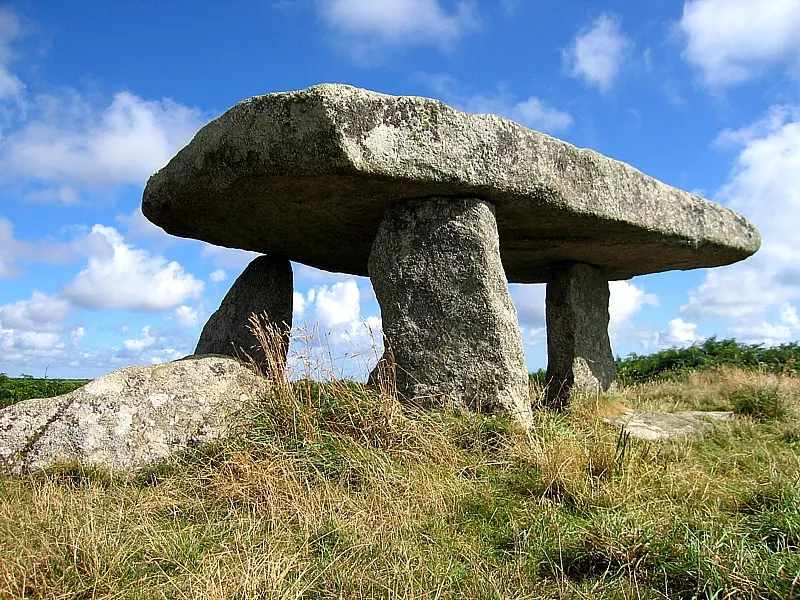
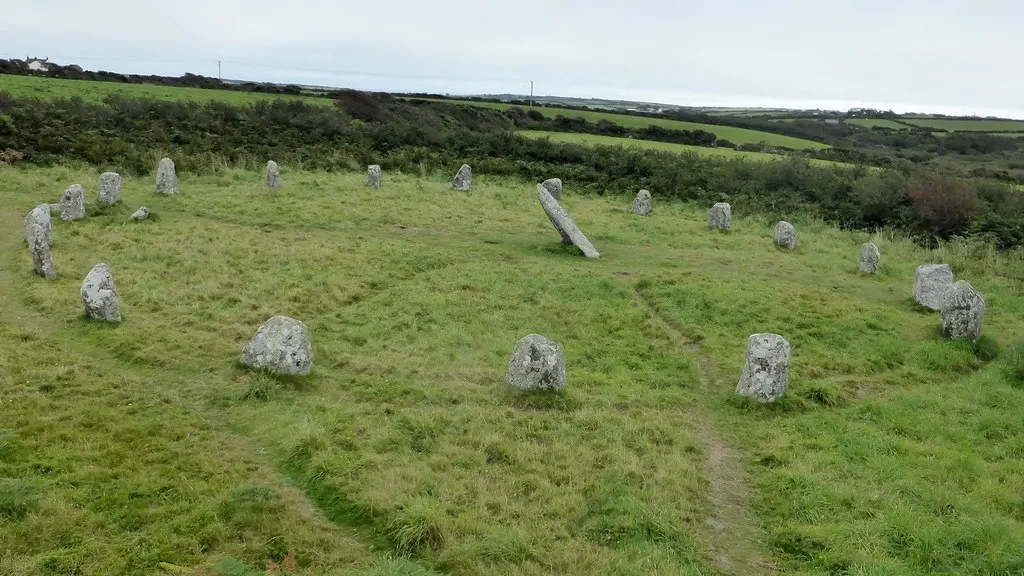
Men-an-Tol belongs to the tradition of megalithic monuments erected across Britain during the Neolithic and Bronze Ages. Holed stones are rare; only one other exists in Cornwall (the Torvan Stone near Gweek). The practice of passing through holed stones for healing is found across Celtic Britain, suggesting widespread ancient belief in the transformative power of such passage. Men-an-Tol sits within the dense concentration of ancient sites in West Penwith, including the Nine Maidens stone circle, Men Scryfa, and Lanyon Quoit.
Traditions and practice
Children with rickets were passed naked through the hole three times, then dragged through the grass three times toward the east. Adults with back pain or rheumatism crawled through nine times anti-clockwise (widdershins). Women seeking fertility passed through seven times backwards at full moon. The stone was consulted as an oracle for questions of love, with two pins placed crosswise to receive answers. Changeling babies were passed through to break the fairy spell.
Contemporary visitors continue to pass through the holed stone, adapting traditional protocols or creating their own. Some follow the anti-clockwise direction; some complete a specific number of passes. Others simply pass through once with focused intention. The stone is also visited for meditation, contemplation, and connection with ancient practice without necessarily passing through.
Consider your intention before approaching. What do you seek? Healing, transformation, connection, curiosity? The stone does not require explanation, only presence. If you choose to pass through, do so with attention. Feel the granite. Notice the transition. Emerge and pause. There is no wrong way to engage with Men-an-Tol, but engagement—not mere tourism—is what the stone invites.
Folk healing tradition
ActiveFor centuries, Men-an-Tol has been sought for healing, particularly for children with rickets and adults with back pain ('Crick Stone').
Children passed through three times and drawn across grass toward the east. Adults crawl through nine times anti-clockwise. The practice continues today.
Fertility tradition
ActiveThe womb-like hole has long been associated with fertility and conception.
Women seeking to conceive pass through the stone seven times backwards at full moon.
Bronze Age ceremonial practice
HistoricalThe original builders invested considerable labor in creating the unique holed stone, indicating profound significance.
Unknown. May have included passage through the hole as part of burial rites, astronomical observation, or ceremonies we cannot reconstruct.
Contemporary spiritual practice
ActiveModern seekers recognize Men-an-Tol as a site of transformation and earth energy.
Meditation, intentional passage through the hole, integration with broader exploration of sacred landscape.
Perspectives and open questions
Men-an-Tol resists definitive interpretation. Its unique form, continuous healing tradition, and invitation to physical engagement create space for multiple readings.
Scholarly perspective
Archaeologists date Men-an-Tol to the late Neolithic or early Bronze Age (approximately 2500-1500 BCE). Survey work in the early 1990s revealed buried stones suggesting the visible monument is a remnant of a larger stone circle. The holed stone may have stood at the center or marked the entrance to a portal tomb. Some propose astronomical function, aligned with lunar extremes. The healing tradition, documented since the 17th century, may preserve memory of original ritual use.
The practice of passing through holed stones for healing appears across Celtic Britain.
Living and traditional perspectives
Cornish tradition maintains Men-an-Tol as the Crick Stone, capable of healing back ailments. Fairy lore assigns the stone a guardian piskie with power to cure. The stone functions as a portal to the otherworld, capable of reversing fairy mischief. These beliefs represent not primitive superstition but a coherent worldview in which landscape features hold agency and power.
Alternative interpretations
Contemporary spiritual seekers recognize Men-an-Tol as a site of transformative power and earth energy. The holed stone is understood as a portal between dimensions, a rebirthing passage, a place of energetic cleansing. The stone features in earth energy mapping of West Penwith's sacred landscape.
Open questions
Why Bronze Age people created this unique holed stone remains unknown. The original configuration of the monument—stone circle, tomb entrance, standalone feature—is uncertain. Whether the documented healing traditions preserve genuine memory of original purpose or represent later folk development cannot be determined. The power that draws people to pass through persists regardless of explanation.
Plan your visit
Access and arrival
Penzance (5 miles) offers full range of accommodation. B&Bs in Madron and surrounding villages cater to visitors exploring West Penwith's ancient sites.
Respectful visit
Practical clothing suitable for moorland walking and potentially crawling through a granite hole. No special dress required.
Photography permitted. Be mindful of others' privacy and experience.
Small, biodegradable offerings may be left if you feel moved to do so. Do not accumulate debris.
Do not damage the stones. Leave no trace. Respect others' experiences.
The hole is large enough for most adults but may be snug for larger individuals. Getting through requires some flexibility. The ground can be muddy. Dress appropriately. Be mindful of others who may be engaged in personal practice.
Current practical details
Address
Penzance TR20 8NU, UK
Hours
Hours, fees, and access can change — verify on the official source before you travel. Practical details last checked Jun 2026.
Location
Map loads as you approach this section.
Pilgrim reflections
A portrait of encounter, not a score
Pilgrims describe what they felt, how present they could become, and whether the place would shape a journey. There are no stars and no ranking of traditions.
No reviewed reflections yet
The first pilgrims can help describe the character of being here.
Share a reflection
Available after an account-backed “Been there.” Every reflection is reviewed before publication.
Nearby sacred places
Explore other sacred places in the region. Proximity does not establish access or travel time; check each place’s guidance.

References
Sources consulted for this page. Source categories describe the publication, not a guarantee that every claim is verified. Traditional accounts and outside interpretations may differ.
- 01Mên-an-Tol — Cornish Ancient Sites Protection NetworkofficialConservation organization with detailed site information
- 02Men-An-Tol Holed Stone — The Megalithic PortalacademicComprehensive archaeological database
- 03Mên-an-Tol — WikipediaencyclopediaWell-referenced encyclopedia article
- 04Men-An-Tol — Cornwall GuideguideLocal visitor information
- 05Mên-an-Tol: History and Facts — History HitacademicHistorical overview
- 06The Essential Guide to Men An Tol Standing Stones — Explore CornwallguideVisitor-focused guide
Share a photo
Help visitors recognize Mên-an-Tol. Every submission is reviewed before publication.