Mutawintji Historic Site
A rock art gallery you can only enter with its own custodians
Understand sacred places, explore living traditions, and learn how to engage respectfully with Pilgrim Map.
Access has not been verified. Check current local guidance before planning a visit.
Mutawintji / Broken Hill region, New South Wales, New South Wales, Australia
Read the sources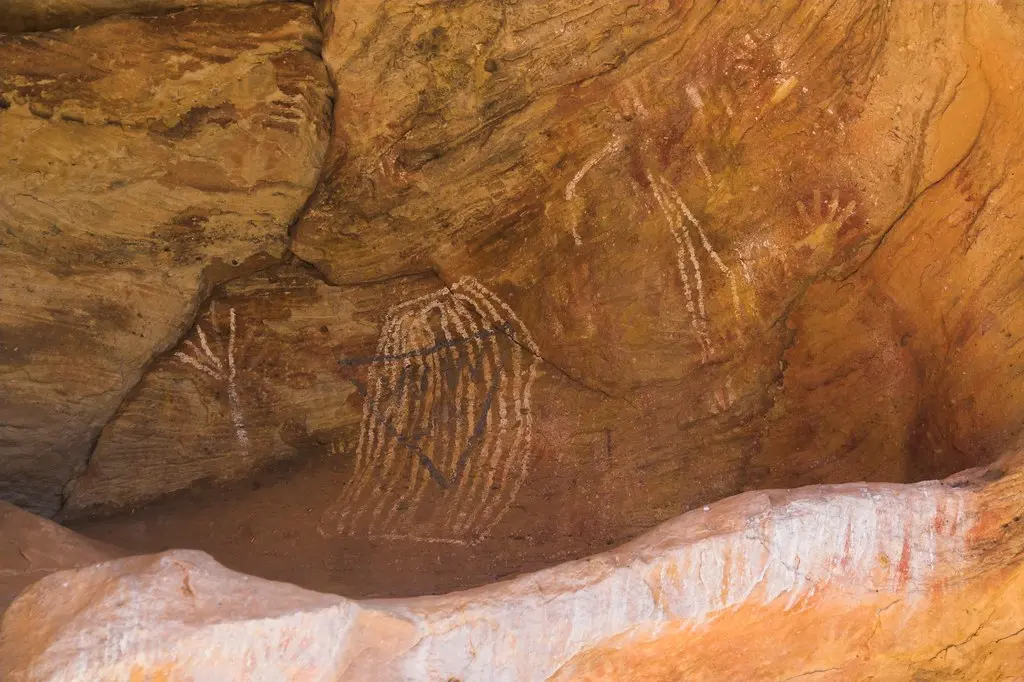
Image of Mutawintji Historic Site. Image source
Visit essentials
A quick read before you go
- Duration
- The Mutawintji cultural tour runs approximately two to four hours and typically covers both the…
- Access
- The Historic Site is accessible exclusively via a pre-booked guided tour through Mutawintji…
Overview
In the arid Byngnano Range of Far West New South Wales, water pooling in gorges and rockholes made Mutawintji a reliable meeting ground where little water was otherwise available. For the Malyangapa, Wilyakali, Wanyuparlku and Pantjikali peoples—whose group names vary slightly across sources, a variation this account records rather than resolves—that reliability made it a major regional gathering place over thousands of years. Initiation ceremonies and rainmaking rites at their largest brought together close to a thousand people.
Rock engravings and ochre hand stencils form one of the state's most extensive Aboriginal rock-art collections.
In 1998, ownership was formally returned to Mutawintji's Traditional Owners, the first handback of its kind in New South Wales. It is now governed through the Mutawintji Local Aboriginal Land Council and a Board of Management with an Aboriginal majority. That governance determines access: independent entry to the Historic Site is not permitted under any circumstance. Every visitor enters as a guest of an accredited Aboriginal guide and receives only what custodians have chosen to share.
Why this place is sacred
What makes Mutawintji thin is less a single story than an accumulated density of use: a place returned to again and again across millennia for the same purpose — bringing people together, marking initiation, calling rain — until the land itself became inseparable from that role.
NSW National Parks describes ongoing gatherings of Aboriginal people from the region continuing at Mutawintji today, which means the site's significance is not something visitors encounter as residue of a finished past but as a still-active center of connection for its custodians.
The Dreaming stories tied to specific rock art motifs are not published anywhere in the official record reviewed for this account, and that absence is treated here as intentional rather than as a gap to be filled — Aboriginal guides share what they choose to share, through direct spoken transmission during the guided tour's campfire storytelling, rather than through text available to anyone who has not made the trip.
This is itself a form of thinness: presence and permission mattering as much as, or more than, information.
Mutawintji served as a major regional ceremonial and meeting ground, hosting large-scale initiation ceremonies and rainmaking rites for gatherings of up to roughly a thousand people, drawn there in part by its unusually reliable water sources within an otherwise arid landscape.
Aboriginal use of the site is documented across thousands of years. In September 1998, land title was formally handed back to Traditional Owners, described by the NSW Aboriginal Land Council as the first handback of its kind in the state; the site has since been jointly managed through the Mutawintji Local Aboriginal Land Council and an Aboriginal-majority Board of Management, with guided cultural tourism developed as the primary form of public access.
Experience and orientation
The Mutawintji cultural tour is structured around direct transmission from an Aboriginal guide rather than self-directed exploration. It typically covers Kuluwirru yapa — the Historic Site itself — and Ngalkirrika, known as the Amphitheatre, moving between rock engravings and ochre stencils while the guide narrates aspects of Dreaming and cultural history at each stop.
NSW National Parks describes the experience as including an audio-visual cultural presentation and a 'campfire yarn,' a storytelling format in which guides share selected traditional narrative content aloud rather than through signage or printed material. Visitors consistently describe the format as educational and relational rather than purely visual — the presence of the guide changes the character of the visit, turning it into something closer to being received as a guest on someone's Country than touring a heritage attraction unattended.
What isn't shared is left unshared; the tour does not attempt to explain every motif or resolve every question a visitor might bring to the rock art.
Book with Mutawintji Heritage Tours well ahead of travel, since this is the only way to enter the Historic Site. Bring water and sun protection for the outback conditions, and expect the visit to run two to four hours depending on which sites are included.
Context and lineage
Public sources confirm that Dreaming stories connected to Mutawintji's rock art are shared with visitors through guided storytelling, including the Wiimpatja campfire yarn experience, but the specific content of those narratives is not published in the official documentation available for this account. This reflects a deliberate choice by Traditional Owners to transmit that material directly and selectively through guided cultural exchange, rather than a gap in outside knowledge.
Governance runs through the Mutawintji Local Aboriginal Land Council and an Aboriginal-majority Board of Management, working jointly with NSW National Parks and Wildlife Service since the 1998 handback — described by the NSW Aboriginal Land Council as the first arrangement of its kind in New South Wales.
Malyangapa, Wilyakali, Wanyuparlku and Pantjikali peoples
Traditional Owners and custodians
The Aboriginal groups recognized by NSW National Parks and the NSW Aboriginal Land Council as traditional custodians of Mutawintji; an alternate source records related group names as Wanuwakul, Malyanuppa, Bungaguli, Wilyakali and Barkandji, a variation this account notes without resolving.
Mutawintji Local Aboriginal Land Council
governing body
The Aboriginal land council that received formal title to Mutawintji in the 1998 handback and now co-governs the site through the Mutawintji Board of Management, alongside NSW National Parks and Wildlife Service.
Traditions and practice
Historically, Mutawintji hosted large-scale initiation ceremonies and rainmaking rites, with regional gatherings reported at up to roughly a thousand people — a scale that reflects the site's role as a meeting point for multiple language groups converging on its reliable water sources.
Aboriginal people from the region continue to gather at Mutawintji for cultural purposes and community meetings, and the Board of Management, comprising a majority of Aboriginal owners, carries out ongoing cultural site protection alongside NSW National Parks and Wildlife Service.
The only way for visitors to engage with Mutawintji's practices is through the guided cultural tour — there is no self-directed alternative, and none is offered as a substitute. Approaching the tour as a chance to listen rather than to document is the most respectful posture available to an outsider here.
Malyangapa, Wilyakali, Wanyuparlku and Pantjikali traditional custodianship
ActiveMutawintji is described by NSW National Parks and the NSW Aboriginal Land Council as the traditional land and cultural heart of the Malyangapa, Wilyakali, Wanyuparlku and Pantjikali peoples, who have used the site as a significant meeting place for thousands of years.
Historically: initiation ceremonies, rainmaking ceremonies, and large regional gatherings of up to a thousand people. Currently: ongoing custodianship through the Mutawintji Local Aboriginal Land Council and Board of Management, contemporary cultural gatherings and meetings, and delivery of guided cultural tourism and storytelling.
Perspectives and open questions
Mutawintji is understood through heritage scholarship as a landmark case of Aboriginal-led joint management, and through its Traditional Owners as a living cultural heart whose deeper content is shared only through direct, guided transmission rather than open documentation.
Scholarly perspective
Heritage-management literature treats Mutawintji as a nationally significant example of large-scale Aboriginal rock art and of successful Aboriginal-led joint management of protected areas, with the 1998 handback cited as a landmark precedent in New South Wales heritage policy.
Living and traditional perspectives
The Malyangapa, Wilyakali, Wanyuparlku and Pantjikali peoples, represented through the Mutawintji Local Aboriginal Land Council and Board of Management, hold Mutawintji as the cultural heart of their region — a living site of continuing connection rather than solely an archaeological record — and have chosen to share aspects of its significance with the public exclusively through guided, Aboriginal-led interpretation rather than open, unmediated access.
Alternative interpretations
No distinct alternative or esoteric interpretive tradition was identified in the sources reviewed for this site; interpretation here runs almost entirely through Aboriginal traditional knowledge and heritage scholarship.
Open questions
The precise Dreaming narratives connected to specific rock art motifs at Mutawintji, and the full extent of any cultural restrictions beyond the confirmed guided-access-only policy, are not disclosed in public sources — appropriately, since this knowledge is held and transmitted according to Aboriginal cultural protocol rather than published for general reference.
Plan your visit
Access and arrival
The Historic Site is accessible exclusively via a pre-booked guided tour through Mutawintji Heritage Tours, contactable via their Broken Hill office; there is no independent or unguided entry option under any circumstance. The site is located approximately 130 km northeast of Broken Hill. The surrounding Mutawintji National Park and Nature Reserve, part of the same 1998 handback, have separate and less restricted visitor access, including the Homestead Creek campground.
Homestead Creek campground within the surrounding Mutawintji National Park offers on-site camping; Broken Hill, roughly 130 km away, is the nearest town with a full range of accommodation.
Respectful visit
No ceremonial dress is required; standard outback bushwalking attire — sturdy footwear and strong sun protection — is appropriate given the arid, exposed terrain.
No blanket photography ban is stated in official sources, but visitors should follow their guide's specific direction at each location, since some art panels may carry restrictions not detailed in general materials.
No visitor offering practice is described at this site.
Independent or unguided access to the Historic Site is not permitted under any circumstance; entry requires a pre-booked tour with an accredited NPWS Aboriginal guide through Mutawintji Heritage Tours. This is stated by official sources as a deliberate cultural-protection measure rather than a matter of visitor safety or logistics.
Beyond this confirmed restriction, research did not surface public confirmation of additional gender-specific content restrictions at Mutawintji, though such restrictions are common at Aboriginal sites of comparable ceremonial scale and cannot be ruled out; this account states only what is confirmed and does not speculate further.
Do not attempt to enter the Historic Site without a booked guide; independent access is not permitted under any circumstance. Follow your guide's directions exactly regarding what may be photographed, touched, or discussed, since specific art panels or locations may carry restrictions not stated in general public materials.
Location
Map loads as you approach this section.
Pilgrim reflections
A portrait of encounter, not a score
Pilgrims describe what they felt, how present they could become, and whether the place would shape a journey. There are no stars and no ranking of traditions.
No reviewed reflections yet
The first pilgrims can help describe the character of being here.
Share a reflection
Available after an account-backed “Been there.” Every reflection is reviewed before publication.
Nearby sacred places
Explore other sacred places in the region. Proximity does not establish access or travel time; check each place’s guidance.
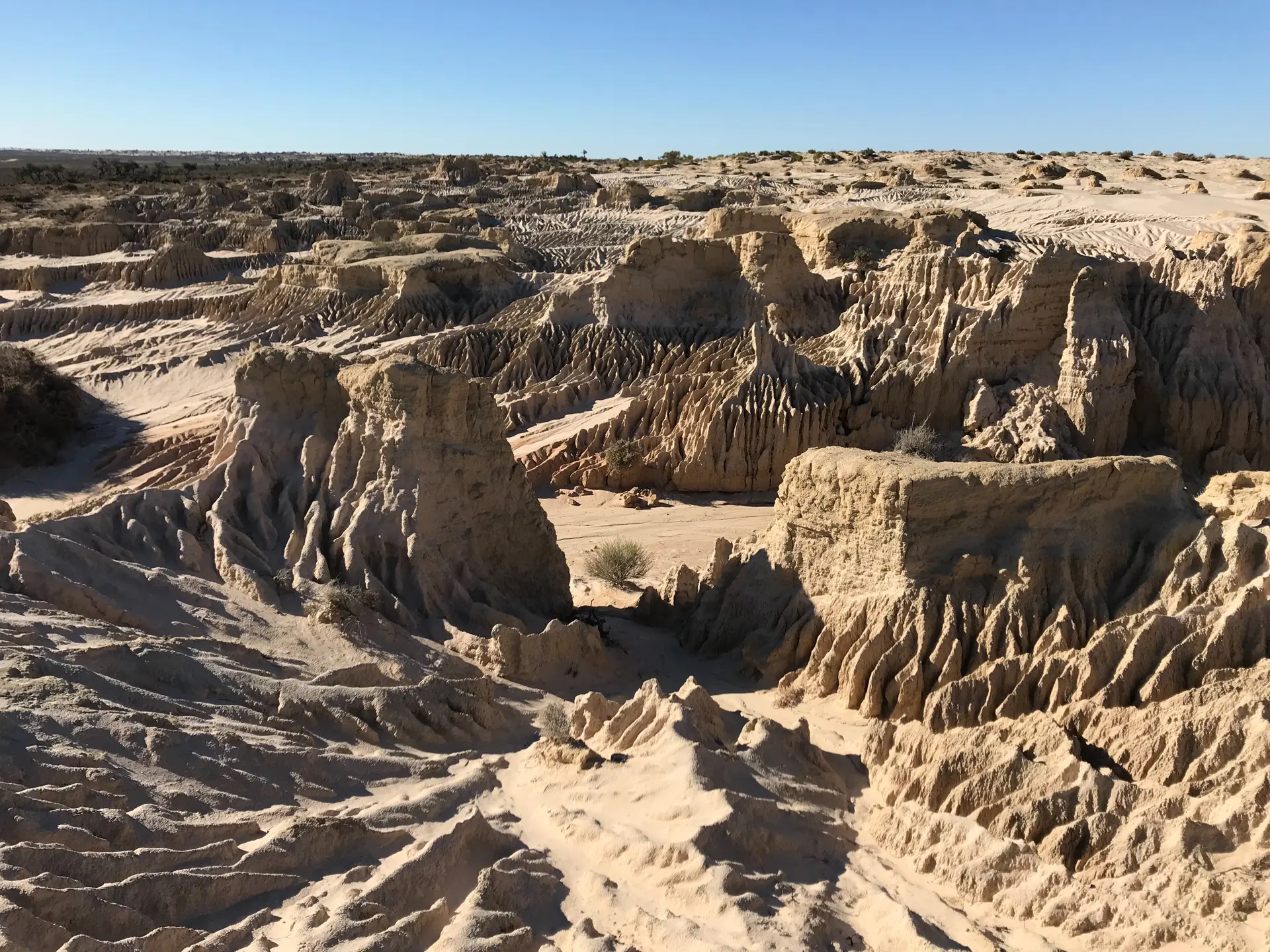
Lake Mungo
Willandra Lakes, New South Wales, Australia
273.0 km away

Wilpena Pound
Pastoral Unincorporated Area, South Australia, Australia
353.0 km away

Wabma Kadarbu Mound Springs
Oodnadatta Track, South Australia, Australia
564.0 km away
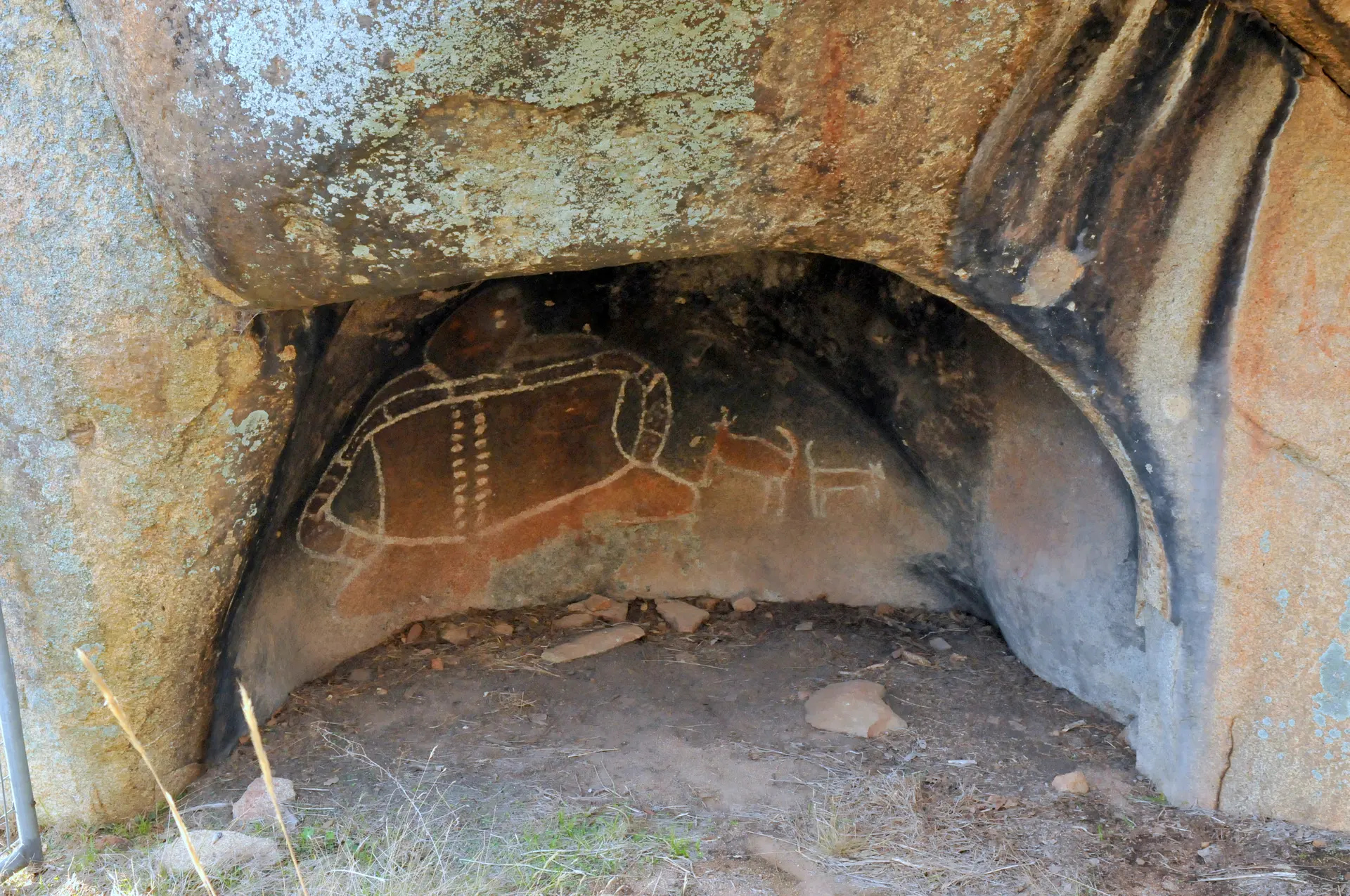
Bunjil's Shelter
Stawell / Black Range, Victoria, Victoria, Australia
641.5 km away
References
Sources consulted for this page. Source categories describe the publication, not a guarantee that every claim is verified. Traditional accounts and outside interpretations may differ.
- 01Mutawintji Historic Site — NSW National Parks and Wildlife ServiceofficialPrimary official park authority page; states guided-tour-only access policy and describes rock art collection.
- 02Mutawintji Historic Site — Learn more — NSW National Parks and Wildlife ServiceofficialDetails ceremonial history (initiations, rainmaking, gatherings of up to 1,000 people) and living cultural use.
- 03Mutawintji National Park joint management program — NSW National Parks and Wildlife ServiceofficialDescribes the Mutawintji Board of Management structure and joint management activities.
- 04Mutawintji Lands Plan of Management — NSW Department of Planning, Environment and HeritageofficialOfficial statutory land management plan; referenced but not fully fetched in this research pass.
- 05Mutawintji — NSW Aboriginal Land Council — NSW Aboriginal Land CouncilSource contextStatement from the peak Aboriginal land council body on the Mutawintji Local Aboriginal Land Council; confirms 1998 land handback as first of its kind in NSW.
- 06Mutawintji LALC: Sustainable Tourism — NSW Aboriginal Land CouncilSource contextDiscusses Mutawintji LALC's tourism officer role and Aboriginal employment as guides.
- 07Mutawintji cultural tour — NSW National Parks and Wildlife ServiceofficialDescribes the guided tour product, duration, and content (audio-visual display, campfire yarn, Dreamtime stories shared by Aboriginal guides).
- 08Native title and Joint Management arrangements for protected areas in New South Wales — AIATSISacademicReferenced in search results as covering NSW joint management case studies including Mutawintji; not fully fetched in this pass.
- 09Mutawintji National ParkacademicGeneral encyclopedic overview; geography, rock art description, 1998 joint management history.
- 10Mutawintji Historic Site — Mutawintji Heritage ToursSource contextAboriginal-guide-operated tourism business affiliated with the site; describes guided tour structure and site names (Kuluwirru yapa, Ngalkirrika).
- 11About Mutawintji National Park — Mutawintji Cultural FestivalSource contextCommunity festival page; reiterates cultural significance and notes access restrictions preserve cultural values.
- 12MUTAWINTJI: Aboriginal Cultural Association with Mutawintji National ParkacademicOfficial Aboriginal Land Rights research report; PDF could not be parsed in this research session (returned as unreadable binary), so content not incorporated beyond the title/existence.
Share a photo
Help visitors recognize Mutawintji Historic Site. Every submission is reviewed before publication.