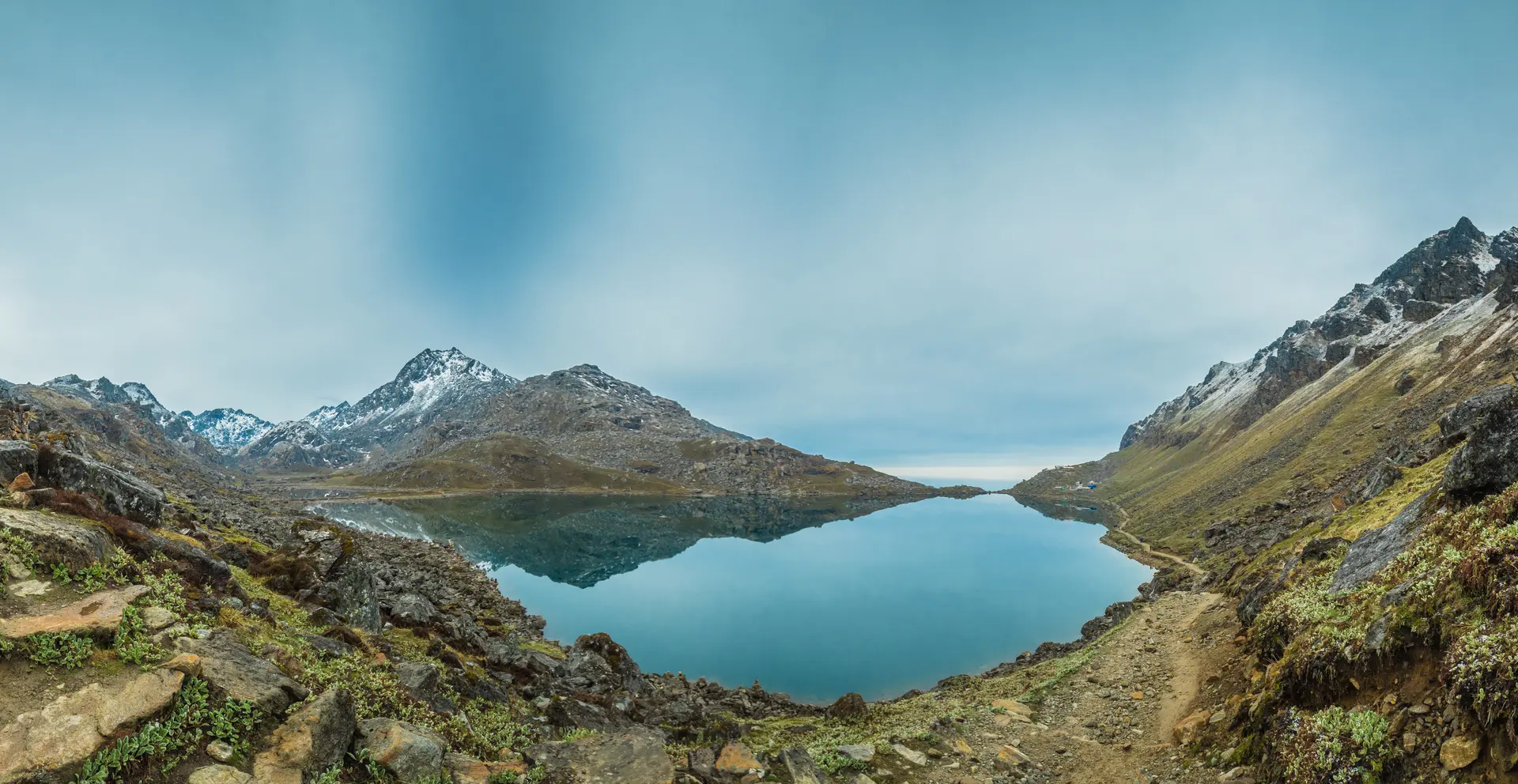
Mt. Targo and Lake Dangra
Tibet's oldest sacred landscape, where a divine mountain and holy lake have been married since before Buddhism
Targo, Tibet, China
Plan this visit
Practical context before you go
One day at the lake after four to five days of travel from Lhasa is the absolute minimum. Two to three days at the lake allows absorption of the landscape and visits to Wenbunan Village and Yuben Temple. One to two weeks for the complete round trip from Lhasa, including acclimatization stops.
Dangra Yumco is in Nyima County, Nagqu Prefecture, Tibet Autonomous Region, approximately 100 km from Nyima County town. Tibet Travel Permit is required for all foreign visitors. Additional Alien's Travel Permit is required for Nyima County. Military permit may also be required. No public transport exists. Access is by private 4WD vehicle only over rough roads. No fuel stations near the lake; carry sufficient fuel. The drive from Lhasa via National Highway 317 takes four to five days with stops. No phone signal in most of the area. No medical facilities anywhere near the lake.
Dangra Yumco is sacred to the Bon religion. Approach with great respect for both the spiritual tradition and the fragile environment. Follow counterclockwise direction when circumambulating. Ask permission before photographing villagers or religious activities. Do not pollute the lake.
At a glance
- Coordinates
- 31.0000, 86.6331
- Suggested duration
- One day at the lake after four to five days of travel from Lhasa is the absolute minimum. Two to three days at the lake allows absorption of the landscape and visits to Wenbunan Village and Yuben Temple. One to two weeks for the complete round trip from Lhasa, including acclimatization stops.
- Access
- Dangra Yumco is in Nyima County, Nagqu Prefecture, Tibet Autonomous Region, approximately 100 km from Nyima County town. Tibet Travel Permit is required for all foreign visitors. Additional Alien's Travel Permit is required for Nyima County. Military permit may also be required. No public transport exists. Access is by private 4WD vehicle only over rough roads. No fuel stations near the lake; carry sufficient fuel. The drive from Lhasa via National Highway 317 takes four to five days with stops. No phone signal in most of the area. No medical facilities anywhere near the lake.
Pilgrim tips
- Dangra Yumco is in Nyima County, Nagqu Prefecture, Tibet Autonomous Region, approximately 100 km from Nyima County town. Tibet Travel Permit is required for all foreign visitors. Additional Alien's Travel Permit is required for Nyima County. Military permit may also be required. No public transport exists. Access is by private 4WD vehicle only over rough roads. No fuel stations near the lake; carry sufficient fuel. The drive from Lhasa via National Highway 317 takes four to five days with stops. No phone signal in most of the area. No medical facilities anywhere near the lake.
- Practical clothing for extreme altitude and weather, including sun, wind, and cold that may arrive in the same day. Respectful attire when visiting Yuben Temple or interacting with villagers.
- Ask permission before photographing villagers or religious activities. Landscape photography is generally acceptable. Do not photograph inside Yuben Temple without explicit permission.
- This is a culturally sensitive site, one of the last places where Bon practice continues in relatively undiluted form. Visitors should observe rather than participate in rituals unless specifically invited. Do not pollute the lake; it is considered a living deity. Do not collect water without appropriate respect. The community's goodwill is earned through respectful behavior, not assumed.
Pilgrim glossary
- Sutra
- A canonical Buddhist scripture, often chanted as part of practice.
Continue exploring
Overview
Dangra Yumco and Dargo Mountain form a sacred married couple in the Bon tradition, Tibet's pre-Buddhist indigenous religion. The lake is the wife, the mountain is the husband, and their union sustains the land. This is the heartland of the ancient Zhangzhung Kingdom, where Bon originated, where Tibet's spiritual identity was formed before Buddhism arrived. Wenbunan Village, on the southern shore, may be the closest surviving community to the original Bon way of life.
Dangra Yumco is the largest and most sacred lake of the Bon religion, the tradition that held Tibet before Buddhism. The lake stretches twenty-six kilometers long across the Changtang Plateau at an elevation of approximately 4,528 meters, its turquoise waters set against barren brown mountains with an intensity that photographs fail to convey.
In Bon understanding, the lake and mountain are not separate sacred sites but a single divine entity. Dargo Mountain, with its pyramid-like peaks rising to 6,344 meters on the southern shore, is the husband. Tangra Yumco, the lake, is the wife. Together they brought barley to the people and taught them to cultivate the land. Their union is the source of all fertility and sustenance in the region. This is not metaphor. The local community's relationship with the landscape is directly reciprocal: offerings maintain the relationship, and neglect would bring drought and disaster.
The area around the lake is traditionally identified with the Zhangzhung Kingdom, the political and religious center of Bon before the spread of Buddhism in Tibet. When the Tibetan Empire absorbed Zhangzhung in the seventh century and later converted to Buddhism, the Dangra Yumco region preserved Bon traditions that were suppressed elsewhere. Wenbunan Village on the southern shore maintains Bon practices in a relatively undiluted form. The Yuben Temple, a cave monastery on a cliff above the lake, is one of the oldest surviving Bon monasteries.
This is one of the least accessible sacred sites on earth. Days of overland travel across the high plateau are required to reach it. There are no tourist facilities, no interpretive signs, no other visitors. The silence is total.
Context and lineage
Dangra Yumco and Dargo Mountain are the most sacred landscape of the Bon religion, Tibet's indigenous pre-Buddhist tradition. The area is associated with the ancient Zhangzhung Kingdom, the political and religious center of Bon before its absorption by the Tibetan Empire in the seventh century.
In the creation time, Dargo Mountain, the husband, stood as guardian over the vast waters of Tangra Yumco, the wife. Together they brought barley to the people and taught them to cultivate the land. Their union is the source of all fertility and sustenance in the region. The herders and farmers who live beside the lake are the beneficiaries of this divine marriage, and their rituals maintain the reciprocal relationship that sustains both human and sacred life.
The area around the lake was the heartland of the Zhangzhung Kingdom, the political and spiritual center of pre-Buddhist Tibet. Zhangzhung was the cradle of the Bon religion, the tradition that shaped Tibetan spiritual life before Buddhism arrived. When the Tibetan Empire absorbed Zhangzhung in the seventh century and later converted to Buddhism, the Dangra Yumco region preserved what was suppressed elsewhere.
The Bon lineage at Dangra Yumco traces from the Zhangzhung Kingdom through centuries of continuous practice at Wenbunan Village and the Yuben Temple cave monastery. Whether this represents an unbroken transmission or a tradition that was interrupted and revived remains a scholarly question, but the community's current relationship with the sacred landscape is undeniably living.
Tonpa Shenrab Miwoche
founder
Legendary founder of the Bon religion, associated with the Zhangzhung Kingdom and, by extension, with this sacred landscape. Traditionally dated to c. 16,000 BC in Bon chronology, though the historicity of this dating is not accepted by scholars.
Dargo and Tangra Yumco
deity
The divine married couple: Dargo the mountain-husband and Tangra Yumco the lake-wife, whose union sustains the fertility of the land and the well-being of its people.
Why this place is sacred
Dangra Yumco and Dargo Mountain represent the oldest continuously sacred landscape in Tibet, sacred in the Bon tradition that predates Buddhism by millennia. The lake and mountain are understood as a living divine couple whose union sustains the land and its people.
The thinness of this place operates on registers that are difficult to separate. The altitude itself, over 4,500 meters, alters perception: the thin atmosphere slows thought, intensifies color, and creates a quality of light found nowhere at lower elevations. The remoteness strips away everything familiar. Days of travel across the high plateau, through landscapes without trees or buildings, prepare the visitor for an encounter with something that exists on its own terms.
But the deepest thinness is relational. In Bon understanding, the lake and mountain are not symbols of the sacred but are themselves sacred beings in ongoing relationship. Dargo guards the waters. Tangra Yumco nourishes the land. The herders of Wenbunan Village are not observers of this relationship but participants in it, their seasonal rituals maintaining the bond between human community and divine landscape. The offering of juniper smoke at dawn is not a gesture toward an absent god but a greeting to a present one.
The association with the Zhangzhung Kingdom adds historical depth to the experiential encounter. This is where Bon originated, where Tibet's pre-Buddhist spiritual identity was shaped. The traditions practiced at Wenbunan have roots that may extend back thousands of years, preserved through isolation and devotion in one of the most remote inhabited places on earth.
The counterclockwise circumambulation of the lake, following Bon tradition, which runs opposite to Buddhist practice, is a bodily reminder that this is a different spiritual world from the Buddhist Tibet most visitors know. Here, the older tradition holds.
The lake and mountain have been sacred in the Bon tradition since before recorded history. They are understood as a divine married couple whose union sustains fertility, health, and the spiritual well-being of the surrounding community. The Zhangzhung Kingdom, which had its center in this region, was the political expression of this sacred relationship.
The absorption of the Zhangzhung Kingdom by the Tibetan Empire in the seventh century and the subsequent spread of Buddhism across Tibet marginalized Bon practice in most regions. Dangra Yumco's extreme remoteness allowed it to preserve Bon traditions that were suppressed or syncretized elsewhere. The Yuben Temple cave monastery has maintained Bon practice across centuries. Contemporary Wenbunan villagers continue the seasonal rituals directed toward the lake and mountain. However, the extent to which current practices represent an unbroken tradition or a revival remains a scholarly question.
Traditions and practice
Bon practices at Dangra Yumco include counterclockwise circumambulation of the lake, seasonal agricultural rituals directed toward the mountain and lake, juniper smoke offerings at dawn, and maintenance of the Yuben Temple cave monastery. Visitors should observe rather than participate unless specifically invited.
The counterclockwise circumambulation of the lake follows Bon tradition, which runs opposite to Buddhist clockwise practice. This is not incidental but fundamental: the direction of movement marks this as Bon territory. Leftward sutra wheel spinning is similarly distinctive. Spring plowing sacrifices directed toward the lake and mountain ask for fertility and rain. Autumn harvest thanksgiving rituals acknowledge what was given. Water collected from the lake for purification and blessing carries the lake-goddess's power into the household. Sang offerings of juniper at dawn facing the lake are daily practice, the smoke carrying prayers upward.
Seasonal agricultural rituals are maintained by Wenbunan villagers. Bon religious services continue at Yuben Temple with a small resident community. Daily household Bon practices in Wenbunan include prayers and offerings directed toward the lake and mountain. Herder rituals for livestock health and fertility maintain the relationship between human livelihood and sacred landscape. Occasional visits by Bon practitioners from other parts of Tibet connect this isolated community to the wider Bon tradition.
Approach the lake in silence and with awareness that you are in the presence of a living deity. Remove your hat. Watch the light on the water at dawn, when the turquoise deepens and the mountain's reflection is clearest.
If you circumambulate the lake, follow the counterclockwise direction that Bon tradition prescribes. The full kora takes several days.
Observe the villagers' relationship with the landscape. The sang offerings of juniper smoke at dawn are not performances but daily conversation with the sacred. If invited to share tea or food, accept with gratitude. Offer a kata (white scarf) as a gift.
Sit at the lakeshore and allow the silence to work. At this altitude and in this remoteness, the thin atmosphere itself becomes a medium for altered perception. The lake is over 200 meters deep in places. Consider what depth means here, where surface and symbol are inseparable.
Bon Religion
ActiveDangra Yumco is the largest and most sacred lake of the Bon religion, Tibet's indigenous pre-Buddhist tradition. The lake and Dargo Mountain form a divine married couple whose union sustains the fertility of the land. The area is associated with the Zhangzhung Kingdom, the political and religious center of Bon. Wenbunan Village is considered the heartland of Bon traditions. The Yuben Temple cave monastery is among the oldest surviving Bon monasteries.
Counterclockwise circumambulation of the lake. Seasonal agricultural sacrifices before spring plowing and after autumn harvest. Leftward sutra wheel spinning. Sang offerings of juniper at dawn. Water collection from the lake for purification. Rituals directed toward Dargo Mountain as the male protector deity. Maintenance of the Yuben Temple cave monastery.
Experience and perspectives
Reaching Dangra Yumco is itself a transformative ordeal: days of driving across the high plateau at altitudes that thin the blood and slow the mind. What awaits is one of the least visited sacred sites on Earth, where a turquoise lake and pyramid-peaked mountain exist in a silence that is total.
The journey to Dangra Yumco strips away everything familiar. From Lhasa, the drive takes four to five days via National Highway 317, crossing passes above 5,000 meters, traversing landscapes of such vastness that the human becomes very small. The road deteriorates as you approach Nyima County, and the final stretch to the lake is unpaved and unmarked. A four-wheel-drive vehicle and an experienced driver are not optional.
Arrival brings the visual shock first. The turquoise of the lake against the brown plateau is of an intensity that seems wrong, as if the color has been artificially heightened. It has not. At this altitude, with this atmosphere and this mineral composition, the water is simply that blue. Dargo Mountain's pyramid-like peaks rise behind the southern shore, sometimes reflected in the lake's surface with mirror precision.
Then the silence registers. There is no traffic, no tourism infrastructure, no crowd noise, no aircraft overhead. The wind is the dominant sound, and when it stops, the silence is so complete that the body becomes aware of its own internal noise: heartbeat, breathing, the ringing that ears produce in the absence of external stimulus.
Wenbunan Village, a handful of traditional Tibetan stone buildings on the southern shore, offers an encounter with a community that maintains Bon practices as a living daily reality, not a cultural performance. The residents herd livestock, tend the land, and direct their spiritual life toward the lake and mountain with the same matter-of-fact attention they give to any essential task.
The Yuben Temple, set in a natural cave on a cliff face above the lake, is reached by a steep and informal path. The cave contains ancient Bon religious objects and texts. The view from the temple entrance, looking out over the lake toward the mountain, is among the most extraordinary vistas in Tibet.
This is not a site for casual visitors. Reaching Dangra Yumco requires a minimum commitment of one to two weeks for the round trip from Lhasa, significant physical conditioning for high altitude, and arrangements for an experienced guide, driver, and fully self-sufficient camping equipment. No facilities exist at the lake. The reward is an encounter with something genuinely ancient and unmediated.
Dangra Yumco exists at the intersection of living spiritual tradition and scholarly investigation of Tibet's pre-Buddhist past. What can be known is limited by the site's extreme remoteness and the privacy of its religious community.
Dangra Yumco's significance in Bon religion is well recognized in Tibetan studies, though detailed research is limited by the site's extreme remoteness. The connection to the Zhangzhung Kingdom is supported by archaeological and literary evidence, but much about Zhangzhung remains poorly understood. Scholars note that Bon practices at Dangra Yumco preserve elements that have been lost or transformed elsewhere in Tibet. The lake's association with pre-Buddhist religion makes it significant for understanding Tibet's spiritual history before the Buddhist conversion of the seventh and eighth centuries.
For the Bon practitioners of Wenbunan Village, Dangra Yumco and Dargo Mountain are not symbols or historical relics but living deities whose well-being is inseparable from the community's survival. The rituals performed for the lake and mountain are essential acts that maintain the relationship between humans and the sacred landscape. The counterclockwise circumambulation is a bodily reminder that this is Bon territory, the older tradition that has held this land sacred since before Buddhism came to Tibet.
The extreme remoteness and altitude of Dangra Yumco attract interest from those seeking the most untouched sacred sites on Earth. The lake's extraordinary color and the pyramid-shaped mountain peaks have generated esoteric interpretations. Some spiritual seekers view the Changtang Plateau as a repository of ancient earth energies.
The full history and extent of the Zhangzhung Kingdom remains largely unrecovered. The original form of Bon practice before contact with Buddhism is unclear, as much of what is now called Bon has been influenced by Buddhism over centuries. Whether the lake level has changed significantly over time and how this may have affected the sacred landscape is unknown. The complete contents of the Yuben Temple have been extremely difficult for researchers to access. Whether Wenbunan's Bon practices represent an unbroken tradition or a revival remains an open question.
Visit planning
Dangra Yumco is one of the most remote sacred sites on Earth, located in Nyima County on the Changtang Plateau. Access requires a Tibet Travel Permit, additional military permits, a private 4WD vehicle, and four to five days of driving from Lhasa. No tourist facilities exist. June through August is the only reliable access window.
Dangra Yumco is in Nyima County, Nagqu Prefecture, Tibet Autonomous Region, approximately 100 km from Nyima County town. Tibet Travel Permit is required for all foreign visitors. Additional Alien's Travel Permit is required for Nyima County. Military permit may also be required. No public transport exists. Access is by private 4WD vehicle only over rough roads. No fuel stations near the lake; carry sufficient fuel. The drive from Lhasa via National Highway 317 takes four to five days with stops. No phone signal in most of the area. No medical facilities anywhere near the lake.
No formal accommodation exists. Camping with your own equipment is necessary. A basic homestay in Wenbunan Village may be possible by prior arrangement through a guide. No running water, no electricity in the village. The nearest hotels are in Nyima County town, approximately 100 km away. Travelers must be entirely self-sufficient.
Dangra Yumco is sacred to the Bon religion. Approach with great respect for both the spiritual tradition and the fragile environment. Follow counterclockwise direction when circumambulating. Ask permission before photographing villagers or religious activities. Do not pollute the lake.
The fundamental etiquette is humility. You are a guest in a sacred landscape maintained by a community that has held it sacred for millennia. The remoteness of Dangra Yumco filters visitors to those with genuine intention, but the responsibility of that intention is to the place and its people.
Follow the counterclockwise direction when moving around the lake or any sacred site, respecting Bon practice. Do not disturb mani stones, prayer flags, or ritual objects. Do not collect water from the lake without understanding that you are taking from a living deity. Do not leave non-biodegradable offerings or waste.
Practical clothing for extreme altitude and weather, including sun, wind, and cold that may arrive in the same day. Respectful attire when visiting Yuben Temple or interacting with villagers.
Ask permission before photographing villagers or religious activities. Landscape photography is generally acceptable. Do not photograph inside Yuben Temple without explicit permission.
Juniper incense for sang offerings is appropriate. Kata (white scarves) as gifts when visiting. Do not leave non-biodegradable offerings.
Follow counterclockwise direction when circumambulating. Do not pollute the lake. Do not disturb ritual objects. Do not collect water from the lake without appropriate respect.
Nearby sacred places
Sacred places within a half-day’s reach. Pilgrims often visit them together: walk one, stay for the other.
Key questions
What pilgrims usually ask
- Why is Mt. Targo and Lake Dangra considered sacred?
- Dangra Yumco and Dargo Mountain form the holiest landscape in Bon religion, a divine couple sustaining life on Tibet's Changtang Plateau.
- What should I wear at Mt. Targo and Lake Dangra?
- Practical clothing for extreme altitude and weather, including sun, wind, and cold that may arrive in the same day. Respectful attire when visiting Yuben Temple or interacting with villagers.
- Can I take photos at Mt. Targo and Lake Dangra?
- Ask permission before photographing villagers or religious activities. Landscape photography is generally acceptable. Do not photograph inside Yuben Temple without explicit permission.
- How long should I spend at Mt. Targo and Lake Dangra?
- One day at the lake after four to five days of travel from Lhasa is the absolute minimum. Two to three days at the lake allows absorption of the landscape and visits to Wenbunan Village and Yuben Temple. One to two weeks for the complete round trip from Lhasa, including acclimatization stops.
- How do you visit Mt. Targo and Lake Dangra?
- Dangra Yumco is in Nyima County, Nagqu Prefecture, Tibet Autonomous Region, approximately 100 km from Nyima County town. Tibet Travel Permit is required for all foreign visitors. Additional Alien's Travel Permit is required for Nyima County. Military permit may also be required. No public transport exists. Access is by private 4WD vehicle only over rough roads. No fuel stations near the lake; carry sufficient fuel. The drive from Lhasa via National Highway 317 takes four to five days with stops. No phone signal in most of the area. No medical facilities anywhere near the lake.
- What offerings are appropriate at Mt. Targo and Lake Dangra?
- Juniper incense for sang offerings is appropriate. Kata (white scarves) as gifts when visiting. Do not leave non-biodegradable offerings.
- What etiquette should visitors follow at Mt. Targo and Lake Dangra?
- Dangra Yumco is sacred to the Bon religion. Approach with great respect for both the spiritual tradition and the fragile environment. Follow counterclockwise direction when circumambulating. Ask permission before photographing villagers or religious activities. Do not pollute the lake.
- What is the history of Mt. Targo and Lake Dangra?
- In the creation time, Dargo Mountain, the husband, stood as guardian over the vast waters of Tangra Yumco, the wife. Together they brought barley to the people and taught them to cultivate the land. Their union is the source of all fertility and sustenance in the region. The herders and farmers who live beside the lake are the beneficiaries of this divine marriage, and their rituals maintain the reciprocal relationship that sustains both human and sacred life. The area around the lake was the heartland of the Zhangzhung Kingdom, the political and spiritual center of pre-Buddhist Tibet. Zhangzhung was the cradle of the Bon religion, the tradition that shaped Tibetan spiritual life before Buddhism arrived. When the Tibetan Empire absorbed Zhangzhung in the seventh century and later converted to Buddhism, the Dangra Yumco region preserved what was suppressed elsewhere.