Mt. Kofinas Minoan Peak Sanctuary, Crete
Crete's highest southern summit, where Minoan boxers left clay gloves among the gods
Understand sacred places, explore living traditions, and learn how to engage respectfully with Pilgrim Map.
Access has not been verified. Check current local guidance before planning a visit.
Kofinas Municipal Unit, Crete, Greece
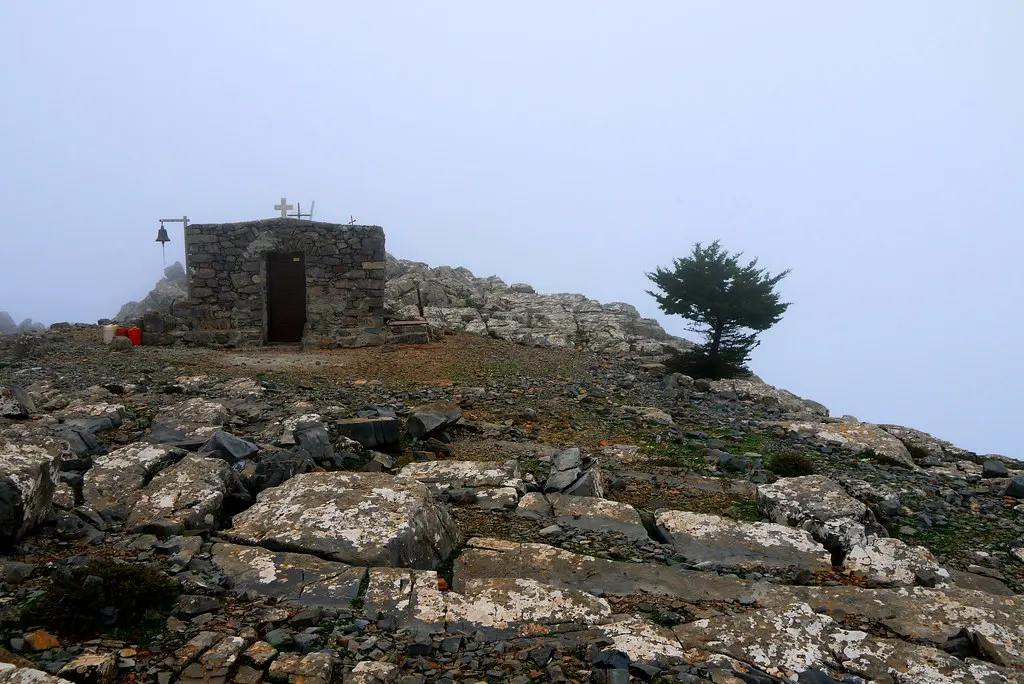
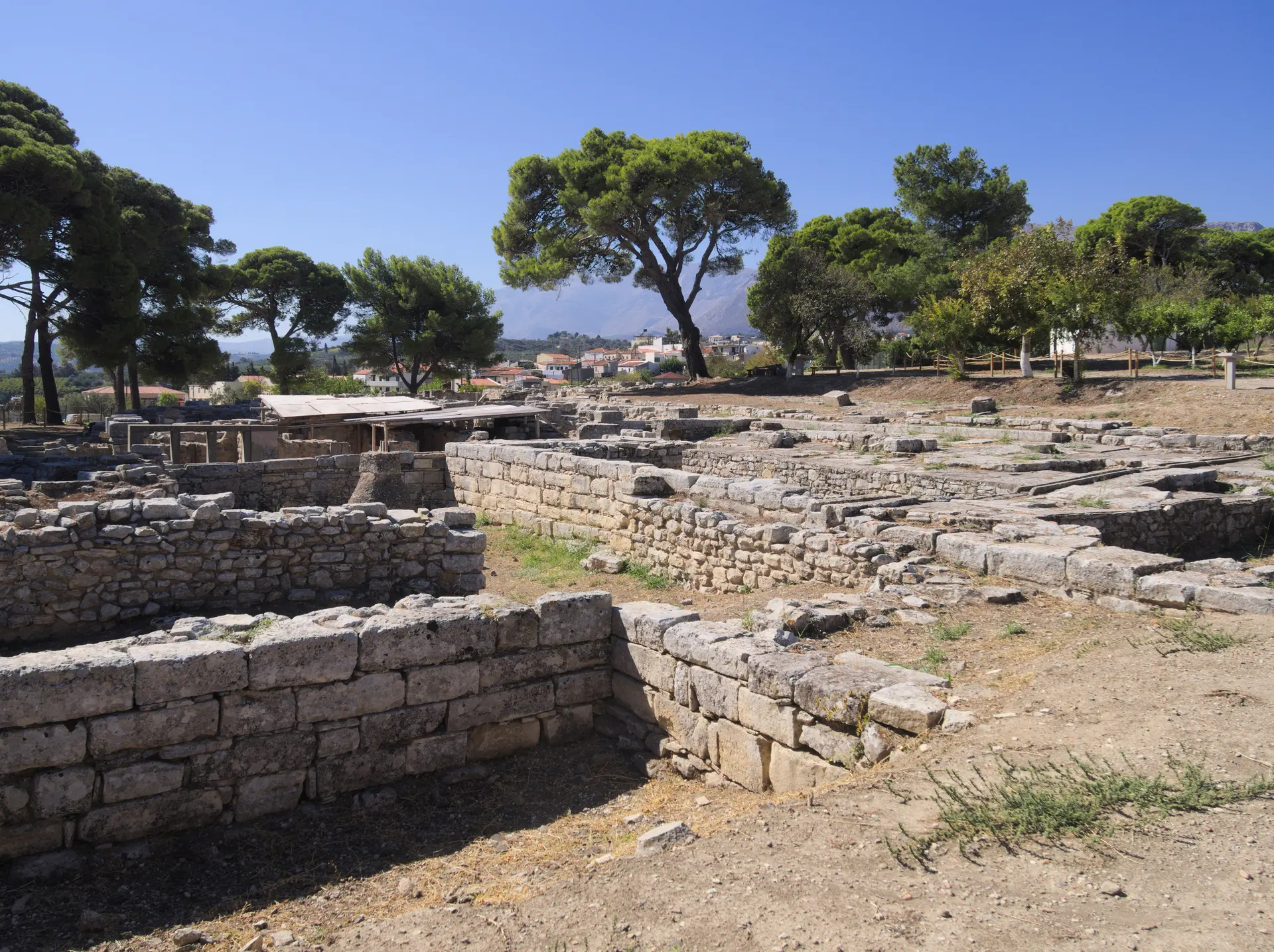
Image of Mt. Kofinas Minoan Peak Sanctuary, Crete. Image source
Visit essentials
A quick read before you go
- Duration
- Allow 4 to 4.5 hours round trip from the Panagia church trailhead via the main trail.
- Access
- The main approach is from Kapetaniana village in the Asterousia Mountains, located about 90…
Overview
South of the Messara Plain and beyond the Asterousia foothills' last villages, Kofinas rises like an inverted basket. The Minoans knew it as the highest point between the fertile plain and the Libyan Sea. Minoans built a formal sanctuary below the summit and filled rock crevices with thousands of clay figures: men in loincloths and headwear, cattle, circle dancers, and clay boxing gloves found at almost no other Minoan site in such concentration.
As a peak sanctuary, Kofinas received offerings at the boundary of earth and sky, but it was not merely local. Roughly 25,000 votive fragments from two excavations, a formal quadrilateral enclosure, and communal-feasting evidence place it among the Neopalatial period's major built sanctuaries with Juktas, Traostalos, and Vrysinas. Overlooking the entire south coast and Messara, it was visually and ritually connected to the Palace of Phaistos, oriented toward the Asterousia range.
Nearly four millennia later, the summit still draws people upward, and the chapel of Timios Stavros, dedicated to the Holy Cross, occupies the peak. Each September 14, Kapetaniana villagers preserve an ancient tree-worship rite within Orthodox Christian practice. They gather tiny 'apples of Kofinas' from three small hillside trees, soak them overnight, have a priest bless them the next morning, and eat them for healing instead of holy bread.
Scholars call this one of Greece's clearest survivals of pre-Christian sacred practice: the mountain remains sacred though its sacred names have changed.
Why this place is sacred
Stand on the summit of Kofinas and the geography becomes a diagram of threshold. To the north, the Messara Plain stretches flat and green, the agricultural heartland of Crete since the Bronze Age, where the Palace of Phaistos once administered the largest grain-producing region on the island. To the south, the Asterousia range drops toward the Libyan Sea, and on clear days the coast of Africa is visible along the horizon.
Every cape and cove of southern Crete is visible from east to west. Above is sky. Below is stone and wind and scrub. There is nothing subtle about the position. It is the place where everything converges and nothing obstructs.
The Minoans who built the sanctuary at Metzolako, just north of the summit, understood this convergence in their own terms. Peak sanctuaries were not incidental to Minoan religion but central to it. These elevated precincts served as places where the human world could reach toward the divine, and the concentration of offerings at Kofinas suggests that this particular summit carried extraordinary significance. Over 25,000 votive fragments deposited in rock crevices represent not just devotion but sustained, communal investment across generations.
People carried clay figurines up the mountain, wedged them into cracks in the limestone, and left them there. The crevices became archives of intention.
What deepens the thinness beyond archaeology is continuity. Worship at Kofinas did not end with the Minoans. It continued, with intervals, through the Roman era. At some point the summit was Christianised with the chapel of Timios Stavros. And the September 14 festival, with its blessing of wild fruit from three sacred trees, carries forward a practice that has no Christian origin. The apples of Kofinas are not mentioned in any liturgical text.
They belong to the mountain itself, to a relationship between humans and this particular summit that predates any doctrine.
The physical effort required to reach the peak adds its own dimension. The trail from Kapetaniana is steep, exposed, and windswept. There are no facilities, no shade, no water at the summit. The climb is not arduous by mountaineering standards, but it is real enough to separate the experience from casual visitation. By the time you reach the top, your body knows it has traveled somewhere. The Minoans who climbed here carrying clay figurines knew the same thing.
This combination, the position at the boundary of earth, sea, and sky, the depth of sacred use extending back nearly four millennia, the survival of pre-Christian ritual within living practice, and the physical demand of the ascent, gives Kofinas a quality of thinness that is earned rather than announced.
Kofinas functioned as a major Minoan peak sanctuary during the Neopalatial period, roughly 1700-1580 BCE. It served as a site of communal worship where communities from the Messara Plain and surrounding settlements ascended to deposit votive offerings, perform ritual feasting, and possibly conduct or commemorate ritual athletic competitions. The sanctuary's formal architecture, including a quadrilateral enclosure and stage, places it among the elite built peak sanctuaries connected to palatial authority.
Its visual relationship with the Palace of Phaistos suggests it operated as a key node in the sacred geography of south-central Minoan Crete.
The sanctuary's peak of activity falls in the Middle Minoan III period, confirmed by pottery analysis from both the 1961 and 1990 excavations. Worship continued with intervals into the Roman era, though the nature of later cult activity remains poorly documented. The summit was Christianised at an unknown date with the construction of the chapel of Timios Stavros, dedicated to the Holy Cross.
The September 14 feast of the Elevation of the Holy Cross became the occasion for an annual pilgrimage that preserves elements of pre-Christian tree worship, the blessing of the apples of Kofinas, a rite that scholars identify as one of the few surviving examples of such practice in Greece. The archaeological discovery of the peak sanctuary in 1960, followed by excavations in 1961 and 1990, revealed the scale of Minoan activity.
In 2020, the Asterousia Mountain Range, including Kofinas as its highest peak, was designated a UNESCO Biosphere Reserve under the Man and Biosphere Programme, recognising both the ecological and cultural significance of the landscape.
Experience and orientation
The approach begins before the trail does. The drive from the Messara Plain south into the Asterousia foothills takes you through a landscape that sheds human presence with every kilometer. The villages grow smaller. The road deteriorates. Past Kapetaniana, the last settlement with services, a dirt track continues to the church of Panagia, where most hikers leave their vehicles. A 4x4 vehicle is strongly recommended for this final stretch; the road is rocky and rutted.
From the Panagia church, the trail climbs through the ravine of the Valaha stream, initially following a clear path through scrubland. The Asterousia landscape is stark and wild, described by some writers as the Mount Athos of Crete for its quality of austere isolation. Griffon vultures circle the thermals. The vegetation is low and aromatic, herbs and thorny shrubs adapted to the thin soil and constant wind.
As you gain elevation, the trail passes the chapel of Panagia Kera, a small devotional waypoint that offers a moment of rest and orientation.
The final ascent to the summit is the most demanding section. The trail steepens considerably, and the exposure increases as the ridge narrows. The wind, which may have been manageable lower down, often intensifies near the top. The rocky terrain requires careful footing. This is not a maintained tourist path but a mountain trail in the traditional sense, and it should be treated with appropriate respect.
And then you arrive. The summit of Kofinas is compact, wind-battered, and extraordinary. The tiny chapel of Timios Stavros occupies the highest point, its whitewashed walls a bright contrast against the grey stone and blue sky. The Minoan sanctuary site is located at Metzolako, slightly north of the summit, where the remains of the quadrilateral enclosure can be discerned among the rocks.
The archaeological excavation areas are not marked or interpreted on-site; what you see are rock crevices, some of which once held thousands of clay figurines now housed in the Heraklion Archaeological Museum.
The views require no interpretation. To the north, the Messara Plain unfolds, the largest flat area in Crete, where you can trace the position of Phaistos and Agia Triada. To the south, the Asterousia range drops dramatically toward the Libyan Sea. Every cape and cove of the south coast is visible, from Tris Ekklisies in the east to Lendas and Kali Limenes in the west. On exceptional days, the coast of Libya is a faint line on the southern horizon.
The sense of standing at a meeting point between worlds, agricultural plain and wild sea, human settlement and elemental exposure, is immediate and physical.
Spend time here. The summit is small enough that you can walk its entire perimeter in minutes, but the experience deepens with patience. Notice the wind. Notice the rock. Consider that the crevices around you once held clay figures of men with loincloths and boxing gloves, cattle figurines, miniature boats, and gold beads.
Consider that nearly four thousand years ago, people climbed this same mountain with offerings in their hands, moved by impulses that we can name but perhaps not fully explain.
If you visit on September 14, the experience transforms entirely. Villagers from Kapetaniana and the surrounding communities hike to the summit on the eve of the feast, gathering the tiny fruit of the three sacred trees on the hillside. The fruit is left in water overnight, and the next morning the priest blesses it during the liturgical service at the chapel. The blessed apples of Kofinas are distributed to worshippers, who eat them for their healing properties.
This is not reenactment or heritage tourism. It is a living practice with roots that scholars trace to pre-Christian antiquity.
Approach Kofinas as a pilgrimage, not a hike. The physical effort is part of the meaning. Start early to avoid afternoon heat and to allow unhurried time at the summit. Bring everything you need: water, food, sun protection, a windproof layer. There is nothing at the top except the chapel, the ruins, and the view. At the summit, visit the chapel first, then walk to the Metzolako area slightly north to contemplate the sanctuary site.
Stand at the edge and look both north and south. Allow the position to register, the convergence of plain, mountain, and sea that made this peak sacred. If you have the good fortune to visit on September 14, participate with respect and openness. The locals welcome those who have made the climb.
Context and lineage
The origins of worship at Kofinas reach into the broader Minoan tradition of peak sanctuaries that emerged across Crete around 2100-2000 BCE. These elevated precincts reflected an agricultural and pastoral society's impulse to commune with weather and sky deities from the highest available vantage points. At 1,231 metres, Kofinas was the highest peak visible from the Messara Plain, the breadbasket of Minoan Crete, making it a natural focus for these devotions.
The name Kofinas derives from the Greek word kofini, meaning basket, a reference to the mountain's distinctive conical shape resembling an inverted basket. This shape may have carried symbolic significance for the Minoans, though the connection remains speculative. What is not speculative is the mountain's visual prominence: from the Palace of Phaistos, the Asterousia range forms the southern horizon, and Kofinas would have been the most conspicuous peak in that panorama.
The palace's orientation appears designed to incorporate views of the mountains into its architectural experience, suggesting an intimate ritual relationship between the lowland center of power and the highland sanctuary.
The September 14 tradition of the apples of Kofinas carries its own origin narrative, one that exists outside written texts and within local practice. Three particular trees on the hillside, identified locally as a species of small crab apple or related wild fruit, produce tiny berries the size of beans. Local tradition holds that these trees are unique to Kofinas and sacred.
Scholars who have studied the practice identify it as a survival of pre-Christian tree worship, one of the few such survivals documented in modern Greece. When exactly the Minoan peak sanctuary gave way to Christian devotion on the summit, no one can say with certainty. The continuity may not be direct. But the pattern, humans climbing this mountain to engage with something they recognise as sacred in the landscape itself, has persisted across nearly four millennia.
Kofinas belongs to the tradition of Minoan peak sanctuary worship, a distinctive form of Cretan Bronze Age religion in which communities carried offerings to elevated hilltop precincts to engage with divine forces associated with weather, sky, and the natural world. The sanctuary's formal architecture connects it to the Neopalatial period, the height of Minoan civilisation, when the major palaces of Knossos and Phaistos exerted control over extensive territories.
Among the approximately thirty known peak sanctuaries, Kofinas ranks alongside Juktas, Traostalos, and Vrysinas as one of the largest and most elaborately constructed. Its Christianisation with the chapel of Timios Stavros follows a pattern seen across Crete and the wider Greek world, where Christian worship absorbed and transformed pre-existing sacred sites. The September 14 tree-worship ritual represents a rare instance where a pre-Christian practice survived within this transformation, preserved in the rhythms of local Orthodox faith.
Nikolaos Platon
Ephor of Antiquities who, with Kostis Davaras, conducted the initial rescue excavation and surface gathering at the peak sanctuary in 1961. His work established the Middle Minoan III dating of the site and brought to light the first evidence of the extraordinary votive assemblage.
Alexandra Karetsou
Archaeologist who led the 1990 excavation that completed the investigation of the sanctuary, significantly expanding the known artifact assemblage and confirming the site's importance among Neopalatial peak sanctuaries. Co-author of 'Kophinas Revisited,' the primary academic publication on the sanctuary's cultic activity.
Giorgos Rethemiotakis
Co-director of the 1990 excavation alongside Karetsou. His collaboration produced the most comprehensive account of the sanctuary's structure, stratigraphy, and ritual function.
Alexia Spiliotopoulou
Ceramic specialist who conducted the preliminary pottery study of finds from both the 1961 and 1990 excavations, confirming the MM III dating and revealing evidence of food preparation vessels and ritual feasting at the sanctuary.
Kostis Davaras
Curator who assisted Platon in the 1961 rescue excavation. His early work at the site helped establish the significance of the peak sanctuary before the more comprehensive 1990 investigation.
Traditions and practice
The Minoans who climbed Kofinas brought offerings. The evidence for this is overwhelming in its volume: approximately 25,000 votive fragments recovered from the rock crevices of the Metzolako sanctuary, including over 3,000 catalogued anthropomorphic figurines. The human figures are predominantly male, adorned with belts, loincloths, and distinctive headwear, suggesting either worshippers presenting themselves before the deity or the deity's attendants. Animal figurines, mostly cattle, reflect the pastoral economy of the Messara Plain, where livestock was central to livelihood and identity.
What distinguishes Kofinas from other peak sanctuaries is the concentration of boxing glove figurines. These clay models of gloves worn in ritual combat appear at Kofinas in quantities not matched elsewhere, suggesting the sanctuary had a particular association with sacred athletics. Boxing and bull-leaping were intertwined with Minoan religious practice, as the palatial frescoes of Knossos demonstrate.
At Kofinas, the votive evidence suggests that either boxing contests took place at the sanctuary itself or that worshippers offered representations of these contests as acts of devotion.
Beyond figurines, the assemblage includes circle-dancing figurines, ceramic boat models that may relate to maritime protection rituals, offering tables used for food and liquid libations, miniature vessels, bronze tools and figurines, gold beads, and large quantities of pebbles whose significance remains debated. The pottery study by Spiliotopoulou revealed evidence of food preparation vessels, indicating that communal meals took place at the sanctuary.
Peak worship was not a solitary act of offering but a social event involving shared eating, drinking, and ritual performance on the mountain.
The September 14 feast of the Elevation of the Holy Cross is the living practice at Kofinas. On the eve of the feast, villagers from Kapetaniana and nearby communities begin the ascent to the summit, carrying supplies for the overnight gathering. Along the hillside, they collect the fruit of the three sacred trees, small berry-like apples no bigger than beans, known locally as militses or the apples of Kofinas. The gathered fruit is placed in water overnight.
The next morning, the priest celebrates the Divine Liturgy at the tiny chapel of Timios Stavros on the summit. During the service, the soaked fruit is blessed. It is then distributed to the faithful, who eat it for its believed healing properties, in place of or alongside the usual holy bread. Blessed bread is also distributed in the standard Orthodox manner.
This practice has no basis in Orthodox liturgical texts. Scholars identify it as a survival of pre-Christian tree worship, one of the few documented examples in modern Greece. The three trees from which the fruit is gathered are regarded locally as unique and sacred to the mountain.
Whether this represents an unbroken tradition from Minoan times or a later syncretic development remains an open question, but the structural parallel is striking: humans climbing to the summit of Kofinas to receive something sacred from the mountain itself.
If visiting outside the September 14 festival, approach the summit with the awareness that you are walking a path that Minoan worshippers walked nearly four thousand years ago. At the Metzolako sanctuary site, north of the summit, pause at the rock crevices that once held thousands of clay offerings. You will not see artifacts; they are in the Heraklion Archaeological Museum.
But you can see the landscape that gave the offerings their meaning: the Messara Plain below, the sea beyond, the sky above.
At the chapel of Timios Stavros, sit quietly. The building is small and simple. If the door is open, you may enter. The silence at the summit, broken only by wind, has a particular quality. Allow yourself to register the fact that you are standing at a place where the sacred has been continuously recognised, in different forms and under different names, for nearly four millennia.
If you are fortunate enough to visit on September 14, join the ascent with the local community. Participation is welcomed. Accept the blessed fruit if offered. This is not a performance for tourists but a living practice, and being present for it is a privilege.
Minoan Peak Sanctuary Worship
HistoricalKofinas was one of the most important peak sanctuaries of Neopalatial Crete, a formal hilltop precinct where Minoan communities deposited votive offerings to engage with divine forces. The approximately 25,000 figurine fragments, the quadrilateral enclosure with stage, and the evidence of communal feasting place it among the elite built sanctuaries alongside Juktas, Traostalos, and Vrysinas. The distinctive concentration of boxing glove figurines suggests a special association with ritual athletics.
Greek Orthodox Christianity
ActiveThe chapel of Timios Stavros on the summit of Kofinas represents the Christianisation of the ancient sacred peak. The September 14 feast of the Elevation of the Holy Cross is celebrated with a remarkable syncretic ritual: the blessing and distribution of the apples of Kofinas, wild fruit from three sacred trees on the hillside, consumed for healing. Scholars identify this practice as a survival of pre-Christian tree worship, one of the few such survivals in modern Greece.
Perspectives and open questions
Kofinas invites understanding as an archaeological site, a living place of worship, a node in Minoan sacred geography, and a landscape where the human impulse toward the sacred has expressed itself continuously across nearly four millennia.
Scholarly perspective
Scholarship recognises Kofinas as one of the major Neopalatial peak sanctuaries of Minoan Crete, alongside Juktas, Traostalos, and Vrysinas. These larger built sanctuaries are distinguished from the smaller, unbuilt peak sanctuaries by their formal architecture, including enclosure walls and stages, and by their association with palatial centres. The volume of votive offerings at Kofinas, estimated at approximately 25,000 fragments, places it among the richest peak sanctuary assemblages known.
The predominance of male figurines and the distinctive concentration of boxing glove votives have attracted particular scholarly attention. Alexandra Karetsou and Giorgos Rethemiotakis, who completed the sanctuary's excavation in 1990, interpreted the boxing figurines as evidence of ritual athletic competitions with deep religious significance, paralleling the bull-leaping and boxing contests depicted in Minoan palatial art.
The pottery analysis by Alexia Spiliotopoulou confirmed the Middle Minoan III dating of the sanctuary's main phase of activity and revealed evidence of food preparation and communal feasting. This finding supports the interpretation of peak sanctuaries not merely as offering repositories but as sites of social and religious gathering where communities came together to eat, worship, and reinforce collective identity.
The intervisibility between Kofinas and the Palace of Phaistos is understood as evidence of a structured sacred landscape in which mountaintop worship and palatial religion were integrated components of a single system.
The full publication of the 1990 excavation findings remains incomplete, and certain aspects of the site, including the provenance of the pottery through petrographic analysis, are still listed as preliminary.
Living and traditional perspectives
For the communities of the Asterousia, Kofinas is the spiritual summit of a landscape that is sometimes called the Mount Athos of Crete. The region's long tradition of monasticism, asceticism, and withdrawal into sacred gorges finds its vertical expression in the annual September 14 pilgrimage. Local understanding of the feast and the blessing of the apples is framed entirely within Orthodox Christian practice.
The three sacred trees are considered gifts of the mountain, their fruit a form of divine provision that the priest's blessing activates for healing.
The locals who maintain the September 14 tradition may or may not be aware of the scholarly interpretation that traces it to pre-Christian tree worship. What they know is that the tradition has been passed down through generations, that the climb is meaningful, and that the blessed fruit carries the mountain's grace. This knowledge is not less valid for being unacademic. It represents the lived continuity that gives the site its deepest significance.
Alternative interpretations
Some visitors and spiritual tourism guides present Kofinas as an energy vortex or power spot in the tradition of sacred earth geography, noting the mountain's role as an axis mundi connecting earth and sky. The survival of the tree-worship ritual and the Minoan heritage attract visitors interested in goddess spirituality and pre-patriarchal religious traditions, who see in the peak sanctuary evidence of a Bronze Age religion centred on the natural world rather than on buildings and texts.
While these interpretations go beyond what the archaeological evidence can support, they respond to something real about the site: the sense that Kofinas was sacred before it was built upon, and that the sacredness resides in the mountain itself rather than in any human structure placed upon it.
Open questions
Several significant questions remain unanswered. Why did boxing and athletic figurines concentrate at Kofinas to a degree unmatched at other peak sanctuaries? Was this a sanctuary dedicated to a specific deity associated with contest and combat? The approximately 25,000 figurine count is extraordinary, but it is unclear whether Kofinas drew worshippers from across south-central Crete as a regional pilgrimage centre or whether a smaller community deposited offerings over a very long period.
The nature of worship during the intervals between the Minoan and Roman periods is unknown: was there continuous low-level activity, or were there genuine breaks? The three sacred apple trees of the September 14 tradition have not been definitively identified to species, and whether the tree-worship ritual truly descends from Minoan practice or represents a later syncretic development cannot be determined with certainty.
The exact relationship between the Kofinas sanctuary and the Palace of Phaistos remains debated: was the sanctuary directly administered by the palace, or was it an autonomous communal site that palatial authority later co-opted? And the significance of the pebbles found among the votive offerings continues to elude confident interpretation.
Plan your visit
Access and arrival
The main approach is from Kapetaniana village in the Asterousia Mountains, located about 90 kilometres south of Heraklion. From the Messara Plain, a paved road leads to Kapetaniana. Beyond the village, a dirt road continues to the church of Panagia in the northern foothills, where the hiking trail begins. A 4x4 vehicle is strongly recommended for the dirt road; standard rental cars may not be suitable and could sustain damage. No public transport serves the trailhead.
The hiking trail ascends via the ravine of the Valaha stream, passes the chapel of Panagia Kera, and reaches the summit. No facilities exist at the trailhead or summit: no water, toilets, shade, or shelter beyond the small chapel. Bring all supplies including sufficient water (minimum 2 litres per person), food, and sun protection. Mobile phone signal is unreliable on much of the trail and may be absent at the summit.
Emergency access is limited; the nearest medical facilities are in the Messara Plain towns. No admission fee. No ticket office or formal site management.
No accommodation exists at or near the trailhead. The nearest options are in Kapetaniana village, where a small number of traditional guesthouses operate, and in the Messara Plain towns of Mires and Tympaki, which offer a fuller range of hotels and services. For visitors combining the hike with broader exploration of the Asterousia, the traditional settlement of Thalori near Kapetaniana offers restored stone accommodation. Most visitors approach Kofinas as a day trip from the Messara Plain or from Heraklion.
Respectful visit
Sturdy hiking boots with ankle support are essential for the steep, rocky trail. The summit is exposed to intense sun and strong wind. Bring sun protection, including hat and sunscreen, as well as a windproof jacket regardless of season. For the September 14 church service, modest clothing is customary in Greek Orthodox tradition, though the practical demands of the mountain hike are well understood by locals.
Photography is freely permitted at the archaeological site and along the trail. At the Timios Stavros chapel, exercise discretion. During the September 14 liturgical service, ask before photographing the priest or worshippers at close range. The summit views are extraordinary in all directions and reward panoramic photography.
Do not leave objects or offerings at the Minoan sanctuary site. At the chapel of Timios Stavros, lighting a candle during the September 14 service follows standard Orthodox practice. Outside the feast day, the chapel may be locked.
Do not excavate, probe, or disturb any part of the archaeological site. The Metzolako sanctuary area is particularly sensitive. The summit ridge is narrow and exposed; exercise caution near edges, especially in wind. Not recommended for those with a fear of heights. Dogs should be kept on lead to protect the Biosphere Reserve wildlife.
Do not dig, remove stones, or disturb the ground at the Metzolako sanctuary site. The archaeological remains are unprotected and fragile. Do not leave objects at the sanctuary. The summit is exposed and wind-battered; conditions can change rapidly. The trail is not marked or maintained to tourist standards. This is a mountain hike, not a site visit, and should be prepared for accordingly.
Current practical details
Address
Gortyn 700 16, Greece
Phone
Hours
Hours, fees, and access can change — verify on the official source before you travel. Practical details last checked Jun 2026.
Location
Map loads as you approach this section.
Pilgrim reflections
A portrait of encounter, not a score
Pilgrims describe what they felt, how present they could become, and whether the place would shape a journey. There are no stars and no ranking of traditions.
No reviewed reflections yet
The first pilgrims can help describe the character of being here.
Share a reflection
Available after an account-backed “Been there.” Every reflection is reviewed before publication.
Nearby sacred places
Explore other sacred places in the region. Proximity does not establish access or travel time; check each place’s guidance.
Share a photo
Help visitors recognize Mt. Kofinas Minoan Peak Sanctuary, Crete. Every submission is reviewed before publication.