Mt. Ida
Crete's highest peak, where Zeus was hidden and Western philosophy first went underground
Understand sacred places, explore living traditions, and learn how to engage respectfully with Pilgrim Map.
Access has not been verified. Check current local guidance before planning a visit.
Kouroutes, Crete, Greece

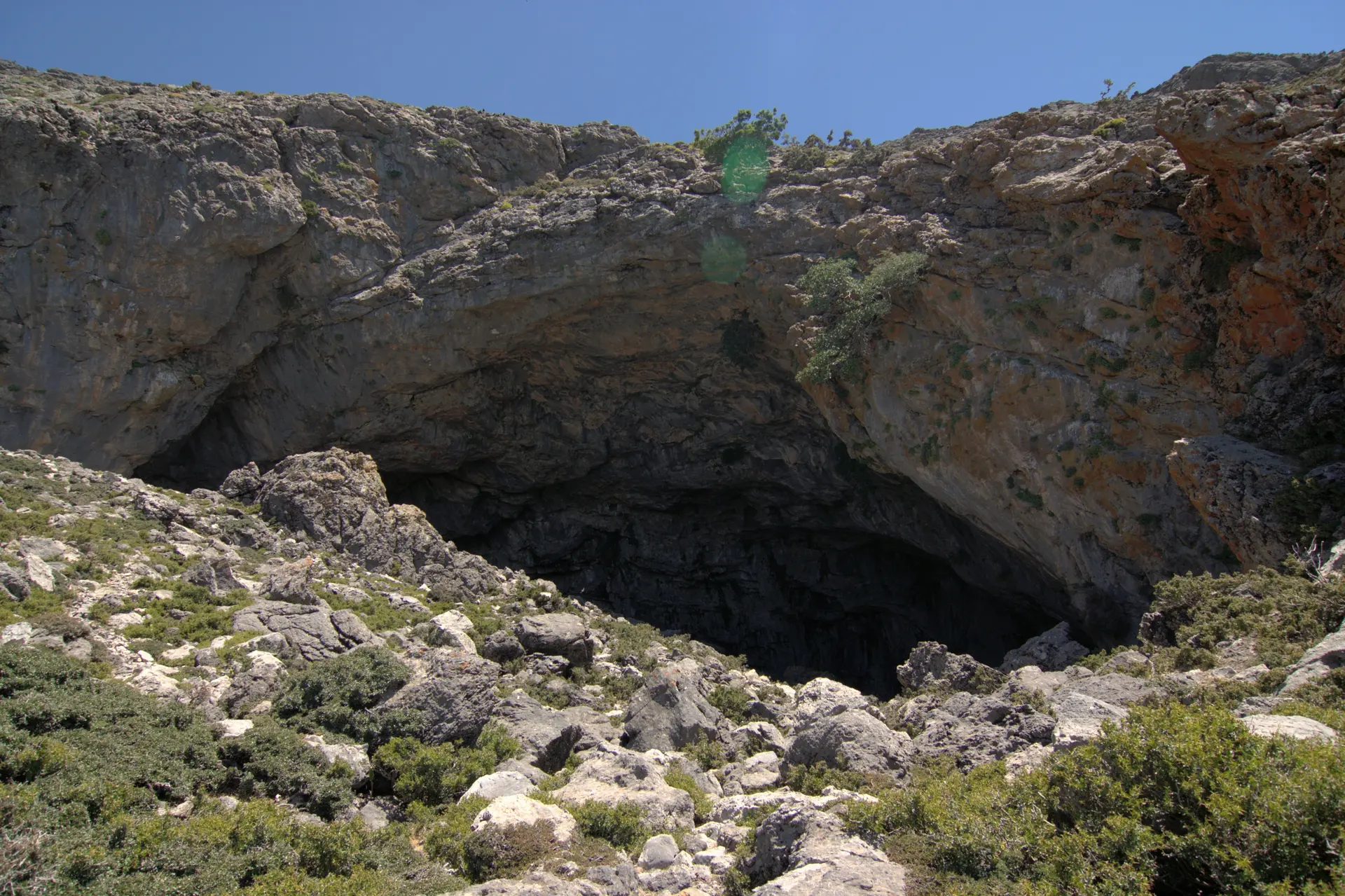
Image of Mt. Ida. Image source · CC-BY-SA-4.0
Visit essentials
A quick read before you go
- Duration
- Idaean Cave only from Nida Plateau: 2-3 hours round trip.
- Access
- From Heraklion, drive approximately 75 kilometers (1.5 hours) to Anogia village at 700 meters…
Overview
Five thousand years of worship remain layered on Psiloritis, Crete's highest peak. At 1,498 meters, the Idaean Cave holds Neolithic pottery, Minoan gold, finely made Greek bronze shields, and Roman oil lamps—successive evidence of human relationship with the underground darkness.
Myth says Rhea fled here while pregnant with Zeus to save him from his child-devouring father Kronos. The infant was hidden and nursed by the goat Amaltheia and nymphs Ida and Adrasteia, while the Kouretes clashed shields to drown his cries. The story presents mountain as sanctuary, cave as womb, and darkness as a place where vulnerability can grow strong enough to overthrow an old order.
Pythagoras wrapped himself in black wool and descended for twenty-seven days. Epimenides entered and, according to legend, slept fifty-seven years. Plato's Laws mentions the pilgrimage route from Knossos to the cave. Such visits made it an initiation chamber of darkness, silence, and possible transformation.
Today Psiloritis is a UNESCO Global Geopark, and the Minoan palace of Zominthos on its slopes is inscribed on the World Heritage List. Shepherds still move flocks across middle elevations and make cheese in stone mitata as predecessors did for centuries. Each September 14, hundreds climb to Timios Stavros's summit chapel for dawn liturgy on the Feast of the Holy Cross, continuing the Cretan practice of meeting the sacred at the island's highest point.
Why this place is sacred
What makes a place thin is not one quality but a convergence. On Mt. Ida, the convergence is unusually complete.
The time depth alone is remarkable. Archaeological evidence from the Idaean Cave documents sacred use from the late fourth millennium BCE through the fifth century CE, roughly 4,500 years of continuous veneration at a single location. Few sites in Europe can match this span. But continuity alone does not create the quality the Irish monks called thinness. What matters is that the worship never quite stopped. The Minoan offerings gave way to Greek bronze shields.
The Greek cult yielded to Roman lamps. The Roman lamps went dark, and Christians built a chapel on the summit. On September 14 each year, the pilgrimage continues.
The cave itself generates a particular quality of encounter. Entering the Idaean Cave means stepping from the harsh light and wind of the Nida Plateau into a darkness that is both physical and symbolic. The interior is large, roughly thirty meters deep, and the temperature drops immediately. The silence is different from the silence outside. It is contained, pressurized, old.
Ancient peoples recognized this quality and responded to it: they understood the cave as a place where birth and death, concealment and revelation, operated simultaneously. Zeus was born here in hiding. Pythagoras entered to die to his former self and emerge transformed.
The vertical dimension amplifies this. The cave sits at 1,498 meters, already well above the settled world. The summit at 2,456 meters is the highest point on Crete, a natural axis mundi. On clear days, the view from Timios Stavros encompasses the entire island and the surrounding seas in every direction. The sense of standing at the pivot point of a world defined by water and stone is difficult to overstate.
The Nida Plateau, the flat highland at approximately 1,400 meters where the road from Anogia ends, functions as a kind of antechamber. Surrounded by mountain walls, empty except for a few shepherd structures and a taverna, the plateau creates a liminal space. You have left the villages behind. You have not yet reached the cave or the summit. You are between worlds, and the mountain has arranged this.
The Idaean Cave served as a sanctuary for worship and votive deposition from the late Neolithic period onward, becoming one of the foremost cult sites of Zeus in the ancient Greek world. It functioned simultaneously as a place of communal offering, mystery initiation, and possibly oracular consultation. The cave's association with the birth and nurturing of Zeus made it a site of cosmic significance where the boundary between mortal and divine was understood to be permeable.
The Minoan palace of Zominthos, on the pilgrimage route from Knossos, confirms that the cave's sanctity was integrated into the political and administrative framework of Minoan civilization.
Sacred use of the Idaean Cave evolved through distinct phases while maintaining an underlying continuity. Neolithic and Early Bronze Age worship left pottery and simple votive deposits. The Minoan period (2000-1450 BCE) produced the richest offerings, including gold jewelry, bronze weapons, and clay figurines of exceptional craft, deposited as part of a formal pilgrimage system connected to the Palace of Knossos through Zominthos.
After the destruction of Minoan palatial civilization around 1450 BCE, the cave's sacred function was absorbed into Greek religion. The Geometric and Archaic periods (8th-7th century BCE) saw the creation of magnificent bronze votive shields showing Near Eastern artistic influences, evidence of Crete's position as a crossroads between cultures.
The cave also became associated with philosophical initiation. Pythagoras, Epimenides, and Plato are all connected to the site, suggesting that by the sixth and fourth centuries BCE the cave had acquired a reputation as a place where the pursuit of wisdom required descent into darkness. Roman worshippers continued to visit through the fifth century CE, leaving oil lamps as offerings.
With Christianization, the cave's role as a living sanctuary faded, but the mountain's sacred identity was preserved through the construction of the Timios Stavros chapel on the summit, continuing the ancient Cretan practice of peak-sanctuary worship in a new theological framework. The September 14 pilgrimage to this chapel perpetuates the pattern of seasonal ascent that the Minoan pilgrims from Knossos would have recognized.
Experience and orientation
Anogia is the beginning. Perched at 700 meters on the mountain's northern approach, this village has been destroyed by occupying forces multiple times throughout its history and always rebuilt. The Cretans here play the lyra, drink raki, and regard the mountain above them not as a tourist destination but as the center of their world. Passing through Anogia is not incidental to the Mt. Ida experience. It is its cultural threshold.
The road from Anogia to the Nida Plateau climbs twenty-one kilometers through increasingly stark terrain. Trees thin. Stone replaces green. At approximately 1,400 meters, the road opens onto the plateau itself: a flat, high basin enclosed by mountains, spare and windswept, with a few stone structures and a taverna. The effect is of having entered a different country. The sky is closer. The light is harder. The settled world has disappeared behind a wall of peaks.
From the taverna, a walk of roughly 580 meters uphill reaches the Idaean Cave. The entrance is wide and unadorned, a dark mouth in pale limestone. Stepping inside, the temperature drops and the light fails within a few paces. The cave extends roughly thirty meters in, the floor uneven with collapsed formations and the accumulated strata of five millennia of offerings. There is no formal lighting. Bring a headlamp. In the beam, the walls show the texture of geological time.
The silence is absolute except for occasional water drip.
This is where Pythagoras spent twenty-seven days in darkness. Where Epimenides reportedly slept for generations. Where Rhea hid her infant son. The cave does not narrate these stories. It simply provides the conditions under which they become plausible.
The summit trail begins near the cave, marked with red paint on rocks. The ascent covers roughly seven kilometers and 1,050 meters of elevation gain. The path crosses increasingly barren terrain: rock, scree, sparse alpine vegetation, and eventually bare stone. There are no trees, no shade, no water above the plateau. The wind arrives and does not relent. In three to four hours of steady walking, the chapel of Timios Stavros comes into view at 2,456 meters.
The summit panorama is complete. On clear days, the entire island of Crete is visible, north coast to south coast, with the sea extending in all directions. The Cretan mountains range east and west. The small stone chapel sits at the highest point, its simplicity proportionate to the setting. This is not a grand architectural statement. It is a room with walls, a roof, and a cross, at the place where Crete meets the sky.
Begin at the village of Anogia, where supplies and fuel are available. Drive the paved road to Nida Plateau, where parking is available near the taverna on the west side. For the Idaean Cave alone, allow two to three hours round trip. For the summit, start early, ideally before dawn in summer, carrying at least two liters of water per person, sun protection, warm layers, and wind protection. The trail is marked but not maintained to formal standards.
Sturdy hiking boots are essential. The summit attempt is 6-8 hours round trip from the plateau. There is no shelter between the plateau and the summit chapel. Check weather before departing. If clouds build or wind intensifies, turn back. The mountain's storms are real, and there is nowhere to hide above the treeline.
Context and lineage
The mythology of Mt. Ida centers on the infancy of Zeus. The Titaness Rhea, pregnant with her sixth child, faced a desperate crisis. Her husband Kronos, king of the Titans, had swallowed each of their previous children to prevent a prophecy that his son would overthrow him. When her contractions began, Rhea fled to the Idaean Cave on the slopes of Crete's highest mountain.
In the cave's darkness, she gave birth to Zeus and immediately hid him there. She wrapped a stone in swaddling clothes and presented it to Kronos, who swallowed it without question. The infant Zeus was placed in the care of the nymphs Ida and Adrasteia, who nursed him alongside the divine goat Amaltheia, whose milk sustained the young god. But a baby's cries threatened to betray the deception.
So the Kouretes, a band of armored warriors or divine beings, took up position outside the cave and performed a frenzied war dance, clashing their bronze spears against their shields with enough force to drown out any sound from within.
Zeus grew to manhood hidden in the mountain. When he emerged, he overthrew Kronos, freed his swallowed siblings, and established the order of the Olympian gods. The story transforms Mt. Ida into the site of the most consequential birth in Greek mythology: the place where the new order gestated in secret darkness before emerging to remake the world.
The Idaean Dactyls, another mythical group associated with the mountain, were said to have discovered the art of working iron and copper in its fires, connecting Mt. Ida to the origins of metallurgy and, by extension, civilization itself.
The sacred lineage of Mt. Ida is characterized by an unusual continuity across civilizations. Neolithic communities established the cave as a place of sacred deposit before 3000 BCE. Minoan civilization integrated the cave into its palatial religious administration, building the palace of Zominthos as a waystation on the pilgrimage route from Knossos.
After the destruction of Minoan palatial civilization around 1450 BCE, the Greek cult of Zeus Idaios absorbed the cave into a new theological framework while preserving its essential function as a place where the divine could be approached underground.
The Geometric and Archaic periods saw the cave reach its peak of Greek-world significance, producing bronze votive shields that rank among the finest metalwork of the ancient Mediterranean. The philosophical initiation tradition of the sixth through fourth centuries BCE added an intellectual dimension: the cave became not only a place of worship but a place of transformation, where thinkers submitted to conditions of darkness and silence to achieve insight.
Roman worship continued through the fifth century CE. Christianization redirected sacred attention from the cave to the summit, where the chapel of Timios Stavros maintains the ancient practice of peak-sanctuary worship. The shepherd culture of the mountain, officially recognized as Intangible Cultural Heritage, represents a parallel thread of sacred relationship with the landscape that predates and outlasts any single theological system.
Pythagoras
The philosopher came to the Idaean Cave for initiation, reportedly spending twenty-seven days wrapped in black wool in the cave's darkness, undergoing ritual purification and contemplation. His time in the cave represents the earliest documented case of a Greek intellectual seeking transformation through sensory deprivation and underground retreat. The experience likely influenced his later teachings on the soul's relationship to the body and the transformative power of silence.
Epimenides of Knossos
A Cretan sage, poet, and prophet who accompanied Pythagoras to the Idaean Cave and became legendary for falling into a sleep lasting fifty-seven years within it. While the duration is mythological, the story likely encodes a memory of extended cave-retreat practices. Epimenides was later summoned to Athens to purify the city after a plague, suggesting that the wisdom gained in the cave was understood as having practical spiritual power.
Federico Halbherr
Italian archaeologist who led the first excavation of the Idaean Cave in 1885, discovering the bronze votive shields that established the cave's importance to the scholarly world. His work revealed the extraordinary quality and Near Eastern artistic influences of the offerings, demonstrating Crete's role as a cultural crossroads in the Geometric period.
Yannis Sakellarakis
Athens University professor and Director of the Heraklion Archaeological Museum who conducted the most systematic excavation of the Idaean Cave between 1982 and 1986, documenting finds spanning from the Neolithic through the Roman period and establishing the cave's chronological depth. The full publication of his findings remains incomplete.
Plato
The philosopher visited the cave for initiation and later referenced the pilgrimage route from Knossos to the Idaean Cave in his dialogue Laws, providing the earliest literary evidence that the journey to the cave was a recognized sacred path. His inclusion of the route in a work about ideal governance suggests the pilgrimage carried political as well as spiritual significance.
Traditions and practice
The traditional practices of Mt. Ida operated on two registers: communal worship and individual initiation. The communal register involved pilgrimage to the Idaean Cave from settlements below, particularly along the route from Knossos through Zominthos, to deposit votive offerings. These offerings ranged from simple pottery in the Neolithic period to gold jewelry, bronze weapons, and elaborately worked figurines during the Minoan era, to the bronze votive shields of the Geometric period that represent the cave's artistic zenith.
The shields, with their incised and embossed mythological scenes showing strong Phoenician and Syrian influences, confirm that the cave drew worshippers and craftspeople from across the eastern Mediterranean.
The individual register involved mystery initiation. Pythagoras's twenty-seven-day retreat in darkness wrapped in black wool represents the most detailed account. Initiates descended into the cave to undergo a transformation whose precise nature was protected by oaths of secrecy that proved remarkably effective: no written description of the rituals has survived.
What is known is that the cave was understood as a place where death and rebirth occurred simultaneously, where the darkness stripped away the old self and something new could emerge.
The Kouretes' war dance, described in the Hymn of the Kouretes inscribed at Palaikastro and now in the Heraklion Archaeological Museum, was a ritual performance that connected the percussion of bronze on bronze to the protection of the divine child. Whether this dance was performed at the cave itself or at associated temples remains debated, but the tradition associates the rhythmic, ecstatic clashing of shields with the mountain's most sacred space.
The primary living practice is the annual pilgrimage to the summit chapel of Timios Stavros on September 14, the Orthodox Feast of the Elevation of the Holy Cross. Pilgrims from across Crete begin the ascent the night before, some sheltering in shepherd huts or camping near the summit. A priest celebrates a dawn liturgy at the chapel, and the occasion combines genuine religious observance with a communal celebration of Cretan mountain identity.
Many hikers who are not formally religious join the pilgrimage, drawn by the physical challenge and the cultural significance.
The Yakinthia Festival in Anogia, held in late July, celebrates Cretan and Mediterranean culture through music, poetry, theater, and traditional food. While not explicitly a religious event, the festival is rooted in the village's deep relationship with the mountain and its traditions.
Transhumant shepherding continues on the mountain's slopes, with cheese-making in traditional stone mitata. This practice, recognized as Intangible Cultural Heritage of Greece, represents a living connection to patterns of mountain use that extend back millennia.
At the Nida Plateau, before approaching the cave, sit with the plateau's silence for ten minutes. Let the enclosing mountains establish the sense of having entered a contained space, a threshold between the settled world and the sacred heights above.
Inside the Idaean Cave, turn off your headlamp for a full minute once you are safely standing on level ground. Allow the darkness to become complete. Consider that Pythagoras stayed in darkness like this for twenty-seven days, that the infant Zeus was hidden in it, that five thousand years of offerings were placed into it. The darkness is not empty. It is full of what has been entrusted to it.
On the summit, face each direction in turn: north toward the sea, east toward the rising point, south toward the Libyan Sea and Africa beyond, west toward the setting sun. The ancient Cretans who built peak sanctuaries understood that standing at the highest point and seeing in all directions was itself a form of knowledge. Allow the panorama to be the practice.
If you visit during the September 14 pilgrimage, walk with the pilgrims rather than observing from a distance. The ascent itself is the ceremony.
Minoan Religion
HistoricalThe Idaean Cave was one of the most important sacred sites of Minoan civilization, used for worship from the late Neolithic period (end of the 4th millennium BCE) through the Bronze Age. The cave's connection to the Palace of Knossos via the pilgrimage route through Zominthos demonstrates that its sanctity was integrated into the political and administrative framework of Minoan civilization. Finds from 2000-1700 BCE are described as exceptional examples of the first advanced culture to arise in Europe.
Pilgrimage from Knossos through Zominthos to the cave. Deposition of votive offerings including pottery, clay figurines, weapons, gold jewelry, and tools. Cave rituals involving altars and libations. Use of the cave as a sacred space for communal worship connected to mountain-peak veneration.
Ancient Greek Religion — Cult of Zeus Idaios
HistoricalThe Idaean Cave became one of the most revered sanctuaries of Zeus in the Greek world from the Geometric period (8th century BCE) onward. The cave's mythology as the birthplace or nursery of Zeus, where the Kouretes protected the infant god through their war dance, made it a site of cosmic significance. The cave also functioned as a center for mystery initiations and possibly oracular consultation.
Dedication of elaborate bronze votive shields with mythological scenes. Mystery initiations involving periods of darkness, silence, and purification. Ritual offerings of bronze and clay figurines, weapons, tripod cauldrons, and gold jewelry. The Kouretes' war dance of clashing spears and shields. Possible oracle consultations. Lighting of Roman lamps as late-period offerings.
Greek Orthodox Christianity
ActiveThe summit chapel of Timios Stavros continues the ancient tradition of mountain-peak worship at Crete's highest point. The September 14 Feast of the Elevation of the Holy Cross draws hundreds of pilgrims who ascend through the night for a dawn liturgy, making it one of the most physically demanding active pilgrimages in Greece.
Annual pilgrimage to the summit chapel for the September 14 feast. Dawn liturgy at Timios Stavros with priest and pilgrims ascending the night before. Overnight camping near the summit in preparation for the feast-day service.
Cretan Pastoral and Shepherd Culture
ActiveThe shepherd culture of Psiloritis is recognized as Intangible Cultural Heritage of Greece. The stone mitata, the seasonal movement of flocks, and the cheese-making traditions represent a way of life that has shaped the mountain's human landscape for centuries and maintains a living connection to patterns of mountain use extending back to antiquity.
Transhumant shepherding with seasonal migration to mountain pastures. Cheese-making in stone mitata. Traditional music featuring the Cretan lyra and laouto. The Yakinthia Festival in Anogia (late July). Hospitality rituals including the offering of raki and local food to visitors.
Perspectives and open questions
Mt. Ida can be read as geology, mythology, archaeology, living culture, or a place where all four merge into something that resists clean categorization. Each lens sharpens the others.
Scholarly perspective
The scholarly assessment of Mt. Ida is unequivocal in its significance. The Idaean Cave's documented worship from the late fourth millennium BCE through the fifth century CE makes it one of the longest continuously venerated sacred sites in Europe. The bronze votive shields of the Geometric period (8th-7th century BCE) are recognized as masterpieces of ancient metalwork, their Near Eastern stylistic influences demonstrating that Crete functioned as a cultural bridge between the Aegean and the Levant.
The debate over whether Zeus was born in the Idaean Cave or the Diktaean Cave (Psychro) in eastern Crete is, by scholarly consensus, mythologically irrelevant. Both caves were major cult sites, and the myth's localization at both reflects a broader pattern of divine-birth narratives being claimed by multiple communities. Homer and Apollonius associate Zeus's upbringing with the Idaean Cave; popular modern tradition often favors the Diktaean Cave.
The significant point is that both caves were sacred, and the rivalry itself is evidence of the myth's cultural power.
The discovery of Zominthos in 1984 and its UNESCO World Heritage inscription in 2025 confirmed Plato's reference in Laws to a pilgrimage route from Knossos to the Idaean Cave, proving that the cave's sanctity was embedded in the administrative and political infrastructure of Minoan civilization. The Sakellarakis excavations of 1982-1986 established the cave's full chronological depth but ended without completion, and full publication of the findings remains pending. The cave likely still holds significant undocumented material.
Ecologically, the Psiloritis UNESCO Global Geopark encompasses 1,272 square kilometers of geological and biological significance, including over 1,700 plant species with a ten percent endemism rate. The bearded vulture (Lammergeier) and golden eagle nest in the mountain's cliffs.
Living and traditional perspectives
For Cretans, Psiloritis is not a historical site but a living presence. The mountain embodies the qualities that Cretans most value in themselves: endurance, independence, and an unbroken connection to their own past. The village of Anogia, the mountain's cultural heart, has been destroyed by occupying forces repeatedly and always rebuilt. The Cretan saying that the mountains make us free reflects a deeply held conviction that the mountain landscape is not merely a setting for Cretan identity but its source.
The shepherd culture of Psiloritis is experienced not as folklore but as a way of life that continues because it works and because it matters. The stone mitata, the seasonal movement of flocks, the making of graviera and mizithra cheese, the playing of the lyra around evening fires: these are not performances for visitors. They are the texture of lives organized around the mountain's rhythms. The September 14 pilgrimage to Timios Stavros is similarly lived rather than observed.
It is a statement, made with the body, that the mountain's summit is where Cretans meet what is highest.
Alternative interpretations
Esoteric interpretations of the Idaean Cave focus on its function as an initiation chamber. Pythagoras's twenty-seven days in darkness wrapped in black wool bear structural resemblance to sensory-deprivation practices and vision-quest traditions across cultures. Some practitioners view the cave as one of Europe's primary energy sites, a place where the earth's geomagnetic properties facilitate altered states. The Kouretes' rhythmic percussion of shield against shield has been compared to shamanic trance-induction techniques using repetitive sound.
The mountain's vertical axis, from the underworld darkness of the cave through the terrestrial plateau to the sky-touching summit, is interpreted by some as a physical embodiment of the axis mundi: the cosmic pillar connecting the three realms.
Open questions
The specific content of the mystery initiations remains genuinely lost. Ancient initiates were bound by secrecy oaths of extraordinary effectiveness, and no written account of what occurred in the cave during initiation has survived. What Pythagoras actually experienced during his twenty-seven days is unknown.
The throne that he reportedly saw yearly made for Zeus in the cave has never been satisfactorily explained: was it a natural rock formation, a ritual construction renewed annually, or a visionary experience induced by prolonged darkness? Epimenides' fifty-seven-year sleep, while mythological, may encode a memory of extended cave-retreat practices whose nature we cannot reconstruct. The Sakellarakis excavations were never completed, and the full scope of the cave's archaeological record remains partially undocumented. The mountain holds what it holds.
Plan your visit
Access and arrival
From Heraklion, drive approximately 75 kilometers (1.5 hours) to Anogia village at 700 meters elevation. From Anogia, continue 21 kilometers on a paved road to the Nida Plateau at approximately 1,400 meters. Park at the taverna on the west side of the plateau. The Idaean Cave is a 580-meter uphill walk from the taverna, or accessible by a rough road to a parking area near the entrance.
The summit trail (red paint markers on rocks) begins near the cave and covers approximately 7 kilometers and 1,050 meters of elevation gain to Timios Stavros at 2,456 meters. Alternative approaches exist from Kamares on the south side and from Fourfouras. A daily bus from Rethymnon at 7 AM serves Fourfouras via the Amari Valley. No public transport reaches Nida Plateau; a car is essential.
Carry at least two liters of water per person for the summit, as there is no water above the plateau. Summit coordinates: 35.2280N, 24.7680E. Idaean Cave: approximately 35.2100N, 24.8200E. Mobile signal is available at Nida Plateau and intermittently on the upper trail but should not be relied upon. Emergency services are accessible through the European emergency number 112, but response times to the mountain's upper elevations will be extended.
The nearest hospital is in Heraklion, approximately two hours from the plateau by car.
Anogia offers guesthouses and tavernas with genuine Cretan character. Heraklion (75 km) provides the full range of accommodation. At Nida Plateau, a single taverna operates seasonally. There is no formal accommodation on the mountain above the plateau. For the September 14 pilgrimage, many participants camp near the summit; bring appropriate gear for cold overnight temperatures at altitude. The taverna at Nida Plateau serves food and coffee during operating season.
Respectful visit
Sturdy hiking boots with ankle support are non-negotiable for the summit trail and advisable even for the short walk to the cave. Sun protection is critical: hat, sunscreen, and sunglasses, as there is no shade above the treeline. Warm layers are necessary at altitude even in summer, as summit temperatures can drop sharply and wind chill is significant. For the September 14 feast at the summit chapel, modest dress appropriate to a Greek Orthodox service is expected.
Trousers or long skirts are appropriate; bare shoulders may draw disapproval.
Photography is unrestricted on the mountain and at the Idaean Cave. During the September 14 liturgy at the summit chapel, photograph with discretion and respect for worshippers. In Anogia and surrounding villages, ask before photographing individuals. Drone use within the UNESCO Global Geopark may require permits; verify current regulations before flying.
Do not leave offerings in the Idaean Cave. It is a protected archaeological site. At the Timios Stavros chapel, candle lighting is appropriate during or outside services. If you wish to mark your visit to the cave or summit, do so inwardly. The most fitting offering to this mountain is attention.
The Idaean Cave is under archaeological protection. Do not dig, collect artifacts, or disturb the ground at or around the cave. Stay on marked paths where available. Do not collect plants, stones, or geological specimens within the Geopark. No camping fires on the mountain. Snow can close the access road from Anogia to Nida Plateau from approximately November through April.
The summit trail has no shade, no water, and no shelter between the Nida Plateau and the top. Heat exhaustion is a real risk in summer, and hypothermia is possible in sudden weather changes at any time of year. The Idaean Cave interior is unlit, with uneven ground and potential for falling; bring a reliable headlamp and watch your footing. The mountain's storms are genuine and arrive quickly. If weather deteriorates above the treeline, descend immediately.
Do not attempt the summit in poor visibility or when thunderstorms are forecast.
Current practical details
Address
Mount Ida, Kouloukonas 740 51, Greece
Hours, fees, and access can change — verify on the official source before you travel. Practical details last checked Jun 2026.
Location
Map loads as you approach this section.
Pilgrim reflections
A portrait of encounter, not a score
Pilgrims describe what they felt, how present they could become, and whether the place would shape a journey. There are no stars and no ranking of traditions.
No reviewed reflections yet
The first pilgrims can help describe the character of being here.
Share a reflection
Available after an account-backed “Been there.” Every reflection is reviewed before publication.
Nearby sacred places
Explore other sacred places in the region. Proximity does not establish access or travel time; check each place’s guidance.
Share a photo
Help visitors recognize Mt. Ida. Every submission is reviewed before publication.