Monastery of Arkadi
Where faith and freedom became inseparable in a single act of Cretan defiance
Understand sacred places, explore living traditions, and learn how to engage respectfully with Pilgrim Map.
Access has not been verified. Check current local guidance before planning a visit.
Municipality of Rethymnon, Crete, Greece
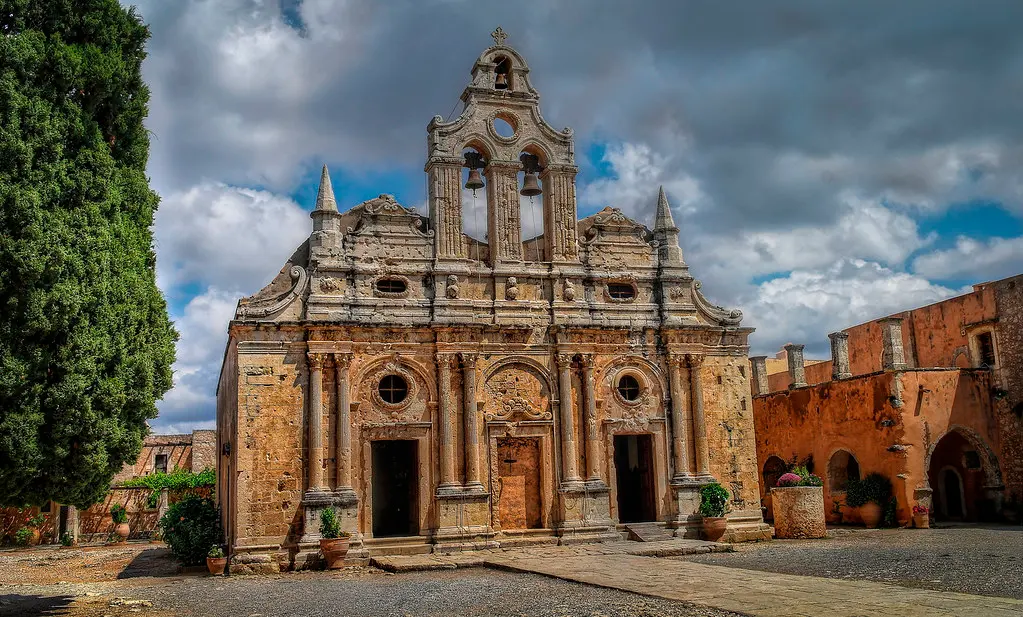
Image of Monastery of Arkadi. Image source
Visit essentials
A quick read before you go
- Duration
- One and a half to two hours for a thorough visit including the church, refectory, powder…
- Access
- The monastery is located 23 km southeast of Rethymno, on a plateau at approximately 500 meters…
Overview
At the end of Arkadi's walled courtyard, a double-aisled church presents an ornate Venetian Renaissance facade fit for northern Italy. Eight Corinthian columns frame the entrance beneath a rounded-arch bell tower; intricate stonework treats elegance as devotion. Built in 1587 under Venetian rule, the katholikon is dedicated to the Transfiguration of Christ and Saints Constantine and Helena.
Beyond the church lies the low, vaulted powder magazine. On November 8, 1866, approximately 964 Cretans—mostly women and children—sheltered within the monastery as 15,000 Ottoman troops besieged it. After the walls were breached, Konstantinos Giaboudakis ignited the stored gunpowder. The explosion killed most defenders and hundreds of Ottoman soldiers; only a fraction of the Cretans survived.
Greek tradition calls this event a 'holocaust'—olokaftoma, a complete burning—a term Cretans do not use lightly. Rather than military defeat, it is understood as deliberate collective self-sacrifice preferable to slavery. The conviction that freedom is worth more than life became modern Cretan identity's founding story, giving Arkadi intertwined religious and national sacredness.
A small monastic community still maintains Orthodox liturgy, with services and candles before icons. In the ossuary, skulls of those killed in 1866 stand behind glass, some marked by bullets and swords. UNESCO designated Arkadi a European Freedom Monument in 1976.
Why this place is sacred
Certain places acquire their charge through gradual accumulation — centuries of prayer, the slow layering of intention upon intention. Other places are marked by a single catastrophic event whose force alters the character of the ground itself. Arkadi holds both.
The monastic layer is the older and quieter one. Whether founded in the fifth century under the Byzantine Emperor Arcadius or in the eleventh century by a monk named Arkadios, the monastery has sustained continuous religious life across a span that few European institutions can match. By the sixteenth century it was a renowned center of learning, its scribes copying manuscripts, its library drawing scholars from across Crete. The church built in 1587 is not merely beautiful.
It is the work of a community that had been praying in this place for centuries before a single stone was laid, and that understood the new building as the architectural expression of an accumulated devotion.
The plateau itself contributes to the sense of separation. At 500 meters elevation, surrounded by olive groves, vineyards, and cypress trees, Arkadi occupies a landscape that asks visitors to leave the ordinary world behind. The drive from Rethymno takes less than thirty minutes, but the transition is complete. The noise of the coast falls away. The monastery's walls enclose a courtyard of unusual stillness.
Then there is November 1866. The thinness that the explosion created is of a different order. It is not the quiet permeability of a place long devoted to prayer. It is a rupture — a moment when the boundary between life and death was not thinned but shattered. The powder magazine room still stands. The refectory preserves bullet and sword marks in its original wooden furniture.
The ossuary, with its glass cases of skulls and bones, makes the cost of the conviction viscerally present. These are not artifacts displayed for education. They are the remains of people who made a decision that most of us will never face, and the gravity of that decision has not dissipated.
What makes Arkadi exceptional among memorial sites is that the monastic life continued after the destruction. The monastery was rebuilt. The monks returned. The liturgical calendar resumed. The prayers that preceded 1866 by centuries continued after it, absorbing the catastrophe into a rhythm of worship that treats both transcendence and suffering as part of the same sacred reality.
The Monastery of Arkadi was founded as a center of Orthodox Christian monastic life, traditionally attributed to either the fifth century under Emperor Arcadius or the eleventh century by a monk named Arkadios. Its purpose was prayer, worship, and the cultivation of spiritual life in the monastic tradition of the Eastern Church.
By the sixteenth century, it had also become a center of learning and manuscript copying, fulfilling the dual monastic vocation of ora et labora — prayer and intellectual work.
Arkadi's evolution follows a trajectory shared by many Cretan monasteries — centuries of quiet religious life punctuated by the island's turbulent political history. The Venetian period (1205-1669) brought the cultural synthesis visible in the 1587 church, whose Renaissance facade married Italian architectural sophistication with Orthodox liturgical purpose. The Ottoman conquest of Crete in 1669 placed the monastery under new political realities, though Orthodox worship continued.
In the nineteenth century, as Cretan resistance to Ottoman rule intensified, Arkadi became a meeting place for revolutionary assemblies. The 1866 siege transformed the monastery from a center of worship and learning into the paramount symbol of Cretan sacrifice. After the destruction, the monastery was gradually rebuilt. Crete's union with Greece in 1913 formalized the national significance that Arkadi had already acquired.
UNESCO's 1976 designation as a European Freedom Monument completed Arkadi's transformation into a site of international heritage significance, while the monastic community maintained — and continues to maintain — the religious life that predates all of this history.
Experience and orientation
You approach along a road that winds through olive groves and low hills, the landscape green or golden depending on the season. The monastery appears on its plateau like a fortified village — stone walls, a gatehouse, the bell tower of the church visible above the roofline. Parking is free and adjacent. The entrance brings you through the outer wall into the courtyard, and the first thing that claims your attention is the facade of the katholikon.
The church facade deserves the time it takes to read it. Eight Corinthian columns in two tiers, with rounded arches, rosettes, and decorative niches, compose a front that architectural historians have compared to the work of Sebastiano Serlio and Andrea Palladio. The craftsmanship is precise and exuberant. This is Venetian Crete at its most culturally confident — a Greek Orthodox church built in an Italian Renaissance vocabulary, the synthesis of two civilizations expressed in carved stone.
Enter the church if services are not in progress. The interior is double-aisled, the northern aisle dedicated to the Transfiguration of Christ, the southern to Saints Constantine and Helena. Icons hang in the dimness. The scent of incense may still be present from the morning liturgy.
From the church, move through the surrounding monastic buildings. The cells, storerooms, and administrative buildings line the courtyard in an arrangement typical of Cretan fortified monasteries. The refectory — the communal dining hall built in 1687 — is where the historical weight begins to press. The long wooden table and benches bear the marks of the 1866 battle: cuts from swords, holes from bullets. These marks have not been cleaned or obscured.
They remain as they were left, and the effect of encountering them in the quiet of a dining hall designed for communal meals is startling.
The powder magazine is nearby. It is a modest room with a low vaulted ceiling, the kind of utilitarian space found in any fortified compound. Nothing in its dimensions prepares you for what happened here. A plaque and a flag mark the spot. Stand in this room and hold in mind that on the night of November 8, 1866, hundreds of people — fathers, mothers, children, fighters — were in and around this building when the powder was lit.
The room is small enough that the decision feels intimate, not abstract.
The museum, housed in the former monastic buildings, displays icons, religious vestments, liturgical objects, and artifacts from the 1866 siege. The collection is modest in size but rich in resonance. Manuscripts that survived the destruction, weapons used in the defense, and personal objects of the defenders are presented without dramatization.
Finish at the ossuary. Located in a small building adjacent to the main compound, it contains the remains of those who died in 1866. Behind glass, skulls and bones are arranged with care. Some skulls show bullet holes. Others bear the marks of edged weapons. This is not a display. It is a memorial, and it functions as one. The ossuary asks nothing of the visitor except presence and silence.
The overall experience at Arkadi moves from beauty through history to confrontation with the irreducible fact of human sacrifice. The sunlit courtyard, the elaborate church, the scarred refectory, the powder magazine, the ossuary — the sequence is not accidental. It recapitulates the monastery's own history: centuries of creation and devotion, followed by a single night that changed everything.
Allow one and a half to two hours for a thorough visit. Begin at the church, then explore the monastic buildings and refectory, the powder magazine, the museum, and the ossuary. Early morning is best for avoiding tour groups. If visiting in November, be aware that the days surrounding November 8 draw large crowds for the annual commemoration. Carry water in summer — the plateau is exposed and temperatures can be high.
Context and lineage
Two traditions claim the founding of Arkadi. The first attributes it to the Byzantine Emperor Arcadius, who ruled from 395 to 408 AD, suggesting the monastery was established during the early Christian transformation of Crete. The second tradition credits a monk named Arkadios, who is said to have built a small chapel and monastic cells in the eleventh century. Neither account can be verified from surviving evidence.
The earliest confirmed reference dates to the fourteenth century, when an inscription mentions a church dedicated to Saint Constantine on the site.
What is certain is that by the sixteenth century, Arkadi had become one of the most important monasteries in Crete. Under Venetian rule, the island experienced a cultural flowering that blended Greek Orthodox tradition with Italian Renaissance influences. The monastery became a center of learning, housing a school, a scriptorium for manuscript copying, and a library that drew scholars from across the island.
The current church, completed in 1587, is the most visible legacy of this period — a building that fuses Venetian architectural ambition with the liturgical requirements of Orthodox worship.
The deeper origin story, the one that defines Arkadi in Cretan consciousness, begins on November 7, 1866. During the Great Cretan Revolution against Ottoman rule, approximately 964 Cretans — 325 fighters and 639 women and children — took refuge within the monastery walls. An Ottoman force of approximately 15,000 soldiers under Mustafa Naili Pasha besieged the compound.
After fierce fighting through November 8 and into the early morning of November 9, with the walls breached and the battle lost, Konstantinos Giaboudakis ignited the powder magazine. The explosion killed the vast majority of the defenders and several hundred Ottoman soldiers. The event galvanized European public opinion, drew comparisons to Thermopylae and Masada, and became the catalyst for the international support that eventually led to Cretan autonomy in 1898 and union with Greece in 1913.
Arkadi belongs to the tradition of fortified Cretan monasteries that served simultaneously as centers of worship, learning, and resistance throughout the island's centuries of foreign rule. Under Venetian and Ottoman dominion, Cretan monasteries preserved Greek language, Orthodox faith, and cultural identity. Arkadi's 1587 church represents the architectural high point of the Veneto-Cretan synthesis. The monastery's role in the 1866 revolt placed it in a lineage of sacred resistance that includes Thermopylae, Missolonghi, and the broader tradition of Orthodox Christian martyrdom.
UNESCO designated Arkadi a European Freedom Monument in 1976, recognizing its significance not only to Greek history but to the European ideal of liberty.
Abbot Gabriel Marinakis
The Hegumen of Arkadi Monastery during the 1866 siege. As both the spiritual leader of the monastery and the elected representative of the Rethymno region in the Cretan revolutionary assembly, Gabriel embodied the inseparability of faith and resistance that defines Arkadi. He led the defense alongside the military commander Ioannis Dimakopoulos. Tradition places him at the powder magazine at the moment of detonation, though some historians believe he was killed on the first day of combat. In either account, he did not survive.
Konstantinos Giaboudakis
The Cretan defender who ignited the gunpowder stores on the night of November 8-9, 1866. His act — lighting the powder magazine rather than allowing the monastery's defenders, and the women and children sheltering with them, to be captured — is the defining moment of Arkadi's history. Whether the decision was pre-planned as a last resort or made in the chaos of battle remains debated. Giaboudakis died in the explosion he caused, along with the majority of those inside.
Ioannis Dimakopoulos
A Peloponnesian lieutenant who served as the military commander of the forces defending Arkadi alongside Abbot Gabriel. His presence connected the Cretan revolt to broader Greek aspirations for national unity, and his willingness to fight alongside Cretan irregulars reflected the pan-Hellenic character of the struggle.
Mustafa Naili Pasha
The Ottoman military commander who led the siege force of approximately 15,000 soldiers against Arkadi. His overwhelming numerical superiority — outnumbering the defenders by more than fifteen to one — and the ferocity of the assault became part of the narrative that turned European sympathy toward the Cretan cause.
Victor Hugo
Though never present at Arkadi, the French writer and champion of oppressed peoples became one of the most prominent European voices to publicize the Cretan cause following the 1866 events. The international outcry that the sacrifice at Arkadi provoked, amplified by figures like Hugo, transformed a local revolt into an international cause and applied the diplomatic pressure that eventually led to Cretan autonomy.
Traditions and practice
The monastic life of Arkadi follows the liturgical calendar of the Greek Orthodox Church. Divine liturgies are celebrated according to the Byzantine rite in the double-aisled katholikon. The church's two dedications — the Transfiguration of Christ in the northern aisle and Saints Constantine and Helena in the southern — shape the ritual year.
The feast of the Transfiguration on August 6 and the feast of Saints Constantine and Helena on May 21 are the primary liturgical celebrations, marked by special services that draw pilgrims from across western Crete.
The November 8 commemoration operates on a different register. It begins with a Hierarchical Divine Liturgy — a liturgy celebrated by a bishop — followed by a memorial service, the trisagion, conducted at the mausoleum and ossuary where the remains of the 1866 defenders rest. Military detachments present arms. Government officials lay wreaths. The ceremony is simultaneously a liturgical act of remembrance and a state memorial.
In Rethymno, a week of commemorative events precedes the November 8 anniversary, including cultural programming, lectures, and civic ceremonies that extend the remembrance beyond the monastery walls.
The monastic community continues to observe the canonical rules of the Orthodox Church. A small number of monks reside at the monastery and maintain the daily cycle of prayer and worship. Regular divine liturgies are held, though the schedule may vary and is not always published for visitors. Pilgrimage visits by Orthodox faithful, particularly around the three major feast days, sustain the monastery's devotional character.
Greek school groups make educational pilgrimages to Arkadi as part of the national curriculum, ensuring that each generation encounters the site's significance firsthand. Candle lighting and private prayer in the church remain the most intimate forms of visitor participation.
Visitors who wish to engage with Arkadi beyond the historical and architectural may consider a contemplative approach to the sequence of spaces.
Begin at the church. If services are not in progress, enter quietly and allow a moment for the eyes to adjust to the dimness. The icons, the scent of incense, and the silence of the interior connect the visitor to the monastic tradition that preceded and survived the 1866 events. Lighting a candle is a simple act of participation that requires no particular belief — only the willingness to mark your presence with a gesture of attention.
At the powder magazine, stand still. The room is small enough to comprehend physically. Allow the dimensions to communicate what happened here without rushing to interpret or narrate the experience.
At the ossuary, the confrontation with the remains of the dead is direct and unmediated. There is no correct response to this encounter. Some visitors are moved to prayer. Others to silence. The ossuary does not instruct. It presents.
If visiting on or near November 8, attending the commemorative ceremony offers an experience unavailable at any other time — the convergence of liturgy, military ritual, and collective memory in a setting that has sustained all three for over 150 years.
Greek Orthodox Christianity
ActiveArkadi has sustained continuous Orthodox monastic life since its founding, making it one of the oldest active religious communities on Crete. The double-aisled katholikon, with its dedications to the Transfiguration of Christ and Saints Constantine and Helena, embodies the liturgical tradition that has shaped this community across centuries of political upheaval. The monastery served as a center of learning and manuscript copying from the sixteenth century, preserving Greek language and Orthodox culture during periods of foreign rule. Today, a small community of monks maintains the daily and seasonal rhythms of Orthodox worship.
Cretan National Memorial and Resistance Legacy
ActiveSince November 1866, Arkadi has been the paramount symbol of Cretan resistance and the willingness to die for freedom. The events galvanized European sympathy, contributed to Cretan autonomy in 1898, and remain foundational to modern Cretan and Greek national identity. UNESCO's designation of Arkadi as a European Freedom Monument in 1976 recognized the site's significance beyond national borders. The November 8 commemoration is a state-level event that unites religious, military, and civic commemorative traditions.
Perspectives and open questions
Arkadi has been read through the lenses of religious devotion, national mythology, architectural history, and the ethics of collective sacrifice. Each perspective illuminates a different facet of the site's layered significance.
Scholarly perspective
Historians agree that the 1866 events at Arkadi were a pivotal turning point in the Cretan struggle for independence and eventual unification with Greece. The sacrifice drew widespread European media coverage and public sympathy, contributing to the diplomatic pressure that led to Cretan autonomy in 1898 and formal union with Greece in 1913. Architecturally, the 1587 katholikon is recognized as one of the finest examples of late Italian Renaissance architecture on Crete, reflecting the cultural synthesis of the Venetian period.
The facade shows clear influence from the published designs of Sebastiano Serlio and Andrea Palladio, adapted to the requirements of an Orthodox double-aisled church. The monastery's role as a sixteenth-century center of learning, manuscript production, and education is well documented, though much of the library was destroyed in the 1866 explosion. The founding date remains debated between the fifth and eleventh century traditions, with the fourteenth century providing the earliest documentary evidence.
Living and traditional perspectives
In Cretan cultural memory, Arkadi occupies a position without parallel. The phrase "Eleftheria i Thanatos" — Freedom or Death — which serves as the national motto of Greece, finds its most visceral physical expression at this site. For Cretans, visiting Arkadi is not tourism. It is a form of pilgrimage that weaves together Orthodox faith and patriotic identity. The annual November 8 commemoration is treated as a sacred obligation, attended by the highest levels of government and military.
The story of the sacrifice is passed down through generations in songs, stories, school curricula, and the naming of civic institutions. The Cretans' Association of Hamilton, Ontario, a diaspora organization, takes the name "Arkadi" — evidence that the monastery's symbolic weight carries across oceans and generations. The defenders are not memorialized as victims but as heroes who enacted the foundational Cretan conviction that slavery is worse than death.
Alternative interpretations
Some scholars and ethicists have examined the events at Arkadi through the framework of collective martyrdom, drawing comparisons to Masada (73 AD), where Jewish defenders chose death over Roman capture, and to Missolonghi (1826), where Greek defenders of the besieged city attempted a mass breakout rather than surrender to Ottoman forces. These comparisons illuminate a pattern in which communities under existential threat choose self-destruction as an act of moral and symbolic resistance, transforming military defeat into a narrative of victory.
The question of agency — whether the women and children in the monastery consented to the decision to ignite the powder — has been raised by some historians, though it receives little attention in the dominant Greek narrative. The intertwining of religious and national sacrifice at Arkadi also resonates with broader patterns of sacred nationalism in the Orthodox world.
Open questions
Several aspects of the 1866 events resist definitive resolution. The exact number of people inside the monastery at the start of the siege is variously reported as 943, 964, or approximately 1,000. The precise circumstances of Abbot Gabriel Marinakis's death remain debated: tradition places him at the powder magazine, but some evidence suggests he was killed on the first day of battle.
Whether the decision to detonate the powder was pre-planned as a final resort or was a spontaneous act by Giaboudakis in the chaos of the breach is not fully documented. The monastery's library, which was largely destroyed in the explosion, represented an unknown quantity of lost manuscripts, though some volumes survive in libraries abroad. The exact founding date — fifth century or eleventh — cannot be determined from surviving evidence, and the earliest confirmed reference remains a fourteenth-century inscription.
Plan your visit
Access and arrival
The monastery is located 23 km southeast of Rethymno, on a plateau at approximately 500 meters elevation. By car, take the National Road from Rethymno toward Heraklion for approximately 6 km to the Tsesme-Platania exit, then follow the Old National Road for 16 km to the monastery. Free parking is available at the entrance. By bus, services run from Rethymno Public Bus Station two to three times daily, with a journey time of approximately 40 minutes.
Admission is approximately 3-5 euros, subject to change. The monastery is open daily. Summer hours are approximately 8:00 AM to 8:00 PM; winter hours approximately 9:00 AM to 5:00 PM. Hours vary by source and season, so checking locally or calling ahead is advisable. Telephone: +30 28310 83116. The site has partial accessibility for visitors with mobility difficulties — the courtyard is largely flat, but some interior spaces involve steps. Mobile phone signal is available.
No on-site restaurant, but a small shop sells refreshments and souvenirs.
Rethymno, 23 km northwest, offers the full range of accommodation from hostels to boutique hotels within its atmospheric Venetian-Ottoman old town. The monastery does not provide overnight accommodation for visitors. For those seeking proximity, several agrotourism properties operate in the villages surrounding Arkadi, offering a rural Cretan experience that complements the monastery visit.
Respectful visit
Modest dress is required throughout the monastery. Shoulders and knees must be covered. This applies to all visitors regardless of gender. Comfortable walking shoes are recommended for the cobblestone courtyard and uneven surfaces. Coverings may be available at the entrance, but bringing appropriate clothing is advisable.
Photography is permitted throughout the courtyard, exterior spaces, museum, and most of the monastic buildings. Photography is not permitted inside the church, consistent with standard practice at Orthodox churches across Crete. Flash photography should be avoided in the museum to protect exhibits. Photography at the ossuary is generally permitted but should be conducted with sensitivity and discretion given the presence of human remains. Video recording follows the same guidelines.
Candles may be purchased and lit inside the church, following standard Orthodox practice. The monastery may accept charitable donations. There is no expectation of offering from non-Orthodox visitors.
No photography inside the church. No food or drink inside the church or ossuary. Certain areas may be closed during liturgical services. The monastery grounds close at the posted hours, which vary seasonally. Loud or disrespectful behavior is inappropriate given both the religious and memorial character of the site.
This is an active monastery. Visitors should not enter the church during liturgical services unless they intend to participate respectfully. The ossuary contains human remains and should be approached with appropriate gravity. Loud conversation, casual behavior, and disrespectful photography at the ossuary are inconsistent with the memorial character of the site. November 8 draws very large crowds, and access to certain areas may be limited during the commemorative ceremony.
Current practical details
Address
Arkadi 741 50, Greece
Phone
Hours
Hours, fees, and access can change — verify on the official source before you travel. Practical details last checked Jun 2026.
Location
Map loads as you approach this section.
Pilgrim reflections
A portrait of encounter, not a score
Pilgrims describe what they felt, how present they could become, and whether the place would shape a journey. There are no stars and no ranking of traditions.
No reviewed reflections yet
The first pilgrims can help describe the character of being here.
Share a reflection
Available after an account-backed “Been there.” Every reflection is reviewed before publication.
Nearby sacred places
Explore other sacred places in the region. Proximity does not establish access or travel time; check each place’s guidance.

Photo gallery
3 curated photos
Share a photo
Help visitors recognize Monastery of Arkadi. Every submission is reviewed before publication.