Mt. Hesperus, Colorado
The sacred mountain of darkness where the Navajo homeland ends and the spirit world begins
Understand sacred places, explore living traditions, and learn how to engage respectfully with Pilgrim Map.
Access has not been verified. Check current local guidance before planning a visit.
Mancos, Colorado, United States
Read the sources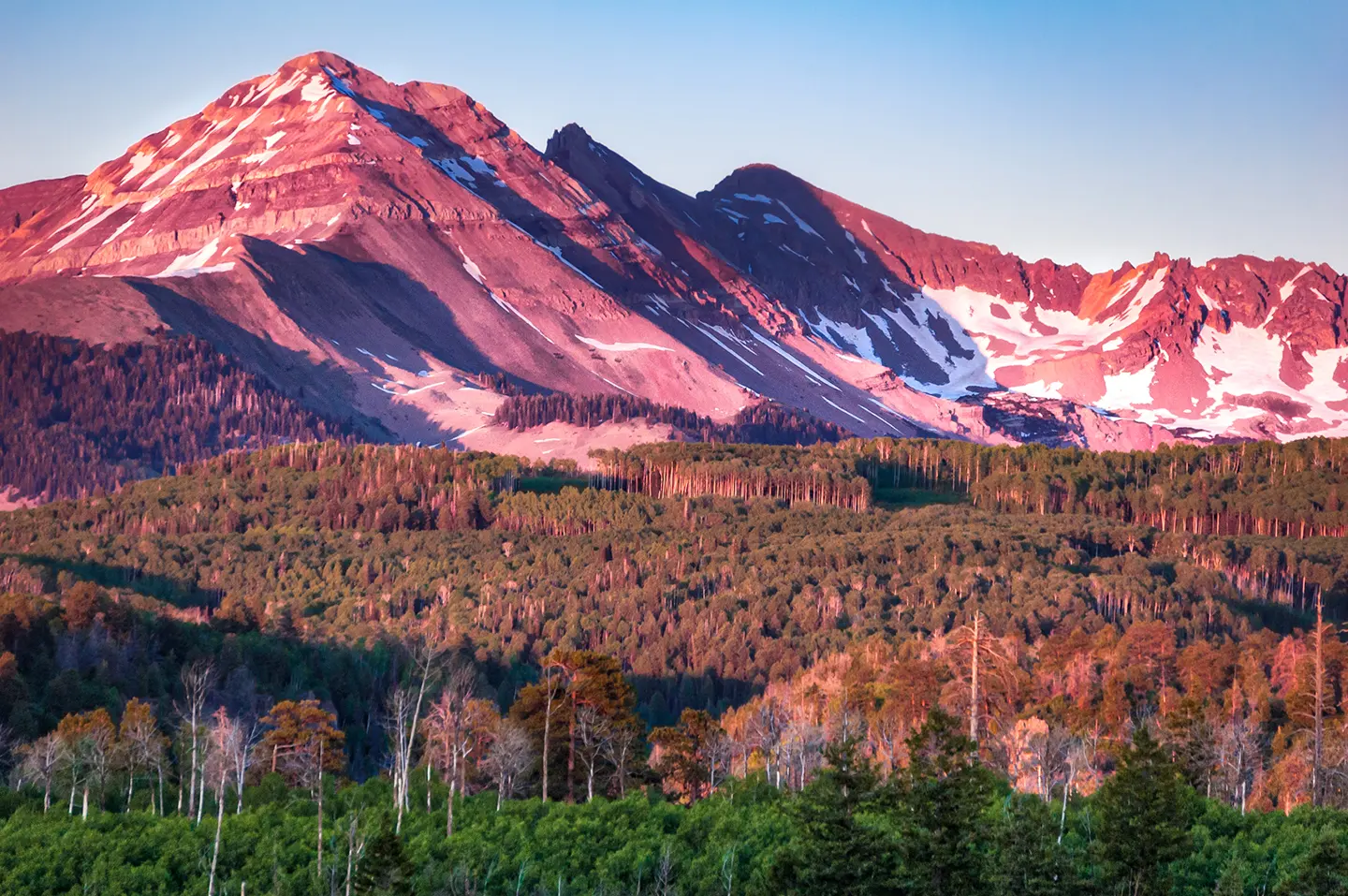
Image of Mt. Hesperus, Colorado. Image source · CC-BY-SA-2.0
Visit essentials
A quick read before you go
- Duration
- Full day including drive and hike.
- Etiquette
- Approach Dibe Ntsaa as a guest on sacred ground.
Overview
Spanish speakers named it Hesperus for the evening star. The Navajo call it Dibe Ntsaa, Big Mountain Sheep, and know it as the northern Sacred Mountain among four defining their homeland. In Navajo understanding it is a living being placed by First Man before this world, rainbow-fastened to earth and covered in darkness.
At 13,232 feet above southwest Colorado's high desert, Hesperus dominates the La Plata Range. Summit geological bands record raised ancient seabeds; Navajo cosmology identifies a replica of a Fourth World peak adorned with Black Jet and obsidian, linked to black, north, and Darkness Girl, guardian between living and departed.
Blanca Peak east, Mount Taylor south, and San Francisco Peaks west carry white, blue, and yellow; Hesperus completes the world's balance with north and darkness. It receives life's completed journeys as a boundary of continuing passage and protection.
Navajo practitioners invoke Dibe Ntsaa regardless of distance. Blessingway names all four mountains, medicine bundles hold soil from each, and prayers address its guardian energy. Though outside current reservation boundaries, it remains in Navajo spiritual geography and on the Navajo Nation flag as homeland and identity.
Why this place is sacred
The concept of thinness takes specific form at Hesperus. In Navajo understanding, this is not merely a place where spiritual sensitivity increases—it is a designed boundary, deliberately placed. First Man positioned the four sacred mountains to mark the edges of Dinetah, and Dibe Ntsaa holds the northern threshold. Beyond this line, the world changes. The mountain is not a window but a door, and doors go both ways.
The darkness associated with Hesperus requires careful understanding. In Navajo cosmology, darkness is not evil but necessary—night completing day, death completing life, the unseen completing the seen. Darkness Girl, associated with this mountain, is not a threatening figure but a protective one. The black of obsidian and jet that adorns the peak is the black of deep night sky, the black that existed before creation and will remain after, the black that holds stars.
For those who climb the physical mountain, the thinness manifests through extremity. At 13,232 feet, the air holds less oxygen. The summit scramble requires care over loose talus and exposed rock. The view from the top opens in every direction—the distant San Juans, the mesas stretching toward Navajo territory, the curve of earth visible at the horizon. The climb itself becomes a form of passage, an approach to something that cannot be reached casually.
But the mountain's thinness does not depend on physical presence. Navajo practitioners invoke Dibe Ntsaa from hundreds of miles away. The mountain participates in ceremony wherever the Blessingway is performed. Its protective power radiates outward from its position in the north, guarding the entirety of Dinetah. For those who hold the mountain sacred, its presence is not local but omnidirectional—the northern anchor of a sacred geography that encompasses all of traditional Navajo homeland.
Dibe Ntsaa was placed by First Man to mark the northern boundary of Dinetah, the Navajo homeland. According to Dine Bahane'—the Navajo creation narrative—the mountain was created as a replica of a peak in the Fourth World, the world before this one. First Man fastened it to the ground with a rainbow and covered it in darkness. The mountain was assembled from Black Jet, adorned with obsidian, and given Darkness Girl as its inner form.
The purpose was not arbitrary. Each of the four sacred mountains serves a specific function in Navajo cosmology, orienting the world and protecting those who live within its boundaries. Dibe Ntsaa guards the north, the direction associated with darkness, death, and the afterlife. It provides spiritual protection against evil and harm. It connects the living to the ancestors who have passed beyond the boundary it marks.
For centuries, Navajo practitioners have maintained relationship with Dibe Ntsaa through prayer, pilgrimage, and ceremony. The mountain's sacred status predates European contact and persists regardless of changing political boundaries. When the Navajo reservation was established—and subsequently modified—Hesperus fell outside its borders, but this did not diminish the mountain's significance. Sacred geography does not follow colonial cartography.
Today, the mountain lies within San Juan National Forest, accessible to any visitor who can manage the approach roads and summit scramble. No formal religious designation protects it. Yet traditional practitioners continue to visit for prayer and offerings, continue to invoke the mountain in ceremony, continue to recognize its presence on the Navajo Nation flag as a statement of enduring sovereignty over sacred homeland.
The boundary may be outside current reservation lines, but the boundary the mountain marks is older and more fundamental than any treaty.
Experience and orientation
The journey to Hesperus begins in the high country northeast of Mancos, Colorado, where forest roads wind through aspens and conifers toward the La Plata Range. The Sharkstooth Trailhead sits at approximately 10,900 feet—already above timberline in many mountain ranges, but here merely the starting point. From here, the trail climbs through alpine meadow and rocky terrain for 2.1 miles to the summit.
The final push requires scrambling over loose talus and boulders, Class 2+ terrain that demands attention to footwork and weather. At this elevation, afternoon thunderstorms arrive without much warning. Snow is possible in any month. The air is thin enough to slow most hikers unaccustomed to altitude. This is not a casual walk but an approach that requires preparation and respect for mountain conditions.
From the summit, the view unfolds across an enormous expanse of the American Southwest. The San Juan Mountains roll to the north and east. Mesa Verde's high mesas are visible to the south. On clear days, the horizon curves visibly at the edges of sight. The geological banding near the summit—alternating layers of lighter and darker rock—speaks to the mountain's deep history, ancient seabeds lifted miles into sky.
For visitors aware of the mountain's significance, the experience carries additional weight. This is not simply a high point but a boundary marker in Navajo sacred geography, the place where the homeland ends and the spirit world begins. Prayer offerings may be encountered among the rocks—tobacco, prayer ties, items left by those who came before. These are not curiosities but evidence of ongoing relationship between practitioners and the mountain they honor.
The return descent offers time for reflection. The 4.2-mile round trip typically takes a full day when accounting for the altitude, the terrain, and the contemplation the summit invites. By the time hikers return to the trailhead, they have made a small pilgrimage of their own—approached something sacred, touched its stones, and descended back into the world below.
Allow a full day for the climb. Start early to avoid afternoon storms. The trailhead elevation of 10,900 feet means altitude affects everyone; acclimatize if possible. Bring layers, rain gear, sun protection, and plenty of water. Check road conditions with the Mancos-Dolores Ranger District before driving in—the forest roads can be rough and may require high clearance. The hiking season runs from late May through October, with the most reliable conditions in summer months.
Context and lineage
According to Dine Bahane', the Navajo creation narrative, the Holy People traveled upward through four underworlds before emerging into the present Fifth World. Upon arrival, First Man and First Woman set about creating order. They placed four sacred mountains to mark the boundaries of Dinetah—the homeland where the Navajo people would live.
Dibe Ntsaa was created as a replica of a mountain from the Fourth World, fastened to the ground with a rainbow—the symbol of peace and harmony—and covered in darkness. The mountain was assembled from Black Jet, the dark stone that would later become coal and lignite, and adorned with obsidian. To the north, they placed a blanket of darkness over the peak. Darkness Girl, Chahalgaii, became its inner form.
Each mountain received its associations: Blanca Peak in the east with white shell and dawn; Mount Taylor in the south with turquoise and blue sky; San Francisco Peaks in the west with abalone and yellow twilight; and Dibe Ntsaa in the north with jet and darkness. Together they established the four directions, the four times of day, the four stages of life. The Navajo people would live within these boundaries, protected by the mountains First Man had placed.
The knowledge of Dibe Ntsaa as one of the four sacred mountains has been transmitted through Navajo oral tradition since time immemorial. The mountain appears in the Dine Bahane', the creation narrative that elders continue to teach. It is referenced in the Blessingway and other ceremonial practices. Medicine people maintain the protocols for gathering sacred mountain soil and making offerings.
The Ute people, whose ancestral territory included the La Plata Mountains, also have historical relationship with this landscape. The Weenuche band of Utes inhabited the region along the western Rocky Mountain flank, following wild game into the high country. The Southern Ute Reservation lies just south of Hesperus today. While specific ceremonial practices at this peak are not well documented in Ute tradition, the broader region held cultural importance as part of ancestral homeland.
First Man (Altse Hastiin)
In Navajo creation narrative, First Man placed the four sacred mountains to mark the boundaries of Dinetah. He fastened Dibe Ntsaa to the ground with a rainbow and covered it in darkness.
Darkness Girl (Chahalgaii)
The inner form or spiritual essence of Dibe Ntsaa. She is associated with the protective power of darkness and the northern direction.
Frederick Endlich
Geologist with the 1874 Hayden Survey who named the peak Hesperus after the evening star—an unintentional echo of its Navajo association with darkness.
Traditions and practice
The four sacred mountains participate in Navajo ceremony wherever it is performed. The Blessingway, one of the most important ceremonial traditions, repeatedly invokes all four peaks. Each mountain is associated with specific prayers, songs, and offerings. The protective power of the mountains extends throughout Dinetah, available to those who know how to call upon it.
Dibe Ntsaa specifically is invoked for protection, for rituals honoring ancestors, for matters concerning death and the afterlife, and for restoration of harmony when the balance between light and darkness has been disturbed. Its association with Black Jet connects it to practices involving that sacred stone. Its position in the north makes it significant in ceremonies oriented to the cardinal directions.
Practitioners who travel to the physical mountain come to pray, to make offerings, and to collect sacred materials for medicine bundles. The soil from each sacred mountain carries particular power and is included in bundles assembled by medicine people. Tobacco, prayer ties, and other offerings may be left at significant locations. The journey to the mountain is itself a form of ceremony, requiring proper preparation and intention.
Traditional practices continue among Navajo practitioners despite the mountain's location outside reservation boundaries. The protocols passed down through generations remain in use. Medicine people still instruct their apprentices in the proper ways of approaching the mountain and honoring its power. The mountain still appears in the Blessingway. Medicine bundles still contain its soil.
The mountain's presence on the Navajo Nation flag is a contemporary assertion of ongoing sovereignty over sacred geography. Adopted in 1968, the flag shows all four sacred mountains surrounding the outline of traditional Navajo homeland. This is not nostalgia but statement of fact: these boundaries remain sacred regardless of what maps drawn by others might suggest.
For many Navajo, the mountain's significance is daily and practical rather than occasional and ceremonial. Living within sight of the sacred mountains—or within the territory they define—is itself a form of relationship. The mountains orient the world. Their presence provides protection. Their invocation in daily prayer maintains the balance they were placed to establish.
Non-Native visitors cannot participate in Navajo ceremonial practice at Dibe Ntsaa. What visitors can do is approach the mountain with awareness of its significance. The climb itself becomes a form of respectful approach—the physical effort required to reach the summit mirrors the preparation that traditional practitioners undertake.
If you encounter prayer offerings among the rocks—tobacco, prayer ties, feathers, or other items—do not disturb them. These are sacred objects, evidence of someone's relationship with the mountain. Observe but do not touch. Do not leave offerings of your own devising unless you are participating in traditional Navajo practice.
The practice available to visitors is witness and respect. Stand at the summit knowing what this mountain means to the people who have held it sacred for centuries. Look out across the territory it guards. Descend with something of that awareness still present. This is enough.
Navajo (Dine) Tradition
ActiveDibe Ntsaa is the Sacred Mountain of the North, one of four mountains that First Man placed to mark the boundaries of Dinetah, the Navajo homeland. It was created as a replica of a peak in the Fourth World, fastened to the ground with a rainbow and covered in darkness. Adorned with Black Jet and associated with Darkness Girl, the mountain represents protection, the afterlife cycle, and the necessary balance of darkness complementing light.
Traditional Navajo ceremonies including the Blessingway reference all four sacred mountains. Practitioners visit for prayer, offerings, and to collect sacred mountain soil for medicine bundles. The mountain is invoked in rituals honoring ancestors and the spirits of the departed. Its protective power extends throughout Dinetah.
Ute Historical Connection
HistoricalThe Ute people, who call themselves Nuche ('mountain people'), historically occupied the La Plata Mountains and surrounding San Juan region. The Weenuche band of Utes inhabited the land along the western Rocky Mountain flank, including the La Plata Range. The Southern Ute Reservation lies just south of Hesperus Mountain today.
Seasonal hunting and gathering, travel through mountain passes, traditional relationship with mountain lands. Specific ceremonial practices at this peak are not well documented in available sources.
Perspectives and open questions
Dibe Ntsaa can be understood through multiple frameworks: geographical, geological, cultural, spiritual. For the Navajo, it is first and foremost a sacred mountain placed by First Man to mark the northern boundary of their homeland. For geologists, it is the highest point in the La Plata Range. For hikers, it is a challenging summit in the Colorado high country. All perspectives are true; none is complete.
Scholarly perspective
Geologically, Hesperus Mountain is the highest peak in the La Plata Mountains, a subrange of the San Juan Mountains in southwest Colorado. The mountain reaches 13,232 feet (varying slightly by measurement method) and features distinctive geological banding near its summit—alternating layers of sedimentary rock uplifted from ancient seabeds.
Anthropologists and religious studies scholars recognize the Four Sacred Mountains as central to Navajo cosmology. The mountains appear extensively in ethnographic literature documenting Navajo creation narratives, ceremonial practice, and sacred geography. Each mountain's association with a cardinal direction, color, and sacred stone is well-established in the academic record.
The name Dibe Ntsaa translates as 'Big Mountain Sheep,' referring to the bighorn sheep that historically inhabited its slopes. The English name Hesperus was given by geologist Frederick Endlich during the 1874 Hayden Survey, derived from the Greek name for the evening star—an unintentional acknowledgment of the mountain's Navajo association with darkness.
Living and traditional perspectives
For the Dine, Dibe Ntsaa is not a geological formation that humans have assigned meaning to—it is a living being, placed by First Man in the time of creation, fastened with a rainbow and covered in darkness. The mountain has an inner form, Darkness Girl, who guards its power. The mountain is not metaphorically sacred; it is literally a foundation stone of the world.
This understanding has practical implications. The mountain's protective power extends throughout Dinetah, regardless of physical distance. Its invocation in the Blessingway is not symbolic but operative—calling on real power. The soil from its slopes, included in medicine bundles, carries something of the mountain's essence. The boundary it marks is not arbitrary but cosmologically determined.
The mountain's presence on the Navajo Nation flag is not nostalgia for a lost world. It is an assertion of ongoing sovereignty over sacred geography—a statement that the boundaries First Man established remain in force regardless of what colonial maps suggest. The reservation boundary may lie to the southwest. The sacred boundary encompasses all of Dinetah, including lands no longer under Navajo political control.
Alternative interpretations
Some New Age and esoteric sources include Hesperus among sacred mountains of North America without adequate acknowledgment of its specific Navajo context. The mountain's association with darkness and black jet/obsidian has attracted interest from crystal enthusiasts. Occasional claims of vortexes or energy centers appear.
Visitors drawn by such frameworks should recognize that Dibe Ntsaa's sacred character is not generic. It emerges from specific tradition, maintained by specific people, over specific millennia. The mountain is not a blank screen for projection but a peak already thick with meaning. Responsible visitors approach the mountain's existing significance rather than overlaying their own.
Open questions
Much about the mountain's ceremonial history remains unknown to outsiders—appropriately so. The specific content of ceremonies performed at or toward Dibe Ntsaa is sacred knowledge, not shared with those outside the tradition. The mountain's role in private practice, vision seeking, and individual prayer is known in general terms but not documented in detail.
The broader relationship between Navajo and Ute claims to the La Plata region remains incompletely understood. Both peoples have historical connection to the landscape; the nature of their historical interactions at this specific peak is not fully documented.
What is certain is that the mountain continues to be held sacred, continues to be invoked in ceremony, continues to mark a boundary that has meaning for hundreds of thousands of people whose ancestors have lived within sight of its summit for longer than memory records.
Plan your visit
Access and arrival
Mancos, Colorado (13 miles southwest) offers lodging and services. Durango, Colorado (25 miles east) has more extensive options. Camping available at Mancos State Park and Transfer Forest Service Campground. The town of Cortez lies 20 miles southwest.
Respectful visit
Dress for mountain conditions at 13,000+ feet. Layers are essential—temperatures can shift dramatically. Sturdy boots with good ankle support for the talus scramble. Sun protection. Rain gear. Bring gloves for the rocky scrambling sections. No ceremonial attire is required; practical mountain clothing is appropriate.
Photographs of the landscape are permitted. Do not photograph offerings or ceremonial items. If you encounter practitioners, do not photograph them without explicit permission. Use judgment about whether a photograph serves respect or reduces the mountain to content.
Do not leave offerings unless you are participating in traditional Navajo practice. Do not disturb offerings left by others. The items you may encounter—tobacco, prayer ties, feathers—are sacred and should be treated as such. If you wish to honor the mountain, the appropriate offering is respect: approach with care, leave no trace, carry awareness of its significance back into your life.
{"Do not disturb prayer offerings or ceremonial items","Do not leave offerings unless participating in traditional Navajo practice","Practice Leave No Trace principles","No dogs recommended due to difficult terrain","Be prepared for Class 2+ climbing with loose rock","Check conditions with Mancos-Dolores Ranger District before climbing","Respect other visitors and practitioners"}
Do not appropriate Navajo ceremony. The mountain's power is rooted in a specific tradition passed through generations of practice. External attempts to conduct ceremony—however well-intentioned—lack the foundation that makes ceremony meaningful. The mountain is open for visitation, not appropriation.
Current practical details
Address
Hesperus Mountain, Colorado 81326, USA
Hours, fees, and access can change — verify on the official source before you travel. Practical details last checked Jun 2026.
Location
Map loads as you approach this section.
Pilgrim reflections
A portrait of encounter, not a score
Pilgrims describe what they felt, how present they could become, and whether the place would shape a journey. There are no stars and no ranking of traditions.
No reviewed reflections yet
The first pilgrims can help describe the character of being here.
Share a reflection
Available after an account-backed “Been there.” Every reflection is reviewed before publication.
Nearby sacred places
Explore other sacred places in the region. Proximity does not establish access or travel time; check each place’s guidance.


References
Sources consulted for this page. Source categories describe the publication, not a guarantee that every claim is verified. Traditional accounts and outside interpretations may differ.
- 01Mount Hesperus – Navajo Sacred Mountain — NavajoePeople.orgspiritualNavajo cultural organization documenting sacred sites
- 02Sacred Mountains of the Southwest — World Pilgrimage GuideSource contextRespected pilgrimage documentation project
- 03The Four Sacred Mountains of the Navajo — The Decolonial AtlasacademicIndigenous mapping and cultural geography project
- 04Mount Hesperus (Dibé Nitsaa) - Sacred Mountains — Navajo Preparatory SchoolacademicNavajo educational institution resource
- 05History – Southern Ute Indian Tribe — Southern Ute Indian TribeofficialOfficial tribal history
- 06Hesperus Mountain (Colorado)encyclopediaOverview with citations on geography and cultural significance
- 07Four Sacred Mountains of the NavajoencyclopediaContext for the Four Sacred Mountains system
- 08Hesperus Mountain — Atlas ObscuraguideTravel publication with cultural context
- 09Hesperus Mountain — SummitPostSource contextMountaineering resource with access information
Share a photo
Help visitors recognize Mt. Hesperus, Colorado. Every submission is reviewed before publication.