Mount Shasta
Where Indigenous sacred ground meets New Age pilgrimage on a snow-capped volcano
Siskiyou County, California, United States

Visit essentials
Before you go
- Duration
- 2-3 days to explore multiple areas and absorb the mountain's atmosphere
- Etiquette
- Respect Indigenous sacred geography.
Overview
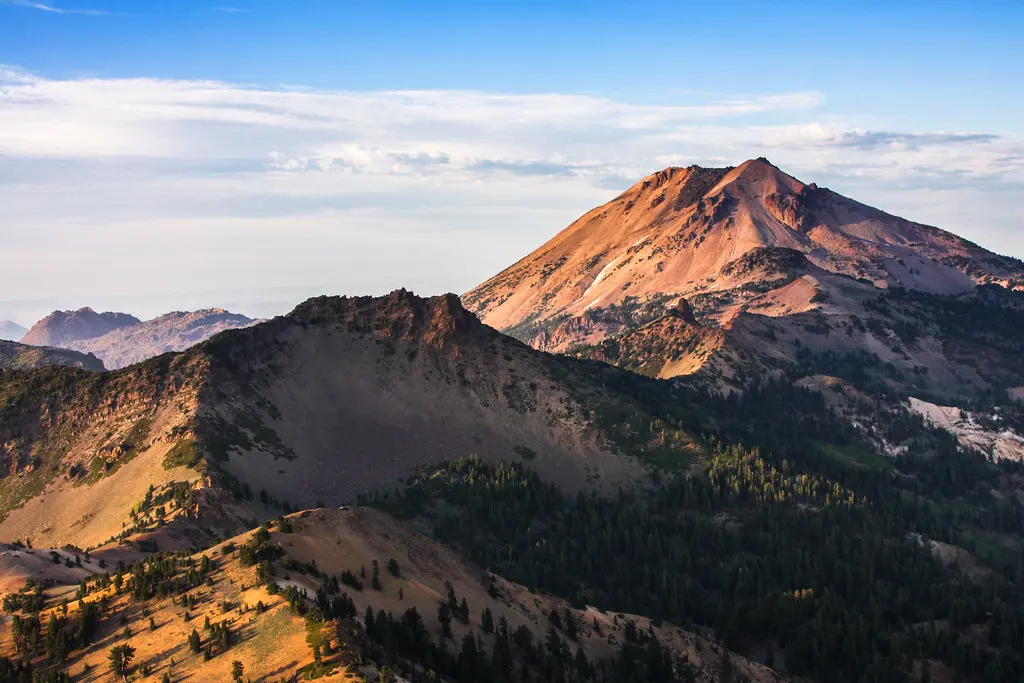
Visible for miles from Interstate 5, Mount Shasta is a solitary white-capped stratovolcano that last erupted in 1786 and ranks second-highest in the Cascade Range. Indigenous peoples have lived in its shadow for over 11,000 years. Modoc tradition places creator G'mokumk and the people's original bones here. The Wintu trace their origin to a sacred spring and maintain ceremonies for its flow.
The Shasta people, who gave the mountain its English name, call it Waka-nunee-Tuki-wuki—“walk around and around, but never on top”—forbidding ascent to creator beings' dwelling. In 1994, the entire 150,000-acre mountain was found eligible for the National Register of Historic Places for Native American cultural significance.
A distinct New Age layer followed Guy Ballard's claimed 1930 encounter with Ascended Master Saint Germain, which began the I AM Activity, considered by some scholars the first UFO religion. Seekers describe Telos, a crystal city inside the mountain inhabited by seven-foot-tall white-robed Lemurian survivors who move between dimensions. About half of 25,000 annual visitors come for spiritual reasons, and the town of 3,000 has exceptionally many metaphysical bookshops per capita.
These traditions coexist uneasily. New Age use crowds places sacred to Indigenous communities, while hikers and spiritual seekers violate the Shasta summit prohibition. Their relationships to the mountain are not equivalent even when both recognize an extraordinary presence.
Why this place is sacred
Mount Shasta rises 10,000 feet above its surroundings in one snow-capped cone. For the Wintu, its springs are not metaphor but the people's literal origin; ceremonies sustain their flow and a relationship of responsibility, guardianship, and care for a relative.
New Age interpretation is different: Lemurians are other-dimensional survivors of a lost continent, not genealogical ancestors. Seekers report vibration, presences, and clouds read as spacecraft camouflage while seeking contact, energy, or transformation. Both frameworks describe permeability beyond ordinary reality, but their authority and relationship to place remain distinct. Whether the mountain or seekers produce such experiences is unresolved; for 11,000 years, humans have continued to find Shasta extraordinary.
Sacred mountain in Indigenous cosmology—dwelling of creators, origin place of peoples, site of ceremony and vision.
Indigenous sacred site since at least 11,000 years ago. European contact in 19th century brought disruption to Indigenous practices. New Age significance developed from 1930s onward with I AM Activity movement. Lemurian legends elaborated through late 20th century. Modern period sees convergence of recreational, spiritual, and Indigenous use—not always harmoniously.
Experience and orientation
Mount Shasta can appear about fifty miles before arrival as a solitary white cone above its western-base town of metaphysical bookshops, crystal stores, meditation centres, and spiritual tours. Bunny Flat, the main trailhead, climbs through red fir toward the Sierra Club's historic Horse Camp stone cabin. Above timberline, technical routes require permits and experience; most visitors do not summit.
Road-accessible July through October, Panther Meadows is both public land and a Wintu sacred place of springs, summer wildflowers, and reported silence, creating continuing tension. Near 8,000 feet, the Old Ski Bowl looks west to Mount Eddy, south to Castle Crags, and toward the distant Trinity Alps. Above lies the summit where Indigenous teaching places creator beings and excludes humans. Smooth lenticular clouds form as moist air crosses the peak; Lemurian believers interpret them as camouflage for interdimensional spacecraft.
I-5 passes through the area; the town of Mount Shasta sits at the mountain's west base. Major trailheads: Bunny Flat (7,000 feet, year-round access to parking), Panther Meadows (7,500 feet, July-October), Old Ski Bowl (8,000 feet, July-October). The summit (14,179 feet) requires technical mountaineering.
Context and lineage
The Modoc people say that G'mokumk, the creator, resided on Mount Shasta. The original bones of the Modoc are placed there. The Wintu trace their origin to a sacred spring on the mountain's slopes; their ceremonies ensure those springs continue to flow. The Shasta people knew the mountain as Waka-nunee-Tuki-wuki—'walk around and around, but never on top'—a name that encodes a prohibition against ascending to the dwelling place of sacred beings.
Archaeological evidence confirms human presence in the area for at least 11,000 years, making this one of the longest continuously inhabited regions in North America. European contact in the 19th century disrupted but did not end Indigenous relationships with the mountain. The California Gold Rush brought prospectors and settlers; conflicts with Indigenous peoples marginalized traditional practices and lands. But the Winnemem Wintu and other communities maintained their connection to the mountain, continuing ceremonies that persist today.
The New Age chapter began in 1930 when Guy Ballard, hiking on Mount Shasta, claimed to encounter Saint Germain, an Ascended Master alleged to be an 18th-century alchemist. Saint Germain began training Ballard as a 'messenger,' leading to the I AM Activity movement. The movement combined theosophy, spiritualism, and new religious elements; some scholars consider it the first UFO religion.
Lemurian legends had earlier origins—Frederick Spencer Oliver's 1905 novel 'A Dweller on Two Planets' described an ancient civilization connected to Mount Shasta—but the I AM movement catalyzed the mountain's emergence as a New Age pilgrimage destination. Through the mid and late 20th century, belief in Telos, the crystal city inside the mountain, elaborated into detailed mythology with named Lemurian leaders and described social structures.
Mount Shasta represents a unique convergence: Indigenous sacred geography preserved through millennia, overlaid with modern metaphysical movements. The Indigenous traditions connect to broader patterns of mountain veneration among Pacific Northwest and California peoples. The New Age traditions trace through theosophy, spiritualism, and the broader emergence of alternative spirituality in 20th-century America.
G'mokumk
Guy Ballard
Frederick Spencer Oliver
Winnemem Wintu tribal members
Traditions and practice
Wintu ritual dances to ensure spring flow. Vision quests at specific sites. Training of medicine people at designated locations. Modoc ceremonies honoring the creator. Traditional prohibition against summit climbing among Shasta people. These are living practices maintained by contemporary tribal communities, not historical artifacts.
Winnemem Wintu continue ceremonial practices at sacred sites. New Age practitioners conduct meditation, channeling, and crystal healing. Guided spiritual tours operate from the town. Retreat centers offer structured experiences. I AM Activity followers make pilgrimages. Some visitors camp on the mountain specifically for spiritual purposes, reporting vivid dreams and encounters.
Visit Panther Meadows when the road is open (July-October) and allow time for quiet presence. The meadow's atmosphere rewards stillness. Hike to Horse Camp via Bunny Flat for a accessible taste of the mountain's higher reaches. Spend time in the town of Mount Shasta to understand the New Age culture that has developed here—visit a metaphysical bookshop, browse the crystals, talk to practitioners. Consider the Indigenous perspective that the summit should not be climbed, even if you are physically capable.
Let the mountain be what it is rather than something to conquer.
Wintu/Winnemem Wintu sacred practice
ActiveThe Wintu trace their origin to a sacred spring on Mount Shasta. The mountain is central to their cosmology. The Winnemem Wintu consider themselves guardians of the mountain and continue ceremonial practices.
Ritual dances to ensure spring flow. Ceremonies at specific sacred sites. Vision quests. Training of medicine people. These are private tribal practices, not open to general participation.
Indigenous sacred geography (multiple tribes)
ActiveMount Shasta is sacred to multiple tribes including Shasta, Modoc, Karuk, Achomawi, and Atsugewi. Each has distinct traditions and relationships with the mountain. In 1994, the entire 150,000-acre mountain was determined eligible for the National Register for its Native American cultural significance.
Vary by tribe. Include creation narratives, ceremonial observances, traditional prohibitions, and ongoing spiritual relationship. Many practices are not publicly shared.
New Age/Lemurian spirituality
ActiveSince the 1930s, Mount Shasta has been a center for New Age spiritual seeking. Believers hold that the mountain contains Telos, a crystal city built by survivors of the lost continent of Lemuria. The town of Mount Shasta has become a hub for metaphysical practice.
Meditation and channeling. Crystal healing and energy work. Guided spiritual tours. Seeking contact with Lemurians and Ascended Masters. Retreat participation. UFO watching.
I AM Activity
ActiveFounded after Guy Ballard's 1930 claimed encounter with Saint Germain on Mount Shasta. Considered by some scholars the first UFO religion and a foundation for later New Age movements.
Pilgrimage to Mount Shasta. Decrees and affirmations. Study of Ballard's teachings. Seeking contact with Ascended Masters.
Perspectives and open questions
Mount Shasta exists at the convergence of Indigenous sacred geography and modern spiritual seeking—a convergence that illuminates both traditions without resolving the tensions between them.
Scholarly perspective
The mountain's Indigenous significance is documented through ethnographic research and recognized through its 1994 determination of eligibility for the National Register. Archaeological evidence confirms human presence for 11,000+ years. Scholars study the New Age phenomenon as an example of modern religious invention, spiritual tourism, and the repurposing of Indigenous sacred space. The I AM Activity movement is analyzed as a precursor to later UFO religions and New Age spirituality.
Living and traditional perspectives
For Indigenous peoples—Wintu, Modoc, Shasta, Karuk, and others—the mountain is not metaphorically sacred but actually so. Creator beings dwell there. Peoples originated there. Ceremonies conducted there maintain the relationship between humans and the powers that sustain life. The Winnemem Wintu consider themselves guardians of the mountain. Traditional prohibitions against summit climbing reflect understanding of appropriate human relationship to sacred power.
Alternative interpretations
New Age believers hold multiple interpretations. Lemurians—tall beings in white robes—are said to live in Telos, a crystal city inside the mountain. Ascended Masters communicate through human channels. The mountain is an energy vortex, a convergence point for ley lines, a landing site for interdimensional spacecraft disguised as lenticular clouds. These beliefs are held sincerely by many practitioners and have generated a distinctive spiritual tourism economy.
Open questions
Why does this particular mountain generate such consistent reports of unusual experience? Is there measurable geomagnetic or other physical anomaly? How do Indigenous and New Age experiences relate—are they the same phenomena interpreted differently, or genuinely distinct? What is the full extent of Indigenous sacred geography on and around the mountain? These questions remain open.
Plan your visit
Access and arrival
Town of Mount Shasta offers hotels, motels, B&Bs, and retreat centers. Camping available in Shasta-Trinity National Forest—both established campgrounds and dispersed camping permitted on most forest land.
Respectful visit
Mountain conditions require appropriate outdoor clothing. Weather changes rapidly; carry layers. Technical gear required for summit attempts.
Permitted throughout public lands. If you encounter people in ceremony or spiritual practice, ask before photographing. Some locations may be particularly sensitive.
Not part of New Age or Indigenous practice in ways visitors can appropriately participate in. Leave no trace.
Wilderness permits required for summit climbs ($30 annual or daily fee). Panther Meadows road open July 1-October 31 only. Some areas are particularly sacred to Indigenous communities—approach with awareness.
Indigenous ceremonial sites should be approached with respect; do not intrude on ceremonies. The summit climb is serious mountaineering requiring permits, experience, and appropriate equipment. Weather changes rapidly. The Winnemem Wintu and other Indigenous communities have expressed concern about New Age appropriation and the environmental impact of spiritual tourism.
Location
Map loads as you approach this section.
Pilgrim reflections
A portrait of encounter, not a score
Pilgrims describe what they felt, how present they could become, and whether the place would shape a journey. There are no stars and no ranking of traditions.
No reviewed reflections yet
The first pilgrims can help describe the character of being here.
Share a reflection
Available after an account-backed “Been there.” Every reflection is reviewed before publication.
Nearby sacred places
Explore other sacred places in the region. Proximity does not establish access or travel time; check each place’s guidance.

References
Sources consulted for this page. Source categories describe the publication, not a guarantee that every claim is verified. Traditional accounts and outside interpretations may differ.
- 01Mount Shasta - National Register of Historic Places — Advisory Council on Historic PreservationofficialOfficial government documentation
- 02A Mountain Of Many Legends Draws Spiritual Seekers From Around The Globe — NPRnewsNational news coverage
- 03Mt. Shasta Wilderness — Shasta-Trinity National ForestofficialOfficial visitor information
- 04Mount Shasta - Sacred Destinations — Sacred DestinationsguideSacred site context
- 05There's Something About Mount Shasta — Atlas ObscuraguideCultural context
- 06Mount Shasta, California — World Pilgrimage GuideSource contextPilgrimage context
Photo gallery
3 curated photos
Share a photo
Help visitors recognize Mount Shasta. Every submission is reviewed before publication.