Mount Kinabalu
Borneo's highest peak, revered by the Kadazan-Dusun as Aki Nabalu, the resting place of the dead
Understand sacred places, explore living traditions, and learn how to engage respectfully with Pilgrim Map.
Access has not been verified. Check current local guidance before planning a visit.
Ranau, Sabah, Malaysia
Read the sources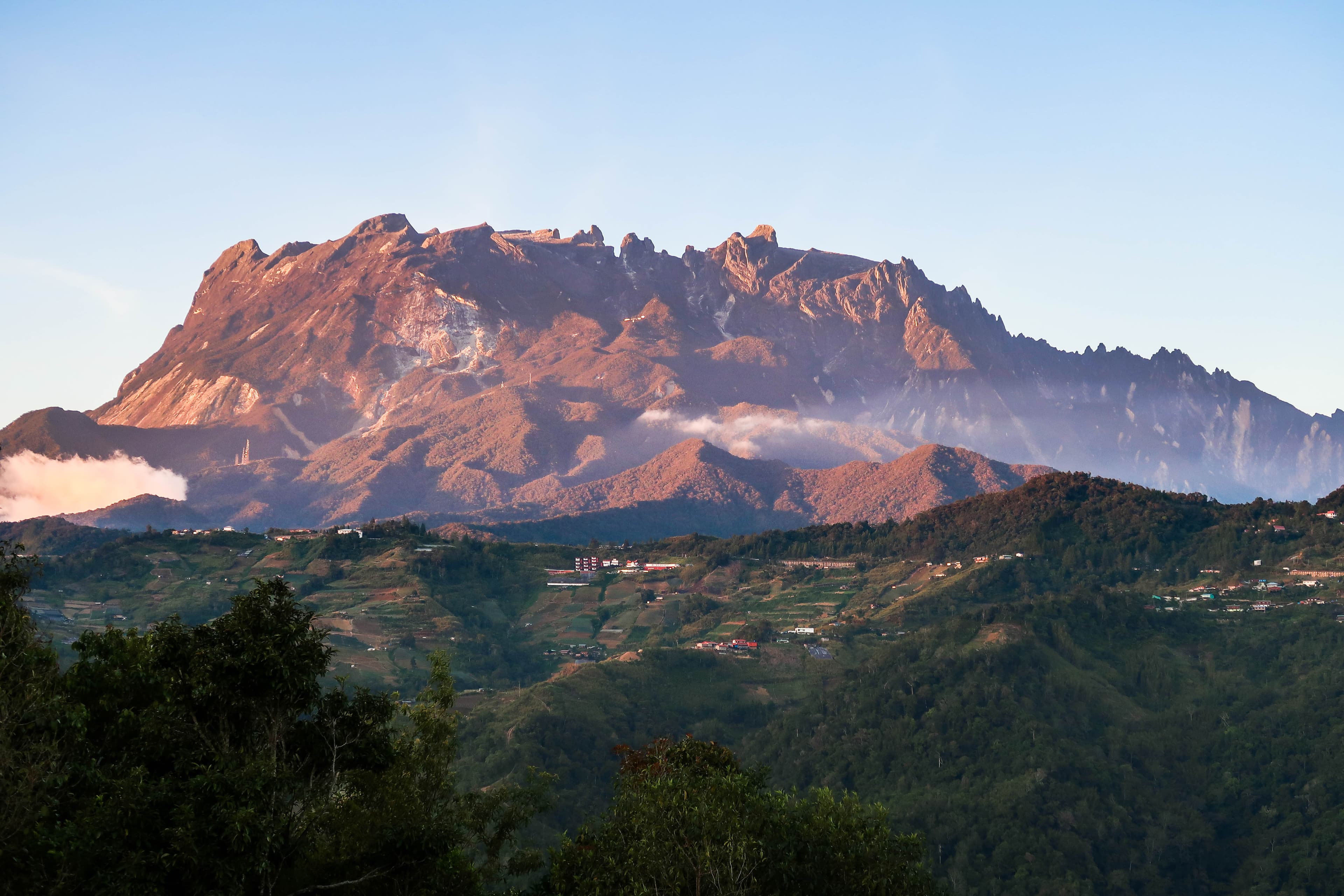
Image of Mount Kinabalu. Image source · CC-BY-SA-4.0
Visit essentials
A quick read before you go
- Duration
- The climb is typically two days and one night: ascend to Laban Rata on day one, summit at dawn…
- Access
- Within Kinabalu Park, about two hours' drive from Kota Kinabalu in Sabah.
Overview
Mount Kinabalu rises above Sabah's forests to 4,095 metres, the highest peak between the Himalayas and New Guinea's mountains. For the indigenous Kadazan-Dusun it is Aki Nabalu, the revered resting place where ancestral spirits gather. This remains living belief: in 2015, summit desecration and a deadly earthquake days later collided in public imagination, prompting a major cleansing ritual by community priestesses. The boundary among living people, the dead, and the spirit world is felt to be unusually thin.
Kinabalu Park became Malaysia's first World Heritage Site in 2000 for endemic life across zones from lowland rainforest to alpine rock, including Nepenthes rajah and Rafflesia. Named a UNESCO Global Geopark in 2022, it is Southeast Asia's youngest granitoid intrusion and still rising. The peak is both ancestral sanctuary and global hotspot of life.
Most visitors are climbers. The demanding two-day ascent crosses rainforest to an overnight rest house near 3,272 metres, followed by a pre-dawn headlamp climb to the bare summit plateau above a sea of cloud. Cold, altitude, and effort heighten the first-light atmosphere, while guides remind climbers whose ground this is.
Why this place is sacred
Kinabalu's hold on the imagination comes from its singularity and its role in the world of the dead. It rises alone above Borneo, the highest thing for an enormous distance, its cloud-wrapped peaks catching dramatic dawn light, and for the Kadazan-Dusun the summit is literally where the spirits of ancestors come to rest. To stand on the bare granite is, in their understanding, to stand at the threshold of the dead.
The mountain's name encodes this: read as Aki Nabalu, the revered place or ancestor of the dead. That a place of such reverence should also hold one of Earth's richest gatherings of endemic life deepens the sense of a charged landscape, where what is venerated by a people and what is studied by science occupy the same granite.
The thinness here is not architectural or liturgical but elemental, a felt nearness of the dead and the spirit-world on a summit that has been held holy long before any record, and that asks of those who climb it a corresponding gravity.
Experience and orientation
Reaching the summit is a physical undertaking that shapes the whole encounter. The standard climb runs over two days: an ascent on the first day from Timpohon Gate up through changing forest, the lowland rainforest thinning to stunted montane growth and finally to bare rock, arriving by afternoon at the Laban Rata rest house near 3,272 metres. Few sleep well at altitude.
Climbers rise in the dark for the final push, moving by headlamp up fixed ropes across cold granite toward Low's Peak, timing the climb to reach the summit plateau as the sun rises. What people describe most is that dawn: a long view over a sea of cloud, the alpine cold, and a quiet that feels weighted, an awareness that the place is sacred to the Kadazan-Dusun and not simply a viewpoint.
The descent on the second day is long on the knees, and running it is forbidden. A licensed guide accompanies every climb, and the rhythm of checkpoints, permits, and the daily quota means the mountain is approached on its own terms, not casually.
Climbs begin at Timpohon Gate, the most common route, with park headquarters at roughly 1,866 metres about two hours by road from Kota Kinabalu. The first day ascends to the Laban Rata rest house near 3,272 metres; the pre-dawn second-day push reaches Low's Peak, the 4,095-metre summit, passing checkpoints at Timpohon, Laban Rata, and Sayat-Sayat. A permit lanyard must stay visible at the checkpoints.
Context and lineage
Kinabalu was never built; it is a young, still-rising granitic mountain whose veneration by the Kadazan-Dusun reaches back beyond any written record and should not be fixed to a date. Geological figures vary by source and describe different rock units and events: the World Heritage datasheet describes a granite intrusion of roughly 15 million years uplifted around a million years ago, while the geopark materials cite a 7-to-8-million-year-old granitoid intrusion, the youngest in Southeast Asia.
Both descriptions hold a mountain still growing. The documented climbing history is recent against this. Hugh Low reached the summit plateau in March 1851, though not the highest point; Low's Peak, named for him, was first reached in 1888 by John Whitehead.
Kinabalu National Park was established in 1964, the surrounding park inscribed as a UNESCO World Heritage Site in 2000, joined by recognition as part of the World Network of Biosphere Reserves in 2014 and as a UNESCO Global Geopark in 2022.
Several origin stories coexist for the mountain itself, told in the perspectives below, but the indigenous reading of the name as Aki Nabalu, the revered place of the dead, is the one favored by the Kadazan-Dusun and by most scholars.
The mountain holds a continuity of indigenous veneration of unknown antiquity, predating the widespread arrival of Christianity and Islam in Sabah, carried forward by Kadazan-Dusun spirit and ancestor reverence and the related rice-spirit tradition tended by the same priestesses. Onto this is layered a modern lineage of scientific recognition and conservation stewardship under Sabah Parks, within the UNESCO World Heritage and Global Geopark frameworks.
The Kadazan-Dusun people
Indigenous custodians of Sabah's interior for whom Kinabalu is Aki Nabalu, the ancestral mountain; their living belief defines its sacredness
Bobolian / Bobohizan priestesses
Ritual specialists who mediate between community, ancestors, and the mountain's spirits through chants and offerings
Hugh Low
British colonial administrator and naturalist who made the first recorded ascent of the summit plateau
John Whitehead
Naturalist and explorer credited with the first ascent of Low's Peak, the true summit
Joseph Pairin Kitingan
Sabah Deputy Chief Minister who, after the 2015 earthquake, tied the disaster to disrespect shown to the sacred mountain and announced a cleansing ceremony
Traditions and practice
Historically, sacrificial offerings were made to the mountain's guardian spirits before an ascent. The most fully documented modern rite is the Monolob, or Monogit, Aki Nabalu cleansing ceremony conducted over three days in 2015 by six Bobolians drawn from seven districts, who offered a goat and seven white chickens to appease the spirits after the June earthquake.
The related Kadazandusun agrarian cycle, centered on the same spirit-world, expresses itself in the Kaamatan harvest festival each May and the Magavau ceremony that calls the rice spirit Bambarayon home, both led by the Bobohizan through rinait chants and offerings.
Bobolian and Bobohizan offerings and chants continue within Kadazandusun communities, and major cleansing ceremonies are convened when the mountain is believed to have been disturbed. Whether any routine ritual still precedes ordinary tourist climbs is not consistently documented today. Kaamatan and its Magavau ceremony are held each May.
For a visitor without standing in the tradition, the practice is one of attention rather than ritual. Treat the climb as a passage onto ground held sacred to the dead, and carry that awareness to the summit, where the Kadazan-Dusun understand ancestral spirits to dwell. The cold dawn on the bare granite lends itself to stillness and to reflection on mortality, fitting for a mountain that is, in indigenous understanding, a resting place of the dead.
Behave at the top as a guest at a grave would.
Kadazan-Dusun indigenous spirit and ancestor veneration
ActiveThe Kadazan-Dusun revere Mount Kinabalu as Aki Nabalu, the revered resting place of the dead, believing the spirits of their ancestors dwell at and around the summit. The mountain anchors creation stories and the community's relationship with land, harvest, and the dead.
Bobolian and Bobohizan offerings and rinait chants to honor and appease the mountain's spirits; historical sacrificial offerings before ascent; cleansing ceremonies such as the Monolob or Monogit conducted when the mountain is believed to be offended.
Kadazandusun agrarian rice-spirit tradition (Kaamatan / Magavau)
ActiveCentered on the rice harvest rather than the summit, but bound to the same spirit-world that venerates Kinabalu: the Bobohizan who tends the rice spirit Bambarayon is the same class of priestess who mediates with the mountain's spirits.
The Kaamatan harvest festival each May; the Magavau ceremony calling the rice spirit Bambarayon home; rinait chants and offerings led by the Bobohizan.
Scientific and conservation stewardship
ActiveKinabalu is recognized as Malaysia's first World Heritage Site, a UNESCO Global Geopark, and a biosphere reserve, valued as a global hotspot of geological youth and biological endemism and managed for conservation by Sabah Parks.
Conservation management, permitted and quota-limited climbing, scientific study of endemic flora and fauna, and the maintenance of the climbing route and checkpoints.
Perspectives and open questions
Kinabalu is read at once as a young, still-rising granite massif of global scientific value and as the ancestral mountain of a living people. These readings do not so much compete as occupy the same summit.
Scholarly perspective
Scientifically, Kinabalu is a young, still-rising granitic massif of outstanding geological and biological value, Malaysia's first World Heritage Site and a global hotspot of plant endemism, home to Nepenthes rajah and Rafflesia keithii. Geologists attribute the 2015 earthquake to tectonic forces, and most scholars derive the name from Aki Nabalu.
Living and traditional perspectives
For the Kadazan-Dusun, the mountain is Aki Nabalu, the revered resting place of the dead and home of ancestral and guardian spirits. Offense to the mountain is understood to bring real consequence, and Bobolian and Bobohizan priestesses mediate the relationship between community, ancestors, and the mountain through offerings and chants.
Alternative interpretations
Popular legend frames the summit as the lair of a dragon guarding a luminous pearl, slain by a Chinese prince who married a local Kadazan woman and then abandoned her, leaving her to return to the mountain and turn to stone; from this comes the widely circulated Cina Balu, or Chinese widow, folk etymology of the name. A Kadazandusun creation account credits the deities Kinohiringan and Umunsumundu with shaping the cosmos. These are cultural narratives rather than verified history.
Open questions
The deep antiquity and original form of indigenous sacred practice at Kinabalu is undocumented. How far pre-climb appeasement rites once extended, and whether any persist for ordinary modern ascents, remains unclear. The interplay between living indigenous belief and mass tourism on a sacred summit is an unresolved, ongoing tension rather than a closed historical question.
Plan your visit
Access and arrival
Within Kinabalu Park, about two hours' drive from Kota Kinabalu in Sabah. Park headquarters sit at roughly 1,866 metres; climbs begin at Timpohon Gate on the most common Ranau or Timpohon trail, with the Mesilau route as an alternative. A compulsory guide and a Sabah Parks permit are required.
Climbers overnight on the mountain at the Laban Rata rest house near 3,272 metres, booked as part of the permitted climb. A wider range of lodging is available in Kota Kinabalu and in the Kundasang and Ranau area near the park gate.
Respectful visit
Practical cold-weather climbing gear is needed; the summit is near freezing before dawn. Beyond comfort, dress and behave decently at the summit. Stripping or posing nude there is both deeply offensive to local belief and, as in 2015, prosecutable as gross indecency.
Landscape and climbing photography is generally welcomed. Indecent or disrespectful posing at the summit is prohibited and culturally inflammatory. Be sensitive about photographing any Kadazandusun ceremony, ask permission, and do not treat rituals as props.
Offerings are made only by Bobolians and Bobohizans within their own ritual context; visitors should not improvise their own. Do not remove stones or natural objects from the summit.
A licensed Sabah Parks guide is compulsory and a valid permit must be carried and shown at checkpoints, with a daily summit quota in force. Reach Timpohon Gate by the posted cutoff. Do not litter, do not run on the descent, and do not take stones from the summit.
Visitors do not take part in Bobolian rituals; these are community religious acts, not activities to join. Do not improvise offerings of your own. If you encounter a Kadazandusun ceremony, especially during Kaamatan, treat its ceremonial elements as sacred rather than spectacle, and never as a photo prop.
Location
Map loads as you approach this section.
Pilgrim reflections
A portrait of encounter, not a score
Pilgrims describe what they felt, how present they could become, and whether the place would shape a journey. There are no stars and no ranking of traditions.
No reviewed reflections yet
The first pilgrims can help describe the character of being here.
Share a reflection
Available after an account-backed “Been there.” Every reflection is reviewed before publication.
Nearby sacred places
Explore other sacred places in the region. Proximity does not establish access or travel time; check each place’s guidance.

References
Sources consulted for this page. Source categories describe the publication, not a guarantee that every claim is verified. Traditional accounts and outside interpretations may differ.
- 01Kinabalu Park — UNESCO World Heritage CentreofficialInscribed 2000 as Malaysia's first World Heritage Site; Mount Kinabalu 4,095 m, highest between Himalayas and New Guinea; outstanding biodiversity across altitudinal habitat range.
- 02Kinabalu UNESCO Global Geopark — UNESCO International Geoscience and Geoparks ProgrammeofficialGlobal Geopark (2022); youngest granitoid intrusion in SE Asia (7-8 Ma); ophiolite (~130 Ma) of subducted Proto-South China Sea; geodiversity context.
- 03Kinabalu Park — World Heritage Datasheet — UNEP-WCMCofficialPark established 1964; biodiversity statistics; granite intrusion ~15 Ma thrust up ~1 Ma; management and conservation framing.
- 04Malaysia official blames nude tourists for deadly quake — BBC NewsSource contextMagnitude-5.9 quake 5 June 2015 killed 18; Deputy Chief Minister Joseph Pairin Kitingan tied tourists' disrespect to the sacred mountain; ritual to appease spirits announced. Western tourists posed nude on the summit 30 May 2015.
- 05Mountain Climbing Tickets / Permits — Sabah ParksofficialOfficial permit booking; guides compulsory; daily climber quota; permit lanyard must be visible at checkpoints.
- 06Mount Kinabalu — Malaysia — Sacred Land Film ProjectspiritualSacred-site framing; Kadazan-Dusun belief that the summit is the resting place of ancestral spirits; pre-climb sacrificial customs.
- 07Myths & Legends of Mount Kinabalu — Amazing Borneo ToursSource contextDragon-and-pearl legend; Chinese prince / Kadazan wife turned to stone; 'Cina Balu' (Chinese widow) folk etymology; Kinohiringan & Umunsumundu creation deities.
- 08Kaamatan Harvest Festival: The Legend of Huminodun and the Sacred Legacy of Rice in Sabah — Amazing Borneo ToursSource contextKaamatan (May); Huminodun myth; Bambarayon/Bambazon rice spirit; Magavau ceremony; Bobohizan/Bobolian priestess role.
- 093-day ritual to appease mountain spirits — Borneo Post OnlineSource contextReportage on the 2015 Monolob/Monogit Aki Nabalu ceremony after the June 5 earthquake; one goat and seven white chickens sacrificed; six Bobolians from seven districts.
- 10Important Tips / FAQ — Mount Kinabalu Information Centre — Mount Kinabalu Climb CentreSource contextTimpohon Gate cutoff times; Laban Rata Resthouse (3,272 m) overnight; checkpoints at Timpohon, Laban Rata, Sayat-Sayat; no littering, no removing stones from summit, no running on descent.
Photo gallery
3 curated photos
Share a photo
Help visitors recognize Mount Kinabalu. Every submission is reviewed before publication.