Mounds State Park, Indiana
Ancient astronomers built circles in earth to track the heavens, and their sacred geometry persists after two millennia
Understand sacred places, explore living traditions, and learn how to engage respectfully with Pilgrim Map.
Access has not been verified. Check current local guidance before planning a visit.
Anderson, Indiana, United States
Read the sources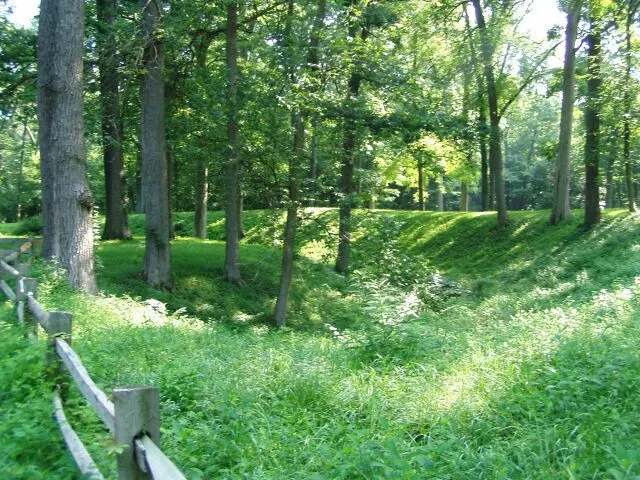
Visit essentials
A quick read before you go
- Duration
- Half a day to explore multiple trails and visit the Nature Center.
- Etiquette
- Mounds State Park requires visitors to treat the earthworks as ancestral sites deserving…
Overview
The Adena people who built the Great Mound around 160 BCE were not burying their dead; they were reading the sky. The nearly 390-foot circular earthwork tracked celestial events. From specific positions within its embankments, observers could mark the sun's solstice and equinox rising and setting points, the moon's movements, and the positions of over one hundred of the brightest stars—calculation encoded in earth.
Post holes on the platform suggest brush fences concealed events from those not permitted to see. Researchers describe sacred activities there: something happened that required concealment. For five centuries, roughly 160 BCE to 50 CE, the Adena used and developed these earthworks. The succeeding Hopewell tradition added burial to ceremonial functions; a log tomb near the Great Mound held artifacts including a platform pipe typical of Hopewell styles. The mounds became both observatory and cemetery.
The site saw continuous human use for ten thousand years, from 8000 BCE to 1400 CE, before the Adena and after the Hopewell. Today Mounds State Park preserves ten earthworks within a recreational landscape. Trails pass mounds that tracked the sun, the Nature Center interprets their builders' work, and the geometry remains beneath the turning sky.
Why this place is sacred
The Great Mound was built as an instrument. Its embankments and ditches created sight lines to celestial markers. From specific positions, observers could watch the sun rise or set at precise points on the horizon, marking solstices and equinoxes. The moon's complex eighteen-year cycle could be tracked. Over one hundred stars could be observed and their positions recorded.
This was practical in one sense: an agricultural calendar could be developed from these observations. But the researchers who studied the site describe it in different terms. The mounds were dedicated to the Sun God and Earth Mother. The astronomical observations were not merely scientific but devotional. Tracking the heavens was participation in sacred order.
The post holes that suggest brush fences carry particular significance. These fences hid what happened on the mound platform from those standing below. The Adena intentionally concealed their activities. This suggests initiation, mystery, practices reserved for those who had earned the right to see. The sacred was not public.
The addition of burial practices during the Hopewell period layered new meaning onto astronomical function. The dead were placed within earthworks designed to track celestial cycles. This suggests a cosmology connecting death and rebirth to the movements of heavenly bodies. The grave was not merely repository but cosmic location.
Ten thousand years of human presence at this site exceeds the earthworks themselves. Whatever drew people here before the Adena built continued to draw them after. The mounds formalized something that preceded them.
The Adena people built the earthworks at Mounds State Park as ceremonial spaces dedicated to the Sun God and Earth Mother. The astronomical alignments served to track celestial events for ceremonial timing and agricultural planning. The hidden platforms suggest initiatory or mystery practices restricted to qualified participants. The Hopewell tradition added burial functions, creating a complex site serving multiple sacred purposes.
Archaeological evidence shows human activity at the site from 8000 BCE to 1400 CE, with the formal earthworks constructed approximately 160 BCE through 50 CE. After the Hopewell period, the specific use of the mounds is unclear. European settlement found the earthworks persisting in the landscape.
The site became an Indiana state park in 1930, shifting its function from working landscape to preserved heritage. Today, the park serves both recreational and interpretive purposes, with the Nature Center explaining what the Adena and Hopewell peoples created.
Experience and orientation
The Great Mound does not announce itself dramatically. Forested and integrated into the park's trail system, it reveals itself gradually. The embankment rises nine feet, circles an area 390 feet across, and surrounds a ditch ten and a half feet deep. The scale becomes clear through walking rather than viewing.
Circling the mound takes time. The circumference is nearly a quarter-mile. Walking it slowly, attending to the geometry, allows something of the builders' intention to register. This was not a pile of earth but a calculated form, designed to relate to the sky above it.
The forested setting creates acoustic isolation. Traffic noise fades. Bird calls rise. The quality of attention available in such settings differs from what museums offer. The mound does its work on visitors who give it time.
Those who visit at solstices or equinoxes can experience something of what the Adena created. The sun rises and sets at predictable positions. The earthworks were built to mark these positions. Watching sunrise or sunset from within the mound geometry connects modern visitors to observations made over two millennia ago.
The other earthworks in the park, including Fiddle Back Mound and Circle Mound, add to the sense of a landscape intentionally shaped for sacred purpose. This was not one structure but a complex, multiple mounds serving related functions.
Mounds State Park rewards visitors who come with historical context. The Nature Center provides interpretation that the mounds themselves cannot offer. Visit the center before walking the trails.
Trail 1 passes the Great Mound and is partly wheelchair accessible. Allow time to walk the full circumference rather than merely viewing from one angle.
Consider what you are walking among. Real people, two thousand years ago, calculated celestial movements and encoded that knowledge in earth. Their sophistication exceeded what casual assumptions about "ancient peoples" might suggest.
Solstice dates, around June 21 and December 21, carry particular significance. No formal ceremonies occur, but the astronomical alignments the builders created persist. Visiting at these times connects you to the observations that gave the mounds their meaning.
Context and lineage
The Adena culture emerged around 1000 BCE in the Ohio River Valley, developing a complex society characterized by earthwork construction, elaborate burials, and long-distance trade. They were not a single tribe but a network of related communities sharing practices and beliefs.
Around 160 BCE, Adena people began constructing the Great Mound and associated earthworks at what is now Mounds State Park. The construction was not merely practical but devotional: the mounds were dedicated to the Sun God and Earth Mother. The astronomical alignments served to connect human ceremony to celestial rhythm.
Over the following centuries, the Adena culture transformed into or was succeeded by the Hopewell tradition, which added burial practices and elaborate mortuary ceremonialism to the site's functions. A log tomb near the Great Mound contained Hopewell-style artifacts, showing the continuity of sacred use across cultural transitions.
The earthworks at Mounds State Park represent the heritage of Woodland-period peoples whose descendants include various Native American communities today. The specific lineages connecting modern tribes to this particular site are not always clear, but the earthworks represent ancestral presence for peoples who maintain connection to Woodland traditions.
Archaeological lineage connects the site to the broader study of Adena-Hopewell cultures, contributing to understanding of pre-Columbian North American civilization.
Traditions and practice
The Adena people conducted ceremonies dedicated to the Sun God and Earth Mother at the mound complex. Astronomical observations marked solstices, equinoxes, and stellar positions for ceremonial timing. The hidden platforms suggest initiatory practices restricted to those deemed qualified. The Hopewell added burial rituals, interring the dead within the sacred geometry.
Specific practices are not documented and can only be inferred from archaeology and comparison with practices at related sites. The post holes suggesting brush fences indicate that some activities were deliberately concealed from general view.
The Nature Center offers educational programs and naturalist-led events. Hiking trails allow visitors to explore the mounds and surrounding forest. The park also includes recreational facilities including a campground, swimming pool, and picnic areas.
The site offers no formal spiritual programming. Engagement is primarily contemplative: walking among earthworks built two millennia ago, considering what they meant to their builders, allowing the landscape to work on attention.
Begin at the Nature Center to understand what the Adena and Hopewell peoples created. Context transforms what might otherwise appear as mere hills into intentional sacred geometry.
Walk Trail 1 to the Great Mound. Rather than viewing from a distance, walk the full circumference if you are able. The geometry reveals itself through movement.
Consider visiting at a solstice or equinox. The sun still rises and sets at the positions the builders marked. You can experience something of what they created, the alignment of architecture and astronomy.
Allow time for quiet. The forested setting creates conditions that visitor centers cannot replicate. Sit with the earthworks. Notice what arises when you stop seeking and simply attend.
Adena culture
HistoricalThe Adena culture built the earthworks at Mounds State Park beginning around 160 BCE. The Great Mound and associated structures were dedicated to the Sun God and Earth Mother, serving as astronomical observatories and ceremonial spaces. The Adena created earthwork enclosures as gathering places for religious ceremonies and celestial observation.
Construction of circular earthwork enclosures. Ceremonies dedicated to the Sun God and Earth Mother. Astronomical observations tracking solstices, equinoxes, lunar cycles, and stellar positions. Hidden activities on mound platforms, concealed by brush fences.
Hopewell culture
HistoricalThe Hopewell tradition succeeded the Adena and used the earthworks for burial purposes. The Hopewell were characterized by elaborate mortuary ceremonialism and extensive trade networks. A log tomb near the Great Mound contained Hopewell-style artifacts.
Burial ceremonies within the earthworks. Elaborate mortuary ritual. Trade in exotic materials over hundreds of miles.
Perspectives and open questions
Mounds State Park invites understanding through archaeological, traditional, and experiential perspectives. The astronomical alignments are documented; the spiritual meaning is inferred; the experience of visitors adds another dimension.
Scholarly perspective
The earthworks at Mounds State Park are recognized as among the best examples of Adena-Hopewell mound building in Indiana. The Great Mound is documented as the largest circular enclosure of its type in the state. Archaeological research has established the astronomical functions of the alignments and the ceremonial purposes of the site.
Scholarly interpretation emphasizes the sophistication of Adena astronomical knowledge. The ability to track over one hundred stars, the moon's eighteen-year cycle, and precise solar positions demonstrates mathematical and observational skills that challenge casual assumptions about pre-literate peoples.
Living and traditional perspectives
The earthworks represent ancestral heritage for descendant communities of Woodland-period peoples. Though specific tribal connections to this site are not always documented, the mounds are part of a broader sacred geography that Indigenous peoples recognize.
The dedication of the site to the Sun God and Earth Mother, reported in archaeological literature, suggests a cosmology connecting celestial observation to spiritual practice. The hidden platforms indicate mystery traditions with restricted access.
Alternative interpretations
Some visitors describe the mounds as places of special energy or spiritual significance. These descriptions often emerge from genuine experiences but lack archaeological documentation. The consistency of such reports suggests the site produces effects worth noting.
Open questions
Genuine mysteries remain. The specific ceremonies conducted at the mounds are not documented. The full extent of astronomical knowledge encoded in the alignments awaits further analysis. The contents of unexcavated portions of the site remain unknown.
Plan your visit
Access and arrival
Campground on site with 75 electric sites available for reservation. Hotels available in Anderson.
Respectful visit
Appropriate outdoor clothing and comfortable walking shoes. Trails can be uneven.
Permitted throughout the park. The mounds may be photographed but should be treated with respect.
Not applicable at this site.
Stay on designated trails. Do not climb on or disturb mounds. Standard state park rules apply.
The mounds are protected archaeological features. Do not climb on or disturb them. Stay on designated trails. The earthworks' preservation depends on visitors who understand that protection is not merely legal but ethical.
Current practical details
Address
4306 Mounds Rd, Anderson, IN 46017, USA
Phone
Hours
Hours, fees, and access can change — verify on the official source before you travel. Practical details last checked Jun 2026.
Location
Map loads as you approach this section.
Pilgrim reflections
A portrait of encounter, not a score
Pilgrims describe what they felt, how present they could become, and whether the place would shape a journey. There are no stars and no ranking of traditions.
No reviewed reflections yet
The first pilgrims can help describe the character of being here.
Share a reflection
Available after an account-backed “Been there.” Every reflection is reviewed before publication.
Nearby sacred places
Explore other sacred places in the region. Proximity does not establish access or travel time; check each place’s guidance.

Maria Stein Shrine of the Holy Relics
Maria Stein, Ohio, United States
102.4 km away
Serpent Mound, Peebles, Ohio
Bratton Township, Ohio, United States
224.2 km away

National Shrine of Saint Jude
Chicago, Illinois, United States
240.7 km away
Saint Meinrad Archabbey
St. Meinrad, Indiana, United States
240.9 km away
References
Sources consulted for this page. Source categories describe the publication, not a guarantee that every claim is verified. Traditional accounts and outside interpretations may differ.
- 01Mounds State Park — Indiana Department of Natural ResourcesofficialOfficial state park documentation
- 02Mounds State Park — WikipediaencyclopediaGeneral reference
- 032,000 Years of History & Nature at Mounds State Park — Visit IndianaguideState tourism information
- 04Friends of Mounds State Park — Friends of Mounds State ParkSource contextPark support organization
Share a photo
Help visitors recognize Mounds State Park, Indiana. Every submission is reviewed before publication.