Mother Shipton’s Cave, Knaresborough, England
Where England's most famous prophetess was born, and waters still turn ordinary things to stone
Understand sacred places, explore living traditions, and learn how to engage respectfully with Pilgrim Map.
Access has not been verified. Check current local guidance before planning a visit.
Knaresborough, England, United Kingdom
Read the sources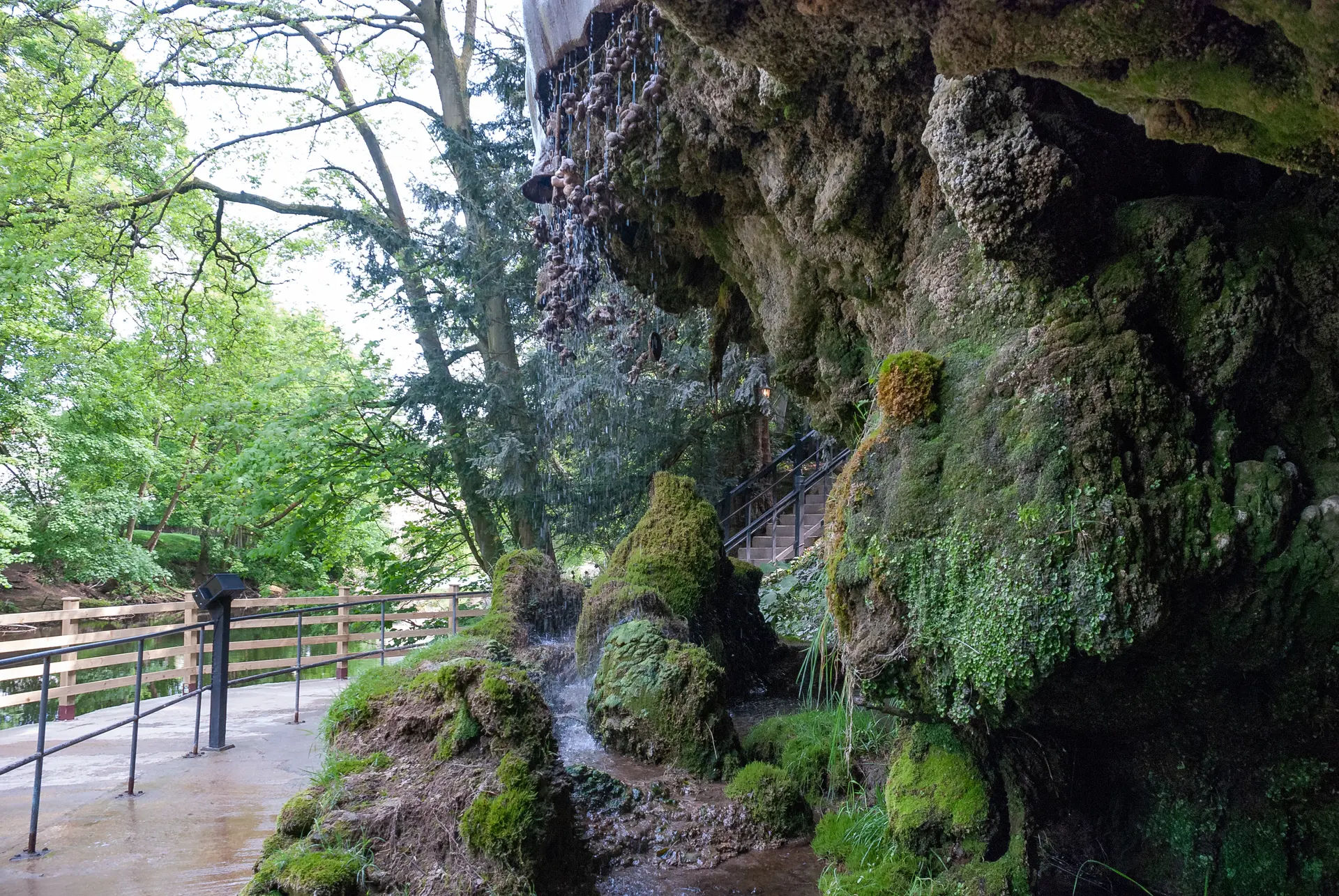
Image of Mother Shipton’s Cave, Knaresborough, England. Image source · CC-BY-SA-2.0
Visit essentials
A quick read before you go
- Duration
- One to two hours covers the essential experience: cave, Petrifying Well, museum of petrified…
- Etiquette
- Mother Shipton's Cave is a commercial attraction welcoming visitors of all backgrounds.
Overview
Mother Shipton's Cave has gathered stories since at least the sixteenth century as the Petrifying Well gathers minerals: layer by layer until the original form is transformed. The woman may or may not have existed, later publishers largely fabricated her attributed prophecies, and calcium carbonate—not witchcraft—causes the petrification.
Knowing this, visitors still arrive by the thousands, feel something in the cave's cool darkness, and hang teddy bears in mineral-rich water to watch them slowly turn to stone. England's oldest tourist attraction has charged admission since 1630. It remains a threshold where reason and mystery coexist, a legendary wise woman receives pilgrims, and matter patiently changes. Folklore, geology, and what is harder to name meet in the possibility that the world is stranger than we have been told.
Why this place is sacred
Caves have always been places where humans encounter the numinous. They are thresholds by nature, openings between the daylight world and something darker, older, unknown. Mother Shipton's Cave follows this ancient pattern: a limestone hollow on the banks of the Nidd, its interior pool shaped like a skull, its shadows deep enough to hide visions.
The woman said to have been born here embodied another kind of threshold. Mother Shipton, if she existed at all, occupied the boundary between village healer and witch, between helpful counselor and feared outcast. Her legendary ugliness, her rumored devil-father, her retreat to this cave after her husband's death: all these details place her at the margins where power gathers precisely because it is not contained by ordinary categories.
The Petrifying Well adds a third layer of liminality. Visitors for centuries have watched ordinary objects undergo slow transformation, their surfaces acquiring stone skins through the steady deposition of minerals. Before the geological explanation was understood, this process seemed to confirm what the legends suggested: that something supernatural dwelt here, capable of turning soft things hard, living things to stone.
Perhaps most significantly, the site has hosted continuous pilgrimage for nearly four hundred years. The weight of accumulated attention, the countless visitors who have stood where you stand and wondered what they wondered, creates its own kind of presence. Thin places are often made as much as found, their power arising from the intersection of landscape and human intention over time.
The cave itself is a natural formation, carved by water through Permian limestone over geological ages. Whether it held significance before the Mother Shipton legends emerged remains unknown. The Petrifying Well was first recorded in 1538, before any written mention of the prophetess, suggesting the waters' strange properties may have drawn attention to this spot long before the stories of a witch's birth attached themselves here.
The cave's meaning has transformed repeatedly across centuries. In Mother Shipton's legendary lifetime, it served as refuge and workshop for an outcast healer. By 1630, when Sir Charles Slingsby opened the well to paying visitors, it had become England's first commercial tourist attraction. Victorian fascination with the supernatural brought new waves of visitors, including famous figures like Samuel Pepys and Daniel Defoe.
The twentieth century added archaeological interest and geological explanation, yet did not diminish the site's pull. Today, Summer Solstice celebrations draw neo-pagans and Wiccans who find in Mother Shipton an authentic representative of pre-Christian wise woman traditions. The cave has become a palimpsest: each era writing its meaning over the last, none entirely erasing what came before.
Experience and orientation
The descent to the cave involves seventy-five steps, a transition from the ordinary world above to something dimmer and older below. The air cools as you descend. The sound of falling water grows louder. By the time you reach the cave mouth, you have already crossed a threshold.
Inside, the atmosphere is hushed and slightly unsettling. The skull-shaped pool that contributed to the witch legends does bear an uncanny resemblance, its dark waters still and watchful. Whether Mother Shipton was ever here, something about the space invites the imagination to populate it: a solitary woman grinding herbs, receiving visions, offering counsel to those desperate enough to seek her out.
The Petrifying Well produces a different kind of wonder. Objects hang in the mineral-rich flow, teddy bears and hats and shoes slowly acquiring their stone skins. The process is perfectly explicable, calcium carbonate accumulating at roughly one inch per year, yet it retains its capacity to astonish. There is something profound in watching transformation made visible, in returning months later to find that the soft has become hard, the ephemeral preserved.
Many visitors report surprise at how the combination of legend and landscape affects them. They arrive expecting kitsch, a tourist trap dressed in supernatural trappings. They leave thoughtful, uncertain why a cave and some dripping water should have moved them. The most honest ones admit they cannot quite explain what they felt.
Approach Mother Shipton's Cave the way you might approach a folktale: knowing it may not be literally true, yet sensing it carries some other kind of truth worth attending to.
Allow time beyond the cave itself. The mile-long woodland walk along the Nidd is where many visitors find their unexpected moments, the combination of ancient trees and flowing water working on them in ways the cave began. Consider coming during a life transition, when you might be more receptive to whatever the site offers.
If you visit during Summer Solstice, you will encounter practitioners who take Mother Shipton's legacy seriously as spiritual inheritance. Their ceremonies are not performance for tourists. Observe respectfully if you do not share their practice, or join if you feel genuinely called.
Context and lineage
According to the legend, Ursula Southeil was born in this cave around 1488, during a thunderstorm so violent it seemed the world was ending. Her mother Agatha was fifteen, unmarried, and would never reveal the father's identity. Rumors naturally filled the gap: the child was sired by the Devil himself.
The infant emerged deformed, with a hunchback, bulging eyes, and twisted limbs. When she cackled instead of crying, the storms miraculously ceased. Agatha gave the child to a local nurse and eventually entered a convent, leaving Ursula to grow up an outcast, marked by her appearance and her mother's scandal.
At twenty-four, Ursula married Toby Shipton, a carpenter from York. When he died around 1514, the townspeople blamed her, and she retreated to the cave of her birth. Here she practiced herbalism, created remedies and potions, and received the visions that would eventually become the prophecies bearing her name. Those who sought her counsel called her Mother Shipton: not a title of respect exactly, but an acknowledgment of her role as helper and wise woman.
How much of this is history and how much invention remains unknowable. The first written account of her life appeared in 1641, eighty years after her reported death, and scholars have traced most biographical details to Richard Head's 1667 publication, which he appears to have largely fabricated.
The lineage at Mother Shipton's Cave is one of storytelling rather than formal transmission. The legends passed through oral tradition, then print, then tourism, each transition adding new layers and losing others.
The first published prophecies appeared in 1641, predicting events that had already occurred by the time of publication, a common pattern in retrospective prophecy. Richard Head's 1667 biography invented much of what we now consider the standard life story. Victorian publishers added apocalyptic predictions, including Charles Hindley's famous forgery.
Through all these transformations, the site itself persisted. The Slingsby family maintained it until the English Civil War disrupted their fortunes. The well has remained open to visitors, with only brief interruptions, for nearly four centuries. Each generation has found its own reasons to come: supernatural curiosity, geological interest, family outing, spiritual pilgrimage.
Mother Shipton
legendary
England's most famous prophetess, reportedly born in this cave around 1488. Whether she existed as a historical person or emerged entirely from legend remains uncertain. She represents the archetype of the wise woman: healer, seer, outcast, helper.
Agatha Southeil
legendary
According to legend, Mother Shipton's unwed teenage mother, who gave birth in the cave during a thunderstorm before eventually entering a convent.
Sir Charles Slingsby
historical
Acquired the site after King Charles I sold Knaresborough Forest in 1630, and opened the Petrifying Well to paying visitors, creating England's first commercial tourist attraction.
Richard Head
historical
Publisher who in 1667 produced the biography that established most details of Mother Shipton's life, which scholars believe he largely invented.
Charles Hindley
historical
Bookseller who in 1871 fabricated the famous prophecy 'The world to an end shall come / In eighteen hundred and eighty one,' causing genuine panic before he confessed to the forgery in 1881.
Traditions and practice
Mother Shipton herself, according to legend, practiced herbalism and divination in this cave. Visitors would seek her out for remedies, potions, and counsel about their futures. She was said to receive visions here, prophecies that her followers recorded and transmitted.
These practices belong to the English cunning folk tradition: village healers and seers who operated outside the official church, providing services that combined practical medicine with folk magic and spiritual counsel. Whether any of this actually occurred at this cave cannot be verified.
The site now functions primarily as a tourist attraction, welcoming families, history enthusiasts, and geology students alongside spiritual seekers. However, certain practices have emerged that carry significance for participants.
Summer Solstice celebrations draw practitioners of paganism, Wicca, and related traditions. These gatherings include singing, dancing, chanting, and the leaving of offerings within the cave. Participants connect with nature, observe midsummer rituals for good fortune and healing, and honor Mother Shipton as a representative of ancient wise woman traditions.
Placing objects in the Petrifying Well has become a practice in its own right. Visitors purchase or bring items to hang in the mineral flow, returning months later to retrieve their transformed objects. The practice connects them to the site's history, to the slow patience of geological time, and to the mystery of transformation that first drew attention to this place.
If you seek more than entertainment, consider these approaches:
Spend time in the cave itself, beyond the quick look most visitors give. Let your eyes adjust. Notice the skull-shaped pool. Imagine what it would mean to retreat here, to the place of your birth, after the world had rejected you.
Walk the woodland path slowly, as contemplative practice rather than exercise. The combination of river, ancient trees, and the knowledge of what lies behind you creates conditions for reflection.
If leaving an object to petrify, choose something meaningful rather than arbitrary. The transformation takes months to a year. Let the object carry an intention: something you want to see become more solid, more enduring, in your own life.
English Wise Woman / Cunning Folk Tradition
HistoricalMother Shipton represents the archetypal English cunning folk practitioner: a village healer, herbalist, and seer operating outside official religious structures. Whether historical or legendary, she embodies a tradition of female power and intuitive wisdom that communities both feared and relied upon. The cave is associated with her practice of creating herbal remedies, potions, and receiving prophetic visions.
Traditional practices included herbal medicine preparation, divination, prophecy, and providing advice and counsel to those who sought her out. Mother Shipton was said to create potions and remedies for visitors who came from great distances seeking her help.
English Folklore
ActiveMother Shipton has been a central figure in English folklore for over four hundred years. Her prophecies have been published, republished, and embellished since 1641. She was referenced by Samuel Pepys and Daniel Defoe. A moth species was named after her because its wing markings resemble a craggy-faced witch. She remains one of England's most recognizable legendary figures.
Engagement with the folklore tradition includes storytelling and retelling of the legends, visiting the cave as a form of pilgrimage to a legendary site, leaving objects to petrify, and connecting with the legend through guided interpretation. The site functions as a gathering point for those interested in English supernatural heritage.
Neo-Pagan and Wiccan
ActiveFor contemporary practitioners of paganism, Wicca, and related paths, Mother Shipton represents an authentic, ancient lineage of female spiritual power predating formalized traditions. She embodies the hedge witch archetype: deeply connected to nature, possessing powerful intuitive abilities, serving her community despite being outcast by it.
Summer Solstice celebrations at the site include singing, dancing, chanting, and leaving offerings in the cave. Practitioners connect with nature, observe midsummer rituals for good fortune and healing, and honor Mother Shipton as a spiritual ancestor. The cave is treated as a place where the veil between worlds is thin.
Geological / Natural Wonder Tourism
ActiveThe Petrifying Well represents a unique geological phenomenon that has fascinated visitors since at least 1538. Mineral-rich water deposits calcium carbonate on objects, creating stone-like coatings over months to years. This natural process, once attributed to witchcraft, now attracts visitors interested in geology, natural history, and the wonder of transformation.
Visitors place objects in the well to be petrified over three to eighteen months. The site maintains a museum displaying petrified objects including Victorian-era items and objects belonging to celebrities. Educational interpretation explains the science while honoring the wonder that predated scientific explanation.
Perspectives and open questions
Mother Shipton's Cave invites different ways of seeing. Historians, folklorists, geologists, and spiritual practitioners each find something genuine here, yet their accounts do not entirely align. The honest approach is to hold these perspectives together, recognizing that a site can be simultaneously a tourist attraction, a geological curiosity, and a place where some find authentic encounter with something beyond the ordinary.
Scholarly perspective
Academic consensus holds that Mother Shipton is largely a mythical figure. The first published prophecies appeared in 1641, eighty years after her reported death, and most biographical details trace to Richard Head's 1667 publication, which scholars believe he invented for commercial purposes. Many famous prophecies were confirmed fabrications, including Charles Hindley's 1871 creation of the end-of-world verse that caused panic in 1881 before he confessed.
Henry VIII's 1537 letter mentioning a 'witch of York' may or may not refer to the same figure. If someone called Mother Shipton existed, we know essentially nothing reliable about her. The cave's association with her legends likely postdates the Petrifying Well's attraction of visitors, which was recorded in 1538.
The geological explanation for petrification is well established: mineral-rich water deposits calcium carbonate at approximately one inch per year, with analysis showing roughly 1,140 milligrams per liter of dissolved solids.
Living and traditional perspectives
Within English folk tradition, Mother Shipton represents the archetypal wise woman or cunning folk practitioner. Whether she existed historically matters less than what she embodies: female power operating outside patriarchal structures, intuitive wisdom that sees beyond surface reality, and the persistence of older ways even within Christian society.
The legends of her devil-sired birth, deformed appearance, and supernatural powers follow classic patterns of witch mythology. Yet her helpful role as community counselor complicates simple good-evil categorizations. She healed the sick, counseled the troubled, and foretold the future. She was feared and needed in equal measure.
For those who value this tradition, Mother Shipton is real in the way archetypes are real: she carries meaning that transcends questions of historical verification.
Alternative interpretations
Neo-pagan, Wiccan, and occult practitioners often view Mother Shipton as a genuine representative of ancient wise woman traditions that predate Christianity's dominance in Britain. The cave is understood as a place of authentic female spiritual power, where the hedge witch archetype comes alive.
From this perspective, the skull-shaped pool and petrifying waters represent the transformative power of the earth itself. The site's long history of drawing seekers has charged it with accumulated spiritual significance. Summer Solstice celebrations reconnect practitioners with this deep tradition of nature-based spirituality and prophetic vision.
These interpretations lack historical support in the conventional sense but emerge from genuine experiences practitioners have at the site.
Open questions
Genuine mysteries persist despite centuries of attention. Whether Mother Shipton existed as a historical person or emerged entirely from legend cannot be determined with current evidence. The identity of the 'witch of York' mentioned in Henry VIII's letter remains unknown.
Whether any prophecies attributed to her contain genuine historical memory, or whether all were retrospective inventions, cannot be established. The original legends told about the cave before the 1641 published prophecies are lost. Any prehistoric or pre-Christian significance the cave may have held is unrecoverable.
The site's use and meaning during the centuries before written records began, the reason particular stories attached to this particular cave, and how much derives from genuine oral tradition versus literary invention: all these remain open questions that honest engagement must acknowledge.
Plan your visit
Access and arrival
Knaresborough offers bed and breakfasts and small hotels. The larger town of Harrogate, fifteen minutes away, has extensive accommodation options across all price ranges. Those seeking longer contemplative stays might consider the Yorkshire countryside retreats in the surrounding area.
Respectful visit
No formal requirements. Comfortable walking shoes are essential for the seventy-five steps and woodland paths. Dress for variable British weather: layers, waterproof options. The cave is cooler than outdoor temperature.
Photography is permitted throughout the site. Use discretion with other visitors, particularly during Solstice events. The cave interior can be challenging to photograph without disturbing the atmosphere.
During Summer Solstice celebrations, offerings may be left in the cave according to event guidance. At other times, do not leave items that would become litter. Objects placed in the Petrifying Well should follow the site's procedures.
The site involves seventy-five steps with no wheelchair access or lift alternative. Dogs are welcome on leads in most areas but not in the adventure playground or museum. Smoking is prohibited in enclosed areas.
The cave and grounds are privately managed heritage attractions, not sacred sites in the formal sense. Respect the site's commercial nature while finding your own meaning within it.
If attending Solstice celebrations, recognize that for some participants, these are genuine religious observances, not performances. Observe or participate with sincerity; do not treat others' practice as spectacle.
The legends surrounding Mother Shipton are largely invention. Claiming certainty about her historical existence, her powers, or her prophecies misrepresents what we actually know.
Current practical details
Address
Prophecy House, Harrogate Rd, High Bridge, Knaresborough HG5 8DD, UK
Phone
Hours
Hours, fees, and access can change — verify on the official source before you travel. Practical details last checked Jun 2026.
Location
Map loads as you approach this section.
Pilgrim reflections
A portrait of encounter, not a score
Pilgrims describe what they felt, how present they could become, and whether the place would shape a journey. There are no stars and no ranking of traditions.
No reviewed reflections yet
The first pilgrims can help describe the character of being here.
Share a reflection
Available after an account-backed “Been there.” Every reflection is reviewed before publication.
Nearby sacred places
Explore other sacred places in the region. Proximity does not establish access or travel time; check each place’s guidance.

References
Sources consulted for this page. Source categories describe the publication, not a guarantee that every claim is verified. Traditional accounts and outside interpretations may differ.
- 01Mother Shipton's Cave - England's Oldest Tourist Attraction — Mother Shipton's Cave LtdofficialOfficial attraction website with visitor information, history, and events
- 02Mother Shipton's Cave and Petrifying Well — Visit North YorkshireofficialOfficial tourism board information
- 03Mother Shipton's Cave Map — MapcartaSource contextGPS coordinates and mapping data
- 04Mother Shipton's Cave - Wikipedia — Wikipedia contributorsencyclopediaGeneral overview of the cave and its history as a tourist attraction
- 05Mother Shipton - Wikipedia — Wikipedia contributorsencyclopediaBiographical information about the legendary prophetess
- 06Yorkshire's Nostradamus: The life and prophecies of Mother Shipton — Sky HISTORYSource contextPopular history account of Mother Shipton's life and prophecies
- 07Mother Shipton and Her Prophesies — Historic UKSource contextOverview of prophecies and their historical context
- 08Mother Shipton's Cave and the Petrifying Well in England — Atlas ObscuraguideDetailed visitor-oriented description
- 09Mother Shipton's Cave of Magic, Mystery, and Prophecy — Ancient OriginsspiritualIn-depth exploration of legends and mysteries
- 10Mother Shipton's Cave — Heritage DailySource contextArchaeological and historical context
- 11Mother Shipton's Cave, Knaresborough — Britain ExpressguideHistorical photos and visiting information
- 12Mother Shipton - OCCULT WORLD — Occult WorldSource contextPerspective from occult and esoteric traditions
Share a photo
Help visitors recognize Mother Shipton’s Cave, Knaresborough, England. Every submission is reviewed before publication.