Yockenthwaite stone circle
A Bronze Age burial ground in the quiet heart of Langstrothdale, where ancestors rest beneath open sky
Understand sacred places, explore living traditions, and learn how to engage respectfully with Pilgrim Map.
Access has not been verified. Check current local guidance before planning a visit.
Buckden, England, United Kingdom
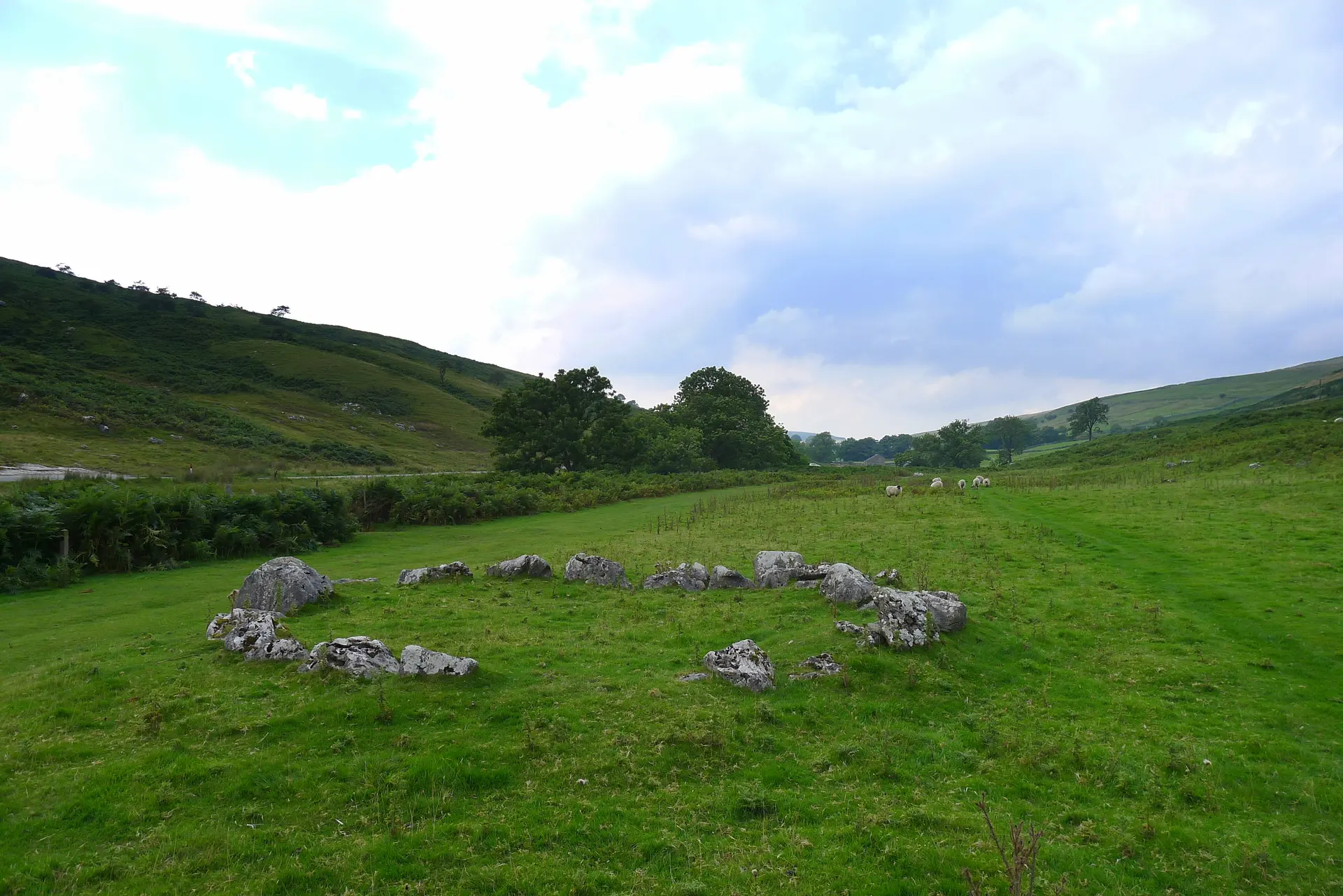
Image of Yockenthwaite stone circle. Image source · CC-BY-SA-2.0
Visit essentials
A quick read before you go
- Duration
- Allow fifteen to thirty minutes at the site itself for contemplation and exploration.
- Etiquette
- Treat Yockenthwaite as you would any burial ground: with quiet respect.
Overview
Yockenthwaite's low stones almost whisper their presence from a slight bank beside the River Wharfe, beneath steep moorland slopes where Bronze Age settlements once clustered.
Local tradition called it the Giant's Grave after its purpose was forgotten. Archaeologists now read the limestone ring not as a ceremonial circle but as the surviving kerbstones of a burial cairn whose earthen mound covered the dead. Four millennia stripped away the soil, leaving a near-perfect ring of flattened-top stones set edge to edge.
The unexcavated burial remains unknown. Its careful construction and prominent valley-floor position, visible from the hills, suggest someone significant—perhaps a chieftain or leader. Denuded settlements above belonged to communities who knew the buried person, gathered to witness the monument's construction, and perhaps returned seasonally to remember. That human connection still reaches across forty centuries.
Why this place is sacred
The Bronze Age peoples who built here understood something about place. This was not a random location but a chosen one, set where the River Wharfe curves through the valley floor, visible from the settlements on the surrounding hills. They placed their dead where the living could see them, where the landscape itself would hold the memory.
Four thousand years later, that landscape remains largely unchanged. The wild moorland still sweeps upward from the valley. The river still flows past the stones. Sheep graze the fields as livestock have done since before recorded history. Yockenthwaite itself is little more than a scattering of farms, a quiet hamlet whose Old Norse name speaks of settlers who arrived when this burial was already ancient.
The thinness here is quiet rather than dramatic. It emerges from the combination of great age, physical survival, and the contemplative silence of the setting. Those who sit with these stones often find themselves considering mortality, the brevity of individual life against the persistence of stone and landscape, the continuity of human presence in this valley across epochs. The one buried here was mourned and remembered. Then the mourners themselves passed.
The people who built the settlements on the hills above lived and died and were forgotten. Yet the stones remain, and visitors come still.
There is something in that continuity. Not supernatural, perhaps, but numinous nonetheless. A sense of being woven into time rather than separate from it.
Archaeological evidence indicates the site served as a Bronze Age burial cairn, dated approximately 2400-1000 BCE. The twenty-four visible stones are interpreted as the kerbstones that would have contained an earthen mound covering one or more burials. The careful construction, with stones set almost edge to edge in a near-perfect circle, and the prominent location suggest the deceased held significant social status.
In Bronze Age communities, such burial monuments served not only as graves but as focal points for ancestor veneration and community memory.
The site's interpretation has shifted over centuries. Victorian antiquarians, influenced by romantic associations between stone monuments and ancient priesthoods, described it as a Druid's Circle. In 1900, local historian Harry Speight proposed it was merely a medieval sheep pen, a theory now discredited. It was Arthur Raistrick's fieldwork in the 1920s that established the Bronze Age dating and suggested the ring cairn interpretation, which remains the scholarly consensus today.
The monument received legal protection when it was scheduled in 1929, just months after Raistrick's publication. It now exists as part of the Yorkshire Dales National Park, visited by walkers, archaeology enthusiasts, and those drawn to ancient places. No formal spiritual practice takes place here, yet visitors consistently report the contemplative atmosphere that ancient burial sites often carry.
Experience and orientation
The experience of Yockenthwaite begins before arrival. The walk from the hamlet, following the Dales Way footpath alongside the river, moves through a landscape that feels removed from the contemporary world. Stone walls section the fields. Sheep watch from hillsides. The sound of the Wharfe accompanies each step. By the time the circle comes into view, set on its low bank, something has already shifted.
The stones themselves are modest. Most stand no higher than knee level, their tops curiously flattened, set almost edge to edge in a ring roughly seven and a half metres across. There is no grand architecture here, no dramatic visual impact. The power is subtler than that. It emerges from the combination of great age, excellent preservation, and the surrounding silence.
Visitors commonly report a sense of connection to the deep past. Sitting among these stones, knowing that four thousand years ago a community gathered here to bury someone they valued, to construct a monument intended to outlast memory, creates an almost physical awareness of time's passage. The one buried here was once as alive as you are now. The mourners were as real as the friends who might mourn you.
Yet all have passed, and the stones remain, and the river flows, and the hills still watch.
Many find themselves contemplating mortality, not morbidly but thoughtfully. This was a place of death, but also of love, of care for the dead, of the human need to mark and remember. That intention persists.
Approach Yockenthwaite as you would any place of burial, with quiet respect. The site rewards slowness. Consider sitting with the stones rather than simply photographing them and moving on.
The walk to reach the circle is part of the experience. Let it slow your pace. Notice the landscape the Bronze Age builders would have known: the river, the moorland rising to either side, the sky that would have been the same sky they saw. By the time you reach the stones, you may find yourself already contemplating questions of time, continuity, and what it means to be remembered.
There is no prescribed ritual here. The practices that once animated this place have been lost for millennia. But sitting in silence, acknowledging the one who lies beneath, honouring the community that built this monument, these feel appropriate. You are a visitor to someone's grave.
Context and lineage
No origin narrative survives from the culture that built this monument. The Bronze Age peoples of northern England left no written records, and the oral traditions they surely possessed died with them. We know them only through what they left in the ground.
What we can reconstruct suggests an agricultural society, settled in the hills above Langstrothdale, raising livestock and working the land. They had the resources and social organisation to construct monumental burial sites for their important dead. The person buried at Yockenthwaite was significant enough to warrant a permanent marker, a cairn visible from the settlements above, a place where the living could see and remember.
Local folklore later named the site Giant's Grave, a common designation for ancient burial monuments whose original purpose had been forgotten. That instinct preserved something true about the place even as its specific history was lost.
The community that buried their dead here left traces throughout the surrounding landscape. On the hills above, both north and south, Bronze Age and Iron Age settlement remains still visible as patterns in the heather. These were the people who knew the one buried at Yockenthwaite, who participated in the funeral rites, who returned in later seasons to remember.
After the Bronze Age, other peoples came. The Celts, the Romans, the Angles, and finally the Norse settlers who gave Yockenthwaite its name, meaning Eogan's clearing, in the 9th to 11th centuries. Each wave found the stones already ancient, already mysterious. The land around the circle was eventually granted to the monks of Fountains Abbey after the Norman Conquest, who likely knew the stones but left no record of their understanding.
Victorian antiquarians rediscovered the circle as an object of scholarly interest. Harry Speight dismissed it as a sheep pen in 1900. Arthur Raistrick corrected the record in 1929. Today the site rests protected within the Yorkshire Dales National Park, visited by those drawn to ancient places.
Unknown Deceased
buried
The individual buried beneath this cairn remains unidentified, the site never having been excavated. The careful construction and prominent location suggest someone of high status within their community, possibly a chieftain or other leader.
Arthur Raistrick
historical
The archaeologist whose 1929 study established the Bronze Age dating and ring cairn interpretation that remains accepted today. His work led to the site's protection as a Scheduled Monument.
Traditions and practice
The original mortuary practices associated with this site are lost to history. Bronze Age burial customs in Britain varied widely and changed over the millennia the period spans. They may have included cremation or inhumation, placement of grave goods with the deceased, construction of the earthen mound over the stone kerb, and possibly ongoing ceremonies commemorating the dead. What specific rituals took place at Yockenthwaite, whether the community returned for anniversary observances or seasonal remembrances, cannot be known without excavation.
No organised spiritual practices are associated with the site today. Visitors come for the walk, the archaeology, the atmosphere. Some approach the visit with contemplative intention, treating it as a place for reflection on mortality and the continuity of human presence in the landscape. The site's status as an unexcavated burial ground gives it a different quality than monuments that have been thoroughly studied and stripped of mystery.
If you come seeking more than exercise, consider approaching the site as you would a graveyard. Someone is buried here. Their community loved them enough to construct a monument intended to outlast memory. Honouring that intention requires no specific belief or practice, only attention and respect.
Sit with the stones for a time rather than simply walking past. Notice the landscape: the river, the hills, the sky that would have looked the same four thousand years ago. Consider what it meant to live and die in this valley, to be remembered, to be forgotten, to have your grave endure anyway.
If you are in a period of transition, grief, or questioning, the site offers an appropriate setting for contemplation. The dead do not answer questions, but being in their presence sometimes clarifies them.
Bronze Age Mortuary Tradition
HistoricalThe site represents the burial practices of Bronze Age communities in Upper Wharfedale, dated approximately 2400-1000 BCE. The careful construction of a ring cairn, with kerbstones set almost edge to edge and an earthen mound covering the burial, indicates established customs for honouring significant dead. The location on the valley floor, visible from the settlements on surrounding hills, suggests the deceased was meant to be remembered by the living community. Such monuments served not only as graves but as focal points for ancestor veneration and community memory.
Original mortuary practices are unknown but likely included preparation of the body, possibly cremation, construction of the stone kerb and earthen mound, placement of the remains within, and possibly ongoing ceremonies commemorating the dead. Bronze Age burial customs varied across Britain and changed over the period's fifteen hundred years. Without excavation, specific practices at Yockenthwaite cannot be confirmed.
Perspectives and open questions
Yockenthwaite invites interpretation across multiple frameworks, from archaeological science to contemplative reflection. The site's mystery, never having been excavated, preserves questions that would otherwise have been answered and closed. Honest engagement means holding what we know and what we do not know in balance.
Scholarly perspective
Archaeological consensus identifies the site as the kerbstones of a Bronze Age ring cairn or burial cairn, dated approximately 2400-1000 BCE. This interpretation, developed from Arthur Raistrick's 1929 fieldwork and refined by subsequent analysis, is supported by Historic England's scheduling description, which terms it a very fine and well-preserved example of its type.
The twenty-four extant stones, set almost edge to edge in a near-perfect circle with flattened tops, are understood to have contained an earthen mound covering one or more burials. The central depression represents either the eroded remains of this mound or possibly the location of the burial pit itself. The prominent location and careful construction indicate the deceased held significant social status.
Without excavation, specific questions remain unanswered. Was this a single burial or multiple interments over time? Were remains cremated or inhumed? Were grave goods included? The outlying boulder six metres from the main circle may be part of the original structure or a later addition. Only archaeological investigation could resolve these questions.
Alternative interpretations
Victorian antiquarians described the site as a Druid's Circle, reflecting nineteenth-century romantic associations between stone monuments and ancient Celtic priesthoods. This interpretation has no archaeological basis but influenced early heritage tourism and local folklore.
In 1900, local historian Harry Speight proposed that the circle was merely a medieval sheep pen. This theory is now discredited, the stones being too carefully placed and the form too consistent with Bronze Age monuments for agricultural explanation.
Some contemporary visitors approach the site through the lens of earth energy or ley line traditions, though no specific claims about Yockenthwaite appear in that literature. The site's quietness and obscurity have protected it from the more elaborate alternative interpretations that cluster around more famous monuments.
Open questions
The fundamental mysteries of Yockenthwaite remain genuinely open. Who was buried here? What was their role in Bronze Age society? What rituals accompanied the burial and subsequent commemoration? Did the community return for anniversary observances or seasonal remembrance?
The site has never been excavated. No burial remains, no grave goods, no organic material has been recovered to tell us about the one who lies beneath. This preservation of mystery is itself significant. Where excavation has occurred, ancient burial sites become known quantities, their questions answered and closed. Yockenthwaite retains the open quality of the unanswered.
The relationship between this burial and the Bronze Age settlements visible on the surrounding hills remains unexplored. What social structure connected them? Over how long was the cairn a focal point for the community? When and why did commemoration cease? The answers lie in the ground, waiting.
Plan your visit
Access and arrival
The nearest accommodations are in Buckden and Hubberholme. Buckden offers bed and breakfast options. Hubberholme has The George Inn, a traditional Yorkshire pub with rooms. For a wider range of options, Kettlewell (approximately 6 miles south) provides more choices. Wild camping is technically possible in the Dales but should be done responsibly and with landowner permission where required.
Respectful visit
No requirements, but sturdy walking boots are strongly recommended. The terrain is uneven and can be wet. Layers are advisable given the exposed nature of the Dales.
Photography is permitted without restriction. Consider spending time with the stones before photographing them.
Physical offerings are not appropriate and would be considered litter. If you wish to offer something, make it internal: a moment of silence, a thought for the unknown dead, an acknowledgment of the community that built this place.
As a Scheduled Monument, any metal detecting, excavation, or disturbance of the site is prohibited by law. Do not climb on or touch the stones. Dogs must be kept under control. Take all litter with you.
This is a Scheduled Monument. Metal detecting, excavation, or any disturbance of the stones or surrounding ground is illegal. Do not climb on the stones or attempt to move them. Leave nothing behind.
Current practical details
Address
Yockenthwaite, Skipton BD23, UK
Hours, fees, and access can change — verify on the official source before you travel. Practical details last checked Jun 2026.
Location
Map loads as you approach this section.
Pilgrim reflections
A portrait of encounter, not a score
Pilgrims describe what they felt, how present they could become, and whether the place would shape a journey. There are no stars and no ranking of traditions.
No reviewed reflections yet
The first pilgrims can help describe the character of being here.
Share a reflection
Available after an account-backed “Been there.” Every reflection is reviewed before publication.
Nearby sacred places
Explore other sacred places in the region. Proximity does not establish access or travel time; check each place’s guidance.

Share a photo
Help visitors recognize Yockenthwaite stone circle. Every submission is reviewed before publication.