Midhowe Chambered Cairn
The Great Ship of Death: Orkney's largest stalled cairn, where twenty-five ancestors were placed in stone compartments five thousand years ago
Understand sacred places, explore living traditions, and learn how to engage respectfully with Pilgrim Map.
Access has not been verified. Check current local guidance before planning a visit.
Rousay, Scotland, United Kingdom
Read the sources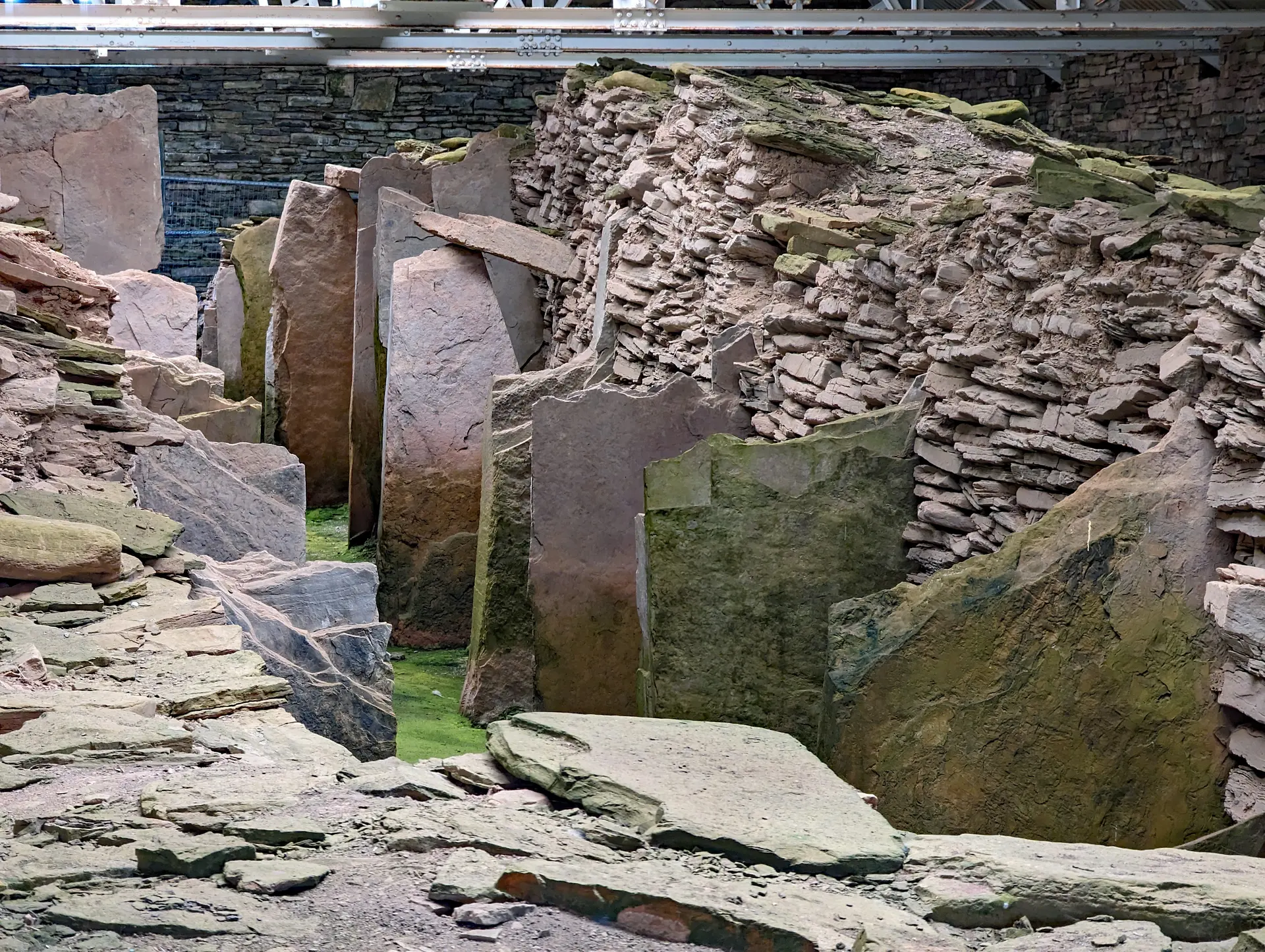
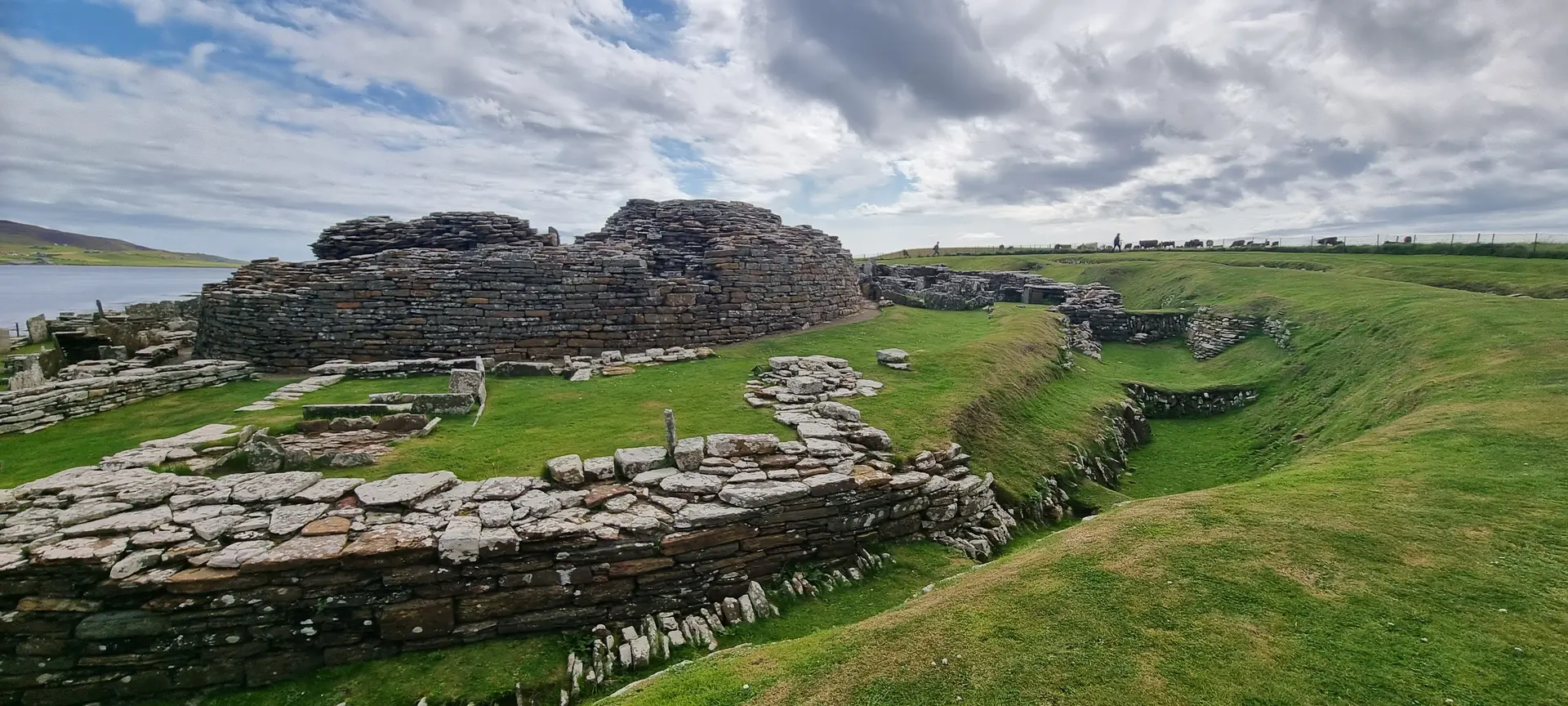
Image of Midhowe Chambered Cairn. Image source · CC-BY-SA-4.0
Visit essentials
A quick read before you go
- Duration
- One to two hours to explore both the cairn and the adjacent Midhowe Broch.
- Access
- Rousay is reached by Orkney Ferries from Tingwall Terminal (approximately thirty-minute…
Overview
Entering the protective building around Midhowe Chambered Cairn means stepping into a space designed for the dead five and a half millennia ago. Its exposed interior runs 23 metres, over 32 metres with the outer structure, through twelve compartments divided by paired upright slabs that rise like a ship's ribs. This was not a single interment but a relationship maintained as successive burials joined the community's ancestors over centuries.
Midhowe belongs to northern Scotland's Orkney-Cromarty tradition of stalled cairns. On the coast of Eynhallow Sound within sight of Mainland Orkney, it occupies a boundary between land and sea. Rousay's concentration of at least fifteen Neolithic chambered cairns has earned the small island the name Egypt of the North; Midhowe is its most imposing funerary monument.
Why this place is sacred
Midhowe's thinness lies in direct encounter: the elevated walkway makes spaces built for the dead legible without requiring visitors to reconstruct them from a panel. Enclosed light and silence contrast with Orkney's wind and weather, setting massive ancient stonework against a functional modern shelter.
Beyond lies Eynhallow Sound and the tidal island of Eynhallow, whose Norse name means Holy Island. Whether that name preserves sanctity older than the Norse period cannot be determined, though the coincidence is suggestive. Visitors consistently describe the scale, age, and material evidence of sustained mortuary care as moving; that response does not recover the builders' lost beliefs.
Archaeological consensus identifies Midhowe as a communal burial monument for Neolithic farming communities. The design of the stalled interior, with its stone benches and dividing slabs, was engineered for the sequential deposition of the dead. Bodies were placed in crouched positions and allowed to decompose; bones were then rearranged and consolidated to make room for new burials.
This practice suggests the tomb functioned not merely as a repository but as a ritual space where the living maintained ongoing relationship with the dead.
The cairn was constructed around 3500 BCE and used over an extended period. Initial construction created the stalled interior with its twelve compartments. The cairn's exterior was progressively elaborated, though the precise sequence is debated. The site fell out of active use before the Bronze Age. It remained largely undisturbed until Walter Grant's 1934 excavation exposed the interior. The protective building was subsequently constructed to preserve the exposed stonework.
The site came under the care of what is now Historic Environment Scotland.
Experience and orientation
The approach follows the same coastal path that leads to Midhowe Broch, crossing agricultural land above Eynhallow Sound. The protective building appears in the landscape as a functional modern structure, its purpose evident only upon entry.
Inside, the cairn reveals its full extent. The walkway runs above the monument, and from this vantage point the internal architecture is comprehensible in a way that ground-level viewing could not achieve. Twelve compartments extend in sequence, divided by pairs of upright stone slabs. The regularity is architectural, deliberate, and speaks to careful planning.
The stone benches within the compartments are clearly visible. Here, bodies were placed in crouched positions over centuries of use. The progressive refinement of the compartments from entrance to rear end is a characteristic feature of stalled cairns, possibly reflecting a hierarchy in burial placement or a chronological sequence.
Light within the building is even but subdued. The silence is notable, insulated from the Orkney wind. This combination of controlled light and quiet creates conditions well-suited to contemplation. You are inside a space built for the dead, viewing it from a perspective the builders never intended but that serves understanding.
The exit leads back into the Orkney weather, and a short walk southeast brings you to Midhowe Broch, where Iron Age life replaced Neolithic death on the same stretch of coast. The juxtaposition is powerful: a burial place and a living settlement, separated by three thousand years but sharing the same relationship with Eynhallow Sound.
Most visitors arrive on Rousay by ferry from Tingwall on Mainland Orkney. From the pier, the site is approximately five miles west along the B9064. A car or bicycle is strongly recommended. The cairn and broch can be visited together in one to two hours. The broader Westside Walk connects several archaeological sites along this coast.
Context and lineage
The Neolithic communities who built Midhowe left no written records. Their motivations must be inferred from what they constructed. The scale of the cairn, over thirty-two metres long, indicates that housing the dead was among the most important activities a community could undertake. The design, allowing repeated entry and the sequential placement of bodies, suggests the dead were not merely deposited and forgotten but remained part of the community's ongoing life.
Rousay's extraordinary concentration of fifteen chambered cairns on a small island suggests it held special significance as a burial landscape, though why this particular island was chosen remains unknown.
No continuous tradition connects present-day communities to the Neolithic builders. Their language, beliefs, and social organisation are irrecoverable. The cairn passed through unknown centuries before antiquarian interest recovered it for modern understanding. The 1934 excavation marked its emergence as a comprehensible archaeological monument. The construction of the protective building ensured its long-term preservation. Today the site is managed as heritage, not as an active sacred space, though individual visitors may engage with it according to their own traditions.
Walter Grant
J. Graham Callander
Traditions and practice
Neolithic burial practices at Midhowe involved placing the dead in crouched positions on stone benches within the compartments, with their backs against the outer wall and heads resting against dividing slabs. Over time, decomposed remains were gathered into neat bone piles to accommodate new burials. Animal bones, particularly cattle, were placed with the human remains, suggesting funerary offerings or ritual feasting. The progressive elaboration of compartments from entrance to rear suggests either chronological sequence or hierarchical organisation.
No established spiritual communities maintain practice at Midhowe Chambered Cairn. Visitors engage with the site as an archaeological monument. Some visitors with interests in ancestral connection or earth-based spirituality may practice personal contemplation.
The elevated walkway invites a slow, careful traversal of the cairn's full length. Pause at each compartment and consider the individuals who were placed there. The physical evidence of how Neolithic communities treated their dead, with care, over centuries, returning to tend and rearrange, speaks across the millennia without need for translation.
Neolithic Orkney-Cromarty Burial Tradition
HistoricalMidhowe represents the pinnacle of the stalled cairn tradition in Orkney, a communal burial practice in which the dead were placed in stone compartments within elongated cairns. The tradition reflects a society that invested enormous labour in honouring the dead, maintaining physical spaces where the boundary between living and dead could be crossed over centuries of use.
The dead were placed in crouched positions on stone benches within compartments. Over time, decomposed remains were gathered into bone piles to accommodate new burials. Animal bones were deposited alongside human remains. The tomb was designed for repeated access, allowing ongoing interaction between the living community and its ancestors.
Perspectives and open questions
Midhowe Chambered Cairn speaks with particular clarity about Neolithic attitudes toward death and community. The evidence, twenty-five individuals placed with care in stone compartments over centuries, invites interpretation while resisting definitive answers. We can see what the builders did. Why they did it, in its full complexity, remains genuinely unknown.
Scholarly perspective
Archaeologists classify Midhowe as the largest and one of the finest examples of the Orkney-Cromarty type stalled cairn. Construction is dated to approximately 3500 BCE. The 1934 excavation by Grant and Callander revealed twenty-five individuals across twelve compartments. Physical anthropological analysis showed the Neolithic occupants were relatively short (men approximately 5 feet 5 inches, women approximately 5 feet) and dolichocephalic. Their teeth were in good condition but heavily worn, consistent with a diet including stone-ground grain.
Both crouched inhumation and bone consolidation were practiced, indicating complex and sustained mortuary rituals. Animal bones, particularly cattle, accompanied the human remains. The cairn's position within Rousay's extraordinary concentration of fifteen Neolithic cairns suggests the island held special significance as a burial landscape.
Living and traditional perspectives
No indigenous oral tradition survives from the Neolithic builders. The specific beliefs and worldview of those who constructed and used Midhowe are lost to history. Comparative archaeology suggests ancestor veneration was central to Neolithic society in Britain. The dead were likely understood as present in a different mode, accessible through the tombs built to house them. But these are inferences from material evidence, not transmitted knowledge.
Alternative interpretations
The cairn's elongated form and its coastal setting have attracted symbolic interpretations. The name Great Ship of Death, while modern, captures an association between the cairn's shape and maritime imagery that some visitors find resonant. Writers interested in death-and-rebirth symbolism across ancient cultures have noted parallels with other traditions where boats carry the dead to the otherworld. The concentration of tombs on Rousay has attracted interest from those who perceive the island as a sacred landscape.
Open questions
The social organisation of the community that built and used Midhowe remains unclear. Whether the twenty-five individuals represent a single family, a social elite, or a broader community sample cannot be determined. The criteria for inclusion in the cairn, while others presumably were not interred here, are unknown. Why Rousay, a relatively small island, holds such an extraordinary concentration of chambered cairns compared to other Orkney islands remains an open question.
The original external appearance of the cairn is uncertain due to erosion and the passage of time.
Plan your visit
Access and arrival
Rousay is reached by Orkney Ferries from Tingwall Terminal (approximately thirty-minute crossing). From the pier, the site is about five miles west on the B9064. A car or bicycle is recommended. The final approach involves walking across steep agricultural ground. The protective building shelters the cairn but the site is not wheelchair accessible.
Limited accommodation on Rousay including the Taversoe Hotel and local bed and breakfasts. More options in Kirkwall on Mainland Orkney.
Respectful visit
No specific requirements beyond practical outdoor clothing. Sturdy, waterproof walking boots are essential. Wind and waterproof outer layers advisable.
Photography is permitted throughout. The elevated walkway provides excellent angles for documenting the cairn's internal structure.
As a heritage monument, leaving offerings is not appropriate.
Remain on the walkway. Do not enter the cairn structure, climb on stonework, or remove any material. Dogs should be kept under control on the approach.
Remain on the elevated walkway. Do not enter the cairn structure or touch the stonework. The approach requires walking across steep agricultural ground in potentially challenging weather.
Current practical details
Address
Orkney KW17 2PS, UK
Hours
Hours, fees, and access can change — verify on the official source before you travel. Practical details last checked Jun 2026.
Location
Map loads as you approach this section.
Pilgrim reflections
A portrait of encounter, not a score
Pilgrims describe what they felt, how present they could become, and whether the place would shape a journey. There are no stars and no ranking of traditions.
No reviewed reflections yet
The first pilgrims can help describe the character of being here.
Share a reflection
Available after an account-backed “Been there.” Every reflection is reviewed before publication.
Nearby sacred places
Explore other sacred places in the region. Proximity does not establish access or travel time; check each place’s guidance.
References
Sources consulted for this page. Source categories describe the publication, not a guarantee that every claim is verified. Traditional accounts and outside interpretations may differ.
- 01Midhowe Chambered Cairn - Historic Environment Scotland — Historic Environment ScotlandofficialOfficial guardian body for the monument; primary source for visitor information and history
- 02Midhowe Chambered Cairn: History - Historic Environment Scotland — Historic Environment ScotlandofficialDetailed historical description from the site's custodial body
- 03Midhowe stalled cairn, Rousay - The Ness of Brodgar Project — The Ness of Brodgar ProjectacademicArchaeological research project providing scholarly context for Orkney Neolithic sites
- 04A Long Stalled Chambered Cairn or Mausoleum (Rousay Type) near Midhowe, Rousay, Orkney: With a description of the skeletal remains — Callander & GrantacademicOriginal 1930s excavation report in Proceedings of the Society of Antiquaries of Scotland
- 05The chambered cairns of Orkney - Archaeology Orkney — Archaeology OrkneyacademicAcademic archaeology project contextualizing Orkney's cairn tradition
- 06Midhowe Chambered Cairn, Orkney - VisitScotland — VisitScotlandSource contextScotland's official tourism body
- 07Midhowe Chambered Cairn - WikipediaSource contextGood general overview with citations to academic sources
- 08Midhowe Chambered Cairn, Rousay - The Orkney News — The Orkney NewsacademicLocal journalism with archaeological detail and community perspective
- 09Midhowe Chambered Cairn - Orkney.com — Orkney.comSource contextCommunity tourism site with practical visitor information
- 10Midhowe Cairn Feature Page - Undiscovered Scotland — Undiscovered ScotlandSource contextIndependent Scottish heritage tourism resource
Share a photo
Help visitors recognize Midhowe Chambered Cairn. Every submission is reviewed before publication.