Midhowe Broch
An Iron Age fortress on the edge of Eynhallow Sound, where domestic life and defensive engineering merged in stone
Understand sacred places, explore living traditions, and learn how to engage respectfully with Pilgrim Map.
Access has not been verified. Check current local guidance before planning a visit.
Rousay, Scotland, United Kingdom
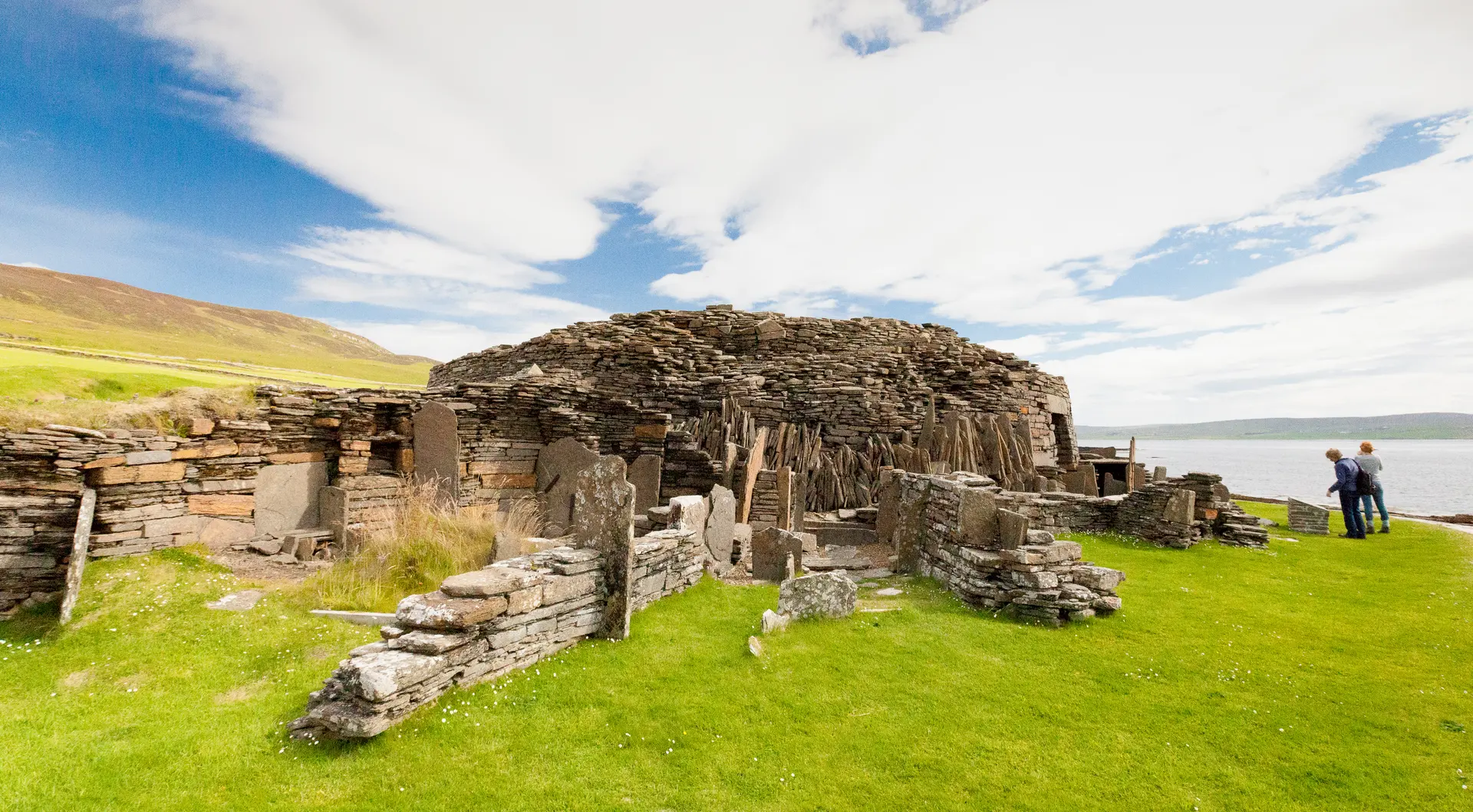
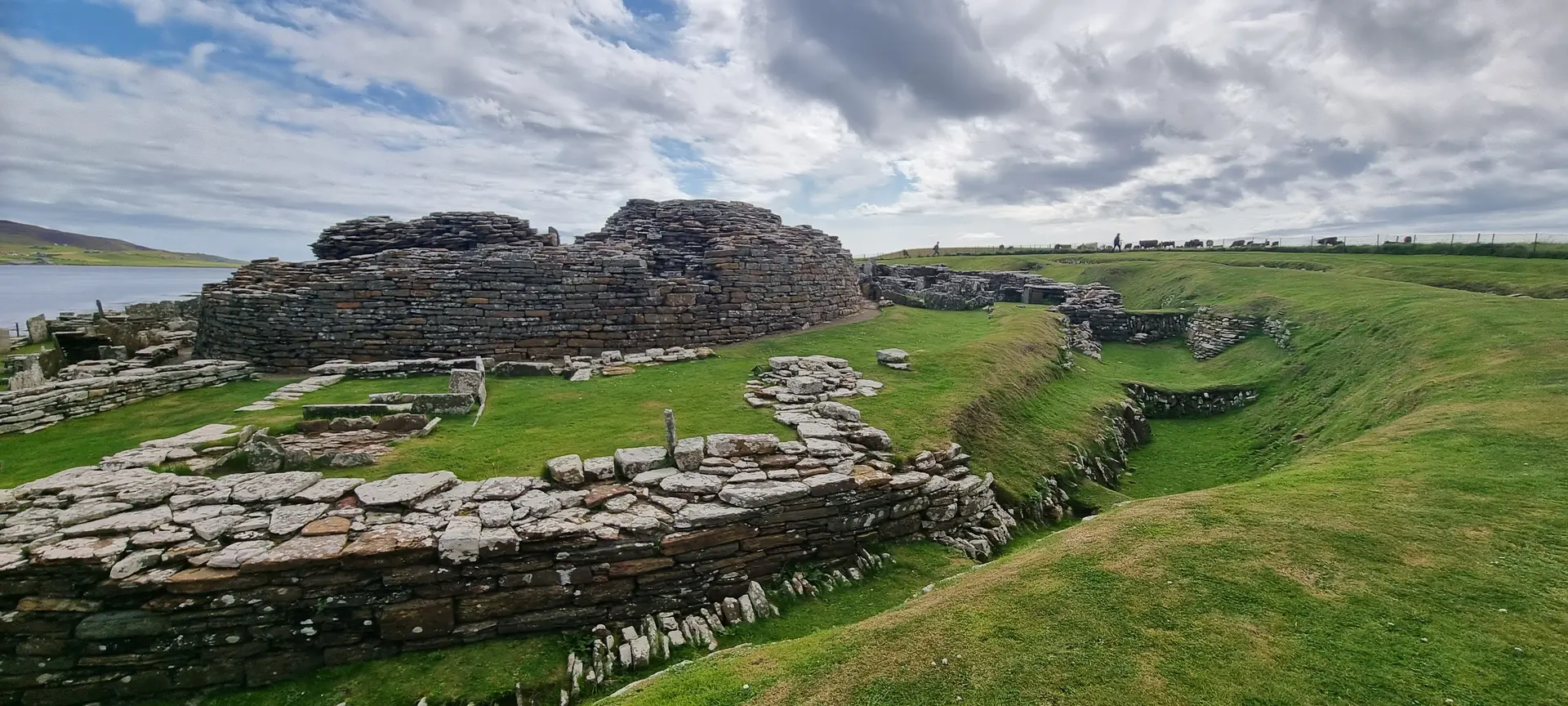
Image of Midhowe Broch. Image source · CC-BY-SA-4.0
Visit essentials
A quick read before you go
- Duration
- One to two hours to explore the broch thoroughly and visit the adjacent Midhowe Chambered Cairn.
- Access
- Rousay is reached by Orkney Ferries from Tingwall Terminal on Mainland Orkney (approximately…
Overview
Midhowe Broch occupies a narrow promontory between two gullies on Rousay's western coast, a natural defensive position above Eynhallow Sound. More than a stronghold, it was a settlement where people lived, worked, ate, and practiced skilled crafts. Its precisely fitted drystone walls, whose precision still impresses engineers, survive to 4.3 metres; a staircase once spiralled upward within their double skin to now-lost upper levels.
Stone partitions, hearths, and a spring-fed stone water tank show command of hydrology, load-bearing construction, and domestic space. Around the tower, houses and workshops include an iron-smelting hearth. Broken crucibles and moulds excavated in the 1930s attest a bronze-worker producing jewellery and tools, while a Roman bronze-vessel fragment points to networks beyond Orkney.
A massive modern sea wall and protective roof now defend the exposed remains without pretending to be ancient, preserving a community's responses to climate, defence, and daily life.
Why this place is sacred
The concept of thin places typically applies to sites of deliberate spiritual intent, but some locations achieve a similar quality through the sheer persistence of human presence in stone. Midhowe Broch is such a place. No evidence suggests it served an explicitly religious function, yet the encounter with its domestic spaces can be deeply affecting.
The thinness here is temporal rather than metaphysical. To stand within these walls is to occupy the same space as people who lived two millennia ago. The hearths where they warmed themselves, the partitions that divided their living quarters, the water tank that held their drinking supply, all remain. The stone has preserved what wood and thatch could not: the skeleton of daily life.
The promontory setting amplifies the experience. The sound of waves carries from both sides. Wind funnels through the gullies. The Eynhallow Sound stretches toward Mainland Orkney. This was a place where the boundary between land and sea narrowed to a sliver, where defence and exposure existed in constant tension. The builders chose this location knowing its vulnerabilities. What they built endured.
The protective roof, while modern, creates an unexpected intimacy. Within its shelter, the broch exists in a state between ruin and preservation, neither fully exposed to the elements nor fully enclosed. Light filters in. The stone retains its weathered texture. There is a quality of arrested time here, of a community frozen at the moment of departure.
Archaeological evidence indicates Midhowe Broch functioned as a fortified settlement, combining residential, industrial, and defensive purposes. The entrance passage with its controlled access point, the massive walls designed to withstand siege, and the promontory location all speak to defensive intent. But the internal complexity, with its multiple rooms, workshops, and water supply, reveals a community that expected to live here long-term, not merely shelter during emergencies.
The broch was likely constructed around 200 BCE and occupied through approximately 200 CE, a span of roughly four centuries. During this time, the surrounding buildings evolved from domestic dwellings to workshops, suggesting shifts in the community's economic organisation. Excavation between 1930 and 1933 by Walter Grant and J. Graham Callander exposed the full complex.
A sea wall was subsequently erected to protect the site from coastal erosion, and a protective roof was built over the broch to shelter the exposed stonework. The site came under the care of what is now Historic Environment Scotland.
Experience and orientation
The approach from the east follows the B9064 road along Rousay's southern coast, then a path descending toward the shore. The landscape is open, windswept farmland giving way to the rocky coast of Eynhallow Sound. Before the broch itself appears, its protective shelter becomes visible, a large modern structure that signals something significant beneath.
Entering the shelter, the scale of the broch becomes apparent. The walls rise over four metres, their drystone courses fitted with remarkable precision. The entrance passage is narrow, deliberately so, designed to admit one person at a time and easily defended. Beyond it, the interior opens into a series of stone-partitioned spaces. Hearths mark the locations of domestic activity. A stone-lined tank, fed by a natural spring, demonstrates sophisticated water management.
The surrounding buildings extend the story. Walking among them, you can identify domestic spaces, with their own hearths and partitions, transitioning to workshop areas where the evidence of metalworking survives. The iron-smelting hearth in one building remains remarkably intact. Crucible fragments and mould pieces found during excavation point to skilled craft production.
What distinguishes Midhowe from many archaeological sites is the legibility of its narrative. You do not need interpretive panels to understand that this was a place where people lived fully: cooking, sleeping, working, defending, creating. The stone preserves their daily arrangements with an clarity that two thousand years have barely diminished.
The adjacent Midhowe Chambered Cairn, just a hundred metres to the northwest, provides a deeper temporal perspective. Where the broch speaks of Iron Age life, the cairn speaks of Neolithic death, separated by more than three millennia but sharing the same stretch of coast.
Most visitors arrive by ferry from Tingwall on Mainland Orkney, a crossing of approximately thirty minutes. From the pier at Trumland, the broch is about five miles west along the B9064. A car or bicycle is recommended, though the island's limited bus service may be available. The Westside Walk, a coastal path connecting several archaeological sites, passes the broch. Allow time to visit the adjacent Midhowe Chambered Cairn.
The combined visit provides a remarkable span of human habitation on one stretch of coast.
Context and lineage
The broch builders left no written records, and the specific circumstances of Midhowe's foundation are unknown. What can be inferred from the archaeological evidence is that a community chose this promontory for its natural defensive properties, investing substantial labour in constructing a tower and settlement complex. The choice of location suggests a society facing real or perceived threats, whether from raiding, inter-community conflict, or the assertion of territorial control.
The sophistication of the construction implies organised communities with specialist skills in stone-working, engineering, and metalcraft.
No continuous tradition connects present-day Orkney to the Iron Age broch builders. The cultural lineage was disrupted first by the Pictish period, then by Norse settlement from the ninth century onward. The broch fell out of use some time around the second or third century CE, and the society that built it gradually transformed into what would become the Pictish communities of the early medieval period.
The site lay abandoned for over a millennium before antiquarian interest revived awareness of its significance. Excavation in the 1930s recovered the physical evidence of its builders' lives, but their language, beliefs, and social organisation remain largely unknown.
Walter Grant
J. Graham Callander
Traditions and practice
Archaeological evidence from the broch and its surrounding settlement reveals a community engaged in pastoral farming (ox and sheep bones were recovered), metalworking (iron smelting and bronze casting), and textile production (stone and bone tools associated with spinning and weaving). A fragment of Roman bronze indicates participation in long-distance trade networks.
Whether any ritual practices occurred within the broch complex is unknown, though recent scholarship on other Orkney brochs suggests that the boundary between domestic and ritual space may have been more permeable than previously assumed.
No established spiritual communities maintain regular practice at Midhowe Broch. The site receives visitors primarily interested in archaeology, history, and the Orkney landscape. Some visitors with interests in earth-based spirituality or ancestral connection may engage in personal contemplation.
For those seeking a contemplative experience, the broch rewards careful observation. Take time to trace the internal layout, identifying hearths, partitions, and the water tank. Consider the skill required to build these walls without mortar, to engineer an internal spring-fed water supply, to smelt iron and cast bronze on a windswept promontory. The adjacent Midhowe Chambered Cairn offers a deeper encounter with Orkney's prehistoric past.
Iron Age Atlantic Scotland (Broch-Building Culture)
HistoricalMidhowe Broch represents the broch-building tradition of Atlantic Scotland, a phenomenon concentrated in the Highlands and Islands during the later Iron Age. Brochs are unique to Scotland and represent one of the most sophisticated forms of drystone construction in prehistoric Europe. The builders invested enormous communal labour in constructing these monumental towers, which served as combined dwellings, defensive structures, and statements of social status or territorial control.
Daily life within and around the broch involved pastoral farming, metalworking (both iron smelting and bronze casting), textile production through spinning and weaving, and participation in wider trade networks. The fortified nature of the settlement, with its controlled entrance passage and massive walls, indicates that defence was a significant concern. The internal organisation of space, with hearths, partitions, and a spring-fed water tank, reveals careful domestic planning.
Perspectives and open questions
Midhowe Broch offers a window into Iron Age society in Orkney, a period less celebrated than the Neolithic but no less remarkable. The evidence preserved here, of domestic organisation, skilled metalworking, defensive engineering, and participation in trade networks extending to the Roman world, challenges any assumption that life on these northern islands was simple or isolated.
Scholarly perspective
Archaeologists classify Midhowe as a ground-galleried broch, one of approximately five hundred to seven hundred brochs identified across Scotland. The construction date falls within the main broch-building period of roughly 200 BCE to 200 CE. The tower walls have an external diameter consistent with substantial brochs, with walls reaching 4.3 metres in surviving height. The complex features characteristic broch elements including a narrow entrance passage, intramural staircase within the double-skinned walls, and stone-built interior partitions.
Excavation between 1930 and 1933 recovered evidence of metalworking, including iron smelting and bronze casting, along with stone and bone tools for textile production. A fragment of a Roman bronze vessel indicates contact with, or at least awareness of, the Roman world. The surrounding buildings document an evolution from domestic to industrial use during the site's occupation.
Living and traditional perspectives
No oral tradition from the Iron Age builders survives. The society that constructed and inhabited Midhowe predates the Pictish period by several centuries, and the subsequent Norse colonisation of Orkney from the ninth century further obscured pre-Norse cultural memory.
What can be said is that the broch builders were part of a sophisticated Iron Age culture that extended across northern and western Scotland, a culture that invested enormous labour in monumental drystone construction for reasons that were simultaneously practical and, perhaps, symbolic.
Alternative interpretations
Some writers within the earth mysteries tradition interpret brochs as more than defensive structures, seeing their circular form, controlled entrance, and enclosure of domestic space as expressions of cosmological belief. The discovery at Minehowe in Orkney of an Iron Age subterranean structure with apparent ritual function lends some archaeological support to the idea that Iron Age Orcadians did not sharply separate the practical from the sacred. However, no specific ritual function has been identified at Midhowe.
Open questions
The full social organisation of the broch community remains unclear. How many people lived within the settlement at any one time? What was the relationship between the broch tower and the surrounding buildings, did they house the same family or a broader community? The reason for the site's eventual abandonment is unknown. Whether the Roman bronze fragment represents direct trade, gift exchange, or looting from a shipwreck cannot be determined.
The existence of any ritual practices within the settlement remains an open question.
Plan your visit
Access and arrival
Rousay is reached by Orkney Ferries from Tingwall Terminal on Mainland Orkney (approximately thirty-minute crossing). From the pier at Trumland, the broch is about five miles west on the B9064. A car or bicycle is recommended. The final approach to the site involves walking across steep agricultural ground. The site itself is sheltered by a modern protective roof but is not wheelchair accessible.
Limited accommodation is available on Rousay, including the Taversoe Hotel and local bed and breakfasts. More options exist in Kirkwall on Mainland Orkney. Day trips from Mainland Orkney are common.
Respectful visit
No specific requirements beyond practical outdoor clothing. Sturdy, waterproof walking boots are recommended for the approach across agricultural ground. Windproof and waterproof outer layers are advisable at any season in Orkney.
Photography is permitted throughout the site. The protective shelter provides even lighting conditions. The elevated position of the surrounding mound offers views into the broch interior.
As a heritage monument, leaving offerings is not appropriate. No objects should be left at the site.
Do not climb on the broch walls or surrounding structures. Do not remove any stones, artefacts, or materials. Remain within designated access areas. Dogs should be kept under control. The site is not wheelchair accessible due to the terrain.
Remain on designated walkways within the protective shelter. Do not climb on or remove stones from the structure. The approach path crosses steep agricultural ground that can be slippery in wet conditions.
Current practical details
Address
Orkney KW17 2PS, UK
Phone
Hours
Hours, fees, and access can change — verify on the official source before you travel. Practical details last checked Jun 2026.
Location
Map loads as you approach this section.
Pilgrim reflections
A portrait of encounter, not a score
Pilgrims describe what they felt, how present they could become, and whether the place would shape a journey. There are no stars and no ranking of traditions.
No reviewed reflections yet
The first pilgrims can help describe the character of being here.
Share a reflection
Available after an account-backed “Been there.” Every reflection is reviewed before publication.
Nearby sacred places
Explore other sacred places in the region. Proximity does not establish access or travel time; check each place’s guidance.
Share a photo
Help visitors recognize Midhowe Broch. Every submission is reviewed before publication.