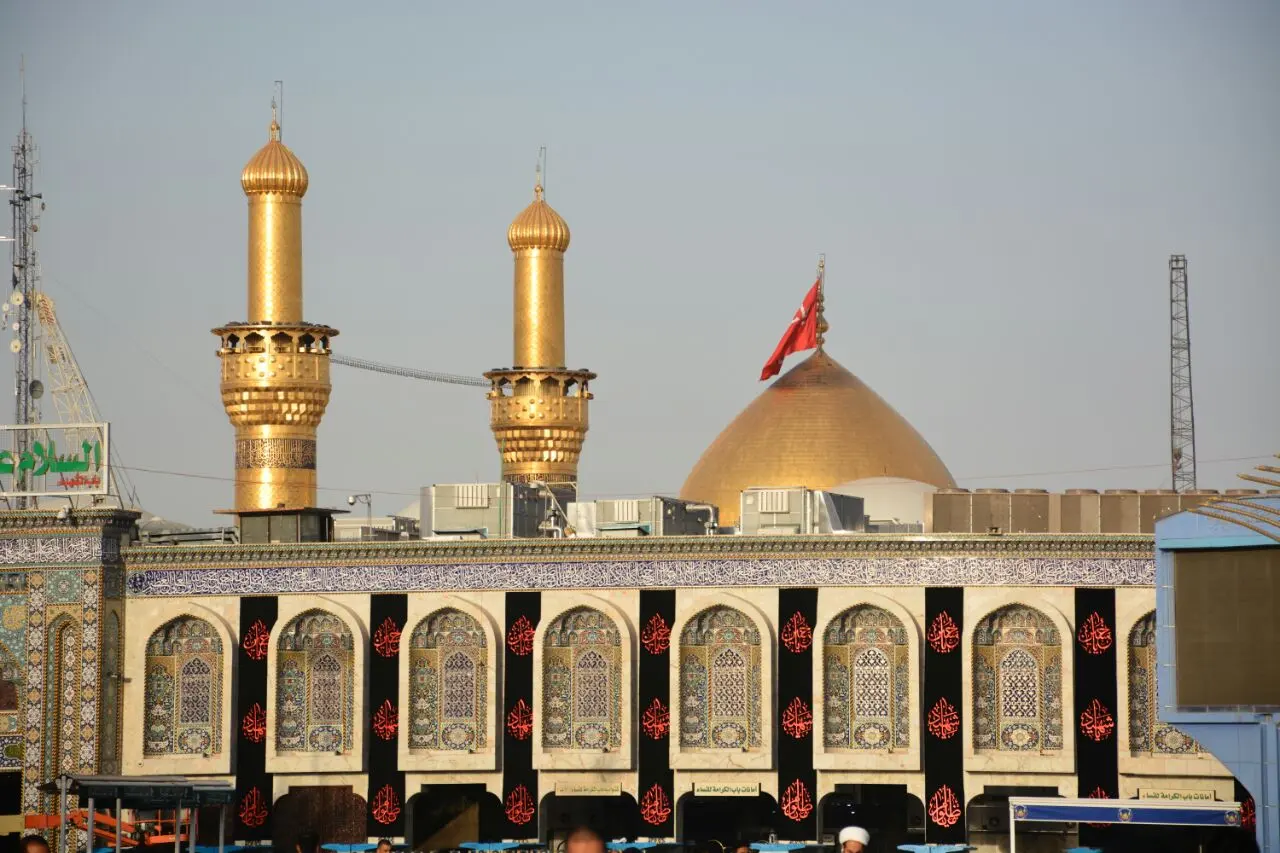
Mausoleum of Abbas (brother of Imam Hussein), Karbala
Karbala's golden shrine of al-Abbas, the water-bearer who died bringing water to Husayn's camp
Understand sacred places, explore living traditions, and learn how to engage respectfully with Pilgrim Map.
Access has not been verified. Check current local guidance before planning a visit.
Karbala, Karbala, Iraq
Read the sources
Visit essentials
A quick read before you go
- Duration
- 1-2 hours, more during major commemorations.
- Access
- In central Karbala, Iraq, directly across the Bayn al-Haramayn plaza from the Imam Husayn…
Overview
Al-Abbas, half-brother and standard-bearer of Imam Husayn at Karbala, embodies loyalty, bravery, and selfless sacrifice in Shia devotion. Known as Saqqa, the water-bearer, and Abu al-Fadl, he was killed on Ashura—10 Muharram 61 AH, 680 CE—while trying to bring water from the Euphrates to Husayn's thirsty camp. The Banu Asad buried him near the place of his martyrdom after the Umayyad army withdrew.
His tomb, beneath a tear-shaped golden dome and gilded minarets, faces Imam Husayn's shrine across the Bayn al-Haramayn. The mirror-worked interior and the walk between the two shrines concentrate the bond at the heart of the Karbala pilgrimage. Millions come for ziyarat, mourning, renewed allegiance to Husayn's ideals, and petition for al-Abbas's intercession.
Why this place is sacred
The thinness of al-Abbas's shrine arises from its place in the central tragedy of Shia memory. This is the ground of the Karbala martyrdom, where al-Abbas fell trying to carry water to a camp dying of thirst, near the channel of the Euphrates that still flows nearby. The tear-shaped golden dome, the mirror-worked interior, and the Bayn al-Haramayn corridor linking his tomb to Imam Husayn's together concentrate centuries of grief and devotion.
For Shia visitors the shrine is a place of catharsis and renewed allegiance; even those outside the tradition report being struck by the depth of collective mourning held in this space.
The burial place of al-Abbas ibn Ali, martyred at Karbala, marked and venerated as a shrine of the standard-bearer and water-bearer of Imam Husayn.
First marked in the first century AH, the shrine was repeatedly demolished and rebuilt — under Abbasid rulers such as Harun al-Rashid and al-Mutawakkil, then restored under al-Muntasir and Adud al-Dawla, and rebuilt and expanded by Safavid and Qajar patrons. The minarets were gilded in 2007. It remains one of the most visited active shrines in the world.
Experience and orientation
The shrine stands in central Karbala, directly across the Bayn al-Haramayn plaza from the Imam Husayn Shrine. Pilgrims describe an overwhelming, emotional atmosphere — weeping, prayer, and dense crowds — beneath a gleaming golden dome and inside a hall of intricate mirror-work. The walk along the Bayn al-Haramayn between the two shrines is especially moving, tracing the bond between al-Abbas and the brother he died defending.
The intensity rises sharply during Muharram, when the first ten days commemorate the martyrdom, and during Arbaeen, forty days after Ashura, when over twenty million pilgrims converge on Karbala in one of the largest gatherings on earth. For Shia visitors the shrine offers catharsis and renewed allegiance to Husayn's ideals, and the chance to petition al-Abbas for intercession; for others, the depth of devotion lingers long after.
The shrine is open 24 hours. Remove shoes before entering the holy areas, cover appropriately, and leave phones and cameras outside the inner sanctum. Walking the Bayn al-Haramayn between al-Abbas's shrine and Imam Husayn's is central to the visit. During Muharram and Arbaeen, follow staff and crowd-control directions closely.
Context and lineage
On 10 Muharram 61 AH (680 CE), al-Abbas — the water-bearer, Saqqa — had his hands severed while fetching water for the besieged camp of Imam Husayn, and the waterskin fell from his arms before he was killed. His body was buried by the Banu Asad near the place of his martyrdom on the banks of the Alqama, a channel of the Euphrates, after the Umayyad army withdrew.
A shrine was raised over the grave and rebuilt many times over the following centuries.
Twelver Shia Islam, centered on the memory of Karbala and the family of the Prophet.
Al-Abbas ibn Ali (Abu al-Fadl)
Standard-bearer and water-bearer of Imam Husayn
Imam Husayn
Grandson of the Prophet, leader at Karbala
Banu Asad tribe
Those who buried the martyrs
Adud al-Dawla and later patrons
Buyid and dynastic rebuilders
Traditions and practice
Ziyarat (devotional visitation) and recitation of Ziyarat Ashura and Ziyarat Arbaeen; mourning processions (latmiya), elegies and votive offerings; intercessory vows often made to Abu al-Fadl al-Abbas; walking the Bayn al-Haramayn between his shrine and Imam Husayn's.
Year-round ziyarat, with peak observances during Muharram (Ashura) and Safar (Arbaeen), when over twenty million pilgrims converge on Karbala.
Move through the shrine with attentiveness to the depth of grief it holds. Walking the Bayn al-Haramayn between the two shrines offers the fullest sense of the bond at the heart of the Karbala story. Reflect on loyalty and self-sacrifice rather than treating the space as a sight to photograph.
Shia Islam (Twelver)
ActiveThe mausoleum of al-Abbas ibn Ali — half-brother and flag-bearer of Imam Husayn at Karbala, known as Saqqa (the water-bearer) and Abu al-Fadl. Killed on Ashura while trying to bring water to the besieged camp, he is a paragon of loyalty, courage and self-sacrifice, and his shrine is among the holiest sites in Shia Islam.
Ziyarat, recitation of Ziyarat Ashura and Ziyarat Arbaeen, mourning rituals, walking the Bayn al-Haramayn between his shrine and Imam Husayn's, and vows and petitions for intercession.
Perspectives and open questions
Al-Abbas is read by historians as a Karbala martyr and by Shia tradition as the very model of loyalty and devotion.
Scholarly perspective
Historically the burial site of al-Abbas ibn Ali, killed at the Battle of Karbala in 680 CE, with a shrine repeatedly destroyed and rebuilt across Abbasid, Buyid, Safavid and Qajar eras; today a major Shia pilgrimage center. Reported annual visitor figures vary by source, from a baseline of several million to over twenty million during Arbaeen.
Living and traditional perspectives
For Shia Muslims al-Abbas is the model of loyalty, courage and devotion — the 'Moon of the Banu Hashim' — and his shrine a place of intercession and mourning central to Shia identity.
Open questions
Details of the earliest shrine structures and the exact original location of the grave relative to the shifting Euphrates channel are debated.
Plan your visit
Access and arrival
In central Karbala, Iraq, directly across the Bayn al-Haramayn plaza from the Imam Husayn Shrine; reached via Karbala from Baghdad or Najaf. Exact GPS coordinates were not pulled.
Karbala has extensive pilgrim lodging from simple hostels to hotels; availability tightens dramatically during Muharram and Arbaeen, so book well ahead for those seasons.
Respectful visit
Strict modest dress: cover shoulders, arms and legs; women must cover their hair with a headscarf; shoes removed before entering the holy areas.
Phones and cameras are not permitted inside the inner shrine; avoid intrusive photography anywhere, especially during prayer.
Votive offerings and donations are customary; intercessory vows to al-Abbas are common.
Maintain quiet, respectful behavior; follow the directions of shrine staff and crowd-control measures, especially during Muharram and Arbaeen.
Phones and cameras are not permitted inside the inner shrine. During Muharram and Arbaeen the crowds are enormous and the mourning intense; follow staff and crowd-control measures, and be aware of heightened security. Note the deep mourning context.
Current practical details
Address
Karbala, Karbala Governorate, 56001, Iraq
Hours
Hours, fees, and access can change — verify on the official source before you travel. Practical details last checked Jun 2026.
Location
Map loads as you approach this section.
Pilgrim reflections
A portrait of encounter, not a score
Pilgrims describe what they felt, how present they could become, and whether the place would shape a journey. There are no stars and no ranking of traditions.
No reviewed reflections yet
The first pilgrims can help describe the character of being here.
Share a reflection
Available after an account-backed “Been there.” Every reflection is reviewed before publication.
Nearby sacred places
Explore other sacred places in the region. Proximity does not establish access or travel time; check each place’s guidance.
Mausoleum of Imam Hussein, Karbala
Karbala, Karbala, Iraq
0.4 km away

Mausoleum of Ezekiel, Kafel
Al Kifl, Babylon, Iraq
53.4 km away

Residence of the 12th Imam Muhammad Almahdi, Sahla Mosque, Najaf
Al Kufa, Najaf, Iraq
72.0 km away

Mausoleums of Muslim bin Aqil, Hani bin Urwa and Almukhtar, Kufa Mosque, Najaf
Al Kufa, Najaf, Iraq
73.8 km away
References
Sources consulted for this page. Source categories describe the publication, not a guarantee that every claim is verified. Traditional accounts and outside interpretations may differ.
- 01Holy Shrine of al-Abbas (a) — WikiShia — WikiShiaacademicShia scholarly encyclopedia; architecture, history of reconstructions, ritual significance.
- 02Al-Abbas Shrine — Wikipedia — Wikipedia contributorsacademicMausoleum of Abbas ibn Ali, flag-bearer at Karbala; burial 10 Muharram 61 AH; repeated destruction/rebuilding; golden dome and minarets.
- 03The Holy Shrine — Al-Abbas — Al-Islam.org — Al-Islam.orgspiritualShia devotional source on the life and shrine of al-Abbas.
- 04Arba'in pilgrimage — Wikipedia — Wikipedia contributorsacademicWorld's largest annual pilgrimage; 40 days after Ashura; 20M+ pilgrims to Karbala.
- 05Karbala Shrine Experience: Etiquette and Visiting Times — Visit Iraq — Visit IraqSource contextDress code, photography rules, Bayn al-Haramayn, best visiting times.
- 06Over 21.1 million pilgrims visited Karbala for Arbaeen — Al-Abbas shrine — Press TVSource contextIranian state media; recent Arbaeen attendance figures from the shrine administration.
Share a photo
Help visitors recognize Mausoleum of Abbas (brother of Imam Hussein), Karbala. Every submission is reviewed before publication.