Mausoleum of Imam Hussein, Karbala
Every day is Ashura, every land is Karbala
Understand sacred places, explore living traditions, and learn how to engage respectfully with Pilgrim Map.
Access has not been verified. Check current local guidance before planning a visit.
Karbala, Karbala, Iraq
Read the sources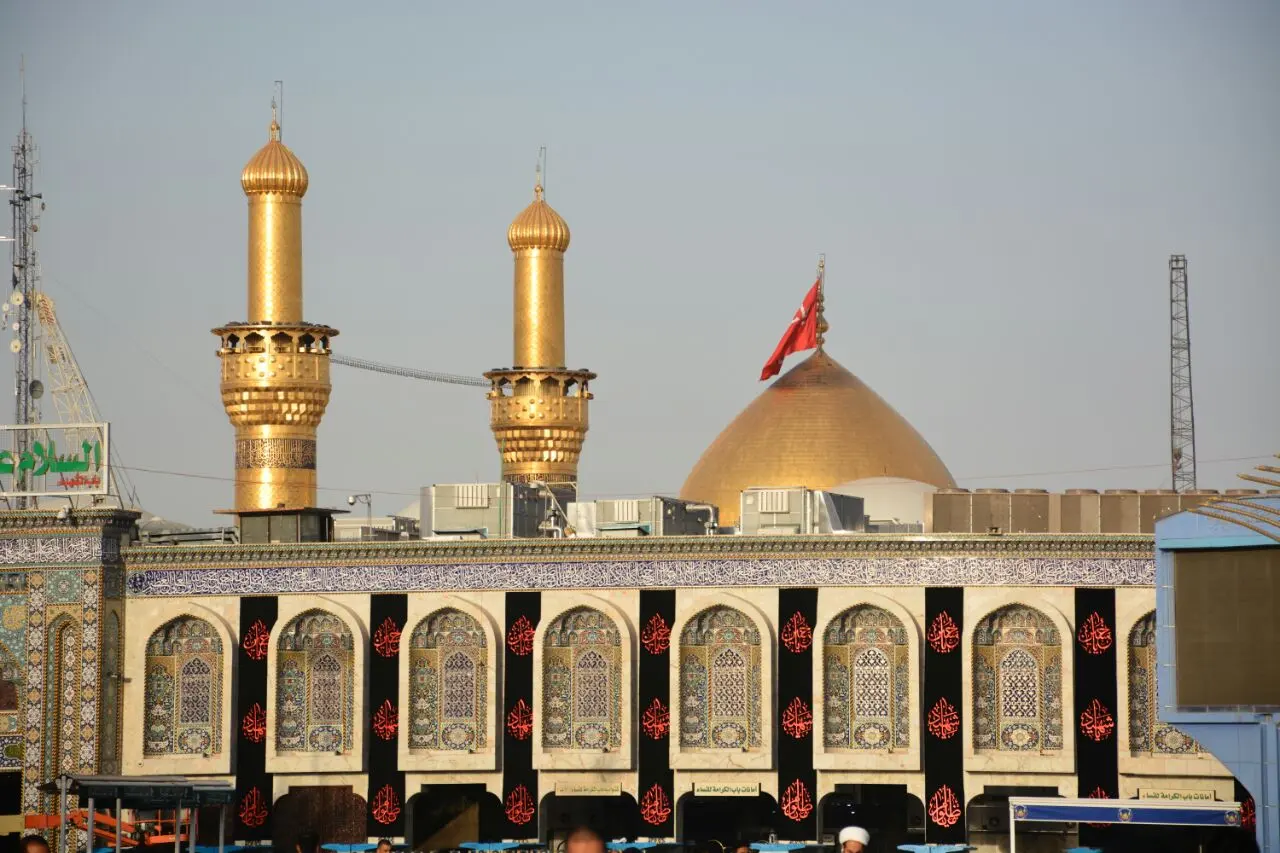
Image of Mausoleum of Imam Hussein, Karbala. Image source · CC-BY-SA-4.0
Visit essentials
A quick read before you go
- Duration
- Half a day for the shrine and the corridor to the ʿAbbas shrine.
- Access
- Karbala, central Iraq, about 100 km south-west of Baghdad.
Overview
The Imam Husayn Holy Shrine in Karbala holds the burial place of Husayn ibn ʿAli, grandson of the Prophet Muhammad, the third Imam of Twelver Shiʿa Islam, and the figure remembered as Sayyid al-Shuhadāʾ — the Lord of Martyrs.
His refusal to give baʿyaʿah to the Umayyad caliph Yazid, his stand at Karbala on 10 Muharram 61 AH (10 October 680 CE), and his death with seventy-two companions and family members are the defining event of Shiʿa religious memory and the origin of an entire ritual culture of mourning.
Forty days after Ashura, the survivors of the family are traditionally said to have returned to bury the dead — the origin of the Arbaʿīn pilgrimage, today among the largest annual gatherings of human beings on Earth.
Pilgrim numbers for Arbaʿīn have been reported at fifteen to twenty-five million and more in recent years, with the central act being a walk of roughly eighty kilometres from the shrine of Imam ʿAli in Najaf to the shrine of his son in Karbala. The shrine's present fabric is largely Safavid–Qajar, with continuous restoration; its golden dome was destroyed in the Wahhabi raid of 1802 and rebuilt under Qajar patronage.
The Husayn shrine faces the shrine of his half-brother and standard-bearer al-ʿAbbas across the open paved corridor known as the bayn al-haramayn — 'between the two shrines.'
Why this place is sacred
Most pilgrimage sites commemorate a story that recedes into the past. Karbala does the opposite. Each Muharram the story is brought forward into the present — recited, sung in latmiyah, performed in taʿziyah passion plays, walked in flesh across the eighty kilometres from Najaf. 'Every day is Ashura, every land is Karbala' is more than a slogan; it is a description of how Shiʿa ritual time works. The shrine sits at the centre of this temporal field.
Inside, beneath the great chandeliers, Qurʾan is recited around the clock. Pilgrims press toward the silver-and-gold zarih, calling out 'Ya Husayn!', weeping unselfconsciously, reciting the Ziyarat al-ʿAshurāʾ — the most-recited devotional text of the shrine. Across the open corridor of the bayn al-haramayn, the shrine of al-ʿAbbas mirrors the same intensity. The Arbaʿīn walk transforms the desert road from Najaf into a forty-kilometre-wide ribbon of pilgrims, fed and sheltered for free by ordinary Iraqis along the way.
What pilgrims report is not contemplation but participation in a grief that has not subsided in fourteen centuries.
Burial place of Husayn ibn ʿAli and his family and companions, killed on the plain of Karbala on 10 Muharram 61 AH. From within decades of his death, the grave was a pilgrimage destination, and the structure raised over it became the centre of Shiʿa devotional life.
A rudimentary tomb was raised over Husayn's grave within decades of his death. Buyid patronage in the tenth century formalised the shrine; Saljuq and Ilkhanid expansions followed. The Safavids, especially Shah Ismaʿil I and Shah ʿAbbas I, embellished it with tile-work and gilding. The original gilded dome was destroyed in the Wahhabi raid of 1802 and rebuilt under Qajar patronage by Fath-ʿAli Shah. Further damage was inflicted in the Baʿathist suppression of the 1991 uprising and repaired.
Since 2003 the Imam Husayn Holy Shrine Custodianship has overseen major expansion of the courtyards and pilgrim infrastructure to accommodate the growing Arbaʿīn.
Experience and orientation
On the Arbaʿīn walk the experience begins long before the shrine is in sight: a continuous river of pilgrims dressed in black, walking on the shoulder of the highway south to north, sheltered by mawkib — free-service stations set up by Iraqi families and charities offering meals, foot-washing, sleep, and medical care. Strangers serve strangers. As Karbala approaches, the gilded dome and twin minarets of the Husayn shrine become visible against the desert sky.
The bayn al-haramayn fills with hundreds of thousands of pilgrims at peak hours, the air thick with the scent of incense and rosewater and the sound of latmiyah. Entering the shrine itself, pilgrims press toward the zarih over Husayn's grave — the 'qibla within the qibla' for many Shiʿa. Many recite the Ziyarat al-ʿAshurāʾ aloud, often through tears. Inside the haram, Qurʾan is recited around the clock; chandeliers cast soft light across the burial chamber.
Withdrawal is done walking backwards, eyes still on the zarih. Many pilgrims then cross the bayn al-haramayn to the shrine of al-ʿAbbas to pay respects to Husayn's standard-bearer.
Enter through one of the named gates of the haram precinct after passing security; cameras with detachable lenses, weapons, and political symbols are not permitted past this point. Women receive chador at the gates if not already wearing one. The bayn al-haramayn — the open paved corridor between the Husayn and ʿAbbas shrines — is the central public space; both shrines open onto it. The Custodianship's international pilgrim office can advise on current access policy and arrange guides.
Context and lineage
After the death of the Umayyad caliph Muʿawiya in 60 AH, the people of Kufa wrote repeatedly to Husayn urging him to come and lead them against Muʿawiya's son Yazid, whom they refused to accept as caliph. Husayn set out from Mecca toward Kufa with his family and a small group of supporters.
The Umayyad governor of Kufa, Ibn Ziyad, dispatched cavalry to intercept him; Husayn and his caravan were forced to camp on the open plain at Karbala on 2 Muharram 61 AH. After negotiations failed and his water supply was cut off, the battle was joined on the tenth — the day of Ashura. Husayn fell with seventy-two companions and family members, including his infant son ʿAli al-Asghar.
The women and surviving men were taken in chains to Damascus to appear before Yazid. Forty days later (Arbaʿīn) the survivors are traditionally said to have returned to Karbala to bury the dead — the origin of the Arbaʿīn pilgrimage that has been walked, in some form, ever since.
Twelver (Ithnāʿasharī) Shiʿa Islam. Husayn is also venerated by Ismaili and Zaydi Shiʿa, by Sufi orders across the Islamic world, and by many Sunnis as Sayyid al-Shuhadāʾ. The shrine is administered by the Imam Husayn Holy Shrine Custodianship.
Traditions and practice
The Ziyarat al-ʿAshurāʾ is the most-recited devotional text of the shrine, addressed to Husayn at his grave. Pilgrims also recite the Ziyarat al-Wārith. At the zarih they touch and kiss the grille, tie cloth strips as votive bonds, and offer personal supplication. Mourning rituals — taʿziyah passion plays during the first ten nights of Muharram, latmiyah (rhythmic chest-beating to elegies of the martyrs), the procession of standards (ʿalams) — are inseparable from the shrine's ritual life.
The mawkib tradition of free hospitality along pilgrimage routes — meals, foot-washing, sleep, medical care — is itself a practice with religious weight.
The two great pilgrimage seasons are Ashura (10 Muharram, drawing perhaps four to six million pilgrims) and Arbaʿīn (20 Safar, drawing fifteen to twenty-five million or more in recent years). The Arbaʿīn walk from Najaf to Karbala, some eighty kilometres on foot over two to five days, is the central act for many participants. Mid-Shaʿbān — the birthday of the twelfth Imam — is the most joyful pilgrimage night of the year.
Daily five-times prayer and round-the-clock Qurʾan recitation continue throughout the year.
If you can, time a first visit outside the peak Arbaʿīn period — the spring months from March to May are most comfortable and the haram is calm enough to recite ziyarat without being moved by the press. If you go for Arbaʿīn, allow extra days at both ends of the walk; the walk itself, with the mawkib hospitality, is for many pilgrims as transformative as the arrival. Do not try to compress the experience.
Twelver Shiʿa Islam
ActiveBurial place of Husayn ibn ʿAli, grandson of the Prophet Muhammad, third Imam of Twelver Shiʿa Islam, and the Sayyid al-Shuhadāʾ ('Lord of Martyrs'). His martyrdom on 10 Muharram 61 AH / 10 October 680 CE at Karbala is the defining event of Shiʿa religious memory and the source of the entire Shiʿa ritual culture of mourning.
Ziyarat of Imam Husayn, including the Ziyarat al-ʿAshurāʾ and the Ziyarat al-Wārith; touching and kissing the zarih over the grave; walking the bayn al-haramayn corridor between the Husayn and ʿAbbas shrines; the Arbaʿīn 40-day mourning culminating in the walking pilgrimage to Karbala; Ashura mourning processions, taʿziyah passion plays, and latmiyah chest-beating; free service in the mawkib (rest stations) along pilgrimage routes.
Perspectives and open questions
Karbala asks something different from a visitor than most sacred places. The historical facts of the battle are not contested. What is at stake is what the death of Husayn means — and Shiʿa tradition has answered that question with fourteen centuries of unbroken ritual.
Scholarly perspective
The historicity of the Battle of Karbala on 10 Muharram 61 AH is uncontested. The shrine's architectural fabric is largely seventeenth- to nineteenth-century Safavid–Qajar with continuous restoration; its religious continuity is unbroken since the first century AH. The Arbaʿīn gathering is one of the largest peaceful annual assemblies on Earth, though exact figures vary year to year and are reported by Iraqi authorities and the shrine custodianships rather than by independent verification.
Living and traditional perspectives
Shiʿa tradition holds Husayn's martyrdom as a cosmically redemptive act — a deliberate self-offering to preserve the integrity of the Prophet's mission against the worldly power of Yazid. The Imam's intercession is sought for healing, justice, and salvation. The ritual culture of mourning — azadari, taʿziyah, latmiyah — is the means by which the community keeps the meaning of Karbala present.
Alternative interpretations
Some Shiʿa mystics describe Karbala as the meeting place of zaman (time) and abadiyya (eternity); the recurring grief of Muharram is read as participation in a perpetual present-tense event. Sufi orders honour Husayn as a polar saint whose self-offering models the spiritual path of self-effacement before God.
Open questions
Where the head of Husayn finally rests is disputed across traditions — variously located in Damascus, Cairo, Karbala, and Medina. Within the rawza at Karbala, devotion does not depend on resolving this question. Sunni and Shiʿa narratives of the battle agree on the central facts but differ in theological framing; this account follows Shiʿa tradition for the meaning of the site.
Plan your visit
Access and arrival
Karbala, central Iraq, about 100 km south-west of Baghdad. Najaf International Airport (NJF) is about 70 km away and is the main entry point for international Shiʿa pilgrims. Buses and shared taxis run from Baghdad and Najaf. Foreign visitors should arrange visas in advance; the Iraqi government and the shrine custodianships issue Arbaʿīn-specific entry procedures each year — consult official channels before travel.
Karbala has a dense concentration of hotels, guesthouses, and free pilgrim accommodation around the bayn al-haramayn. During Arbaʿīn, demand far outstrips supply and most pilgrims walk; many sleep in mawkib along the way. The Custodianship provides large temporary shelters during peak periods. Outside the mourning calendar, hotel availability is straightforward.
Respectful visit
Women: full chador over modest clothing, hair completely covered (chador available at gates). Men: long trousers and long sleeves; shorts forbidden. Shoes removed at the haram entrance.
Heavily restricted inside the haram and burial chamber. Outer courtyards usually allow personal photos without flash. Do not photograph pilgrims, especially women or those weeping. Cameras with detachable lenses often refused at security.
Donations to the shrine and to mawkib charities are welcomed. Money is sometimes thrown over the zarih; cloth strips are tied as vows. Do not bring food or perfume into the burial chamber.
No bags, weapons, recording equipment beyond a phone, or political symbols past security. Maintain a tone of grief and respect — laughter or loud talk near the rawza is inappropriate. Withdraw walking backwards from the burial chamber. Men's and women's prayer spaces are separated inside the inner shrine. Non-Muslim access policy varies; verify with the Custodianship before travel.
Karbala summers are extreme (often above 45°C); plan for heat. Maintain a tone of grief and respect throughout the precinct; laughter or loud conversation near the rawza is inappropriate. Verify current non-Muslim access policy with the Custodianship before travel — conditions change. Iraqi government and shrine custodianships issue specific procedures and visa arrangements each Arbaʿīn; check official channels.
Current practical details
Address
Karbala, Karbala Governorate, 56001, Iraq
Phone
Hours
Hours, fees, and access can change — verify on the official source before you travel. Practical details last checked Jun 2026.
Location
Map loads as you approach this section.
Pilgrim reflections
A portrait of encounter, not a score
Pilgrims describe what they felt, how present they could become, and whether the place would shape a journey. There are no stars and no ranking of traditions.
No reviewed reflections yet
The first pilgrims can help describe the character of being here.
Share a reflection
Available after an account-backed “Been there.” Every reflection is reviewed before publication.
Nearby sacred places
Explore other sacred places in the region. Proximity does not establish access or travel time; check each place’s guidance.

Mausoleum of Abbas (brother of Imam Hussein), Karbala
Karbala, Karbala, Iraq
0.4 km away

Mausoleum of Ezekiel, Kafel
Al Kifl, Babylon, Iraq
53.5 km away

Residence of the 12th Imam Muhammad Almahdi, Sahla Mosque, Najaf
Al Kufa, Najaf, Iraq
72.0 km away

Mausoleums of Muslim bin Aqil, Hani bin Urwa and Almukhtar, Kufa Mosque, Najaf
Al Kufa, Najaf, Iraq
73.9 km away
References
Sources consulted for this page. Source categories describe the publication, not a guarantee that every claim is verified. Traditional accounts and outside interpretations may differ.
- 01Imam Husayn Holy Shrine — Official English Portal — Imam Hussain Holy Shrine CustodianshipofficialCustodian-published history, ziyarat texts, services, Arbaʿīn coordination, and live-stream of the haram.
- 02Imam Husayn Shrine — Wikipedia — Wikipedia contributorsencyclopediaArchitectural history of the shrine: dome, two minarets, ten gates, the bayn al-haramayn corridor to the Abbas shrine.
- 03Arbaʿeen Pilgrimage — Wikipedia — Wikipedia contributorsencyclopediaPilgrim numbers (15–25M+), routes (notably Najaf-to-Karbala ~80 km on foot), mawkib (free-service stations).
- 04Battle of Karbala — Wikipedia — Wikipedia contributorsencyclopedia10 Muharram 61 AH / 10 October 680 CE. Husayn ibn ʿAli, 72 companions and family killed by Umayyad forces under ʿUmar ibn Saʿd.
- 05ḤOSAYN B. ʿALI i. LIFE AND SIGNIFICANCE IN SHIʿISM — Encyclopædia Iranica — Encyclopædia IranicaacademicAuthoritative scholarly entry on Imam Husayn's life, martyrdom, and the soteriological meaning of Karbala in Shiʿism.
- 06Karbalāʾ | Iraq — Britannica — Encyclopædia BritannicaencyclopediaCity overview, ~100 km SW of Baghdad; description of the two shrines and pilgrimage role.
- 07Arbaeen pilgrimage: Millions of Shia Muslims gather in Iraq — BBC News — BBC NewsnewsReportage on annual Arbaʿīn scale, security, and mass hospitality (mawkib).
- 08Encyclopaedia Islamica — al-Ḥusayn, Shrine of — Encyclopaedia Islamica (Brill / CIS)academicScholarly article on the architectural history and waqf administration of the shrine.
Share a photo
Help visitors recognize Mausoleum of Imam Hussein, Karbala. Every submission is reviewed before publication.